Tag Archives: Bible Highlights

Demonstrate Christlike Humility and Modesty

Download pdf format to Demonstrate Christlike Humility and Modesty here

Even though Jesus was the greatest man who ever lived, he showed humility and modesty by glorifying Jehovah. (Joh 7:16-18) On the other hand, Satan became the Devil, which means “Slanderer.” (Joh 8:44) Satan’s attitude was manifested by the Pharisees, whose pride caused them to belittle anyone who showed faith in the Messiah. (Joh 7:45-49) How can we imitate Jesus when we receive privileges or responsibilities in the congregation?

WATCH THE VIDEO “HAVE LOVE AMONG YOURSELVES”—AVOID JEALOUSY AND BRAGGING, PART 1, AND THEN DISCUSS THE FOLLOWING:

How did Alex manifest pride?

Bill!
Carl! How are you?
Good! And how are you?
Good.
Great! Alex! I had not told you yet, but the other week you did a really good speech.
It’s true you’ve been good!
Oh! Thanks guys, it’s that I’ve been so busy, that I almost did not have time to get ready.
Do not talk to me, the whole congregation has had a lot to do in this period.
Yes it’s true.
Yes but I have been particularly busy.
Why what have you done? It’s not that you’re bad, right?
No, it’s not for this. And that there are all these theocratic commitments, pioneers, assignments in the congregation, and other things like this Saturday, I have to come to the Kingdom Hall and stay there all afternoon.
Saturday in the hall, and why?
Wait a minute, I’ve already understood everything. Do not you do the circuit assembly tests this Saturday?
Ah yes, you’re right, so you have to do something.
I’m not sure I can tell you.
You just did it! So what is it you have to do a demonstration, an interview, now You can not leave us like that.
Ok, it’s not just an interview, I have to do my experience too. After the experience, they ask me questions. I will be on the podium for almost the whole part. In short, guys, the part is me.
Are you the part? Are you sure you’re not a little exaggerating?
No, I do not think so. Ok, the part of brother Jones lasts 10 minutes, I stand on the podium for 6. This means more than half the part. However, now I will tell you what I will do. They will ask me to tell that fantastic experience I had. I knock at the door, I ring the bell, but what happens? Does not work! So I knock so loud that …

WATCH THE VIDEO “HAVE LOVE AMONG YOURSELVES”—AVOID JEALOUSY AND BRAGGING, PART 2, AND THEN DISCUSS THE FOLLOWING:

In che modo Alex si è dimostrato umile?

Bill!
Carl! How are you?
Good! And how are you?
Good.
Great! Alex! I had not told you yet, but the other week you did a really good speech.
It’s true you’ve been good!
Thanks guys with Jehovah’s help, I did it. I was so busy that it was hard to find the time to get ready.
Do not talk to me or the whole congregation has had a lot to do during this time.
Yes indeed!

How did Alex manifest humility?

You know something. Are you doing the pioneers, are you? How is it going?
Very well. Yesterday I showed a person a video on jw.org. He said I can come back this Saturday. I think I could even start a study. Do you want to come with me Alex?
I’m sorry, but Saturday I’m busy almost all day. But maybe he can accompany you Bill.
What do you say, Bill?
Of course I have to do a visit too, we can go there together.
Perfect!
So Bill you found a nice visit too. Come on, tell me!
Yes, then I met a gentleman …

WATCH THE VIDEO “HAVE LOVE AMONG YOURSELVES”—REPUDIATE PRIDE AND INDECENCY, PART 1, AND THEN DISCUSS THE FOLLOWING:

How did Brother Harris fail to demonstrate modesty?

Excuse Tom would you have a minute?
Sure Faye, how can I help you?
Well maybe you already know, David and I got engaged last Saturday.
Yes, I knew! Congratulations! I’m really happy for you.
Thank you, and since I grew up here we would love to be able to marry in this hall of the kingdom. So since you are the coordinator of the elderly body, could you let us know today if we can use the hall? So David and I can start preparing invitations. David sends you this official letter of request from the hall.
So let’s see a little bit. I have yes, the letter is fine, with this I have all the information I need. Faye I can not imagine another place where you could get married. You can definitely use this room. Now I tell the other elders that I have already given my approval, but to David you can already say that we can not wait for the big day to come.
Thanks so much Tom, I was sure you would help us.

WATCH THE VIDEO “HAVE LOVE AMONG YOURSELVES”—REPUDIATE PRIDE AND INDECENCY, PART 2, AND THEN DISCUSS THE FOLLOWING:

How did Brother Harris demonstrate modesty?

Excuse Tom would you have a minute?
Sure Faye, how can I help you?
Well maybe you already know, David and I got engaged last Saturday.
Yes, I knew! Congratulations! I’m really happy for you.
Thank you, and since I grew up here we would love to be able to marry in this hall of the kingdom. So since you are the coordinator of the elderly body, could you let us know today if we can use the hall? So David and I can start preparing invitations. David sends you this official letter of request from the hall.
Ok! Yes, the letter is fine, there is all the information we need. Now I meet the other elders so we talk and let you know as soon as possible.

What did Brother Harris’ example teach Faye?

Ah! Do you mean that you can not let me know immediately? I thought that since you are the coordinator I had the authority to … well …
Yes, I understood, but there is a theocratic disposition that we must all take into account also the elderly, and according to the provision the service committee must talk and evaluate the matter carefully before giving its approval. So you understand, I do not have the authority to make this decision alone.
Of course it seems right to me.
Do not worry Faye, we’ll take care of it as soon as possible, so you can proceed with the wedding preparations.
Thank you so much Tom, I appreciate it very much.
Is a real pleasure.

Digging for Spiritual Gems: John 5-6 (Week September 17-23)

John 5-6
Digging for Spiritual Gems: (8 min.)

Joh 6:44​—How does the Father draw people to himself? (“draws him” study note on Joh 6:44, nwtsty)
draws him: Although the Greek verb for “draw” is used in reference to hauling in a net of fish (Joh 21:6, 11), it does not suggest that God drags people against their will. This verb can also mean “to attract,” and Jesus’ statement may allude to Jer 31:3, where Jehovah said to his ancient people: “I have drawn you to me with loyal love.” (The Septuagint uses the same Greek verb here.) Joh 12:32 shows that in a similar way, Jesus draws men of all sorts to himself. The Scriptures show that Jehovah has given humans free will. Everyone has a choice when it comes to serving Him. (De 30:19, 20) God gently draws to himself those who have a heart that is rightly disposed. (Ps 11:5; Pr 21:2; Ac 13:48) Jehovah does so through the Bible’s message and through his holy spirit. The prophecy from Isa 54:13, quoted in Joh 6:​45, applies to those who are drawn by the Father.—Compare Joh 6:65.

Joh 6:64​—In what sense did Jesus know “from the beginning” that Judas would betray him? (“Jesus knew . . . the one who would betray him,” “from the beginning” study notes on Joh 6:64, nwtsty)
Jesus knew . . . the one who would betray him: Jesus was referring to Judas Iscariot. Jesus spent the entire night in prayer to his Father before selecting the 12 apostles. (Lu 6:12-16) So at first, Judas was faithful to God. However, Jesus knew from Hebrew Scripture prophecies that he would be betrayed by a close associate. (Ps 41:9; 109:8; Joh 13:18, 19) When Judas started to go bad, Jesus, who could read hearts and thoughts, detected this change. (Mt 9:4) By use of his foreknowledge, God knew that a trusted companion of Jesus would turn traitor. But it is inconsistent with God’s qualities and past dealings to think that Judas had to be the one who would fail, as if his failure were predestined.
from the beginning: This expression does not refer to Judas’ birth or to his being selected as an apostle, which happened after Jesus had prayed the entire night. (Lu 6:12-16) Rather, it refers to the start of Judas’ acting treacherously, which Jesus immediately discerned. (Joh 2:24, 25; Re 1:1; 2:23; see study notes on Joh 6:70; 13:11.) This also shows that Judas’ actions were premeditated and planned, not the result of a sudden change of heart. The meaning of the term “beginning” (Greek, ar·kheʹ) in the Christian Greek Scriptures is relative, depending on the context. For example, at 2Pe 3:4, “beginning” refers to the start of creation. But in most instances, it is used in a more limited sense. For instance, Peter said that the holy spirit fell on the Gentiles “just as it did also on us in the beginning.” (Ac 11:15) Peter was not referring to the time of his birth or to the time when he was called to be an apostle. Rather, he was referring to the day of Pentecost 33 C.E., that is, “the beginning” of the outpouring of holy spirit for a specific purpose. (Ac 2:1-4) Other examples of how the context affects the meaning of the term “beginning” can be found at Lu 1:2; Joh 15:27; and 1Jo 2:7.

What has this week’s Bible reading taught you about Jehovah?

*** ws18 June p. 14 par. 18 May We All Be One as Jehovah and Jesus Are One ***
18 It is good for us to remember that we all used to be far away from God. (Ephesians 2:12) But Jehovah drew us to him with love. (Hosea 11:4; John 6:44) And Christ welcomed us. He made it possible for us to become part of God’s family. (Read Romans 15:7.) Even though we are imperfect, Jesus has kindly accepted us, so we should never even think of rejecting anyone!

*** w17 February p. 7 par. 18 Jehovah’s Purpose Will Be Fulfilled! ***
18 Satan’s rebellion did not stop Jehovah from extending his love to mankind, nor can it prevent even imperfect humans from being loyal to Jehovah. Through his provision of the ransom, Jehovah will help all of his children to become completely righteous. Imagine what life will be like when everyone “who recognizes the Son and exercises faith” will have everlasting life. (John 6:40) With great love and wisdom, Jehovah will bring the human family to perfection, according to his original purpose. Jehovah, our Father, will then become “all things to everyone.”—1 Cor. 15:28.

*** w17 February p. 10 par. 10 The Ransom—A “Perfect Present” From the Father ***
10 What about the billions of people who died without ever having an opportunity to know and serve Jehovah? The ransom makes possible the resurrection of the dead. Our loving heavenly Father will bring them back to life and give them an opportunity to learn about his purpose and to gain everlasting life. (Acts 24:15) Jehovah wants people to live, not die. As the Source of life, he becomes the Father of everyone who is resurrected. (Ps. 36:9) How appropriate, therefore, that Jesus taught us to pray: “Our Father in the heavens.” (Matt. 6:9) Jehovah has given Jesus an important share in resurrecting the dead. (John 6:40, 44) In Paradise, Jesus will fulfill his role as “the resurrection and the life.”—John 11:25.

*** w17 March p. 9 par. 4 Give Honor to Whom It Is Due ***
4 Honoring Jehovah and Christ is not optional. Our everlasting life depends on our doing so. Jesus’ words that we read at John 5:22, 23 help us to see that plainly: “The Father judges no one at all, but he has entrusted all the judging to the Son, so that all may honor the Son just as they honor the Father. Whoever does not honor the Son does not honor the Father who sent him.”—Read Psalm 2:11, 12.

*** w17 July p. 13 par. 4 “Weep With Those Who Weep” ***
4 Our Father of tender mercies has himself experienced the loss of loved ones, such as Abraham, Isaac, Jacob, Moses, and King David. (Num. 12:6-8; Matt. 22:31, 32; Acts 13:22) God’s Word assures us that Jehovah has eagerly anticipated—has had an earnest longing for—the time when he will bring them back to life. (Job 14:14, 15) They will be happy and in vibrant health. Consider, too, that God’s dearly beloved Son—“the one he was especially fond of”—died an agonizing death. (Prov. 8:22, 30) Words cannot express the pain Jehovah must have suffered.—John 5:20; 10:17.

*** w17 December p. 12 par. 21 “I Have Hope Toward God” ***
21 In the meantime, we should bolster our faith in Jehovah, who through Jesus assured us that the dead in God’s memory will rise. (John 5:28, 29; 11:23) Proving that Jehovah is capable of resurrecting the dead, Jesus once said that Abraham, Isaac, and Jacob “are all living to him.” (Luke 20:37, 38) Meanwhile, we have ample reason to say, as did Paul: “I have hope toward God . . . that there is going to be a resurrection.”—Acts 24:15.

*** w16 May p. 19 par. 6 Is the Bible Still Changing Your Life? ***
6 Our inherited imperfection does not need to prevent us from enjoying Jehovah’s friendship or continuing to serve him. Consider this: When Jehovah drew us into a relationship with him, he knew that we would err at times. (John 6:44) Since God knows our traits and what is in our heart, he surely was aware of what sort of imperfect tendencies would be particularly troublesome for us. And he knew that we would occasionally transgress. Yet, this did not prevent Jehovah from wanting us as his friends.

What other spiritual gems have you discovered in this week’s Bible reading?

*** w18 June p. 4 par. 5 “My Kingdom Is No Part of This World” ***
5 Such expectations about the Messiah doubtless led the people of Galilee to want Jesus to become their king. We can imagine that they were thinking that Jesus would be an ideal leader. He was an outstanding speaker; he could cure the sick; he could even supply food for the hungry. After Jesus fed about 5,000 men, he sensed the mood among the people. “Jesus, knowing that they were about to come and seize him to make him king, withdrew again to the mountain all alone.” (John 6:10-15) The following day on the other side of the Sea of Galilee, the enthusiasm may have died down some. Jesus then explained to the crowd the true nature of his work. He had come to bring spiritual, not material, benefits to the nation. “Work, not for the food that perishes, but for the food that remains for everlasting life,” he told them.—John 6:25-27.

*** w18 November p. 9 par. 5 “I Will Walk in Your Truth” ***
5 Sadly, some today have failed to hold on to the truth. Some were stumbled by an adjusted understanding of a Bible passage or by what a prominent brother said or did. Others were offended by Scriptural counsel they received, or they let go of the truth because of a personality clash with a fellow Christian. Still others took sides with apostates and other opposers who misrepresented our beliefs. As a result, some deliberately began “drawing away” from Jehovah and the congregation. (Heb. 3:12-14) How much better it would have been if they had maintained their faith and kept their confidence in Jesus, as the apostle Peter did! When Jesus asked the apostles if they wanted to leave, Peter immediately replied: “Lord, whom shall we go away to? You have sayings of everlasting life.”—John 6:67-69.

*** w16 March p. 7 pars. 16-17 Young Ones—Are You Ready to Get Baptized? ***
16 To illustrate, imagine that a friend gives you a car as a gift. He hands you the title and says: “The car is yours.” But suppose your friend adds: “I will keep the keys. And I will be the one who drives the car, not you.” How would you feel about this “gift”? How would you feel about the giver?
17 Now think about what Jehovah rightfully expects of a person who makes a dedication to him, a person who tells him: “I am giving you my life. I belong to you.” What if that person were to start living a double life, perhaps secretly dating an unbeliever? What if he were to accept employment that crippled his whole-souled service in the ministry or attendance at Christian meetings? Would that not be like keeping the keys to the car? A person who dedicates himself to Jehovah is, in effect, saying: “My life belongs to you more than to me. If there is ever a conflict between what you want and what I am inclined to want, what you want will win—every time.” That would reflect the thinking of Jesus, who while on earth stated: “I have come down from heaven to do, not my own will, but the will of him who sent me.”—John 6:38.

*** w16 April pp. 14-15 par. 7 “Let Endurance Complete Its Work” ***
7 Nourish your faith with spiritual food. On Mount Everest, the world’s tallest mountain, a climber burns about 6,000 calories a day, considerably more than the average person needs. To endure the ascent and reach their goal, climbers must consume as many calories as possible. Similarly, to endure in our Christian course and reach our goal, we must regularly take in as much spiritual food as possible. We need self-discipline to devote time to reading, study, and our Christian meetings. These activities nourish our faith with “the food that remains for everlasting life.”—John 6:27.

*** w16 April p. 28 par. 3 Maintain Your Neutrality in a Divided World ***
3 The Bible gives several reasons why God requires that we remain neutral. For example, we follow the teachings and example of his Son, Jesus Christ, by being “no part of the world,” avoiding its politics and wars. (John 6:15; 17:16) We must remain neutral in order to be loyal subjects of God’s Kingdom. Otherwise, how could we have a clean conscience when we preach the good news that only God’s Kingdom can solve mankind’s problems? Additionally, unlike false religions that divide their members by meddling in politics, true worship preserves our international brotherhood by helping us to remain neutral.—1 Pet. 2:17.

*** w15 2/15 p. 9 par. 16 Imitate Jesus’ Humility and Tenderness ***
16 Our tender words. Our tender affection for others moves us to “speak consolingly to those who are depressed.” (1 Thess. 5:14) What can we say to encourage such ones? We can lift their spirits by expressing our genuine care and concern for them. We can offer sincere commendation to help them see their positive qualities and abilities. We can remind them that Jehovah drew them to his Son, so they must be precious in his eyes. (John 6:44) We can reassure them that Jehovah deeply cares for his servants who are “brokenhearted” or “crushed in spirit.” (Ps. 34:18) Our tender words can have a healing effect on those who need comfort.—Prov. 16:24.

*** w15 4/15 p. 7 par. 20 Elders, How Do You Feel About Training Others? ***
20 Elders, remember: A successful teacher is someone who not only loves to train another person but also loves the person he is training. (Compare John 5:20.) That crucial aspect of a teacher’s disposition is quickly discerned by a learner and greatly affects the way he responds to the training he receives. Therefore, dear elders, as you give training, be more than a teacher—be a friend.—Prov. 17:17; John 15:15.

Digging for Spiritual Gems – John 3-4 (Week of September 10-16, 2018)

Digging for Spiritual Gems – John 3-4 

Week of September 10-16, 2018

Joh 3:29:  How are we to understand this verse? (“the friend of the bridegroom” study note on Joh 3:29, nwtsty) John the Baptist likened himself to “the friend of the bridegroom.” In this case, Jesus was the bridegroom and the disciples as a class made up his symbolic bride. Preparing the way for the Messiah, John the Baptist introduced the first members of “the bride” to Jesus Christ. (Joh 1:29, 35; 2Co 11:2; Eph 5:22-27; Re 21:2, 9) “The friend of the bridegroom” accomplished his objective by making successful introductions; he was then no longer a principal figure. Likewise, John said of himself in relation to Jesus: “That one must keep on increasing, but I must keep on decreasing.”—Joh 3:30.
Joh 1:29  How might the Samaritan woman have understood Jesus’ expression “living water,” but what was Jesus referring to? (“living water” study note on Joh 4:10, nwtsty) This Greek expression is used in a literal sense to refer to flowing water, spring water, or freshwater from a well supplied by springs. This is in contrast with stagnant water from a cistern. At Le 14:5, the Hebrew expression for “running water” is literally “living water.” At Jer 2:13 and 17:13, Jehovah is described as “the source [or, “spring”] of living water,” that is, life-giving symbolic water. When speaking with the Samaritan woman, Jesus used the term “living water” figuratively, but it appears that she initially took his words literally.—Joh 4:11; see study note on Joh 4:14.
What does this week’s Bible reading teach me about Jehovah?


Joh 3:2:  Shows that Jehovah is the one who give the power, so a person can performs signs or miracles like he did with Jesus. Jehovah is the source of all power and should be shown honor and praise.  (Acts 10:38, Re 4:11, Isa 40:26)

Joh 3:5:  God announced that he had brought forth Jesus as a spiritual son at Mt 3:16-17 and having the prospect of entering into the heavenly Kingdom. Later Jehovah at Pentecost 33 C.E., holy spirit was poured out on other baptized ones, and they will thus be born again as spiritual sons of God. (Acts 2:1-4)

Joh 3:16-17:  Jehovah loves us so much he was willing to sacrifice his beloved Son Jesus to save us from sin and so we can gain everlasting life. This unique expression of divine love, God counterbalanced the death sentence that sheer justice would have required.

Joh 3:35:  Jehovah is a God of love and loves his only begotten Son Jesus. We can be sure that Jehovah loves all his faithful children. (1Jo 4:8)

Joh 3:36:  Jehovah does have a wrath or anger for those who do not exercises faith in him who he sent and those who do not do his will. (Eph 3:5-6’ 2Th 1:7-9)

Joh 4:10:   Jehovah is the greatest gift giver to all of his faithful servants and teaches us this in this verse and Jehovah will give it freely if we asked. Jas 1:17 “Every good gift and every perfect present is from above, coming down from the Father” (Lu 11:9-13 give HS)

Joh 4:23:  Jehovah wants to be worship with truth not made up ways.For our worship to be acceptable to God it must conform to the truth revealed in the pages of the Bible and it must be guided by his holy spirit.

Joh 4:24:  Jehovah is a Spirit person, A spirit has a form of life that differs greatly from that of humans, and it is invisible, it’s body, “a spiritual one,” that is far superior to “a physical body.” (1Co 15:44; Joh 1:18)   

Joh 4:46-53:  Jesus demonstrated that the power of God to heal through him is not bound by distance. As a result the man and “his whole household believed.” We to can have confident that Jehovah will keep his word at Isa 33:24 “no resident will say : ”I am sick.”” (De7:15; Re 21;3-4)  
   
What other spiritual gems have you discovered in this week’s Bible reading?

Joh 3:2:  Pharisee and a teacher Nic-o-de-mus recognized that Jesus was not God the Almighty but a teacher sent by God and signs that he performs was because of God. This shows that Jesus is not part of a trinity. (Act 2:22)

Joh 3:5:  The Greek word for “flesh” (sarx) is here used to refer to a living being with fleshly or human heritage, along with its limitations. Show those who are not chosen by Jehovah cannot enter the heavenly Kingdom of God. Flesh cannot go to heaven as shown at 1Co 15:50.

Joh 3:13:  Jesus used the expression “Son of man” to refer to himself, emphasizing that he was truly human, born from a woman, and that he was a fitting human counterpart to Adam, having the power to redeem humankind from sin and death. (Ro 5:12, 14-15)  

Joh 3:13:  The phrase “no man has ascended into heaven,” show that faithful one like David, Abraham and many other did not go to heaven but are waiting asleep for the resurrection and do not have a immoral soul. (Ec 9:5, 10 John 11:11-12; Mt 9:24, Ps 13:3)  

Joh 3:13, 31:  Show Jesus “descended from heaven” in that he had previously life in the spirit realm with his Father. (Ga 4:4; Heb 2:9, 14, 17)

Joh 3:15:  If a Christian allows anything or anyone to destroy his brotherly love, he is walking in spiritual darkness, not knowing where he is going.

Joh 3:16:  Another scripture that show Jesus is not part of a trinity. For we see it was God who gave the world something, not Jesus. So those who would exercise faith in Jehovah gift of Jesus could gain everlasting life if they remain to the end faithful. Mt 24:13. 

Joh 3:16, 18:  Jesus is rightly called “the only-begotten Son of God. The Greek word translated “only-begotten” has been defined as “single of its kind, only,” or “unique.” Jesus is unique in that he is the sole direct creation of his Father. He is the firstborn Son. In fact, he is “the firstborn of all creation.” (Col. 1:15) He is “the beginning of the creation by God.” (Rev. 3:14)

Joh 3:28-30:  John the Baptizer show that he was not jealous or envy because he was going to decrease and Jesus was going to increase. May we learn from John not to compare the works of what we do to others, for Jehovah loves us all for our whole soul work that we can do. 

Joh 3:35:  Another scripture that show Jesus is not part of a trinity. We see that Jehovah loves the Son; one is show affection for another. Also we see the Jehovah the Father is giving the Son authority. Again we see two individuals and no third person.    

Joh 4:1-2; 3:22:  Jesus “did baptizing,” while at John 4:2, the record states that “Jesus himself did no baptizing” is not a Contradictions. Jesus’ disciples who performed the actual baptisms in his name and under his direction, so Jesus could claim that he did baptizing.

Joh 4:7-9:   Jesus, set the example on treated woman with respect and consideration and was neither racially prejudiced nor gender prejudiced. May we do the same as Jesus did, for we are all of the same kind or family.  

Joh 4:14:   God’s Word uses water as a symbol of God’s provisions for restoring mankind to perfect life by Jesus’ ransom sacrifice. As we “come to know” Jehovah God and Jesus Christ and acting on that knowledge with faith, we can have the prospect of gaining everlasting life. (Joh 17:3)

Joh 4:17-18:   Jesus talk to a woman who was then living with a man who was not her husband a type of association that the Jew look down on.  It is heartwarming that Jehovah God and his Son will help those who have problems, may we do the same.

Joh 4:23-24:  For our worship to be acceptable to Jehovah it must conform to the truth revealed in the pages of the Bible and it must be guided by the Holy Spirit. Truth does not have tens of thousands of religious denominations worldwide as shown in World Christian Encyclopedia 2001.

Joh 4:25-26:  Jesus reveals to the Sa-mar’-i-tans woman that Jesus is the Messiah and not God. Messiah means “anointed” or “anointed one,” and being anointed by another. In this case Jesus was anointed by Jehovah at Matt. 3:13-17.

Joh 4:34:  Another scripture that show Jesus is not part of a trinity. We see Jesus has a purpose in life and that is to do God’s will and the work that been assign to him. One is greater because he assign the work to do. NO Trinity here but two separate individuals  

Joh 4:42:  This expression “savior of the world”, appearing here and at 1Jo 4:14, which indicates that Jesus would save from sin those from “the world” of mankind who demonstrate faith to the end.


John 3-4
Digging for Spiritual Gems: (8 min.)


Joh 3:29—How are we to understand this verse? (“the friend of the bridegroom” study note on Joh 3:29, nwtsty)
the friend of the bridegroom: In Bible times, a close acquaintance of the bridegroom acted as his legal representative and played a key role in making arrangements for the marriage. He was viewed as the one who brought the bride and bridegroom together. On the wedding day, the bridal procession would arrive at either the house of the bridegroom or that of his father, where the marriage feast would be held. During this feast, the friend of the bridegroom would be happy when he heard the voice of the bridegroom as he talked with his bride, since the friend would feel that he had successfully done his duty. John the Baptist likened himself to “the friend of the bridegroom.” In this case, Jesus was the bridegroom and the disciples as a class made up his symbolic bride. Preparing the way for the Messiah, John the Baptist introduced the first members of “the bride” to Jesus Christ. (Joh 1:29, 35; 2Co 11:2; Eph 5:22-27; Re 21:2, 9) “The friend of the bridegroom” accomplished his objective by making successful introductions; he was then no longer a principal figure. Likewise, John said of himself in relation to Jesus: “That one must keep on increasing, but I must keep on decreasing.”—Joh 3:30.

Joh 4:10—How might the Samaritan woman have understood Jesus’ expression “living water,” but what was Jesus referring to? (“living water” study note on Joh 4:10, nwtsty)
living water: This Greek expression is used in a literal sense to refer to flowing water, spring water, or freshwater from a well supplied by springs. This is in contrast with stagnant water from a cistern. At Le 14:5, the Hebrew expression for “running water” is literally “living water.” At Jer 2:13 and 17:13, Jehovah is described as “the source [or, “spring”] of living water,” that is, life-giving symbolic water. When speaking with the Samaritan woman, Jesus used the term “living water” figuratively, but it appears that she initially took his words literally.—Joh 4:11; see study note on Joh 4:14.


What has this week’s Bible reading taught you about Jehovah?

*** wp18 No. 2 p. 13 You Can Live Forever on Earth ***
The rebellion in Eden did not thwart God’s original purpose for mankind and the earth. God’s perfect love and sense of justice moved him to provide a way to free us from the bondage of inherited sin and death. The apostle Paul explained: “The wages sin pays is death, but the gift God gives is everlasting life by Christ Jesus our Lord.” (Romans 6:23) Lovingly, God “gave his only-begotten Son [Jesus Christ], so that everyone exercising faith in him might not be destroyed but have everlasting life.” (John 3:16) By offering himself willingly as a ransom sacrifice, Jesus redeemed all that was lost through Adam.

*** w18 September p. 14 pars. 8-9 Keep Displaying Love—It Builds Up ***
8 True Christians also have this reason to be drawn to God’s love: He “loved the world so much that he gave his only-begotten Son, so that everyone exercising faith in him might not be destroyed but have everlasting life.” (John 3:16) What love Jesus also showed in giving his life for us! And what a powerful motivation that love is for us! God’s Word promises that not even “tribulation or distress” can “separate us from the love of the Christ.”—Rom. 8:35, 38, 39.
9 When we grapple with trials that are physically, emotionally, or spiritually draining, the compelling force of Christ’s love can give us the strength to endure. (Read 2 Corinthians 5:14, 15.) Jesus’ love has the power to sustain us and to motivate us not to give up, even in the face of such trials as disasters, persecution, personal disappointments, or gnawing anxiety.

*** wp17 No. 2 p. 5 God’s Greatest Gift—Why So Precious? ***
Some gifts are precious because they represent a great sacrifice made by the giver. When a person is willing to part with something that is of great value to him and gives it to us, we especially treasure the gift because of the sacrifice.
God “gave his only-begotten Son.” (John 3:16) He could not have offered us anyone dearer to him. During the aeons that God was creating the universe, Jesus worked alongside him and became “the one he was especially fond of.” (Proverbs 8:30) Jesus is God’s “beloved Son” and “the image of the invisible God.” (Colossians 1:13-15) Never has a closer bond existed between two intelligent beings.
Yet, God “did not even spare his own Son.” (Romans 8:32) Jehovah gave his very best for us. No gift has cost him more.

*** w17 October pp. 7-8 par. 3 “Love . . . in Deed and Truth” ***
3 After Adam and Eve rebelled, Jehovah made his greatest expression of unselfish love. He arranged to ransom the future descendants of those two rebels, certain that some of them would respond favorably to His love. (Gen. 3:15; 1 John 4:10) In fact, from the moment that Jehovah promised a future Savior, He viewed this sacrifice as already made. Then, some 4,000 years later, Jehovah at great personal cost sacrificed his only-begotten Son for the world of mankind. (John 3:16) How grateful we are for Jehovah’s unselfish love!

*** wp16 No. 2 p. 7 Why Did Jesus Suffer and Die? ***
By Jesus’ sacrificial death, God opened the way to endless life in Paradise on earth. Note Jesus’ words as recorded at John 3:16: “God loved the world so much that he gave his only-begotten Son, so that everyone exercising faith in him might not be destroyed but have everlasting life.” Jesus’ death is thus an expression not only of God’s unfailing justice but, more specially, of his great love for humans.

*** w16 June pp. 4-5 Jehovah “Cares for You” ***
The reason is God’s incomparable love. He loves the world so much that he has given his Son, Jesus, to rescue humans from sin and the harm that it brings to mankind. (John 3:16) In fact, the ransom accomplishes more. By means of Christ’s sacrifice, God freely forgives those whom he loves. The apostle John wrote: “If we confess our sins, he is faithful and righteous so as to forgive us our sins.” (1 John 1:9) Because of Jehovah’s forgiveness, people can continue to enjoy his friendship, and knowing this touches us deeply.


What other spiritual gems have you discovered in this week’s Bible reading?

*** w18 September p. 4 pars. 3-4 “If You Know These Things, Happy You Are if You Do Them” ***
3 We receive much good counsel and training through the Bible, our Christian publications, our websites, JW Broadcasting, and our meetings and assemblies. But according to Jesus’ words found at John 4:34, spiritual food involves more than just taking in knowledge. What more is involved? Jesus said: “My food is to do the will of him who sent me and to finish his work.”
4 To Jesus, spiritual food included acting on God’s direction. In what sense is this like food? Just as our bodies are contented and nourished when we eat a good meal, our hearts are strengthened and our faith is nourished for everlasting life when we participate in doing God’s will. How many times have you gone to a meeting for field service not feeling your best—only to finish preaching that day refreshed and invigorated?

*** wp17 No. 2 p. 7 How Will You Respond to God’s Greatest Gift? ***
Exercise faith in the ransom. “The one who exercises faith in the Son has everlasting life.” (John 3:36) What does it mean to exercise faith? It means action; to show faith in the ransom requires action. (James 2:17) What kind of action? A gift becomes yours only when you reach out and accept it. So you must reach out and accept the ransom. How? Learn how God wants you to live, and then act accordingly. Pray to God for forgiveness and a clean conscience. Approach God in full confidence that the ransom guarantees an eternal future of peace, security, and prosperity for all who exercise faith in it!—Hebrews 11:1.

*** wp16 No. 2 pp. 9-10 Should Christians Worship at Shrines? ***
In his conversation with the Samaritan woman, Jesus also mentioned that “the hour” for this change in God’s worship was “coming.” When would that be? The hour came when Jesus, by his sacrificial death, ended the Jewish system of worship based on the Law of Moses. (Romans 10:4) Yet, Jesus also said: “The hour . . . is now.” Why? Because as the Messiah, he was already gathering disciples who would obey the command he stated next: “God is a Spirit, and those worshipping him must worship with spirit and truth.” (John 4:24) What, then, does it mean to worship with spirit and truth?
When Jesus mentioned worshipping with spirit, he was not speaking of a particularly spirited, animated, or enthusiastic form of worship. Rather, he was talking about being guided by God’s holy spirit, which among other things guides our understanding of the Scriptures. (1 Corinthians 2:9-12) And the truth Jesus referred to is an accurate knowledge of Bible teachings. Therefore, rather than being rendered at any special place, our worship will be acceptable to God if it conforms to what the Bible teaches and is guided by the holy spirit.

*** w16 February p. 19 Keep On Serving Jehovah With Joy ***
Jehovah has provided the ransom sacrifice, making it possible for us to have a joyful life. Indeed, “God loved the world so much that he gave his only-begotten Son, so that everyone exercising faith in him might not be destroyed but have everlasting life.” (John 3:16) Yes, our sins can be forgiven and we can have everlasting life on the basis of faith in God’s loving provision of Jesus’ ransom sacrifice. Is that not an excellent reason to be grateful? And should not our gratitude for the ransom motivate us to serve Jehovah joyfully?

*** w16 May p. 19 par. 7 Is the Bible Still Changing Your Life? ***
7 Love moved God to offer us a precious gift—the ransom sacrifice of his beloved Son. (John 3:16) If on the basis of this priceless provision we repentantly seek Jehovah’s forgiveness when we err, we can have the confidence that our friendship with him is still intact. (Rom. 7:24, 25; 1 John 2:1, 2) Should we hesitate to avail ourselves of the benefits of the ransom because we feel unclean or sinful? Of course not! That would be like refusing to use water to wash our hands when they are dirty. After all, the ransom is provided for repentant sinners. Thanks to the ransom, then, we can enjoy a friendship with Jehovah even though we are in an imperfect state.—Read 1 Timothy 1:15.

*** w16 July p. 28 par. 8 Spread the Good News of Undeserved Kindness ***
8 We have the responsibility to make known to our fellow humans that they can come into a friendly relationship with their Creator. Before humans exercise faith in Jesus’ sacrifice, God considers them to be his enemies. The apostle John wrote: “The one who exercises faith in the Son has everlasting life; the one who disobeys the Son will not see life, but the wrath of God remains upon him.” (John 3:36) Happily, Christ’s sacrifice makes reconciliation with God possible. Paul declared: “You who were once alienated and enemies because your minds were on the works that were wicked, he has now reconciled by means of that one’s fleshly body through his death.”—Col. 1:21, 22.

*** w16 August p. 27 pars. 8-9 Do You See the Need to Train Others? ***
8 Converse with people. Jesus often spoke to individuals about the Kingdom. For instance, he carried on a lively and fruitful conversation with a woman at Jacob’s well near the city of Sychar. (John 4:5-30) He also spoke with Matthew Levi, a tax collector. The Gospels record very little of that conversation, but Matthew accepted Jesus’ invitation to be his follower. Matthew and others heard Jesus speak at some length during a feast held in Matthew’s home.—Matt. 9:9; Luke 5:27-39.
9 On another occasion, Jesus spoke in a friendly way to Nathanael, who had a negative view of people from Nazareth. However, Nathanael was moved to change his thinking. He decided to learn more about what Jesus, a man from Nazareth, was teaching. (John 1:46-51) So we have good reason to train new publishers to converse with people in a friendly, relaxed manner. Those whom we help in this way will likely be delighted to see how honesthearted people respond favorably to personal interest and kind words.

*** w16 August pp. 27-28 pars. 11-12 Do You See the Need to Train Others? ***
11 Nicodemus, a member of the Sanhedrin, became interested in Jesus’ teaching. He wanted to learn more but was afraid of what others would say if he spoke with Jesus in public. Jesus was flexible and generous with his time; he met with Nicodemus at night—away from the crowds. (John 3:1, 2) What lesson can we learn from these accounts? God’s Son set aside time to build up the faith of individuals. Should we not be diligent in making return visits and conducting Bible studies with interested ones?

12 New publishers are very likely to improve their skills as teachers of Bible truth if we work with them in the field service. We can help them to keep in mind those who show even slight interest. We can invite new publishers to accompany us when we make return visits and conduct home Bible studies. With such training and encouragement, less experienced publishers will surely want to cultivate the interest of others and conduct Bible studies on their own. They will also learn not to give up quickly but to be patient and persevere in the ministry.—Gal. 5:22; see the box “Perseverance Is Essential.”

Digging for Spiritual Gems – John 1-2 (Week September 3-9

Digging for Spiritual Gems – John 1-2

Joh 1:1:  What reasons are there for saying that John did not mean that “the Word” was the same as Almighty God? (“the Word,” “with,” “the Word was a god” study notes on Joh 1:1, nwtsty) First, the preceding clause and the following clause both clearly state that “the Word” waswith God.”(In this context, the Greek preposition pros implies close proximity and fellowship. It also indicates separate persons, in this case, the Word and the only true God.) Also, the Greek word the·osʹoccurs three times in verses 1 and 2. In the first and third occurrences,the·osʹ is preceded by the definite article in Greek; in the second occurrence, there is no article. Many scholars agree that the absence of the definite article before the second the·osʹ is significant. When the article is used in this context, the·osʹ refers to God Almighty. On the other hand, the absence of the article in this grammatical construction makes the·osʹ qualitative in meaning and describes a characteristic of “the Word.” Therefore, a number of Bible translations in English, French, and German render the text in a way similar to the New World Translation, conveying the idea that “the Word” was “a goddivinea divine being; of divine kindgodlike.” Supporting this view, ancient translations of John’s Gospel into the Sahidic and the Bohairic dialects of the Coptic language, probably produced in the third and fourth centuries C.E., handle the first occurrence of the·osʹ at Joh 1:1 differently from the second occurrence. These renderings highlight aquality of “the Word,” that his nature was like that of God, but they do not equate him with his Father, the almighty God. In harmony with this verse, Col 2:9 describes Christ as having “all the fullness of the divine quality.” And according to 2Pe 1:4, even Christ’s joint heirs would “become sharers in divine nature.” Additionally, in the Septuaginttranslation, the Greek word the·osʹ is the usual equivalent of the Hebrew words rendered “God,” ʼel and ʼelo·himʹ, which are thought to convey the basic meaning “Mighty One; Strong One.” These Hebrew words are used with reference to the almighty God, other gods, and humans. (See study note on Joh 10:34.) Calling the Word “a god,” or “a mighty one,” would be in line with the prophecy at Isa 9:6, foretelling that the Messiah would be called “Mighty God” (not “Almighty God”) and that he would be the “Eternal Father” of all those privileged to live as his subjects. The zeal of his own Father, “Jehovah of armies,” would accomplish this.—Isa 9:7.
Joh 1:29  Why did John the Baptist call Jesus “the Lamb of God”? (“the Lamb of God” study note on Joh 1:29, nwtsty) This expression occurs only here and at Joh 1:36. (See App. A7.) Comparing Jesus to a lamb is fitting. Throughout the Bible, sheep were offered in recognition of sin and to gain approach to God. This foreshadowed the sacrifice that Jesus would make when he surrendered his perfect human life in behalf of mankind. The expression “the Lamb of God” could reflect a number of passages in the inspired Scriptures. In view of John the Baptist’s familiarity with the Hebrew Scriptures, his words may have alluded to one or more of the following: the male sheep that Abraham offered up instead of his own son Isaac (Ge 22:13), the Passover lamb that was slaughtered in Egypt for the deliverance of the enslaved Israelites (Ex 12:1-13), or the male lamb that was offered up on God’s altar in Jerusalem each morning and evening (Ex 29:38-42). John may also have had in mind Isaiah’s prophecy, where the one whom Jehovah calls “my servant” is said to be “brought like a sheep to the slaughter.” (Isa 52:13; 53:5, 7, 11) When the apostle Paul wrote his first letter to the Corinthians, he referred to Jesus as “our Passover lamb.” (1Co 5:7) The apostle Peter spoke of Christ’s “precious blood, like that of an unblemished and spotless lamb.” (1Pe 1:19) And more than 25 times in the book of Revelation, the glorified Jesus is spoken of figuratively as “the Lamb.”—Some examples are: Re 5:8; 6:1; 7:9; 12:11; 13:8; 14:1; 15:3; 17:14; 19:7; 21:9; 22:1.

What does this week’s Bible reading teach me about Jehovah?


Joh 1:3,10:  Jehovah is the creator and the true God. It was Jehovah who used his beloved Son to create all other things. For both verse show that Jehovah create THROUGH Jesus, not that Jesus did it on his own. 
Joh 1:14:  Jehovah shows his love for mankind by sending his only begotten Son to die for us. As John 3:16 it show this “For God loved the world so much that he gave his only-begotten Son,” May we shows our love in return for what Jehovah did for us. 

Joh 1:18:  No man has seen God because they would die if they see him according to  Exodus 33:20. This is because Jehovah is holy and so he used his angel to represent him. (Acts 7:38’; Gal 3:19)

Joh 1:23:  Jehovah is the fulfiller of prophecy about the one who would make the road straight at Isa 40:3.  Again showing Jehovah keeps his word and we can trust what Jehovah promises for the future.

Joh 1:33:  Jehovah gives Holy Spirit to ones that deserve it and in this case it was his beloved Son. Likewise Jehovah will give us Holy Spirit if we keep asking and if we are doing his will. (Luke 11:9-13)  

Joh 2:16:  It shows how Jehovah feels about those who try to contaminate the way he wants to be worship. He sees what we are doing because his name is involved. We are told at Jer 7:11 “this house that bears my name become a cave of robbers in your eyes? Here I have seen it for myself,” May we always worship Jehovah in truth.  
   
What other spiritual gems have you discovered in this week’s Bible reading?


Joh 1:1:  In The Interlinear Bible Hebrew & Greek English by Jay P. Green,Sr  C-1985   Preface show the Bible in the original languages does not “distinguished between upper and lower-case letters.” So how do we know the last God should not be capitalized, beside there being no definite articles. The Bible at John 20:17 shows Jesus has the same God and Father as we do so the Word cannot be God. 
  
Joh 1:3, 10:  Does not make Jesus the creator because we see the Jehovah created all things THROUGH Jesus as most Bibles shows. Also as Pr 8:30 show that Jesus was a master worker and without Jehovah power Jesus could not doing anything at all. (John 5:19, 30)

Joh 1:5:  Light stands for truth and righteousness, in contrast with darkness, which stands for error and unrighteousness. John shows that the darkness will not conquer the light. Proof of this is the light is now shining in 240 lands. This should encourage us to keep letting our light shin with the other millions.

Joh 1:6-7:  John the Baptist served as a prophet, a teacher (with disciples), and an evangelizer.—Lu 1:76, 77; 3:18; 11:1; Joh 1:35. John not only announced the approach of the Messiah and of God’s Kingdom, but also encouraged other to repent of their sins. May we imitate John example as servants doing Jehovah’s will.  

Joh 1:11:  When on earth Jesus was rejected by most of his own people, the Jews. They did not want their badness and hypocrisy exposed. They preferred darkness rather than light, much like most of the world today. Yet out of our love of neighbor, we must keep warning them so they maybe save.

Joh 1:14:  Jesus was flesh and human just like us, except without sin (1Pe 2:22; Heb 4:15) and not a Godman. Yet the scriptures help us see Jesus was like us “in all respects: as shown at Heb 2:17. (Php 2:7) 

Joh 1:14:  Jesus is “the only-begotten son,” which show Jesus is not part of a trinity. The Bible uses the term in describing the relation of sons and daughters to their parents. In this case this showing the relationship between Jehovah the Father and Jesus the Son.

Joh 1:18:  In this passage, John calls Jesus “the only-begotten god,” a term that emphasizes Jesus’ unique position in God’s arrangement. Jesus can rightly be called “a god” because of the way the term “god” is used in the Bible. This title conveys the basic idea of a mighty one,

Joh 1:18:  Jesus is spoken “at the Father’s side” or “in the bosom of the Father.” This expression refers to a position of special favor and close fellowship, not showing that Jesus is part of some Trinity of Gods.

Joh 1:23:  John would”make the way of Jehovah straight,” in the sense that he would be the forerunner of Jesus, who would represent his Father and come in his Father’s name. (John 5:43; 8:29)

Joh 1:29,36:  Here we see Jesus is the ”Lamb of God,” not God the Lamb. A sacrifice is  needed to be made to Jehovah, in order for sin to be taken away from mankind. So Jesus cannot be a Trinity God and the sacrifice to be offer up. 

Joh 1:51:  Son of man or “Son of a human.” This expression occurs about 80 times in the Gospels. Jesus used it to refer to himself, evidently emphasizing that he was truly human and not a God man or God the Son, (Da 7:13, 14)

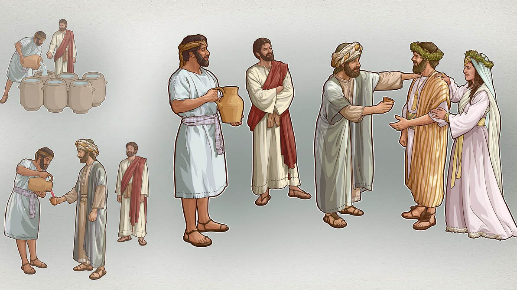
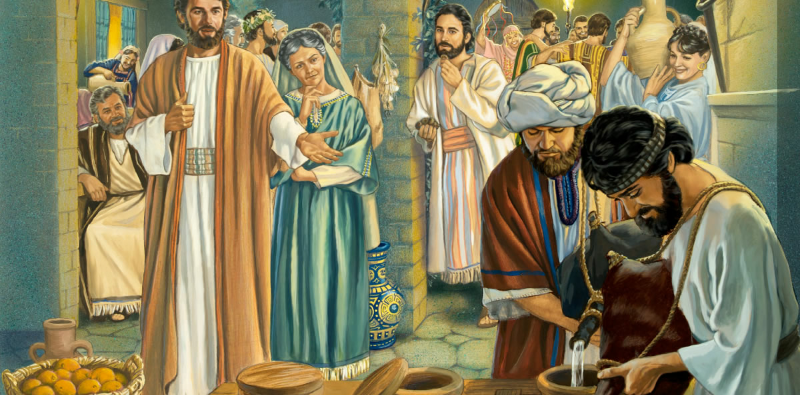
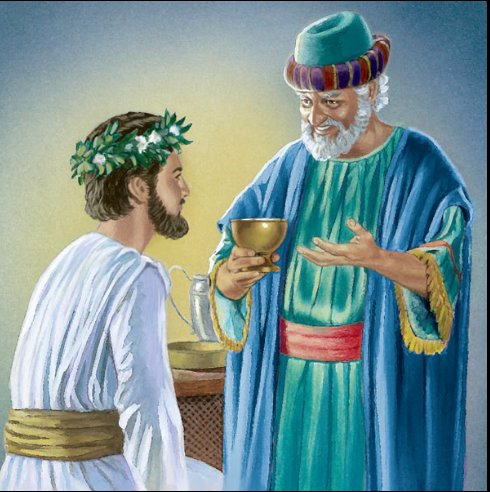
Joh 2:2-10:  Jesus performs his first miracle and demonstrates generosity.  Jesus was not obligated to perform this miracle, but he simply cared about people and was imitating his heavenly Father by being generous. Also the wine was real and not grape juice for the director said it was fine wine. 

Joh 2:14-16:  Jesus demonstrated that he and Jehovah will not tolerate contamination of pure worshiped to his Father. That is why few are worshipping Jehovah today compare to the world. Mt 7:13-14; Lu 13:24.

Joh 2:16:  Another scripture that show Jesus is not part of a trinity. Here we see Jesus call the Father “my Father,” which mean Jesus has a Father which was taught by his disciples at  Eph 1:3, 1Pe 1:3 and many other verses. 

Joh 2:17:  Jesus set the example for to make Jehovah house a place of pure worship and not place to carry on business. Even Jesus disciples recognized that Jesus was fulfilling prophecy at Ps 69:9.    

Joh 2:19-21:  Jesus was not saying he was going resurrected himself but was using figurative speech; he was comparing his anticipated death and resurrection to the demolition and reconstruction of the temple. The Bible clearly shows that it was God who resurrected him. (Ac 2:25-32; 3.15; 4.10; 5.30;10:40; Ro 8:11; Heb 13:20)

Jesus Died for Your Brother Too

Jesus sacrificed his life for imperfect people. (Ro 5:8) No doubt we personally appreciate that Jesus showed his love for us by giving his life in our behalf. Nevertheless, at times we may need to remind ourselves that Christ died for our brother too. How can we show Christlike love to our brothers and sisters, who just like us are imperfect? Consider three ways. First, we can expand our circle of friends to include those whose background is different from ours. (Ro 15:7; 2Co 6:12, 13) Second, we can be careful to avoid saying or doing things that may offend others. (Ro 14:13-15) Finally, if someone sins against us, we can be quick to forgive. (Lu 17:3, 4; 23:34) If we work hard to imitate Jesus in these ways, Jehovah will continue to bless the congregation with peace and unity.

WATCH THE VIDEO BECOME MORE BEAUTIFUL! AND THEN ANSWER THE FOLLOWING QUESTIONS:

How did Miki initially feel about her congregation?

My name is Miki, and I moved here a year ago. They were all so cute, friendly, or so it seemed to me the beginning. And you took me for your baby-sitter, but you did not see that we were talking. Hey, we’re not at the playground here. And the elderly are always busy, I’m not sure that here, they really want me.
What caused her feelings to change?
Then Yoko, a pioneer of my old congregation, came to see me. He asked me how it was going, and I told her, how I felt in the congregation. She told me that she had a similar experience, and she told me about an article in the watchtower, which had been very useful. So I decided to examine it, during my personal study.
What do you see when you look at others? Do you have the tendency to express categorical judgments about what they say or do, considering them either right or wrong, or white or black, as if there were no other colors and nuances? Who sees things in this way, is like a photographer who ignores, the wide variety of bright colors, and shadows, in an autumn landscape. As if they existed, only black and white images. Perhaps, I was seeing the congregation in black and white.
How did Jesus’ example help Miki to adjust her viewpoint? (Mr 14:38)
 The article then made me reflect on the example of Jesus. Certainly the spirit is eager, but the flesh is weak. Why did Jesus manage to use such kind words with his disciples? Are we perspicacious? Can we put ourselves in the shoes of others? And what Jesus did, with his disciples. And that’s what I have to do.
How can Proverbs 19:11 help us to view fellow Christians in a positive way?
At home, he must always stay behind the children, at least in the hall, he would need to enjoy a little, the company of the brothers. I do not think he wanted to be rude, maybe he just wanted to join us, and have a nice chat. The elders do a lot of work to take care of the congregation. I know they do their best, and I want to do everything possible to make their work lighter.
Miki, you’re really a nice person. We are happy to have you in our congregation. The perspicacity of a man certainly slows his anger, and it is beauty of his own, to pass over the transgression.

Digging for Spiritual Gems: Luke 23-24 (Week August 27 – September 2, 2018)

Lu 23:31:  What is Jesus apparently referring to in this verse? (“when the tree is moist, . . . when it is withered” study note on Lu 23:31, nwtsty) Jesus is apparently referring to the Jewish nation. It was like a dying tree that still had some moisture left, for Jesus was present and so were a number of Jews who believed in him. However, Jesus would soon be executed, and faithful Jews would be anointed with holy spirit and become part of spiritual Israel. (Ro 2:28, 29(who a Jew); Ga 6:16) At that time, the literal nation of Israel would be spiritually dead, resembling a withered tree.—Mt 21:43 “Kingdom of God will be taken from you and be given to a nation producing its fruits.”
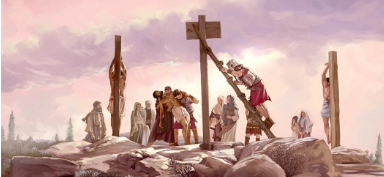
Lu 23:33:  What archaeological evidence indicates that in executions nails were likely used to fasten a person to a stake? (“Nail in a Heel Bone” media on Lu 23:33, nwtsty) A photograph of a replica of a human heel bone pierced by an iron nail that was 11.5 cm (4.5 in.) long. The original artifact was found in 1968, during excavations in northern Jerusalem, and dates to Roman times. It provides archaeological evidence that nails were likely used in executions to fasten the person to a wooden stake. This nail may be similar to the nails employed by the Roman soldiers to fasten Jesus Christ to the stake. The artifact was found in a stone box, called an ossuary, into which the dried bones of a deceased person were placed after the flesh had decomposed. This indicates that someone executed on a stake could be given a burial. Photo Clara Amit, Courtesy of the Israel Antiquities Authority
What does this week’s Bible reading teach me about Jehovah?

Lu 23:11:  Jehovah is the fulfiller of prophecies for we see they treated Jesus with contempt, and mocked fulfilling the prophecies at Isa 53:3 and Ps 22:7. Jehovah’s words will always come true, so we can trust that Jehovah’s Kingdom will put end to Satan world in the near future.    

Lu 23:34:  Jesus perfectly reflected his Father’s love in another important way like he was ready to forgive Roman soldiers who nailed him to the stake.” We are told at Ps 86:5 “For you, O Jehovah, are good and ready to forgive.”  May we imitate their example to other that may have done us wrong.   

Lu 23:35-39:  Jehovah prophesied that the Messiah would be reviled atPs 22:8-9. Yet Jehovah used his self-control not used his power on those who were insulting his Son while dying on the stake. We can be sure the paradise earth hope is not a dream but will be a reality because Jehovah said so. 

Lu 23:44-45:  Jehovah has great power and can even control the light of day. It is now “the sixth hour,” or noon and a strange darkness falls, not caused by a solar eclipse. This occurs at the time of the new moon on the Passover.  Also this darkness lasts much longer than the few minutes of an eclipse.  Jehovah caused this darkness and is the one we should put our trust in.

Lu 23:46:  Jehovah is the fulfiller of another prophecy dealing with his Son Jesus of the words he will speak before dying. Found at Ps 31:5 “Into your hand I entrust my spirit. You have redeemed me, O Jehovah, the God of truth.” We to can trust Jehovah with our future life if we remain faithful to him.

Lu 24:19:  Jehovah give power to his Son Jesus because he was faithful and was the one mankind could be save by. An Acts 2:22 show that is was Jehovah who did all the miracles through Jesus.  
Lu 24:49:  Jehovah is the giver of every good gift and giving his Holy Spirit is next greatest gift he could give faithful man to help them understand and gain the wisdom needed to do his will.

What other spiritual gems have you discovered in this week’s Bible reading?

Lu 23:2:  The religious leaders falsely accuse Jesus of subverting our nation, and forbidding the paying of taxes to Caesar.  Yet Jesus three days before at Luke 20:20-25 told them “pay back Caesar’s things to Caesar.” This is a warning for us to be cautious with our words for we live in a world that hates Jehovah Witnesses.

Lu 23:4:  Governments know that Jehovah’s people didn’t commit any crime and yet they are persecuted and throw in prison. They did this to Jesus because he was “no part of the world,” as we are not. (John 17:14, 16, 15:18, 20)

Lu 23:15-16, 24:  Example of what can happen from peer pressure: Herod and Pilate find Jesus did not commit any crime deserving of death and yet they allow the Jew to put Jesus to death. Likewise peer pressure can move one to do what is bad in Jehovah eye which can lead us in damaging our relationship with Jehovah and future life.

Lu 23:21,26:  Three time the Greek word stau·rosʹ is used which mean an upright stake or pole, such as the one on which Jesus was executed. There is no evidence that the Greek word meant a cross, such as the pagans used as a religious symbol for many centuries before Christ.

Lu 23:34:  Jesus teaches us a valuable lesson for imperfect humans to forgiving others. When a personal problem between Christians arises, ask should ourselves, ‘Is not gaining God’s forgiveness far more important than proving that a brother or a sister was wrong? (Mt 6:15)    

Lu 23:34:  Another scripture that show Jesus is not part of a trinity. First Jesus is praying to the Father and asking him to forgive the Roman soldiers for what they are doing. If Jesus is the Almighty God why would he have to pray to someone else and have him  forgive them? This is because Jesus is not the Almighty God and not part of a trinity.

Lu 23:35-39:  Jesus was being reviled while suffering on the torture stake, yet he bore all of this with dignity. What a fine example for us when we may be being belittle whether at the door or by the governments.

Lu 23:43: Reasons why the comma should go after the word “today:” First Jesus would not be raised up until the third day. Second it was 40 days after Jesus’ resurrection that he began his ascent to heaven. (Acts 1:3, 6-11) So Jesus was not talking about that day.   

Lu 23:46:  Another scripture that show Jesus is not part of a trinity. It show Jesus is trust his future life in his Father hand. This show two separate individual one is trusting the other. Also we see no third person involve.

Lu 24:3-7,15:  The resurrection of Jesus had witnesses that it did happen and the numbers kept growing too over 500 according to 1Co 15:6. We should never doubt that this did not happen, else our faith is worthless as shown 1Co 15:13-14.   

Lu 24:19:  Jesus is call a prophet not God, so Jesus cannot be part of Trinity. Other Bibles say the same because Jesus is a servant of Jehovah. (Acts 3:13,26; 4:24,27,30)

Lu 24:31-43:  Jesus could not have the same physical body that he die in. For one thing a physical body cannot suddenly disappear and appear when his disciples are behind lock door. They could see his body of flesh and could touch him, feeling the bones; he also ate in their presence, just like the angels did in the pass. (Ge 6:4; 19:1-3)  

Lu 24:34:  When Jesus was resurrected he made a personal visit to Peter showing he forgave him for denying him. Jesus may have wanted to assure the repentant Peter that he was still loved him and was valued to his Lord. We can be sure that if we stumble and repentant we also can be forgiven.

Lu 24:49:  Another scripture that show Jesus is not part of a trinity. For Jesus speak of having a Father with the word “my Father.”  Also Jesus shows that the pouring out of the Holy Spirit was something that his Father has promise not Jesus.  Again show two separate individuals. 

Digging for Spiritual Gems: Luke 21-22 (Week August 20-26, 2018) – EXPANDED

Lu 21:33—How might Jesus’ words in this verse be understood? (“Heaven and earth will pass away,” “my words will by no means pass away” study notes on Lu 21:33, nwtsty)
Heaven and earth will pass away: Other scriptures show that heaven and earth will endure forever. (Ge 9:16; Ps 104:5; Ec 1:4) So Jesus’ words here could be understood as hyperbole, meaning that even if the impossible happened and heaven and earth did pass away, Jesus’ words would still be fulfilled. (Compare Mt 5:18.) However, the heaven and earth here may well refer to the figurative heavens and earth that are called “the former heaven and the former earth” at Re 21:1.
my words will by no means pass away: Or “my words will certainly not pass away.” The use of two Greek negatives with the verb emphatically expresses rejection of an idea, vividly emphasizing the permanence of Jesus’ words.

Lu 22:28-30—What covenant did Jesus make, with whom did he make it, and what does it accomplish? (w14 10/15 16-17 ¶15-16)
15 After instituting the Lord’s Evening Meal, Jesus made a covenant with his faithful disciples, often referred to as the Kingdom covenant. (Read Luke 22:28-30.) Unlike other covenants, in which Jehovah is one of the parties to the covenant, this is a personal covenant between Jesus and his anointed followers. When saying, “just as my Father has made a covenant with me,” Jesus was apparently alluding to the covenant that Jehovah had made with him to be “a priest forever in the manner of Melchizedek.”—Heb. 5:5, 6.
16 The 11 faithful apostles had ‘stuck with Jesus in his trials.’ The Kingdom covenant assured them that they would be with him in heaven and sit on thrones to rule as kings and serve as priests. However, those 11 would not be the only ones to have that privilege. The glorified Jesus appeared to the apostle John in a vision and said: “To the one who conquers I will grant to sit down with me on my throne, just as I conquered and sat down with my Father on his throne.” (Rev. 3:21) Thus, the Kingdom covenant is made with the 144,000  anointed Christians. (Rev. 5:9, 10; 7:4) This is the covenant that forms a legal basis for them to rule with Jesus in heaven. This is similar to a bride from a noble family who might marry a ruling king and come into position to share in his ruling power. In fact, the Scriptures refer to anointed Christians as “the bride” of Christ, “a chaste virgin” promised in marriage to the Christ.—Rev. 19:7, 8; 21:9; 2 Cor. 11:2.
What has this week’s Bible reading taught you about Jehovah?

*** w18 February pp. 25-26 par. 12 Move Forward as a Spiritual Person! ***

12 As we work at cultivating spirituality, holy spirit will give us the power to transform our mind. With the spirit’s help, we can gradually begin to think more and more as Christ did. (Rom. 15:5) Additionally, it will help us root out fleshly desires and cultivate qualities pleasing to God. (Gal. 5:16, 22, 23) If we find that our mind pushes us toward materialistic thinking or fleshly desires, we should not give up. Keep asking for the spirit, and Jehovah will help you to redirect your mental attitude to focus on proper things. (Luke 11:13) Remember the apostle Peter. Several times in his life, he did not respond as a spiritual man should. (Matt. 16:22, 23; Luke 22:34, 54-62; Gal. 2:11-14) But he did not give up. Gradually, with Jehovah’s help, Peter developed Christlike thinking. We can do the same.

*** w18 March pp. 26-27 par. 16 Discipline—Evidence of God’s Love ***

16 Jesus always listened obediently to his Father, even when doing so was very difficult. (Matt. 26:39) And he gave his Father the credit for his teachings and wisdom. (John 5:19, 30) Jesus’ humility and obedience drew people of honest heart to him and helped to make him a compassionate and gracious teacher. (Read Matthew 11:29.) His kind words heartened those who were figuratively like a bruised reed or the wick of an oil lamp about to go out. (Matt. 12:20) Even when his patience was tested, Jesus was kind and loving. This was evident when he corrected his apostles for showing a selfish, ambitious spirit.—Mark 9:33-37; Luke 22:24-27.

*** w18 April p. 16 par. 7 Imitating Jehovah—A God Who Gives Encouragement ***

7 Jesus’ apostles often quarreled over who was the greatest among them, but Jesus patiently encouraged them to humble themselves and to become servants, not bosses. (Luke 22:24-26) Peter in particular disappointed Jesus several times. (Matt. 16:21-23; 26:31-35, 75) Rather than reject Peter, Jesus encouraged him and even commissioned him to strengthen his brothers.—John 21:16.

*** w18 June p. 7 par. 14 “My Kingdom Is No Part of This World” ***

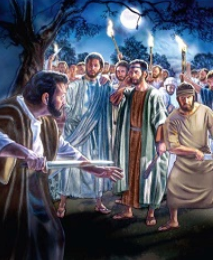
14 Caiaphas sent soldiers to arrest Jesus under the cover of night. Jesus was aware of this shameful strategy, so during his final meal with the apostles, he asked them to get some swords. Two would be sufficient to teach them a vital lesson. (Luke 22:36-38) Later that night, Peter used a sword to attack a member of the mob. No doubt, he was incensed at the injustice of Jesus’ nighttime arrest. (John 18:10) But Jesus told Peter: “Return your sword to its place, for all those who take up the sword will perish by the sword.” (Matt. 26:52, 53) This powerful lesson was in harmony with what Jesus prayed about earlier that night—they must be no part of the world. (Read John 17:16.) Fighting injustice was something to be left to God.

*** w18 June pp. 8-9 pars. 2-3 May We All Be One as Jehovah and Jesus Are One ***

2 Jesus’ emphasis on unity is understandable. He had noticed a lack of unity or harmony among the apostles, such as during his final meal with them. As had happened before, a dispute arose over “which one of them was considered to be the greatest.” (Luke 22:24-27; Mark 9:33, 34) Another time, James and John requested that Jesus give them prominent places alongside him in his Kingdom.—Mark 10:35-40.
3 Desire for prominence, however, was not the only potential cause of disunity among Christ’s disciples. The people of the land were divided by animosity and prejudice. Jesus’ disciples would need to overcome those feelings. In this article, we will consider the following questions: How did Jesus deal with prejudice? How did he help his followers learn to treat others impartially and be truly united? And how will his teaching help us to keep united?

*** w18 July p. 8 par. 3 Whose Recognition Do You Seek? ***

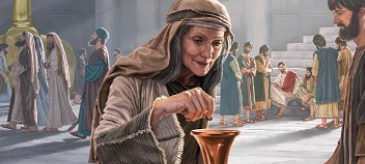
3 In Jesus’ day, some religious leaders had the wrong view of recognition. Jesus warned his followers: “Beware of the scribes who like to walk around in robes and who love greetings in the marketplaces and front [“best,” ftn.] seats in the synagogues and the most prominent places at evening meals.” He went on to say: “These will receive a more severe judgment.” (Luke 20:46, 47) By contrast, Jesus commended a poor widow whose small contribution was likely not recognized by others. (Luke 21:1-4) Jesus’ view of recognition was obviously very different from that of others. This article will help us maintain the right view, the one that Jehovah God accepts.

*** w18 September pp. 26-27 par. 16 Almighty yet Considerate ***
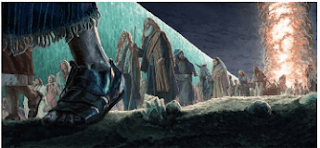
16 Today, too, Jehovah cares for his people as a group—spiritually and physically. He will continue to do so during the fast-approaching great tribulation. (Rev. 7:9, 10) Hence, whether young or old, sound in body or disabled, God’s people will not panic or cower in fear during the tribulation. In fact, they will do the very opposite! They will bear in mind these words of Jesus Christ: “Stand up straight and lift up your heads, because your deliverance is getting near.” (Luke 21:28) They will maintain that confidence even in the face of the attack by Gog—a coalition of nations that will wield far more power than did ancient Pharaoh. (Ezek. 38:2, 14-16) Why will God’s people remain confident? They know that Jehovah does not change. He will again prove to be a caring and considerate Savior.—Isa. 26:3, 20.

*** w17 January p. 11 par. 17 “Trust in Jehovah and Do What Is Good” ***

17 Think, too, of the needy widow in Jesus’ day. (Read Luke 21:1-4.) She could hardly do anything about the corrupt practices being carried on at the temple. (Matt. 21:12, 13) And there was likely little she could do to improve her financial situation. Yet, she voluntarily contributed those “two small coins,” which were “all the means of living she had.” That faithful woman demonstrated wholehearted trust in Jehovah, knowing that if she put spiritual things first, he would provide for her physical needs. The widow’s trust moved her to support the existing arrangement for true worship. Likewise, we trust that if we seek first the Kingdom, Jehovah will make sure that we have what we need.—Matt. 6:33.

*** w17 February p. 21 par. 17 Jehovah Leads His People ***

17 Angels assisted Jesus. Shortly after Jesus was baptized, “angels came and began to minister to him.” (Matt. 4:11) Hours before his death, “an angel from heaven appeared to him and strengthened him.” (Luke 22:43) Jesus was confident that Jehovah would send angelic help whenever he needed it to accomplish God’s will.—Matt. 26:53.

*** w15 11/15 p. 14 Show Appreciation for Jehovah’s Generosity ***

How can we show appreciation for all that Jehovah and his Son have done and will yet do for us? One way is by being generous in the giving of our time, energy, and resources to advance the pure worship of Jehovah, whether it is a small amount or a greater portion.—1 Chron. 22:14; 29:3-5; Luke 21:1-4.

What other spiritual gems have you discovered in this week’s Bible reading?

*** wp18 No. 2 p. 7 Prophecies That Have Come True ***

Luke 21:11: “There will be great earthquakes.”
Each year, some 50,000 earthquakes are large enough to be felt by humans. About 100 bring substantial damage to buildings, and one very great earthquake occurs about every year. According to one estimate, between 1975 and 2000, earthquakes claimed the lives of 471,000 people.

*** wp18 No. 2 p. 8 A Silent Witness to Accurate Prophecy ***

Jesus’ words evidently puzzled his disciples. Two days later, on viewing Jerusalem’s temple, one of them exclaimed: “Teacher, see! what wonderful stones and buildings!” Indeed, some temple stones were reportedly over 35 feet (11 m) long, 15 feet (5 m) wide, and 10 feet (3 m) high! Yet, Jesus replied: “As for these things that you now see, the days will come when not a stone will be left upon a stone and not be thrown down.”—Mark 13:1; Luke 21:6.
Jesus further told them: “When you see Jerusalem surrounded by encamped armies, then know that the desolating of her has drawn near. Then let those in Judea begin fleeing to the mountains, let those in the midst of her leave, and let those in the countryside not enter into her.” (Luke 21:20, 21) Did Jesus’ words come true?

*** wp17 No. 6 p. 9 What Did Jesus Really Look Like? ***

Religious leaders of Jesus’ day contrived ways to draw attention to themselves and underscore their authority. (Numbers 15:38-40; Matthew 23:5-7) Unlike them, Jesus instructed his apostles not to “lord it over” others. (Luke 22:25, 26) In fact, Jesus warned: “Beware of the scribes who want to walk around in robes and want greetings in the marketplaces.”—Mark 12:38.

*** w17 January p. 13 par. 4 Treasure Your Gift of Free Will ***

4 When Jehovah began his creative works, he lovingly chose to bestow free will on his intelligent creatures. The first one to receive this gift was his firstborn Son, “the image of the invisible God.” (Col. 1:15) Even before coming to earth, Jesus chose to remain loyal to his Father and not join Satan in his rebellion. Later, when Jesus was on earth, he exercised his free will to reject the temptations of the great Adversary. (Matt. 4:10) In earnest prayer the night before his death, Jesus reaffirmed his determination to do the will of God. He said: “Father, if you want to, remove this cup from me. Nevertheless, let, not my will, but yours take place.” (Luke 22:42) May we imitate Jesus and use our free will to honor Jehovah and to do his will! Is that really possible?

*** w17 December p. 13 Do You Remember? ***

What factors should affect a Christian’s view of keeping a firearm for protection against other humans?
Some are: God views life as sacred. Jesus did not urge his followers to get swords for protection. (Luke 22:36, 38) We are to beat our swords into plowshares. Life is more valuable than material things. We respect the conscience of others, and we want to be exemplary. (2 Cor. 4:2)—w17.07, pp. 31-32.

*** wp16 No. 2 p. 4 Did It Really Happen? ***

Jesus himself is mentioned by secular writers of the first and second centuries. His manner of death, as described in the Gospels, agrees with Roman executional methods of the time. Moreover, events are related in a factual and candid manner—even portraying some of Jesus’ disciples unfavorably. (Matthew 26:56; Luke 22:24-26; John 18:10, 11) All these factors strongly indicate that the Gospel writers were honest and accurate in what they wrote about Jesus.

*** w16 April pp. 13-14 par. 2 “Let Endurance Complete Its Work” ***

2 We too are fighting a relentless battle. Our enemies include Satan, his world, and our own imperfections. Some of us have battled for decades, and with Jehovah’s help, we gained victories. At times, though, we may get tired of battling our enemies and of waiting for the end of this system of things. Indeed, we have not yet won the complete victory. Jesus warned that we who live in the last days would face severe trials and cruel mistreatment, but he also said that gaining the victory would depend on our endurance. (Read Luke 21:19.) What is endurance? What will help us to endure? What can we learn from those who have endured? And how can we “let endurance complete its work”?—Jas. 1:4.

*** w16 June pp. 8-9 par. 10 Appreciating Jehovah as Our Potter ***

10 Like a highly skilled potter, Jehovah knows the type and quality of “the clay” that is before him, and he molds it accordingly. (Read Psalm 103:10-14.) Indeed, he deals with us as individuals, taking into account our particular weaknesses, limitations, and level of spiritual growth. His attitude toward imperfect servants was demonstrated by his Son. Consider how Jesus dealt with his apostles’ shortcomings, especially their inclination to argue among themselves over position. If you had witnessed the apostles’ heated disputes, would you have viewed these men as meek and malleable? Yet, Jesus did not adopt a negative view. He knew that his faithful apostles could be molded by kind, patient counsel and by their observing his example of humility. (Mark 9:33-37; 10:37, 41-45; Luke 22:24-27) After Jesus was resurrected and the holy spirit was poured out, the apostles focused, not on position or prominence, but on the work he had given them to do.—Acts 5:42.

*** w16 June p. 26 par. 10 Do Not Let the Faults of Others Stumble You ***

10 The Bible provides us with accounts of servants of God who remained loyal to Jehovah and his people despite the serious faults of others around them. For example, after spending a night in prayer to his Father, Jesus selected the 12 apostles. Judas Iscariot was one of those. When Judas later betrayed him, Christ did not let that defection mar his own relationship with his Father, Jehovah; nor did Jesus allow Peter’s denial to do that. (Luke 6:12-16; 22:2-6, 31, 32) Jesus knew that those actions were not the fault of Jehovah or his people in general. Jesus continued his wonderful work despite the disappointment that some of his followers caused him. Jehovah rewarded him by resurrecting him from the dead, thus opening the way for Jesus to become King of the heavenly Kingdom.—Matt. 28:7, 18-20.

*** w16 July p. 14 par. 3 Why Must We “Keep on the Watch”? ***

3 As Jehovah’s Witnesses, we take seriously Jesus’ warning. We know that we are living deep in “the time of the end” and that there cannot be much time left before the “great tribulation” begins! (Dan. 12:4; Matt. 24:21) We see distressing wars, increasing immorality and lawlessness, religious confusion, food shortages, pestilences, and earthquakes taking place around the world. We know that a phenomenal Kingdom-preaching work is being accomplished by Jehovah’s people everywhere. (Matt. 24:7, 11, 12, 14; Luke 21:11) We eagerly anticipate what the Lord’s coming will mean for us and for the accomplishment of God’s purpose.—Mark 13:26, 27.

*** w16 August p. 28 pars. 13-14 Do You See the Need to Train Others? ***

13 Bible accounts highlight the privilege we have of showing “brotherly affection” and serving one another. (Read 1 Peter 1:22; Luke 22:24-27.) The Son of God gave everything, including his life, in ministering to others. (Matt. 20:28) Dorcas “abounded in good deeds and gifts of mercy.” (Acts 9:36, 39) Mary, a sister in Rome, “worked hard” in behalf of those in the congregation. (Rom. 16:6) How can we help new ones grasp the importance of helping their brothers and sisters?
14 Mature Witnesses can invite new ones to come along when visiting the sick and the elderly. If appropriate, parents can take their children on such visits. Elders can work with others in making sure that our dear older ones have good food and that their homes are maintained. In these ways, younger ones and those newly associated learn to perform acts of kindness for others. While preaching, one elder would briefly visit the Witnesses living in his rural territory to see how they were doing. A young brother who often accompanied him thus learned that all in the congregation should feel loved.—Rom. 12:10.

*** w16 September p. 16 Defending the Good News Before High Officials ***

Yet, even today Jehovah’s name can be glorified when Christians make a defense of their faith. As Paul was, we should try to be calm, sincere, and convincing. Jesus told his followers that they would not have to ‘rehearse beforehand how to make their defense, for he would give them words and wisdom that all their opposers together would not be able to resist or dispute.’—Luke 21:14, 15; 2 Tim. 3:12; 1 Pet. 3:15.
When Christians defend their faith before kings, governors, or other officials, they can give a witness to people whom it might otherwise have been difficult to reach with the Christian message. Some favorable court decisions have refined legal codes, thus protecting freedom of speech and of worship. But whatever the outcome of such cases, the courage God’s servants display under trial makes God rejoice.

*** w16 October p. 27 par. 5 Exercise Your Faith in Jehovah’s Promises ***

5 Clearly, our prospect of enjoying eternal life in God’s new world depends on our having faith and keeping it strong. The need to keep our faith healthy can be likened to a plant’s need for water. Unlike an artificial plant, a living plant keeps changing. A live plant either withers because of a lack of water or continues to thrive with a regular supply of moisture. If deprived of sufficient water, a once healthy plant will eventually die. So, too, our faith. It will wither and die if neglected. (Luke 22:32; Heb. 3:12) But if we give it due attention, our faith will stay alive and keep “growing,” and we will be “healthy in faith.”—2 Thess. 1:3; Titus 2:2.

*** w16 November p. 6 par. 9 “Keep On Encouraging One Another Each Day” ***

9 Jesus. On the night when Jesus instituted the Memorial, pride was one negative trait that he saw in his apostles. Jesus humbly washed their feet, but they were still arguing about which one of them was the greatest; and Peter was overconfident. (Luke 22:24, 33, 34) Yet, Jesus commended his faithful apostles for sticking with him in his trials. He predicted that they would do works greater than his, and he assured them that God had affection for them. (Luke 22:28; John 14:12; 16:27) We might ask ourselves, ‘Shouldn’t I imitate Jesus by commending my children and others for what they do well instead of focusing on their shortcomings?’

*** w15 4/15 p. 22 par. 13 How Real Is Your Relationship With Jehovah? ***

13 Consider this: From his prehuman existence, Jesus observed firsthand Jehovah’s response to the prayers of His human servants. Then, during his earthly ministry, Jesus used prayer as his means of communicating his feelings to his Father in heaven. Would he have done so—even spending an entire night in prayer—had he thought that Jehovah was not really listening? (Luke 6:12; 22:40-46) Would he have taught his disciples to pray had he thought that prayer was nothing more than a psychological crutch? Clearly, Jesus knew that prayer is real communication with Jehovah. On one occasion, Jesus said: “Father, I thank you that you have heard me. True, I knew that you always hear me.” We too can have confidence that Jehovah is the “Hearer of prayer.”—John 11:41, 42; Ps. 65:2.

*** w15 5/15 p. 18 par. 18 You Can Fight Satan—And Win! ***

18 How can we fight Satan and win? Jesus told his disciples: “By your endurance you will preserve your lives.” (Luke 21:19) Nothing that any human can do will cause us permanent harm. Nobody can take away our precious friendship with God unless we allow that to happen. (Rom. 8:38, 39) Even the death of Jehovah’s servants does not score a victory for Satan, for Jehovah will see to it that they are resurrected! (John 5:28, 29) On the other hand, Satan’s prospects are bleak indeed. After the destruction of his ungodly system, Satan will be abyssed for 1,000 years. (Rev. 20:1-3) At the end of Jesus’ Thousand Year Reign, Satan will be “released from his prison” for a short time to make a final attempt to mislead perfect mankind. After that, the Devil will be destroyed. (Rev. 20:7-10) Satan faces certain doom, but that is not true of you! Take your stand against Satan, firm in the faith. You can fight Satan and win!

*** w15 8/15 p. 15 par. 4 Keep in Expectation! ***

4 The Bible leaves no doubt about what our attitude should be toward the impending destruction of this system of things. Jesus told his followers to “keep on the watch” and to “keep awake.” (Matt. 24:42; Luke 21:34-36) That in itself is a good reason to remain in expectation—Jesus told us to do so! In this regard, Jehovah’s organization has set an example. Its publications have consistently exhorted us to “await and keep close in mind the presence of the day of Jehovah” and to fix our hope on God’s promised new world.—Read 2 Peter 3:11-13.

*** w15 9/1 p. 16 Bible Questions Answered ***

How do Bible prophecies help us?
Some prophecies warn God’s servants to take action. For example, when first-century Christians saw certain prophecies fulfilled, they left Jerusalem. Later, when the city was destroyed because most of its people had rejected Jesus, the Christians were far away in a safe place.—Read Luke 21:20-22.
Today, fulfilled prophecies show that God’s Kingdom will soon bring an end to human kingdoms and governments. (Daniel 2:44; Luke 21:31) So it is urgent that each person act now to gain the approval of the King, Jesus Christ, whom God has appointed.—Read Luke 21:34-36.


*** w15 11/1 p. 6 God’s View of War in the First Century ***

Thus, like God’s servants of the ancient past, those first-century Christians were to wait until God’s time to bring an end to wickedness and oppression. In the meantime, they were not authorized by God to take it upon themselves to engage in warfare against their enemies. Jesus Christ made this clear in his teachings. For example, he did not direct his followers to engage in warfare, but instead he told them: “Continue to love your enemies and to pray for those who persecute you.” (Matthew 5:44) Foretelling the time when first-century Jerusalem would be attacked by Roman armies, Jesus instructed his disciples, not to stay and fight, but to flee—which they did.—Luke 21:20, 21.

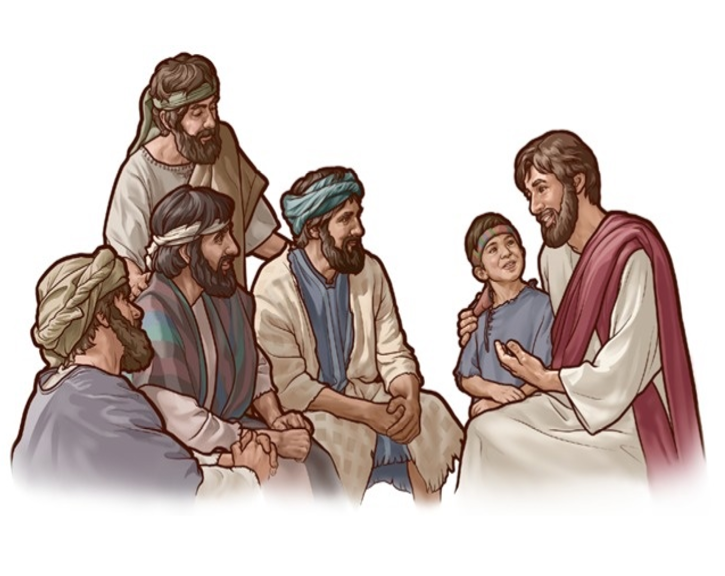
Digging for Spiritual Gems: Week August 20-26, 2018 – Luke 21-22

Lu 21:33:  How might Jesus’ words in this verse be understood? (“Heaven and earth will pass away,” “my words will by no means pass away” study notes on Lu 21:33, nwtsty)  “Heaven and earth will pass away”- Jesus’ words here could be understood as hyperbole, meaning that even if the impossible happened and heaven and earth did pass away, Jesus’ words would still be fulfilled. (Compare Mt 5:18.) However, the heaven and earth here may well refer to the figurative heavens and earth that are called “the former heaven and the former earth” at Re 21:1.
Or “my words will certainly not pass away” The use of two Greek negatives with the verb emphatically expresses rejection of an idea, vividly emphasizing the permanence of Jesus’ words.
Lu 22:28-30:  What covenant did Jesus make, with whom did he make it, and what does it accomplish? (WT14 10/15 pg16-17 par15-16) (“for they are all living to him” study note on Lu 20:38, nwtsty) the Kingdom covenant.  Unlike other covenants, in which Jehovah is one of the parties to the covenant, this is a personal covenant between Jesus and his anointed followers. When saying, “just as my Father has made a covenant with me,” Jesus was apparently alluding to the covenant that Jehovah had made with him to be “a priest forever in the manner of Melchizedek.”—Heb. 5:5, 6.  16 The 11 faithful apostles had ‘stuck with Jesus in his trials.’ The Kingdom covenant assured them that they would be with him in heaven and sit on thrones to rule as kings and serve as priests. However, those 11 would not be the only ones to have that privilege. The glorified Jesus appeared to the apostle John in a vision and said: “To the one who conquers I will grant to sit down with me on my throne, just as I conquered and sat down with my Father on his throne.” (Rev. 3:21) Thus, the Kingdom covenant is made with the 144,000 anointed Christians. (Rev. 5:9, 10; 7:4)
What does this week’s Bible reading teach me about Jehovah?

Lu 21:1-4:  Jehovah value what we can give no matter how little it may seem to us. Jehovah is pleased to accept the best that we can give. Jehovah “sees into the heart,” so he is fully aware of the yearnings of your heart. 1Sa 16:7.

Lu 21:9-11:  Jehovah is the fulfiller of prophecies for these words started being fulfilled in 1914 on Jehovah time table. Even though words spoke by Jesus they were still Jehovah words as shown at John12:49, 50. We can be sure that Jehovah promises will be fulfill.  

Lu 21:12:  Jehovah sees and knows the hate the world show toward Jehovah’s faithful servants because of his name.” Jesus’ name represents as God’s appointed Ruler, the King of kings, to whom all the nations should submission, but are not willing to do. Yet Ps 2:1-7 show they cannot stand again Jehovah so our trust should be in Jehovah.

Lu 21:14-15:  Jehovah cares about servants that he has provide us with his instruction from his Word, organization and even his holy spirit to help us. This spirit can equip us with the “power beyond what is normal,” enabling us to serve God faithfully despite obstacles and what to speak to opposers. 2Co 4:7; Luke 11:13; Acts 15:8; Eph 4:30.    

Lu 21:17-18:  Jehovah wants us to know that his faithful servants are very valuable to him, and they will never perish in his eyes. For Jehovah has put in place the means to resurrect then and they live in his heart and mind.   

Lu 21:17-18:  Jehovah has the power to darken the sun, the moon not give its light, the stars fall from heaven, and the powers of the heavens be shaken. During the great tribulation Jehovah can display such power to cause such cataclysmic effects as he did in the pass, and he can do it again. Ex 10:21-23; Jos 10:12-14; Jg 5:20.

Lu 21:27:  Jehovah shares his power with his appointed judge Jesus, his begotten Sons who comes with power and glory. With this authority Jesus will accomplish Jehovah’s will, to bring an end to Satan’s world. Jesus was given all authority at Mt 28:18 and at 1Co 15:27 show Jesus has no authority of his Father.   

Lu 22:28-30:  Jehovah foretold a new arrangement for his people at Jer. 31:31-33 of a new covenant with a spiritual Israel. Jehovah used his beloved Son as mediator this new covenant. We see Jehovah keeps words and we know all this promised will all come true.     

Lu 22:34:  Jehovah the “Reveler of secrets’ as shown Da 2:28-29, 47. How else could Jesus know that Peter was going to “disown” him three times? For it was Jehovah that did all the miracles through Jesus as shown at Acts 2:22. So it was by Jehovah powers that reveal these this to Jesus.  So we can be sure all Jehovah’s words will come true.    

Lu 22:42-43:  Jehovah is the one who answer prayer and that why Jesus pray to the “Hearer of prayer” as shown in Ps 65:2; 66:19.  Also Jehovah has the power to act in behalf of the petitioners. So let us always pray to Jehovah to give us strength to be faithful to him to the end.

Lu 22:63-64:  Jehovah fulfilled word in what they do to his beloved Son Jesus according to Isa 50:6-9. Here Jehovah shows self-restraint, long-suffering, and patience as he watch what they did to his innocent Som. Soon all Jehovah promise will be fulfill and that why we need to put trust in one who keep his word and show our loyal love by doing his will. 
What other spiritual gems have you discovered in this week’s Bible reading?

Lu 21:1-4:  The example of the poor widow teaches us that we should be unselfish in supporting true worship of what we are able to give.

Lu 21:6-7:  Jesus is talking about to different fulfillments. First question: “When will these actually be?” or when will Jerusalem and its temple be destroyed? Second question deals with when the end of this system of things was at hand. Mt 24:3; Mr 13:4

Lu 21:12:  The truths about God’s have caused many to hated Jehovah Witnesses. Today in 33 lands Jehovah Witnesses have been ban, and almost all continents Jehovah’s people have been persecute even the U.S. during WWII.  We must ask ourselves, will I stand firm for Jehovah?

Lu 21:15-17:  We have been warned that the world will hate us and possible even our love ones could hate us because of Jehovah’s name. We must ask ourselves, who do we love more, Jehovah or those who cannot give us life? May we all choose Jehovah who always love us and wants us to be saved and gain everlasting life.  

Lu 21:19:  Once save always save is a false teaching. Only those who endure to the end in either this system or to death will be saved. This shows true believers will have to put a hard fight for their faith to the end of Satan’s world. Mt 10:22, Mk 13:13 Lu 21:19; Heb 10:36.

Lu 21:20-22, 24: This had it first fulfillment in 66 C.E. when the Roman army attacked Jerusalem and its temple (a place holy in the eyes of the Jews). In the larger fulfillment, the “standing” will occur when the United Nations (the modern-day “disgusting thing”) attacks as shown in Re 17:16-18.

Lu 21:33:  These words are referring to two groups of anointed Christians. The first group was on hand in 1914, and discerned the sign of Christ’s presence in that year. The second group included in “this generation,” is anointed contemporaries of the first group. They were not simply alive during the lifetime of those in the first group.

 Lu 21:34-35:  Jesus cautioned us against becoming absorbed by the mundane concerns of life.  If our concern is over material things and that begin to dominate our thinking, we are in danger of losing our focus on Kingdom realities. (Mt. 6:19-24, 31-33) Let us not be like the world that passing away and took no note and die.1Jo 2:17.

Lu 22:20:  Jesus is the mediator of the new covenant, between Jehovah and anointed Christians, was made operative by Jesus’ sacrifice. Jesus’ blood made valid the new covenant that Jehovah would make with spiritual Israel. That covenant went into effect at Pentecost 33 C.E.—Heb 9:14, 15.

Lu 22:3-6,47-48:  Example that once saved, always saved is not true. Judas new the truth and yet he betray his loving teacher. Two other example is found at 1Ti 1:18-20.  Other scriptures that show once saved, always save in not true: 1Ti 4:1-3; Acts 20:29-30; 2Ti 4:3-4; Jude 3-5; Re 2:5,16; 3:3, 11, 15-16.

Lu 22:24-26:    Human imperfection and a religious background that emphasized position made Jesus’ disciples overly concerned about greatness. We should cultivate humility as we guard against sinful tendencies and maintain a proper view of privileges and responsibilities.

Lu 22:28-30:  Another scriptures show that Jesus is not part of a trinity. We see Jesus has a Father by the words “my Father,” and this Father make a covenant with Jesus for a Kingdom. This show Jehovah and Jesus are two separate individual making an agreement between them.   

Lu 22:36-38:  Jesus did not ask his disciples to carry a weapon for protection or self-defense. Rather, their having swords on hand on the night of his betrayal made it possible for Jesus to teach them a vital lesson: “All those who take the sword will perish by the sword.”(Mt. 26:52.)

Lu 22:56-62:  Peter’s tragic experience shows that even a person of faith and devotion can be thrown off balance if he is not properly prepared for unexpected trials or temptations. May what Peter went through serve as a warning to keep close to Jehovah and pray constantly that we do not give into Satan tactics.

Lu 22:69:  Jesus helps us to see that he is not part of a trinity by telling us he is “the Son of God and not God the Son. Also Jesus show he will be sitting at the right hand of someone else and that one has authority over Jesus 1Co 15:27. 

Digging for Spiritual Gems: Luke 19-20 (Week August 13-19)

The week of  Aug 13 – 19Digging for Spiritual Gems


Lu 19:43:  How were Jesus’ words fulfilled? (“fortification of pointed stakes” study note on Lu 19:43, nwtsty) Jesus’ words came true in the year 70 C.E. when the Romans, commanded by Titus, erected a siege wall, or palisade, around Jerusalem. Titus’ objective was threefold—to prevent the Jews from fleeing, to encourage their surrender, and to starve the inhabitants into submission. To provide materials for the construction of this fortification around Jerusalem, Roman troops stripped the countryside of trees.
Lu 20:38:  How does Jesus’ statement strengthen our confidence in the resurrection? (“for they are all living to him” study note on Lu 20:38, nwtsty) Approved servants of God who die are still living from Jehovah’s standpoint, since his purpose to resurrect them is sure of fulfillment. Ro 4:16, 17.
 
What does this week’s Bible reading teach me about Jehovah?

Lu 19:28-36:  Jehovah is the fulfiller of prophecies, for he foretold that his promised King would come into Jerusalem on a colt at Zec 9:9 “Humble and riding on a donkey, On a colt, the foal of a female donkey.” Yes, nothing can stop Jehovah promises from being fulfilled.

Lu 19:41-44:  Jehovah fulfill the prophecies that his son Jesus spoke about Jerusalem destruction in 70 C.E. in every detail.  We can be sure that all Jehovah words will be fulfill in every detail concerning the Kingdom.

Lu 19:46:  It show Jehovah feel about those who try to contaminate the way he is to be worship for he see what we are doing because his name is involve. We are told at Jer 7:11  “this house upon which my name has been called become a mere cave of robbers in YOUR eyes? Here I myself also have seen [it]…”

Lu 20:16:  Show that Jehovah has the right to repay the evil ones for their action for justice sake. That is what Jehovah has promise to do at 2Th 1:6 “it is righteous on God’s part to repay tribulation to those who make tribulation for you.  (2Th 1:7-9; Ro 12:19)

Lu 20:17:  Jehovah loves mankind so much that he wanted to save them from sin and death, so he sent his only begotten Son to save us as shown at John 3:16.  Now Jehovah has given Jesus the power to save mankind because he was faithful to the end and is our cornerstone to approach Jehovah.

Lu 20:21:  Jehovah is the greatest teacher and he is the one who taught Jesus the truth  and seen his Father was not partial.  John 5:19. 8:28  12:49,50 ;Acts 15:34

Lu 20:37-38:  Jehovah sees his faithful servants as alive even if they should die, since his purpose to resurrect them is a sure fulfillment in his eyes. Ro 4:16, 17.  

Lu 20:47:  We see the religious leader display of false holiness by “making long prayers.”  Jesus said to pray in privacy, without vain repetition, and he gave them a simple model prayer. (Mt 6:6-8; John 14:6, 14; 1Pe 3:12; Mt 6:9-13)
What other spiritual gems have you discovered in this week’s Bible reading?

Lu 19:7-8:  Jesus sees the potential for repentance in sinners.  May we never judge people because of what we heard or what we know about a person, for it is Jehovah who sees the hearts, and their potential and knows if one can be a sheep.     

Lu 19:10:  Jesus loved those who were despised by others and was willing to show mercy to those. Jesus exercising mercy toward sinners is not condoning of their sins, but knew that people could change. May we do the same as we preach.   

Lu 19:15-22:  Shows that Jesus expected all to be diligent in serving to the best of their ability in the ministry. Each of us has our own circumstances that can allow one to do more for Jehovah, while another cannot do as much, yet both are look on favorably.   

Lu 19:37-38:  We see here that Jehovah and Jesus do not mind the disciples giving praise to their creator, whether they do it in witnessing to others or in song.

Lu 19:38:  Jesus comes in Jehovah name by doing his Father will and speaking what his Father him to speak. John 4:34, 6:38, 8:28,38, 12:49.

Lu 19:39:  May we learn not to be like those religious leaders of Jesus day, instead of looking for the good that Jesus and his disciples did, they were look for what they thought was bad or wrong. We are all imperfect and make mistake, so in love, look at all the good our brothers and sisters are doing.     

Lu 19:47:  The chief priests, scribes, and principal ones of the people hear what Jesus has done, and they respond with renewed efforts to have him killed.  We can be sure they will do the same today to those who speak the truth about Jehovah and his son Jesus.  

Lu 20:2, 8:  Just like in Jesus’ day they question his authority of what he does, yet his works and teaching show his authority came from Jehovah. Likewise today Jehovah people get their authority form Jehovah’s Word like Acts 15:14 shows Jehovah has a people for his name and they do his will and glorified his name.  
Lu 20:9-14:  Another scriptures show that Jesus is not part of a trinity.The owner of vineyard is Jehovah (Isa 5:7), and the vineyard is the nation of Israel, and Jehovah sent his Son Jesus who the religious leaders killed. (John 17:3; 3:16; 13:16) two separate being one is doing the sending is greater than the one sent.   

Lu 20:20:  Haters of Jehovah will look for way to trap his people in words, just like they try to do with Jesus.  They will look for ways to try to stop the truths about Jehovah and his son Jesus being made known as shown at John 15:20, 21. This is going on in 33 lands.


Lu 20:25:  Jesus shows us that we must submit to authority of the government under which we live by obeying its laws, respecting its officials, and paying the taxes it levies. This authority is not absolute, for we cannot disobey God laws if they asked us to as shown at Acts 5:29.   

Lu 20:35:  Jesus show that there is going to be a resurrection and that it is going to be in the future with the words “For when they rise from the dead. This is what he taught all along at John 6:39-40,43, 54; 5:28-29. 

Luke 17 – 18 Digging for Spiritual Gems

Luke 17 – 18 Digging for Spiritual Gems (Alternative)
Week August 6-12, 2018


Lu 17:7-10:  What is the point of Jesus’ illustration? (“good-for-nothing” study note on Lu 17:10, nwtsty) The point of Jesus’ illustration is notthat the slaves, his disciples, are to consider themselves useless or worthless. According to the context, “good-for-nothing” conveys the idea that the slaves would view themselves modestly, not as deserving special credit or praiseSome scholars consider the term as it is used here to be hyperbole meaning “we are merely slaves deserving no special attention.”
Lu 18:8:  What kind of faith is Jesus referring to in this verse? (“this faith” study note on Lu 18:8, nwtsty) The use of the Greek definite article before the word “faith” indicates that Jesus was referring, not to faith in a general sense, but to a particular kind of faith, like that of the widow in Jesus’ illustration. (Lu 18:1-8) This would include having faith in the power of prayer as well as faith that God will cause justice to be done to his chosen ones. Jesus apparently left the question about faith unanswered so that his disciples would think about the quality of their own faith. The illustration about prayer and faith was particularly appropriate because Jesus had just been describing the tests his disciples would face. Lu 17:22-37.
What does this week’s Bible reading teach me about Jehovah?

Lu 17:5-6: Jehovah can give us more faith that is need by giving us his holy spirit. We see this request was answered, at Pentecost 33 C.E., when the promised holy spirit came upon the disciples and gave them deeper insight into God’s Word and purpose. (Act 2:14-21)

Lu 17:9-10:  Jehovah does appreciate what we do in his service, no matter how little it maybe because of our circumstances. We can be sure Jehovah will not forget our works and love we shown for his name as shown in Heb 6:10. 

Lu 17:12-14:  Jehovah has the power to cure all diseases in the whole world. That is a promise by Jehovah at Isa 33:24. See Re 21:3-4, De7:15.

Lu 18:7-8:  Jehovah is the hearer of prayer and we must keep asking for his help and in time Jehovah will cause justice to be done.  Ps 65:2, 145

Lu 18:14:  Jehovah love humble people and this will help us to draw close to him.  We can see this in Jesus case, for Jehovah exalts Jesus to a superior position. We to can be close to Jehovah, if we stay humble and do Jehovah’s will he will exalt us to life everlasting in a paradise earth. 

Lu 18:16-17:  Jehovah has tender concern for each of his worshippers including the “little ones” even those who may seem unimportant from the standpoint of the world.

Lu 18:18:  Jehovah the true God is the source of all good things. Moreover, Jesus drew attention to the fundamental truth that the Creator of all things, Jehovah God, alone has the right to set the standards of good and bad.

Lu 18:27:  Jehovah has the power to make the impossible to be possible for we are told here “impossible with men are possible with God.” So we can put our trust in Jehovah for he can make it possible for some of the rich to enter his kingdom, if they do his will. Ge 18:14; Job 42:2; Zec 5:6. 

Lu 18:31-33:  Jehovah is the fulfiller of prophecies, who foretold all what will happen to his beloved Son like: Ps 22:7; Isa 50:6, 53:5,7.  Yes good reason for us to trust in Jehovah to fulfilled his promises to the faithful ones about new heaven and new earth of peace.

Lu 18:41-43:  Jehovah never wanted his earthly children to suffer with illness like blindness. Yet Jehovah has promise to do away with blindness for at Isa35:5 “At that time the eyes of the blind will be opened.” Yes Jehovah is the greatest healer and shows his power through Jesus. Ps 146:8
What other spiritual gems have you discovered in this week’s Bible reading?

Lu 17:3-4:  The offended one is encouraged to try to forgive if there is sincere repentance. Jehovah himself views matters this way; to receive divine forgiveness, we must be sincerely repentant.

Lu 17:9-10:  As slaves of Jehovah we need not think that what all we do makes us better than other. Rather, we should look at what we do for Jehovah is what we can do because our circumstances allow it.  

 Lu 17:12:  In Bible times, lepers evidently congregated together or lived in groups, making it possible for them to help one another as we see 10 lepers here. (2Ki 7:3-5) God’s Law required that lepers live in isolation, to warn others of their presence and stay at a distance. (Le 13:45, 46)

Lu 17:15:  We should glorify Jehovah for all the good things he has done for us and express it in our prayers to him.  

Lu 17:16-19:  We do not want to be like the nine lepers who did not show appreciation for what Jesus did for them. Rather, when someone treats us well, we should be quick to say thank you and, where appropriate we can show appreciation by sending a note.   

Lu 17:21:   Many Bible translate that the Kingdom of God ”inside you,” yet this cannot be true for Jesus was talking to the Pharisees who did not believe in him and wanted to Kill him.  Jesus was God’s royal representative, and anointed by God; hence, so it could be said that “the Kingdom” was in their midst.

Lu 17:24-31:  Jesus is not saying that people in Noah’s and in Lot’s day were destroyed simply because they pursued the normal activities of life. Rather they went about without paying any attention to God’s will, May we stay awake of the time we live in and not be destroy. 

Lu 17:34-35:  Those taken in this context, it evidently refers to receiving a favorable standing with the “Lord” and being saved like Noah and Lot.  Yet those that are being abandoned would then mean to be judged worthy of destruction like those in Noah’s day.

Lu 18:10-14:  Jesus emphasizes the need for his disciples to be humble. Being reared in a society in which the self-righteous Pharisees are so influential and position and rank are always stressed, yet we see that Jesus’ was not affected. May we do the same of being humble.  

Lu 18:18:  Jesus here recognizes Jehovah as the ultimate standard of what is good, the one who has the sovereign right to determine what is good and what is bad. It also show that Jesus is not the one who set the standard of what is good and bad, so he cannot be God.

Lu 18:22-25:  A warning for those who put the love of money or material things before their love of Jehovah. Satan wants Jehovah’s people to love the temporary things of life so they will lose out on the permanent things that bring everlasting happiness.    

Lu 18:29-30:  Jesus promises, wherever in the world his disciples go, they enjoy a relationship with fellow Christians that is closer and more precious than that enjoyed with natural family members.