Tag Archives: Bible Highlights

Digging for Spiritual Gems: Acts 1-3 (Week November 12-18)

Acts 1-3
Digging for Spiritual Gems: (8 min.)

Ac 3:15—Why is Jesus called “the Chief Agent of life”? (it-2 61 ¶1)
“Chief Agent of life.” As an expression of his Father’s undeserved kindness, Christ Jesus laid down his perfect human life in sacrifice. This made possible the union of Christ’s chosen followers with him in his heavenly reign and also made possible the arrangement for earthly subjects of his Kingdom rule. (Mt 6:10; Joh 3:16; Eph 1:7; Heb 2:5; see RANSOM.) He thereby became “the Chief Agent [“Prince,” KJ; JB] of life” for all mankind. (Ac 3:15) The Greek term here used means, basically, “chief leader,” a related word being applied to Moses (Ac 7:27, 35) as “ruler” in Israel.

Ac 3:19—How does this verse describe the way Jehovah forgives repentant wrongdoers? (cl 265 ¶14)
14 Jehovah’s forgiveness is further described at Acts 3:19: “Repent, therefore, and turn around so as to get your sins blotted out.” That last phrase translates a Greek verb that can mean “to wipe out, . . . cancel or destroy.” According to some scholars, the image expressed is that of erasing handwriting. How was this possible? The ink commonly used in ancient times was made of a mixture that included carbon, gum, and water. Soon after working with such ink, a person could take a wet sponge and wipe the writing away. Therein is a beautiful picture of Jehovah’s mercy. When he forgives our sins, it is as though he takes a sponge and wipes them away.

What has this week’s Bible reading taught you about Jehovah?

*** w18 November p. 16 par. 14 Trust in Jehovah and Live! ***
14 Patiently waiting on Jehovah and paying close attention to what he tells us will give us confidence and will help us to acquire a calm heart despite adversities and hardships. Jesus confirmed that we can trust in Jehovah as the Great Timekeeper, not focusing on “times or seasons” that God has not yet revealed. (Acts 1:7) Therefore, may we not give up but wait in humility, faith, and patience, making good use of the time we have to serve Jehovah to the best of our abilities.—Mark 13:35-37; Gal. 6:9.

*** wp17 No. 1 p. 15 Is It Just a Small Misunderstanding? ***
Has timing ever caused Jehovah’s Witnesses to misunderstand the Bible? Yes. But when God’s time came to make matters clearer, the Witnesses readily adjusted their understanding. They believe that they thereby imitate Christ’s apostles, who humbly adjusted their thinking whenever Jesus corrected them.—Acts 1:6, 7.

*** w17 January p. 10 par. 12 “Trust in Jehovah and Do What Is Good” ***
12 Being imperfect, all of us sin. Some mistakes are more serious than others. In some cases, we may not be able to undo our mistakes. We may simply have to live with the consequences. (Gal. 6:7) But we take God at his word, trusting that if we are repentant, Jehovah will support us through difficult times—even when those difficulties are of our own making.—Read Isaiah 1:18, 19; Acts 3:19.

*** w15 8/15 p. 17 par. 14 Keep in Expectation! ***
14 In the new world, we will have reason to reflect on the fact that all the foretold events associated with the conclusion of the system of things did indeed take place. Meditating on how matters actually turned out will further strengthen our confidence in Jehovah and his promises yet to be fulfilled. (Read Joshua 23:14.) We will surely be thankful that God, who ‘has placed times and seasons in his own jurisdiction,’ exhorted us to live with an awareness that ‘the end of all things had drawn close.’—Acts 1:7; 1 Pet. 4:7.

*** w15 9/15 pp. 14-15 par. 8 “Stand Firm in the Faith” ***
8 Do God’s promises seem less real to me now than they once did? For instance, God has promised to destroy the present system of things. Yet, are we distracted by the world’s array of entertainment options, thus weakening our faith in God’s promise? We might start to doubt that the end is really near. (Hab. 2:3) Here is another example. God promises to forgive us on the basis of the ransom. If, though, we became obsessed with guilt over our past mistakes, we could begin to doubt whether Jehovah has really “blotted out” all our sins. (Acts 3:19) Consequently, we could lose our joy in God’s service and become inactive.

*** w15 10/15 p. 7 par. 14 Do You See God’s Hand in Your Life? ***
14 The preaching of the good news worldwide is accomplished only with God’s help. (Matt. 24:14; Acts 1:8) Add to that the unified, multinational brotherhood of Jehovah’s people today—something the world cannot imitate—and we can see why even outsiders admit: “God is really among you.” (1 Cor. 14:25) So as a whole, we have abundant proof that God is working in behalf of his people. (Read Isaiah 66:14.) However, what about you personally? Do you clearly see Jehovah’s hand in your life?

What other spiritual gems have you discovered in this week’s Bible reading?

*** w18 May p. 26 par. 15 Know Your Enemy ***
15 Satan cannot force people to act against their own will. (Jas. 1:14) Out of ignorance, many work in harmony with Satan’s purpose. But after they learn the truth, each one makes a choice as to whom he or she will serve. (Acts 3:17; 17:30) If we are resolved to do God’s will, there is nothing Satan can do to break our integrity.—Job 2:3; 27:5.

*** w18 June p. 10 par. 11 May We All Be One as Jehovah and Jesus Are One ***
11 To fulfill their commission, Jesus’ disciples needed to conquer the pride and prejudice they had. Before ascending to heaven, he assigned them to bear witness to “all Judea and Samaria, and to the most distant part of the earth.” (Acts 1:8) Jesus had earlier prepared them for such an extensive assignment by drawing their attention to good qualities in foreigners. He praised a foreign army officer for his outstanding faith. (Matt. 8:5-10) In his hometown of Nazareth, Jesus spoke of how Jehovah had favored foreigners, such as the Phoenician widow from Zarephath and the Syrian leper Naaman. (Luke 4:25-27) And Jesus not only preached to a Samaritan woman but he spent two days in a Samaritan town because of the people’s interest in his message.—John 4:21-24, 40.

*** w18 July p. 10 par. 14 Whose Recognition Do You Seek? ***
14 What about Mary? Did Jehovah continue to show her due recognition for faithfully caring for and raising his Son? Yes, he did. God had her actions and words recorded in the Bible. Apparently, Mary was not in a position to travel with Jesus during the three and a half years of his ministry. Perhaps as a widow, Mary had to stay in Nazareth. But even though she missed out on many privileges, she was able to be with Jesus at the time of his death. (John 19:26) Later, though, Mary was in Jerusalem along with the disciples during the days leading up to Pentecost when holy spirit was poured out. (Acts 1:13, 14) She was likely anointed along with the others present. If so, this would mean that she was given the opportunity to be in heaven with Jesus for all eternity. What a beautiful reward for her faithful service!

*** w17 February p. 10 par. 8 The Ransom—A “Perfect Present” From the Father ***
8 While on earth, Jesus helped his disciples to see the importance of God’s Kingdom. Immediately after his baptism, Jesus proclaimed “the good news of the Kingdom of God” far and wide. (Luke 4:43) In his last words to his disciples before he returned to heaven, Jesus instructed them to be witnesses of him “to the most distant part of the earth.” (Acts 1:6-8) By means of the Kingdom-preaching work, people throughout the earth would have an opportunity to learn about the ransom and become subjects of God’s Kingdom. Today, we show our support for the Kingdom by assisting Christ’s brothers on earth in carrying out the commission to preach the good news of the Kingdom worldwide.—Matt. 24:14; 25:40.

*** w16 April pp. 21-22 par. 16 Why Should We Meet Together for Worship? ***
16 The early Christians did not simply meet together for a brief period following the stunning miracle at Pentecost 33 C.E. “They continued devoting themselves to the teaching of the apostles, to associating together.” (Acts 2:42) The Greek word translated “devoting themselves” implies enduring or persevering in a course with intense effort. Under Roman rule and faced with opposition by the Jewish religious leaders, those Christians did not find it easy to attend meetings. Nevertheless, they persevered.


Digging for Spiritual Gems: John 20-21 (Week November 5-11)

John 20-21
Digging for Spiritual Gems: (8 min.)

Joh 20:17—What is the meaning of Jesus’ words to Mary Magdalene? (“Stop clinging to me” study note on Joh 20:17, nwtsty)
Stop clinging to me: The Greek verb haʹpto·mai can mean either “to touch” or “to cling to; to hang on to.” Some translations render Jesus’ words: “Do not touch me.” However, Jesus was not objecting to Mary Magdalene’s merely touching him, since he did not object when other women who saw him after he was resurrected “took hold of his feet.” (Mt 28:9) It appears that Mary Magdalene feared that Jesus was about to ascend to heaven. Moved by her strong desire to be with her Lord, she was holding fast to Jesus, not letting him go. To assure her that he was not yet leaving, Jesus instructed Mary to stop clinging to him and, instead, to go to his disciples and declare the news of his resurrection.

Joh 20:28—Why did Thomas call Jesus “my Lord and my God”? (“My Lord and my God!” study note on Joh 20:28, nwtsty)
My Lord and my God!: Lit., “The Lord of me and the God [ho the·osʹ] of me!” Some scholars view this expression as an exclamation of astonishment spoken to Jesus but actually directed to God, his Father. Others claim that the original Greek requires that the words be viewed as being directed to Jesus. Even if this is so, the intent of the expression “my Lord and my God” is best understood in the context of the rest of the inspired Scriptures. Since the record shows that Jesus had previously sent his disciples the message, “I am ascending to my Father and your Father and to my God and your God,” there is no reason to believe that Thomas thought that Jesus was the almighty God. (See study note on Joh 20:17.) Thomas had heard Jesus pray to his “Father,” calling him “the only true God.” (Joh 17:1-3) So Thomas may have addressed Jesus as “my God” for the following reasons: He viewed Jesus as being “a god” though not the almighty God. (See study note on Joh 1:1.) Or he may have addressed Jesus in a manner similar to the way that servants of God addressed angelic messengers of Jehovah, as recorded in the Hebrew Scriptures. Thomas would have been familiar with accounts in which individuals, or at times the Bible writer of the account, responded to or spoke of an angelic messenger as though he were Jehovah God. (Compare Ge 16:7-11, 13; 18:1-5, 22-33; 32:24-30; Jg 6:11-15; 13:20-22.) Therefore, Thomas may have called Jesus “my God” in this sense, acknowledging Jesus as the representative and spokesman of the true God.
Some argue that the use of the Greek definite article before the words for “lord” and “god” indicates that these words refer to the almighty God. However, in this context the use of the article may simply reflect Greek grammar. Cases where a nominative noun with the definite article is used as vocative in Greek can be illustrated by a literal translation of such scriptures as Lu 12:32 (lit., “the little flock”) and Col 3:18–4:1 (“lit., “the wives”; “the husbands”; “the children”; “the fathers”; “the slaves”; “the masters”). In a similar way, a literal translation of 1Pe 3:7 would read: “The husbands.” So the use of the article here may not be of significance in determining what Thomas had in mind when he made his statement.

What has this week’s Bible reading taught you about Jehovah?

*** w15 1/1 p. 14 Should We Pray to Jesus? ***
HIS TEACHING: When one of his disciples asked Jesus, “Lord, teach us how to pray,” Jesus replied: “Whenever you pray, say: ‘Father.’” (Luke 11:1, 2) Further, in his famous Sermon on the Mount, Jesus urged his listeners to pray. He said: “Pray to your Father.” He also reassured them by saying: “Your Father knows what you need even before you ask him.” (Matthew 6:6, 8) On his final night as a human, Jesus told his disciples: “If you ask the Father for anything, he will give it to you in my name.” (John 16:23) Jesus thus taught us to pray to the one who is both his Father and our Father, Jehovah God.—John 20:17.

*** w14 8/15 p. 5 Are You Receiving “Food at the Proper Time”? ***
It is also worth noting that much of what Jesus said and did while on earth is not recorded in the Gospel accounts. The apostle John wrote: “There are also, in fact, many other things that Jesus did, which if ever they were written in full detail, I suppose the world itself could not contain the scrolls written.” (John 21:25) Even though Jesus’ first-century followers had more information about the perfect man Jesus than we do, we are not deprived. Jehovah has made sure that we know enough about Jesus for us to be his footstep followers.—1 Pet. 2:21.

*** w13 5/1 p. 14 pars. 3-4 Does Jehovah Really Care About You? ***
What does it mean that Jehovah draws us? The Greek verb rendered “draws” is also used in reference to hauling in a net of fishes. (John 21:6, 11) Does Jehovah drag us against our will, forcing us to serve him? No. Jehovah gave us free will, so he does not force our heart open. (Deuteronomy 30:19, 20) One scholar puts it this way: “There is no handle on the outside of the door of the human heart. It must be opened from within.” Jehovah searches through the billions of hearts in this world, looking for individuals who are inclined toward him. (1 Chronicles 28:9) When he finds such a person, he responds in a touching way. How so?
Jehovah gently attracts, or tugs at, the heart of an individual who is “rightly disposed.” (Acts 13:48) Jehovah does so in two ways—through the Bible’s message of good news, which reaches us as individuals, and through his holy spirit. When Jehovah sees a heart that is responsive to Bible truth, he uses his spirit to help the individual to grasp and apply that truth in his life. (1 Corinthians 2:11, 12) Without divine help, we could never become genuine followers of Jesus and devoted worshippers of Jehovah.

*** w13 7/15 p. 16 par. 7 Feeding Many Through the Hands of a Few ***
7 What would be the role of the apostles? As Pentecost 33 C.E. drew near, it was clear that the apostles would serve in an “office of oversight.” (Acts 1:20) What, though, would be their primary concern? Following his resurrection, Jesus provided a clue in a conversation he had with the apostle Peter. (Read John 21:1, 2, 15-17.) In the presence of some of the other apostles, Jesus told Peter: “Feed my little sheep.” Jesus thereby indicated that his apostles would be among the few through whom he would provide spiritual food to the many. What a touching and telling indication of how Jesus feels about his “little sheep”!

*** w13 11/1 p. 5 The Lie That Made God a Mystery ***
WHAT MANY BELIEVE The Christian religion “in its three classic forms of Roman Catholicism, Eastern Orthodoxy, and Protestantism acknowledges one God in three Persons: God the Father, God the Son, and God the Holy Spirit. According to Christian theology, this acknowledgment is not a recognition of three gods but that these three persons are essentially one.”—The New Encyclopædia Britannica.
THE TRUTH FROM THE BIBLE Jesus, the Son of God, never claimed to be equal to or of the same substance as his Father. Rather, he said: “I am going my way to the Father, because the Father is greater than I am.” (John 14:28) He also told one of his followers: “I am ascending to my Father and your Father and to my God and your God.”—John 20:17.

What other spiritual gems have you discovered in this week’s Bible reading?

*** w18 April p. 16 par. 7 Imitating Jehovah—A God Who Gives Encouragement ***
7 Jesus’ apostles often quarreled over who was the greatest among them, but Jesus patiently encouraged them to humble themselves and to become servants, not bosses. (Luke 22:24-26) Peter in particular disappointed Jesus several times. (Matt. 16:21-23; 26:31-35, 75) Rather than reject Peter, Jesus encouraged him and even commissioned him to strengthen his brothers.—John 21:16.

*** w17 May pp. 22-23 par. 2 “Do You Love Me More Than These?” ***
2 After serving them breakfast, Jesus turned to Simon Peter and said: “Simon son of John, do you love me more than these?” To what was Jesus referring? Peter was quite attached to fishing. So it seems that Jesus was asking him where his true affection lay. Did he have greater affection for the fish and the fishing business than for Jesus and the things that he taught? In answer, Peter said: “Yes, Lord, you know I have affection for you.” (John 21:15) Peter certainly lived up to his word. From that point forward, he proved his love for Christ by busying himself in the disciple-making work, becoming a pillar in the first-century Christian congregation.

*** w11 6/15 p. 22 par. 11 “Shepherd the Flock of God in Your Care” ***
11 Peter next reminded the older men how the shepherding work should and should not be done. Elders are to shepherd the flock of God, “not under compulsion, but willingly.” What moves elders to serve their brothers willingly? Well, what moved Peter to shepherd and feed Jesus’ sheep? A key was his love and affection for the Lord. (John 21:15-17) Because of love, elders “live no longer for themselves, but for him who died for them.” (2 Cor. 5:14, 15) This love, combined with their love for God and their brothers, compels elders to serve the flock, devoting their efforts, resources, and time to doing so. (Matt. 22:37-39) They give of themselves, not grudgingly, but willingly.

*** w11 11/15 p. 28 par. 1 Train Others to Reach Out ***
CONCLUDING his Gospel account, the apostle John wrote: “There are, in fact, many other things also which Jesus did, which, if ever they were written in full detail, I suppose, the world itself could not contain the scrolls written.” (John 21:25) Among all the things that Jesus accomplished during his short but dynamic ministry was the locating, training, and organizing of men who would take the lead after his earthly sojourn. When he returned to heaven in 33 C.E., Jesus left behind the foundation of a remarkable congregation that would quickly number into the thousands.—Acts 2:41, 42; 4:4; 6:7.

Digging for Spiritual Gems: John 18-19 (October 29 – November 4, 2018)

Digging for Spiritual Gems: (8 min.) – John 18-19

Joh 19:30—What does it mean that Jesus “gave up his spirit”? (“he gave up his spirit” study note on Joh 19:30, nwtsty)
he gave up his spirit: Or “he expired; he stopped breathing.” The term “spirit” (Greek, pneuʹma) may here be understood to refer to “breath” or “life force.” This is supported by the use of the Greek verb ek·pneʹo (lit., “to breathe out”) in the parallel accounts at Mr 15:37 and Lu 23:46 (where it is rendered “expired” or, as in the alternative rendering mentioned in the study notes on these verses, “breathed his last”). Some suggest that the use of the Greek term rendered “gave up” means that Jesus voluntarily stopped struggling to stay alive, since all things had been accomplished. He willingly “poured out his life even to death.”—Isa 53:12; Joh 10:11.

Joh 19:31—What evidence indicates that Jesus died on Nisan 14, 33 C.E.? (“that Sabbath day was a great one” study note on Joh 19:31, nwtsty)
that Sabbath day was a great one: Nisan 15, the day after Passover, was always a sabbath, regardless of the day of the week on which it fell. (Le 23:5-7) When this special Sabbath coincided with the regular Sabbath (the seventh day of the Jewish week, which runs from sunset Friday to sunset Saturday), it was “a great” Sabbath. Such a sabbath followed the day of Jesus’ death, which was on a Friday. In the period from 29 to 35 C.E., the only year in which Nisan 14 fell on a Friday was the year 33 C.E. So this evidence supports the conclusion that it must have been on Nisan 14, 33 C.E., that Jesus died.

What has this week’s Bible reading taught you about Jehovah?

*** wp17 No. 4 p. 13 A Powerful Reassurance From Hebrew’s Smallest Letter ***
Does Jehovah God care about small details? Yes, indeed. Consider this: The ancient Israelites were told that they must not break any bone of the Passover lamb. (Exodus 12:46) A small detail, perhaps. Did they understand why they should not break any of the bones? Probably not. Jehovah God knew, though, that this detail was prophetic of the fact that the Messiah would not have any of his bones broken when put to death on the torture stake.—Psalm 34:20; John 19:31-33, 36.

*** w15 12/1 p. 16 Bible Questions Answered ***
Why does God welcome lovers of truth?
Jehovah is the God of truth, and he sent his Son, Jesus, to teach mankind the truth. Therefore, lovers of truth are attracted to Jesus. (John 18:37) God wants such people as his worshippers.—Read John 4:23, 24.
Satan the Devil has prevented many people from knowing God by spreading teachings about God that are not true. (2 Corinthians 4:3, 4) People who do not love what is good are attracted to such false teachings. (Romans 1:25) But millions of sincere people are finding the truth about God by studying the Bible.—Read Acts 17:11.

*** w13 5/15 p. 9 par. 4 Are You “Zealous for Fine Works”? ***
4 Consider, too, Jesus’ zeal. He set a perfect example of zealous perseverance in the ministry. Despite bitter opposition, he maintained his zeal for the preaching work right to the painful end of his earthly life. (John 18:36, 37) As the time for his sacrificial death drew near, Jesus’ determination to help others come to know Jehovah intensified.

*** w12 3/1 p. 5 “No Part of the World” ***
What It Means: Being no part of the world, Jesus was neutral in the social and political conflicts of the day. “If my kingdom were part of this world,” he explained, “my attendants would have fought that I should not be delivered up to the Jews. But, as it is, my kingdom is not from this source.” (John 18:36) He also urged his followers to shun attitudes, speech, and conduct condemned in God’s Word.—Matthew 20:25-27.

*** w12 12/1 p. 17 Why Did God Send Jesus to Earth? ***
3. Why did God send Jesus to earth?
God sent Jesus to teach people the truth. Jesus taught about God’s Kingdom, a government in heaven that will bring peace to all the earth. He provided the hope of everlasting life. (John 4:14; 18:36, 37) Jesus also taught people many things about finding real happiness. (Matthew 5:3; 6:19-21) He taught by example. For instance, he showed how to do God’s will even in difficult circumstances. When he was mistreated, he did not retaliate.—Read 1 Peter 2:21-24.
Jesus taught his followers self-sacrificing love. He had enjoyed many privileges living in heaven with his Father, yet he humbly obeyed his Father and came to earth to live among mankind. No one could give us a finer example of love than Jesus.—Read John 15:12, 13; Philippians 2:5-8.

*** w11 9/1 p. 23 Taxes—Must You Pay Them? ***
Christians today may be disturbed by how some of their taxes are spent, but they do not attempt to interfere with or influence government actions by resisting them or refusing to pay taxes. That would betray a lack of trust in God’s solution for mankind’s woes. Instead, they patiently wait for God’s due time to intervene in human affairs through the rule of his Son, Jesus, who said: “My kingdom is no part of this world.”—John 18:36.

*** w10 4/15 pp. 27-28 par. 13 Are You Fully Following the Christ? ***
13 It is good to remember, though, that being whole-souled is not a matter of how much time we spend in the ministry. Individual circumstances vary. A person who spends just an hour or two in field service each month may be very pleasing to Jehovah if that really is all his health allows him to do. (Compare Mark 12:41-44.) Hence, to determine what whole-souled service to God means for us personally, we need to make a frank appraisal of our abilities and circumstances. As followers of Christ, we also want to harmonize our viewpoint with his. (Read Romans 15:5; 1 Cor. 2:16) What did Jesus put foremost in his life? He told the crowds from Capernaum: “I must declare the good news of the kingdom of God, because for this I was sent forth.” (Luke 4:43; John 18:37) With Jesus’ zeal for his ministry in mind, evaluate your circumstances to see if you could further expand your ministry.—1 Cor. 11:1.

What other spiritual gems have you discovered in this week’s Bible reading?

*** w18 May p. 24 par. 9 Know Your Enemy ***
9 What advantage do we gain from knowing the extent of Satan’s influence? It helps us keep a balanced view of secular authorities and motivates us in our witnessing work. We understand that Jehovah wants us to respect governmental authorities. (1 Pet. 2:17) And he expects us to obey the laws of human governments as long as those laws do not conflict with his standards. (Rom. 13:1-4) But we realize that we must remain neutral, never favoring one political party or human leader over another. (John 17:15, 16; 18:36) Because we see what Satan is trying to do to Jehovah’s name and reputation, we feel more compelled to teach others the truth about our God. We proudly bear and use his name, knowing that loving him is far more rewarding than loving money or things.—Isa. 43:10; 1 Tim. 6:6-10.

*** w17 September p. 29 par. 8 “Be Courageous . . . and Go to Work” ***
8 Jesus’ faithful apostles set a fine example of courage. They had seen the courage Jesus displayed. (Matt. 8:28-32; John 2:13-17; 18:3-5) That example helped them to build courage. When opposed by the Sadducees, the apostles would not stop teaching on the basis of Jesus’ name.—Acts 5:17, 18, 27-29.

*** w15 2/15 pp. 11-12 par. 6 Imitate Jesus’ Courage and Discernment ***
6 It is faith-strengthening to trace Jesus’ courageous steps in the face of suffering. Consider the courage he showed on the final day of his earthly life. He knew the chain of events that would be set in motion by his betrayer. Yet, at the Passover meal, Jesus told Judas: “What you are doing, do it more quickly.” (John 13:21-27) In the garden of Gethsemane, Jesus fearlessly identified himself to the soldiers who came to arrest him. Although his own life was in danger, he spoke up to protect his disciples. (John 18:1-8) When questioned before the Sanhedrin, he boldly affirmed that he was both the Christ and the Son of God, even though he knew that the high priest was looking for an excuse to have him killed. (Mark 14:60-65) Jesus steadfastly kept his integrity down to death on an execution stake. About to take his last agonizing breath, he called out in triumph: “It has been accomplished!”—John 19:28-30.

*** w15 12/15 pp. 19-20 par. 8 Use the Power of Your Tongue for Good ***
8 Jesus knew when not to speak, but he also knew when it was the right time to speak. (John 18:33-37; 19:8-11) He once told his disciples: “I still have many things to say to you, but you are not able to bear them now.” (John 16:12) The Witnesses in eastern Japan followed Jesus’ example. Two and a half years after the tsunami, they shared in a worldwide campaign to distribute Kingdom News No. 38, entitled “Can the Dead Really Live Again?” At that time, more people were ready to be comforted by the heartwarming message of the resurrection, and many householders readily accepted their personal copy of the tract. Of course, cultures and religious beliefs vary greatly, so we need to be discerning when it comes to choosing the right time to speak.

*** w14 3/15 p. 21 par. 6 Honor the Aged Among You ***
6 God’s Word tells us: “Honor your father and your mother.” (Ex. 20:12; Eph. 6:2) Jesus underscored this commandment by condemning the Pharisees and scribes who refused to provide for their parents. (Mark 7:5, 10-13) Jesus himself set a good example. For instance, when he was at the point of death on the stake, Jesus entrusted the care of his mother, who was apparently then a widow, to his beloved disciple John.—John 19:26, 27.

*** w14 5/1 p. 11 Did You Know? ***
Why did the execution of criminals include the breaking of their legs?
Regarding the execution of Jesus and two criminals on torture stakes, the Gospel account reads: “The Jews asked Pilate to have the legs broken and the bodies taken away.”—John 19:31.
Jewish law stated that the body of a criminal hung on a stake after execution “should not remain all night on the stake.” (Deuteronomy 21:22, 23) The Jews apparently applied the same rule to those executed on a stake by the Romans. In this instance, breaking the men’s legs would hasten their death and permit their burial before the Sabbath began at sundown.
During many executions like these, a condemned man was affixed to a stake with nails that pierced his hands and his feet. When the stake was lifted upright, he would be left hanging in excruciating pain, with all his weight on those nails. In order to breathe, the individual would have to push up against the nail, or nails, in his feet. If the bones of his legs were broken, however, it would be impossible for him to do this. Death by asphyxiation—if not from shock—would quickly ensue.

*** w14 7/15 p. 28 par. 1 “You Will Be Witnesses of Me” ***
“FOR this I have been born, and for this I have come into the world, that I should bear witness to the truth.” (Read John 18:33-37.) When on trial for his life, Jesus Christ said those words to the Roman governor of Judea. Jesus had just identified himself as a king. Years later, the apostle Paul referred to this courageous example of Jesus, “who as a witness made the fine public declaration before Pontius Pilate.” (1 Tim. 6:13) Indeed, it sometimes requires great courage to be a “faithful and true witness” in Satan’s hate-filled world!—Rev. 3:14.

Sample Conversations – Second return visit 10-2018 (Transcript)

○○● SECOND RETURN VISIT
Question: How does God feel about our suffering?
Scripture: Isa 63:9
Link: What will God do to end our suffering?
Hi Dario
Ah! Good morning. How is everything all right?
Yes, thank you and you?
All right, thank you.
The last time we left with the question, what God feels when we suffer. Notice the comforting response of the Bible, found in Isaiah 63:9. This verse describes what God felt and did, when in the biblical times the Israelites were suffering. Would you like to read it aloud?
All right. “During all their suffering, you suffer too. There he saved his own personal messenger. In his love he is in his compassion He redeems them, and I lift them up and carry them for all the ancient days “.
Thanks Dario. According to this verse, what does God feel when he saw that his people suffered? Did you notice, what does the first part of the verse say?
He says he also suffers.
Exact. So God understood them very well. He felt sorry and suffered too. But God did not just suffer with them, his love pushed him to do something. The verse explains it, did you notice what it is?
Here he says he saved them.
That’s right. At the right time, God did something to eliminate their suffering, and at the same time comfort them so that they could endure them. God does the same today. I remember the other time, he told me how much his family suffered.
Yes indeed, we have spent some really terrible moments.
You see Dario, this verse also concerns you. When she suffers, God suffers with her, and if she allows it, God will give her comfort and help.
Look, I would really like to believe it. It’s just that so difficult.
Sure, he’s right, but through the Bible, God makes her understand that she’s really interested in her. He, for example, has promised that he will soon eliminate suffering. If you like it, we’ll talk about it next time we visit you.

Digging for Spiritual Gems: John 13-14 (Week October 15-21)

Joh 14:6—How is Jesus “the way and the truth and the life”? (“I am the way and the truth and the life” study note on Joh 14:6, nwtsty)
I am the way and the truth and the life: Jesus is the way because it is only through him that it is possible to approach God in prayer. He is also “the way” for humans to be reconciled to God. (Joh 16:23; Ro 5:8) Jesus is the truth in that he spoke and lived in harmony with truth. He also fulfilled scores of prophecies that show his central role in the outworking of God’s purpose. (Joh 1:14; Re 19:10) These prophecies became “‘yes’ [or were fulfilled] by means of him.” (2Co 1:20) Jesus is the life because by means of the ransom, he made it possible for mankind to gain “the real life,” that is, “everlasting life.” (1Ti 6:12, 19; Eph 1:7; 1Jo 1:7) He will also prove to be “the life” for millions who will be resurrected with the prospect of living in Paradise forever.—Joh 5:28, 29.

Joh 14:12—How would those who exercise faith in Jesus “do works greater” than he did? (“works greater than these” study note on Joh 14:12, nwtsty)
works greater than these: Jesus is not saying that the miraculous works his disciples would perform would be greater than his own miraculous works. Rather, he humbly acknowledges that the extent of their preaching and teaching work would be greater than his. His followers would cover more territory, reach more people, and preach for a longer period of time than he would. Jesus’ words clearly show that he expected his followers to continue his work.

What has this week’s Bible reading taught you about Jehovah?

*** wp18 No. 3 p. 10 Suffering—Is It Punishment From God? ***
CONSIDER: Why would Jesus heal people who were sick if sickness and suffering were deserved punishments from God? Would that not amount to undermining God’s justice and righteousness? (Matthew 4:23, 24) Jesus would never counteract God’s actions. He said: “I always do the things pleasing to him” and, “I am doing just as the Father has commanded me to do.”—John 8:29; 14:31.

*** w18 May pp. 18-19 pars. 6-7 Why We “Keep Bearing Much Fruit” ***
6 How do we show that we want to remain in Christ’s love and keep his approval? By observing Jesus’ commandments. Simply put, Jesus tells us, ‘Be obedient to me.’ Yet, Jesus only asked us to do what he himself did, for he added: “Just as I have observed the commandments of the Father and remain in his love.” Jesus sets the example.—John 13:15.
7 As to the connection between obedience and love, Jesus earlier said to his apostles: “Whoever has my commandments and observes them is the one who loves me.” (John 14:21) Moreover, by carrying out Jesus’ command to go and preach, we too show our love for God because Jesus’ commandments reflect his Father’s thinking. (Matt. 17:5; John 8:28) In response to our expression of love, Jehovah and Jesus keep us in their love.

*** w18 June p. 19 par. 15 Let God’s Laws and Principles Train Your Conscience ***
15 The foremost law for Christians is the law of love. Jesus told his disciples: “By this all will know that you are my disciples—if you have love among yourselves.” (John 13:35) Jesus’ half brother James called love “the royal law.” (Jas. 2:8) Paul said: “Love is the law’s fulfillment.” (Rom. 13:10) This emphasis on love is not surprising, since the Bible tells us that “God is love.” (1 John 4:8) God’s love is not reflected merely in sentiment. John wrote: “By this the love of God was revealed in our case, that God sent his only-begotten Son into the world so that we might gain life through him.” (1 John 4:9) Yes, God’s love moved him to action. To the extent that we demonstrate love for Jehovah and his Son, for our Christian brothers, as well as for others of mankind, we give evidence of our Christian maturity.—Matt. 22:37-39.

*** w17 August p. 12 par. 15 “The Peace of God . . . Surpasses All Understanding” ***
15 How can we face challenges and still retain “the peace of God”? It is by maintaining a good relationship with our God, Jehovah. Such a relationship is possible only “by means of Christ Jesus,” who offered his life as a ransom sacrifice. The provision of that ransom is yet another one of the amazing works of our Father. Jehovah uses the ransom to cover our sins, enabling us to have a clean conscience and draw close to him.—John 14:6; Jas. 4:8; 1 Pet. 3:21.

*** w17 September p. 11 par. 12 Imitate Jehovah’s Compassion ***
12 Be helpful in everyday life. Showing compassion for one’s neighbor and Christian brothers is a basic requirement of those who strive to imitate Jesus. (John 13:34, 35; 1 Pet. 3:8) One meaning of compassion is “to suffer together.” A person who shows compassion is moved to relieve others’ suffering, perhaps by helping them out of their difficulties. Seek opportunities to do so! For example, could you help someone by offering to perform a necessary chore, maybe running an errand for him?—Matt. 7:12.

*** w17 October p. 9 par. 10 “Love . . . in Deed and Truth” ***
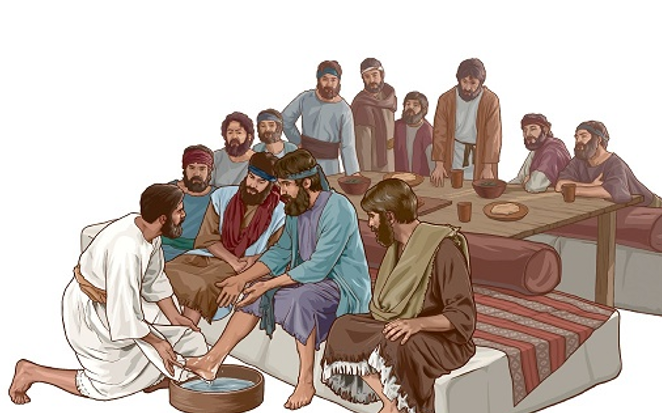
10 Take the lead in showing honor to others. (Read Romans 12:10.) Jesus set the pattern in honoring others by performing the lowliest of tasks. (John 13:3-5, 12-15) We may have to work hard to develop the humility needed to show honor to others in this way. Even the apostles could not fully understand Jesus’ actions until they received holy spirit. (John 13:7) We can show honor to others by not thinking too much of ourselves because of our education, material possessions, or privileges in Jehovah’s service. (Rom. 12:3) And rather than envying those who receive praise, we rejoice with them even if we feel that we deserve equal honor or a share of the credit for what was done.

What other spiritual gems have you discovered in this week’s Bible reading?

*** w18 January pp. 29-30 par. 11 See the Difference in People ***
11 In contrast with the people who show the widespread lack of love today, those who worship Jehovah have genuine love for their fellow man. This has always been true. Jesus said that love of neighbor, a form of a·gaʹpe, was the second most important commandment in the Mosaic Law, second only to love of God. (Matt. 22:38, 39) Jesus also said that love for one another would be the quality that would identify true Christians. (Read John 13:34, 35.) Such Christian love would even be extended to one’s enemies.—Matt. 5:43, 44.

*** w18 July p. 26 par. 15 We Belong to Jehovah ***
15 Our appreciation for Jehovah’s special friendship is shown in how we treat fellow worshippers. They too belong to Jehovah. If we never lose sight of that fact, we will always treat our brothers and sisters with kindness and love. (1 Thess. 5:15) Jesus said to his followers: “By this all will know that you are my disciples—if you have love among yourselves.”—John 13:35.

*** w18 August p. 28 Patience—Endurance With a Purpose ***
We can develop patience by examining and imitating Jesus’ perfect example. In harmony with that example, the apostle Paul under inspiration described “the new personality,” which includes “patience,” and then he urged us to “let the peace of the Christ rule in [our] hearts.” (Col. 3:10, 12, 15) We can let such peace “rule” in our hearts by imitating Jesus’ unbreakable faith that in His due time, God will correct matters that concern us. When we follow Jesus’ example, we will not be provoked into losing our patience, no matter what may be happening around us.—John 14:27; 16:33.

*** w18 September p. 4 par. 5 “If You Know These Things, Happy You Are if You Do Them” ***
5 Putting divine instruction into practice is essentially what wisdom means. (Ps. 107:43) The reward for wisdom is worth the effort. “Nothing you desire can compare to it. . . . It is a tree of life to those who take hold of it, and those who keep firm hold of it will be called happy.” (Prov. 3:13-18) Jesus said: “If you know these things, happy you are if you do them.” (John 13:17) The disciples’ happiness would last if they kept doing what Jesus instructed them to do. They did not embrace his teachings and example simply as an immediate response on that one occasion. It became their way of life.

*** wp17 No. 1 p. 15 Is It Just a Small Misunderstanding? ***
2. The Bible is directed to people who honestly want God’s help to understand it. Jesus showed that people would need help to understand fully what he taught. How would they receive it? Jesus explained: “The helper, the holy spirit, which the Father will send in my name, that one will teach you all things.” (John 14:26) So God provides his holy spirit—his powerful active force—to help people understand what they read in the Bible. However, God withholds his spirit from people who do not rely on him to help them, so the Bible often seems obscure to them. The holy spirit also moves more knowledgeable Christians to come to the aid of those seeking greater understanding.—Acts 8:26-35.

*** w17 January p. 31 par. 17 “These Things Entrust to Faithful Men” ***
17 In the matter of training others to take on increased responsibility, there is no better example than that of Jesus. He knew that his earthly ministry would come to an end and that others would carry on his work. Though his disciples were imperfect, he had confidence in them and told them that they would do works greater than he did. (John 14:12) He trained them thoroughly, and they spread the good news throughout the then-known world.—Col. 1:23.

*** w17 June p. 19 Will You Resolve Conflicts and Promote Peace? ***
Perhaps there is in your congregation a brother whose speech and actions irritate you. Still, you realize that Christ died for that person and you are to show love. (John 13:34, 35; Rom. 5:6-8) So rather than write off any friendship with that one or tend to avoid him, ask yourself: ‘Is my brother doing something that is clearly wrong Scripturally? Is he maliciously trying to cause me discomfort? Or do we just have different personalities?’ Also, of great importance is the question: ‘Which of his good qualities can I benefit from?’

*** w17 August p. 25 par. 12 How We Put On and Keep On the New Personality ***
12 To remain humble, we need to set aside time to meditate daily on what we read in God’s Word. (Deut. 17:18-20) In particular, we do well to reflect on Jesus’ teachings and his wonderful example of humble service. (Matt. 20:28) Jesus even washed the feet of his apostles. (John 13:12-17) We also need to pray frequently for God’s spirit to help us fight any tendency of feeling superior to others.—Gal. 6:3, 4; Phil. 2:3.

Jesus Is “the Resurrection and the Life”

Jesus Is “the Resurrection and the Life” (Joh 11:25): (15 min.) Discussion. Play the video ‘For a Certainty God Made Him Lord and Christ’—Part II, Excerpt. Then ask the audience the following questions: What does this account teach us about Jesus’ compassion? In what way is Jesus “the resurrection and the life”? What miracles will Jesus perform in the future?

What does this account teach us about Jesus’ compassion?

*** w08 12/1 p. 5 Jesus—The Perfect Model to Follow ***
He was empathetic and compassionate. One of Jesus’ greatest virtues was his ability to put himself in the place of others, to share their feelings, and to respond with helpful action. The apostle John relates that when Jesus saw Mary weeping over the death of her brother, Lazarus, Jesus “groaned in the spirit and became troubled” and “gave way to tears.” Onlookers could easily perceive the great affection Jesus felt for that family, an affection that he was not ashamed to manifest openly. And what compassion he showed when he then brought his friend back to life!—John 11:33-44.

*** w06 5/1 p. 28 par. 6 Loyally Serving Christ the King ***
6 Christ revealed some of his most tender feelings when his dear friend Lazarus died. He was so deeply moved by Mary and Martha’s anguish that he could not restrain a grief-stricken groan, and he “gave way to tears.” He “became troubled”—agitated by great heartache and sorrow—even though he knew that he was shortly going to bring Lazarus back to life. Then, moved by love and compassion, Jesus exercised his God-given authority and raised Lazarus from the dead.—John 11:11-15, 33-35, 38-44.

*** we p. 29 A Sure Hope for the Dead ***
The Greek word rendered “groaned” is from a verb (em·bri·maʹo·mai) that signifies to be painfully, or deeply, moved. One Bible scholar notes: “Here it can only mean that such deep emotion seized Jesus that an involuntary groan was wrung from His heart.” The expression translated “troubled” comes from a Greek word (ta·rasʹso) that indicates agitation. According to a lexicographer, it means “to cause one inward commotion, . . . to affect with great pain or sorrow.” The expression “gave way to tears” comes from a Greek verb (da·kryʹo) that means “to shed tears, weep silently.”

*** we pp. 29-30 A Sure Hope for the Dead ***
The response of Jesus to Lazarus’ death reveals a very tender side of the Son of God. His deep feelings on this occasion clearly indicate his intense desire to resurrect the dead. We read: “Mary, when she arrived where Jesus was and caught sight of him, fell at his feet, saying to him: ‘Lord, if you had been here, my brother would not have died.’ Jesus, therefore, when he saw her weeping and the Jews that came with her weeping, groaned in the spirit and became troubled; and he said: ‘Where have you laid him?’ They said to him: ‘Lord, come and see.’ Jesus gave way to tears. Therefore the Jews began to say: ‘See, what affection he used to have for him!’”—John 11:32-36.
Jesus’ heartfelt compassion is here indicated by three expressions: “groaned,” “became troubled,” and “gave way to tears.” The original-language words used in recording this touching scene indicate that Jesus was so deeply moved by the death of his dear friend Lazarus and the sight of Lazarus’ sister weeping that His eyes brimmed over with tears.
What is so remarkable is that Jesus had previously brought two others back to life. And he fully intended to do the same with Lazarus. (John 11:11, 23, 25) Yet, he “gave way to tears.” Restoring humans to life, then, is not a mere procedure for Jesus. His tender and deep feelings as manifested on this occasion clearly indicate his intense desire to undo the ravages of death.

*** w18 November pp. 29-30 Kindness—A Quality Expressed in Word and Action ***
To please God fully, we must develop kindness as a permanent part of our personality and way of life. For this reason, Jehovah tells us to “clothe” ourselves with kindness. (Col. 3:12) Admittedly, though, we do not always find it easy to make this godly quality a part of us. Why not? We may hold back from showing kindness because of shyness, insecurity, opposition, or lingering traces of selfishness. Nevertheless, we can overcome such difficulties by relying on holy spirit and by imitating Jehovah’s pattern of kindness.—1 Cor. 2:12.
Can we identify areas wherein we need to improve in showing kindness? We should ask ourselves: ‘Am I an empathetic listener? Am I alert to the needs of others? When was the last time I was kind to someone who is not a family member or a close friend?’ Then we can set goals, such as getting to know more about the people around us, especially in the Christian congregation. In this way we can become alert to their circumstances and their needs. Next, we should try to show kindness to others in ways that we would appreciate receiving it if we were in their place. (Matt. 7:12) Finally, Jehovah will bless our efforts to cultivate kindness if we ask him for help.—Luke 11:13.

*** w17 September pp. 11-12 Imitate Jehovah’s Compassion ***
CULTIVATING AND SHOWING APPROPRIATE COMPASSION
12 Be helpful in everyday life. Showing compassion for one’s neighbor and Christian brothers is a basic requirement of those who strive to imitate Jesus. (John 13:34, 35; 1 Pet. 3:8) One meaning of compassion is “to suffer together.” A person who shows compassion is moved to relieve others’ suffering, perhaps by helping them out of their difficulties. Seek opportunities to do so! For example, could you help someone by offering to perform a necessary chore, maybe running an errand for him?—Matt. 7:12.
13 Share in relief work. The sufferings of those struck by disasters move many to manifest compassion. Jehovah’s people are known for coming forward to help in such times of need. (1 Pet. 2:17) One Japanese sister lived in an area that was seriously damaged by the earthquake and tsunami of 2011. She says that she was “very encouraged and comforted” by the efforts of the many volunteers from elsewhere in Japan and from overseas to repair property damage. She writes: “This experience helped me to realize that Jehovah cares. And fellow Witnesses care about one another. Many brothers and sisters all over the world are praying for us.”
14 Assist the sick and the elderly. When we see others experiencing the effects of Adamic sin, we are rightly moved to show compassion. We long to see sickness and aging brought to an end. So we pray for God’s Kingdom to come. In the meantime, we do what we can to assist those in need. Consider what one author wrote about his elderly mother, who suffered from Alzheimer’s disease. One day, she soiled her clothes. As she was trying to clean up, the doorbell rang. The visitors turned out to be two Witnesses who regularly called on the woman. The sisters asked if there was anything they could do to help. “It is embarrassing but yes,” the woman replied. The visitors helped her to clean up. Then they made her a cup of tea and stayed for a chat. The son was most grateful. “Hats off to these Witnesses,” he wrote. “They practice what they preach.” Does your compassion for the sick and the elderly move you to do all you can to lessen their suffering?—Phil. 2:3, 4.
15 Help people spiritually. People’s problems and worries move us to want to help them spiritually. The best way we can do that is by teaching them about God and about what his Kingdom will do for mankind. Another way is by helping them to see the wisdom of living by godly standards. (Isa. 48:17, 18) Could you increase the share you are having in the ministry, a work that truly honors Jehovah and manifests your compassion for others?—1 Tim. 2:3, 4.
COMPASSION IS GOOD FOR YOU TOO!
16 Mental-health experts say that practicing compassion can improve your health, well-being, and relationships. When you relieve the suffering of others, you will feel happier, more optimistic, less lonely, and less inclined to think negative thoughts. Yes, your showing compassion will benefit you. (Eph. 4:31, 32) Christians who lovingly seek to help others are rewarded with a good conscience, knowing that they are acting in harmony with godly principles. Having such a disposition makes for a more caring parent, a better spouse, and a better friend. Those who are quick to show compassion are, in turn, more likely to receive help and support when they need it.—Read Matthew 5:7; Luke 6:38.
17 Knowing that compassion is good for you should not be your main reason for wanting to cultivate it. The principal reason should be your desire to imitate and glorify the Source of love and compassion, Jehovah God. (Prov. 14:31) He sets the perfect example for us. May we do all we can, then, to imitate him—to promote warm affection among our brothers and good relations with our neighbors by showing compassion.—Gal. 6:10; 1 John 4:16.

In what way is Jesus “the resurrection and the life”?

*** w89 5/1 p. 8 The Resurrection Hope ***
However, Jesus gives hope for immediate relief, replying: “I am the resurrection and the life.” He reminds Martha that God has given him power over death, saying: “He that exercises faith in me, even though he dies, will come to life; and everyone that is living and exercises faith in me will never die at all.”
Jesus is not suggesting to Martha that faithful ones then alive will never die. No, but the point he is making is that exercising faith in him can lead to everlasting life. Such life will be enjoyed by most people as a result of their being resurrected on the last day. But others who are faithful will survive the end of this system of things on earth, and for these Jesus’ words will be true in a very literal sense. They will never die at all! After this remarkable statement, Jesus asks Martha, “Do you believe this?”

What miracles will Jesus perform in the future?

*** w14 10/1 pp. 5-7 God’s Kingdom—What It Means to Jesus ***
Jesus, of course, knew that the relief he offered then was only temporary. He realized that sooner or later, all whom he healed would get sick again and all whom he resurrected would die again. However, Jesus also knew that God’s Kingdom would bring a permanent end to such problems. That is why Jesus did not just perform miracles; he also zealously declared “the good news of the Kingdom.” (Matthew 9:35) His miracles demonstrated on a small scale what God’s Kingdom will soon do earth wide. Consider what the Bible promises regarding that time.
No more health problems.
“At that time the eyes of the blind will be opened, and the ears of the deaf will be unstopped. At that time the lame will leap like the deer, and the tongue of the speechless will shout for joy.” Additionally, “no resident will say: ‘I am sick.’”—Isaiah 33:24; 35:5, 6.
No more death.
“The righteous will possess the earth, and they will live forever on it.”—Psalm 37:29.
“He will swallow up death forever, and the Sovereign Lord Jehovah will wipe away the tears from all faces.”—Isaiah 25:8.
Those who have died will return to life.
“All those in the memorial tombs will hear his voice and come out.”—John 5:28, 29.
“There is going to be a resurrection.”—Acts 24:15.
No more homelessness or unemployment.
“They will build houses and live in them, and they will plant vineyards and eat their fruitage. They will not build for someone else to inhabit, nor will they plant for others to eat. . . . The work of their hands my chosen ones will enjoy to the full.”—Isaiah 65:21, 22.
No more war.
“He is bringing an end to wars throughout the earth.”—Psalm 46:9.
“Nation will not lift up sword against nation, nor will they learn war anymore.”—Isaiah 2:4.

No more food shortages.
“The earth will give its produce; God, our God, will bless us.”—Psalm 67:6.
“There will be an abundance of grain on the earth; on the top of the mountains it will overflow.”—Psalm 72:16.
No more poverty.
“The poor will not always be forgotten.”—Psalm 9:18.
“He will rescue the poor who cry for help, also the lowly one and whoever has no helper. He will have pity on the lowly and the poor, and the lives of the poor he will save.”—Psalm 72:12, 13.
When you consider those promises regarding God’s Kingdom, can you see why the Kingdom means so much to Jesus? While on earth, he was eager to talk about God’s Kingdom to anyone who would listen, for he knew that the Kingdom would bring an end to all the distressing problems we see today.

Digging for Spiritual Gems:John 11-12 (Week October 8-14)


Joh 11:49—Who appointed Caiaphas as high priest, and for how long did he hold this office? (“high priest” study note on Joh 11:49, nwtsty)
high priest: When Israel functioned as an independent nation, the high priest held his office for life. (Nu 35:25) However, during the Roman occupation of Israel, the rulers assigned by Rome had authority to appoint and to depose the high priest. (See Glossary, “High priest.”) Caiaphas, appointed by the Romans, was a skillful diplomat who held his office longer than any of his immediate predecessors. He was appointed about 18 C.E. and remained in office until about 36 C.E. By saying that Caiaphas was high priest that year, that is, in 33 C.E., John apparently meant that Caiaphas’ term as high priest included the memorable year in which Jesus was executed.—See App. B12 for the possible location of Caiaphas’ house.

Joh 12:42—Why were some Jews afraid to acknowledge Jesus as the Christ? (“the rulers,” “expelled from the synagogue” study notes on Joh 12:42, nwtsty)
the rulers: Here the Greek word for “rulers” apparently refers to members of the Jewish high court, the Sanhedrin. The term is used at Joh 3:1 with reference to Nicodemus, a member of that court.—See study note on Joh 3:1.
expelled from the synagogue: Or “excommunicated; banned from the synagogue.” The Greek adjective a·po·sy·naʹgo·gos is used only here and at Joh 12:42 and 16:2. An expelled person would be shunned and scorned as a social outcast. Such cutting off of fellowship from other Jews would have severe economic consequences for the family. The synagogues, which were used primarily for education, to some extent were also used as places for local courts that had the power to inflict the penalties of scourging and excommunication.—See study note on Mt 10:17.

What has this week’s Bible reading taught you about Jehovah?

*** wp18 No. 3 p. 13 God Will Soon End All Suffering ***
Death: That Jehovah has the power to undo death is clearly shown by the three resurrections Jesus is recorded to have performed. One of those whom he brought back to life had been dead for four days.—Mark 5:35-42; Luke 7:11-16; John 11:3-44.

*** w18 June p. 11 par. 16 May We All Be One as Jehovah and Jesus Are One ***
16 Clearly, the apostles did learn from Jesus’ example to love “all sorts of men.” (John 12:32; 1 Tim. 4:10) Although it took time, they adjusted their way of thinking. The early Christians gained a reputation of loving one another. Tertullian, a second-century writer, quoted non-Christians as saying: “They love one another . . . They are ready even to die for one another.” Putting on “the new personality,” the early Christians came to view all people as equal in the sight of God.—Col. 3:10, 11.

*** wp17 No. 4 p. 6 What the Bible Says About Life and Death ***
WHERE ARE THE DEAD?
Simply put, the Bible says that the dead are in the grave, awaiting the resurrection. (John 5:28, 29) They are not suffering or in any kind of pain, for “the dead know nothing at all.” (Ecclesiastes 9:5) In his teachings, Jesus likened death to a deep sleep. (John 11:11-14) Thus, we have no need to fear those who have fallen asleep in death or to appease them by making offerings to them. They can neither help nor harm us, because “there is no work nor planning nor knowledge nor wisdom in the Grave.” (Ecclesiastes 9:10) By means of the resurrection, however, God will do away with death forever.—1 Corinthians 15:26, 55; Revelation 21:4.

*** w17 February p. 10 par. 10 The Ransom—A “Perfect Present” From the Father ***
10 What about the billions of people who died without ever having an opportunity to know and serve Jehovah? The ransom makes possible the resurrection of the dead. Our loving heavenly Father will bring them back to life and give them an opportunity to learn about his purpose and to gain everlasting life. (Acts 24:15) Jehovah wants people to live, not die. As the Source of life, he becomes the Father of everyone who is resurrected. (Ps. 36:9) How appropriate, therefore, that Jesus taught us to pray: “Our Father in the heavens.” (Matt. 6:9) Jehovah has given Jesus an important share in resurrecting the dead. (John 6:40, 44) In Paradise, Jesus will fulfill his role as “the resurrection and the life.”—John 11:25.

*** w17 December pp. 3-4 pars. 1-2 “I Know He Will Rise” ***
JESUS’ close friend and disciple Martha was grieving. Her brother, Lazarus, had died. Could anything ease her sorrow? Yes. Jesus assured her: “Your brother will rise.” That may not have erased all her sadness; yet, Martha accepted Jesus’ assurance. She said: “I know he will rise in the resurrection on the last day.” (John 11:20-24) She was sure that would occur in the future. Jesus then performed a miracle. He brought Lazarus back to life that very day.
2 We have no basis to expect that Jesus or his Father will now perform such a miracle for us. Are you, though, just as sure as Martha was of a future resurrection for a loved one? Maybe it is your deceased mate, your mother, your father, or a beloved grandparent. Or you may be grieving over the loss of a child. You long to hug, to speak with, and to laugh with that dear one. Happily, like Martha, you have good reason to say, ‘I know that my loved one will rise in the resurrection.’ Still, it will do each Christian good to reflect on why that is a valid conviction.

*** wp16 No. 1 p. 16 What Does the Bible Say? ***
WHAT ELSE CAN WE LEARN FROM THE BIBLE?
• The Bible often compares death to sleep. (John 11:11-14) God can awaken the dead, just as we can awaken a person from sleep.—Job 14:13-15.
• The Bible records several resurrections, thus giving us a solid basis for believing that the dead will be raised up.—1 Kings 17:17-24; Luke 7:11-17; John 11:39-44.

*** w16 October p. 29 pars. 10, 12 Exercise Your Faith in Jehovah’s Promises ***
10 For example, John explained: “The one who exercises faith in the Son has everlasting life; the one who disobeys the Son will not see life, but the wrath of God remains upon him.” (John 3:36) Christian faith includes a demonstration of obedience to Jesus’ commands. John often quoted Jesus’ words that show that exercising faith is an ongoing process.—John 3:16; 6:29, 40; 11:25, 26; 14:1, 12.
12 We should keep exercising our faith in Jehovah’s promises. We must do this in ways that are clearly evident to others. For example, we keep on preaching about God’s Kingdom and sharing in the work of making disciples. We also keep working “what is good toward all, but especially toward those related to us in the faith.” (Gal. 6:10) And we work hard to “strip off the old personality with its practices,” guarding against anything that could weaken us spiritually.—Col. 3:5, 8-10.

*** w15 1/1 p. 14 Should We Pray to Jesus? ***
HIS EXAMPLE: In line with the way he taught others to pray, Jesus personally prayed: “I publicly praise you, Father, Lord of heaven and earth.” (Luke 10:21) On another occasion, “Jesus raised his eyes heavenward and said: ‘Father, I thank you that you have heard me.’” (John 11:41) And as he was dying, Jesus prayed: “Father, into your hands I entrust my spirit.” (Luke 23:46) In praying to his heavenly Father—the “Lord of heaven and earth”—Jesus set a clear example for all to follow. (Matthew 11:25; 26:41, 42; 1 John 2:6) Is that how Jesus’ early disciples understood his instructions?

*** w15 4/15 p. 22 par. 13 How Real Is Your Relationship With Jehovah? ***
13 Consider this: From his prehuman existence, Jesus observed firsthand Jehovah’s response to the prayers of His human servants. Then, during his earthly ministry, Jesus used prayer as his means of communicating his feelings to his Father in heaven. Would he have done so—even spending an entire night in prayer—had he thought that Jehovah was not really listening? (Luke 6:12; 22:40-46) Would he have taught his disciples to pray had he thought that prayer was nothing more than a psychological crutch? Clearly, Jesus knew that prayer is real communication with Jehovah. On one occasion, Jesus said: “Father, I thank you that you have heard me. True, I knew that you always hear me.” We too can have confidence that Jehovah is the “Hearer of prayer.”—John 11:41, 42; Ps. 65:2.

What other spiritual gems have you discovered in this week’s Bible reading?

*** w18 May p. 26 par. 16 Know Your Enemy ***
16 Satan and the demons have other limitations. For example, nowhere do the Scriptures indicate that they can read the mind or heart of an individual. Only Jehovah and Jesus are spoken of as having that ability. (1 Sam. 16:7; Mark 2:8) What, though, about speaking or praying out loud? Should we fear that the Devil or the demons might hear our prayers and interfere? The answer is no. Why not? We are not afraid to do good works in Jehovah’s service just because the Devil might see us. Likewise, we should not be afraid to pray out loud just because the Devil might hear us. In fact, the Bible contains many examples of God’s servants who prayed out loud, and there is no hint that these ones feared that the Devil would hear them. (1 Ki. 8:22, 23; John 11:41, 42; Acts 4:23, 24) If we do our best to speak and act in harmony with God’s will, we can be confident that Jehovah will not allow the Devil to do us any lasting harm.—Read Psalm 34:7.

*** w18 June p. 7 par. 13 “My Kingdom Is No Part of This World” ***
13 When religion is mixed with politics, violence can easily erupt. Jesus taught his disciples that they must maintain neutrality in these circumstances. That is related to the reason why the chief priests and the Pharisees planned to kill Jesus. They saw him as a political and religious rival who threatened their position. “If we let him go on this way, they will all put faith in him, and the Romans will come and take away both our place and our nation,” they said. (John 11:48) Thus, High Priest Caiaphas took the lead in plotting Jesus’ death.—John 11:49-53; 18:14.

*** w18 July pp. 10-11 par. 15 Whose Recognition Do You Seek? ***
15 Jesus did not crave to be honored by the religious or political leaders of his day. But how encouraged he must have been when Jehovah acknowledged him on three separate occasions by speaking directly from heaven. Just after Jesus’ baptism in the Jordan River, Jehovah said: “This is my Son, the beloved, whom I have approved.” (Matt. 3:17) Evidently, John the Baptist was the only other person who heard those words. Then, about a year before Jesus’ death, three of his apostles heard Jehovah say about Jesus: “This is my Son, the beloved, whom I have approved. Listen to him.” (Matt. 17:5) Finally, just a few days before Jesus’ death, Jehovah again spoke to his Son from heaven.—John 12:28.

*** wp17 No. 3 p. 8 The Four Horsemen—Who Are They? ***
When Jesus lived on earth, he provided a heartwarming preview of future conditions under his rulership. He promoted peace, miraculously fed thousands, cured the sick, and even raised the dead to life again.—Matthew 12:15; 14:19-21; 26:52; John 11:43, 44.

*** w17 May pp. 8-9 par. 3 Helping the Children of “Foreign Residents” ***
3 Parents, your example is essential to start your children on the path to endless life. When your children see you “seeking first the Kingdom,” they learn to depend on Jehovah for their daily needs. (Matt. 6:33, 34) So live modestly. Sacrifice material things for spiritual benefits—not the other way around. Strive to stay out of debt. Seek “treasure in heaven”—Jehovah’s approval—and not riches or “the glory of men.”—Read Mark 10:21, 22; John 12:43.

*** w17 July pp. 13-14 pars. 9-10 “Weep With Those Who Weep” ***
9 When Jesus embarked on his ministry, it was with a remarkable depth of insight and fellow feeling. Take, for example, the time when his dear friend Lazarus died. Even though Jesus knew that he was going to resurrect Lazarus, he felt the painful sting of sorrow that overwhelmed Mary and Martha. He was so moved that a surge of strong empathetic feeling cut him to the heart and brought him to tears.—John 11:33-36.
10 How can Jesus’ expressions of sympathy and consolation help us today? The Scriptures reassure us that “Jesus Christ is the same yesterday and today, and forever.” (Heb. 13:8) Since “the Chief Agent of life” personally understands what it is like to feel grief, “he is able to come to the aid of those who are being put to the test.” (Acts 3:15; Heb. 2:10, 18) Therefore, we can be confident that Christ continues to be moved by the anguish of others, to understand their grief, and to provide them consolation “at the right time.”—Read Hebrews 4:15, 16.

*** w16 July p. 16 par. 11 Why Must We “Keep on the Watch”? ***
11 The Devil is lulling people into spiritual apathy. Shortly before his death, Jesus three times warned his disciples about “the ruler of this world.” (John 12:31; 14:30; 16:11) Jesus knew that the Devil would keep people in darkness mentally in order to undermine the sense of urgency that permeates God’s prophecies about the future. (Zeph. 1:14) Satan blinds people’s minds through the world empire of false religion. What have you detected in your conversations with others? Has the Devil not already “blinded the minds of the unbelievers” about the coming end of this system of things and the fact that Christ is now ruling God’s Kingdom? (2 Cor. 4:3-6) How often do you hear people say, “I’m not interested”? For the most part, they are apathetic when we try to tell them where this world is headed.

*** w15 2/15 p. 8 par. 12 Imitate Jesus’ Humility and Tenderness ***
12 How did Jesus show tenderness? His tender feelings and actions. Jesus felt tender compassion for others. When he saw his friend Mary and those with her weeping over the death of her brother, Lazarus, Jesus openly “gave way to tears.” (Read John 11:32-35.) Then, likely stirred by heartfelt pity—just as when he raised a widow’s son—he resurrected Lazarus. (Luke 7:11-15; John 11:38-44) By means of that tender act, Jesus may have put Lazarus in line to receive life in heaven. On an earlier occasion, Jesus “felt tender affection” for a crowd that came to him. Impelled by compassion, “he started to teach them many things.” (Mark 6:34; Kingdom Interlinear) What a life-changing experience that was for any who responded to his teachings! Note that Jesus’ tenderness was more than a feeling; it moved him to take the initiative to help others.—Matt. 15:32-38; 20:29-34; Mark 1:40-42.

*** w15 5/15 p. 16 par. 10 You Can Fight Satan—And Win! ***
10 Satan is “the ruler of this world,” and it is lying in his power. (John 12:31; 1 John 5:19) Therefore, much of what this world promotes runs counter to the standards set forth in the Bible. Of course, not everything the world offers is evil. However, we should expect that Satan would use his world to exploit our desires and try to induce us to sin or to develop love for the world and neglect our worship of Jehovah.—Read 1 John 2:15, 16.

*** w15 6/15 pp. 11-12 par. 13 He Loved People ***
13 Jesus’ heart was touched by the pain of others. Deeply moved by others’ reaction to the death of his friend Lazarus, Jesus “groaned” and “became troubled.” He felt that way even though he knew that he would shortly bring Lazarus back to life. (Read John 11:33-36.) Jesus was not ashamed to manifest strong emotions. Onlookers could see the affection Jesus felt for Lazarus and his family. What compassion Jesus showed by using his God-given power to bring his friend back to life!—John 11:43, 44.

*** w15 8/15 pp. 29-30 What We Can Learn From Joanna ***
Neither Jesus nor his apostles did secular work during their preaching tours. Hence, they probably did not have the means to pay for all the food and other things needed by a group of perhaps 20 people. Although they may have been received hospitably, the fact that Christ and his apostles carried a “money box” suggests that they did not always rely on hospitality. (John 12:6; 13:28, 29) Joanna and the other women may have made contributions to cover expenses.

Sample Conversations – Initial Call 09-2018 (Transcript)

●○○ INITIAL CALL

Question: How do we know that our suffering is not punishment from God?
Scripture: Jas 1:13
Link: Why do we suffer?
Good morning My name is Francesco and he is Claudio, what’s his name?
Dario.
I’m glad to meet you. Today we are talking about a question that many are asked about God.
About God? I know that I no longer believe in God.
What could I say now? Apparently he once believed in God. I remember that the watchtower said that in the face of many tragedies they find it hard to believe in God. Well rather than making assumptions about why he no longer believes in God, I could try to make him express . He is not the only one wondering if God exists or not. But can I ask you a question? It has long been asked whether God exists?
Watch once I believed in God, I was raised like this. But then everything went wrong. My mother got sick, and my father left us. We were my brother and I, and we took care of our mother until she died.
I’m really sorry Dario.
Yes me too. In some ways I can understand it. My family has gone through a situation similar to hers.
I do not understand precisely because God has done all this to us. We are good people, we went to church every Sunday. We never hurt anyone.
I can assure you, that he is not the only one to feel these feelings. Many people try to understand, because bad things happen. The answer of the Bible will surprise you, in fact today we are here for this. We wanted to answer the question with the Bible, why can we say that our sufferings are not a punishment from God?
Yes, really?
Sure! Look at what we read here in James chapter 1 verse 13: “No one, when he faces a trial, says: ‘I am tested by God’, because with the evils God can not be tested nor let anyone test.” Notice the first part of the verse. When we face difficulties in life, we may think that God is testing us. But, are things really like that? Look at the second part of the verse. Do you agree that if God exists, can he not be tested with evil?
Well yes, it would be impossible!
I agree! And then look at the concluding part of the verse. What do you say about encouraging?
That God does not test us with evil?
That’s right. Sure! At this point one wonders, if it is not God who makes us suffer, then why do we suffer? The next time we see together, the main reason we suffer.
All right.

Digging for Spiritual Gems: John 9-10 (Week October 1-7)

Joh 9:38:  In what sense did the formerly blind beggar do obeisance to Jesus? (“did obeisance to him” study note on Joh 9:38, nwtsty) “bowed down to him; prostrated himself to him; paid him homage.” When the Greek verb pro·sky·neʹo (pros-koo-neh’-o); is used to refer to the rendering of worship to a god or a deity, it is translated “to worship.” (Mt 4:10; Lu 4:8) In this context, however, the healed man, who was born blind, recognized Jesus as God’s representative and did obeisance to him. He viewed him, not as God or a deity, but as the foretold “Son of man,” the Messiah with divine authority. (Joh 9:35) When he bowed down to Jesus, he apparently did so in a way similar to that of people mentioned in the Hebrew Scriptures. They bowed down when meeting prophets, kings, or other representatives of God. (1Sa 25:23, 24; 2Sa 14:4-7; 1Ki 1:16; 2Ki 4:36, 37) On many occasions, the obeisance done to Jesus expressed a gratitude for divine revelation or evidence of divine favor.—See study notes on Mt 2:2; 8:2; 14:33; 15:25.

Joh 10:22:  What was the Festival of Dedication? (“the Festival of Dedication” study note on Joh 10:22, nwtsty) The Hebrew name of this festival is Hanukkah (chanuk·kahʹ), meaning “Inauguration; Dedication.” It was held for eight days, beginning on the 25th day of the month of Chis-lev, close to the winter solstice, to commemorate the rededication of Jerusalem’s temple in 165 B.C.ESyrian King Antiochus IV Epiphanes had shown his contempt for Jehovah, the God of the Jews, by desecrating His temple. For example, he built an altar on top of the great altar, where formerly the daily burnt offering had been presented. On Chislev 25, 168 B.C.E., to defile Jehovah’s temple completely, Antiochus sacrificed swine on the altar and had the broth from its flesh sprinkled all over the temple. Heburned the temple gates, pulled down the priests’ chambers, and carried away the golden altar, the table of showbread, and the golden lampstand. He then rededicated Jehovah’s temple to the pagan god Zeus of Olympus. Two years later, Judas Maccabaeus recaptured the city and the temple. After the temple was cleansed, the rededication took place on Chislev 25, 165 B.C.E., exactly three years after Antiochus had made his disgusting sacrifice on the altar to Zeus. The daily burnt offerings to Jehovah were then resumed. There is no direct statement in the inspired Scriptures indicating that Jehovah gave Judas Maccabaeus victory and directed him to restore the temple. However, Jehovah had used men of foreign nations, such as Cyrus of Persia, to carry out certain purposes as regards His worship. (Isa 45:1) It is reasonable to conclude, then, that Jehovah might use a man of his dedicated people to accomplish His will. The Scriptures show that the temple had to be standing and operating in order for the prophecies regarding the Messiah, his ministry, and his sacrifice to be fulfilled. Also, the Levitical sacrifices were to be offered until the time when the Messiah would present the greater sacrifice, his life in behalf of mankind. (Da 9:27; Joh 2:17; Heb 9:11-14) Christ’s followers were not commanded to observe the Festival of Dedication. (Col 2:16, 17) However, there is no record that Jesus or his disciples condemned the celebrating of this festival.
What does this week’s Bible reading teach me about Jehovah?

Joh 9:3:  Jehovah has a longing to fix the problems that imperfection has plagued mankind since Adam and Eve sinned. Yes, Jehovah is demonstrated he has the power and wants to heal all. (Isa 33:24, Mic 7:18-19, Acts 2:22)   

Joh 9:33:  Jehovah is the source of power which enables others to perform miracles like Jesus and the apostles did. We are told about this power at Isa 40:26 “Because of his vast dynamic energy and his awe-inspiring power.”
Joh 10:17:   Jehovah is love according to 1Jo 4:8 and as we see here because of Jesus faithfulness, the Father love him. Likewise Jehovah loves all his faithful ones and will remember their deeds and will reward them. (Heb 11:6) 
Joh 10:32:  Jesus show that the “many find works” he did is from his Father Jehovah. So we should praise Jehovah for all the proof that he has the power to fulfill all his promises written for all his faithful servants.
Joh 10:38:  In this context, the Greek preposition en is used to show close association. We see here that Jehovah and Jesus have this close relationship. Jehovah also want to a close relationship with his faithful servants as show “in union with” is the way the preposition is used at Joh 17:20-23, where it occurs five times.
What other spiritual gems have you discovered in this week’s Bible reading?

Joh 9:1-3:  Some who believe in reincarnation suggest this man was born blind, because he sin occurred in a former life. The answer Jesus gave contradicts reincarnation when he said at John 9:3: “Neither this man sinned nor his parents.”

Joh 9:4:  Another scripture that show Jesus is not part of a trinity.  First see that the one who send Jesus gave him work to do and that same one also gave work for those who follow his son. This show Jesus was doing someone else will and work he was assign to do.

Joh 9:4:  Jesus was here talking about the night, which he was referring to the time when he would go into the grave and would no longer be able to perform the marvelous works that he had performed while alive.
Joh 9:15-16, 18:  Lovers of darkness ignore the evidences of a thrilling miracles took place; a man born blind was heal. Instead of expressing joy, they condemned Jesus and said he was a sinner. May we always not let our hearts become so harden that we ignore the light and miss on all Jehovah promise of a happy future.  
Joh 9:22:  Parents had good reason to fear the Jewish religious leaders, who can expelled person and would be shunned and scorned as a social outcast. Such cutting off of fellowship from other Jews would have severe economic consequences for the family. 

Joh 9:30-33:  The Pharisees could not refute the formally blind man reasoning. We know that God does not listen to sinners, that if one is God-fearing, God listen to that one, and never has anyone “opened the eyes of one born blind.” May we use such reasoning from Jehovah’s Word and maybe their eyes will be open and see the truth.
Joh 10:3-5:  Today we know the shepherd voice and listen to it is because we know the truth as Jesus said at John 8:32 ”you will know the truth, and the truth will set you free.” That is why when a stranger come we know not to listen to them for we know Jehovah’s will.
Joh 10:11,15:  We Jesus great love for his sheep and is willingness to lay his life down for them, so they can be freed from sin and death. Jesus has long had a love or fondness for mankind for we are told at Pr 8:31 “. . .I was especially fond of the sons of men,” so he did his Father will even to death.
Joh 10:15:   Another scripture that show Jesus is not part of a trinity. Jesus show that the Father has the knowledge about his and know the person he is and Jesus know his Father, this show two separate individual knowing each other.
Joh 10:16:   Fine Shepherd, Jesus gathers, guides, protects, and feeds the sheep that belong to this fold (also the “little flock” at Lu 12:32) and his other sheep. These become one flock under one shepherd. This word picture emphasizes the unity that Jesus’ followers would enjoy.

Joh 10:17:   Another scripture that show Jesus is not part of a trinity. For we see that the Father show emotion of love toward his Son Jesus. Father is not showing love to himself but to his beloved Son. (Mt 3:17) Also Jesus will receive his life back from the Father.
Joh 10:18:   Another scripture that show Jesus is not part of a trinity. We see Jesus has a Father by the words “my Father.” Also we see that Jesus received a command from his Father to surrender and receive his live, showing one has more authority over the other.
Joh 10:19-21:  Just as the truth of Jesus cause division in Jesus day, so too in our day. The truth can cause division even in one’s family for we are told at Mt 10:35 “For I came to cause division, with a man against his father, 35 Indeed, a man’s enemies will be those of his own household.” May we be steadfast toward the truth and we will be rewarded. 

Joh 10:24-25:  When a person has preconceived belief about the Christ, they are one who is hard to teach the truth too like the Jewish religious leader here did not believe.  Today many are taught mans thoughts as God’s truth, so many will not listen or teach.      
Joh 10:25:   Another scripture that show Jesus is not part of a trinity. Jesus shows that the work he does is in his Father’s name. Show that Jesus gets his power from another who is greater than he is according to John 14:28.

Joh 10:29:   Another scripture that show Jesus is not part of a trinity. We see Jesus has a Father by the words “my Father.” Also we see no one can snatch these precious sheep out of his Father hand who gave them to Jesus. Two separate individuals one is giving and other is receiving. 

Joh 10:30:   This is not proof of the trinity, for there is no mentioning of the Holy Spirit as being one with the Father and the Son. Also the word one here can also mean unity, which is referring to an oneness of purpose and action is confirmed by comparing the scriptures. (Joh 10:25-29; 17:2, 9-11)
Joh 10:33:  Many Trinitarians to use this scripture as proof that Jesus is God because the religious leaders said so and they know the Bible. Yet they deny believing what they said Jesus at John 10:20 “He has a demon: or John 9:16”Not a man of God.”  What make this thing they are telling truth now and not the others.   
Joh 10:34-35:  Others were call god but that did not make them the true God like Jehovah. Jesus here quotes from Ps 82:6, where the Hebrew word ʼelo·himʹ (gods) is used of men, human judges in Israel. They were “gods” in their capacity as representatives of and spokesmen for God. Also Moses was call God by God at Ex 4:16, and 7:1,The word “God” is a title.    
Joh 10:36-37:  Another scripture that show Jesus is not part of a trinity. We see here the Father sanctified and sent the Son in to the world. Also Jesus claim to be “God’s Son” not God the Son. Also Jesus has a Father when he said “my Father.” 

Digging for Spiritual Gems: John 7-8 (Week September 24-30)

Download pdf format to John 7-8 references here


Joh 7:8-10—Did Jesus lie to his unbelieving fleshly brothers? (w07 2/1 6 ¶4)
What example did Jesus Christ set in this regard? On one occasion, Jesus was conversing with some unbelievers who showed interest in his travel plans. “Pass on over from here and go into Judea,” they advised him. What was Jesus’ reply? “You go up to the festival [in Jerusalem]; I am not yet going up to this festival, because my due time has not yet fully come.” Shortly thereafter, Jesus did travel to Jerusalem for the festival. Why did he answer that way? They were not entitled to know the exact details of his whereabouts. So while Jesus did not utter an untruth, he gave them an incomplete answer in order to limit the possible harm they could do to him or to his followers. This was not a lie, for the apostle Peter wrote about Christ: “He committed no sin, nor was deception found in his mouth.”—John 7:1-13; 1 Peter 2:22.

Joh 8:58—What basis is there for rendering the last expression of this verse “I have been” instead of “I am,” and why is this important? (“I have been” study note on Joh 8:58, nwtsty)
I have been: The opposing Jews wanted to stone Jesus for claiming that he had “seen Abraham,” although, as they said, Jesus was “not yet 50 years old.” (Joh 8:57) Jesus’ response was to tell them about his prehuman existence as a mighty spirit creature in heaven before Abraham was born. Some claim that this verse identifies Jesus with God. They argue that the Greek expression used here, e·goʹ ei·miʹ (rendered “I am” in some Bibles), is an allusion to the Septuagint rendering of Ex 3:14 and that both verses should be rendered the same way. (See study note on Joh 4:26.) In this context, however, the action expressed by the Greek verb ei·miʹ started “before Abraham came into existence” and was still in progress. It is therefore properly translated “I have been” rather than “I am,” and a number of ancient and modern translations use wording similar to “I have been.” In fact, at Joh 14:9, the same form of the Greek verb ei·miʹ is used to render Jesus’ words: “Even after I have been with you men for such a long time, Philip, have you not come to know me?” Most translations use a similar wording, showing that depending on context there is no valid grammatical objection to rendering ei·miʹ as “have been.” (Other examples of rendering a present tense Greek verb using a present perfect tense verb are found at Lu 2:48; 13:7; 15:29; Joh 1:9; 5:6; 15:27; Ac 15:21; 2Co 12:19; 1Jo 3:8.) Also, Jesus’ reasoning recorded at Joh 8:54, 55 shows that he was not trying to portray himself as being the same person as his Father.

What has this week’s Bible reading taught you about Jehovah?

*** wp18 No. 3 p. 10 Suffering—Is It Punishment From God? ***
Some may wonder, does God really use sickness to make people suffer for their sins?
CONSIDER: Why would Jesus heal people who were sick if sickness and suffering were deserved punishments from God? Would that not amount to undermining God’s justice and righteousness? (Matthew 4:23, 24) Jesus would never counteract God’s actions. He said: “I always do the things pleasing to him” and, “I am doing just as the Father has commanded me to do.”—John 8:29; 14:31.
The Bible is clear. Jehovah God “is never unjust.” (Deuteronomy 32:4) For example, God would never cause an airplane disaster, killing hundreds of innocent people, because he wanted to punish someone on board! In harmony with God’s righteousness, Abraham, a faithful servant of God, said that God would never “sweep away the righteous with the wicked.” That would be “unthinkable,” he said. (Genesis 18:23, 25) The Bible also says that “God does not act wickedly”; he does not “do wrong.”—Job 34:10-12.

*** wp18 No. 3 p. 12 Who Is to Blame? ***
3. The Evil Ruler of the World. The Bible clearly identifies the primary cause of human suffering. It states: “The whole world is lying in the power of the wicked one.” (1 John 5:19) That “wicked one” is Satan the Devil, a powerful spirit creature who was originally an angel of God but “did not stand fast in the truth.” (John 8:44) Other spirit creatures joined Satan and rebelled against God in order to pursue selfish desires, thus making themselves demons. (Genesis 6:1-5) Ever since their rebellion, Satan and his demons have exerted a powerful and cruel influence over this world’s affairs. This has been particularly so in our time. Now, the Devil has great anger and “is misleading the entire inhabited earth,” which has resulted in “woe for the earth.” (Revelation 12:9, 12) Indeed, Satan is a brutal dictator. He gets perverse satisfaction from human suffering. It is Satan—not God—who causes people to suffer.
CONSIDER: Only a heartless, diabolical evildoer would cause innocent people to suffer. By contrast, the Bible says: “God is love.” (1 John 4:8) In harmony with his loving personality, “it is unthinkable for the true God to act wickedly, for the Almighty to do wrong!”—Job 34:10.

*** w18 May pp. 18-19 par. 7 Why We “Keep Bearing Much Fruit” ***
7 As to the connection between obedience and love, Jesus earlier said to his apostles: “Whoever has my commandments and observes them is the one who loves me.” (John 14:21) Moreover, by carrying out Jesus’ command to go and preach, we too show our love for God because Jesus’ commandments reflect his Father’s thinking. (Matt. 17:5; John 8:28) In response to our expression of love, Jehovah and Jesus keep us in their love.

*** w18 September p. 7 par. 18 “If You Know These Things, Happy You Are if You Do Them” ***
18 Doing what we know to be right brings rich blessings. No wonder Proverbs 4:7 says that “wisdom is the most important thing”! Although wisdom is based on knowledge, it particularly has to do with the decisions we make rather than just the facts we understand. Even ants reveal wisdom. Ants demonstrate instinctive wisdom by preparing their food in the summer. (Prov. 30:24, 25) Christ, “the wisdom of God,” always does the things pleasing to the Father. (1 Cor. 1:24; John 8:29) God knows the difference between making the right choice and acting on that choice. And he rewards those who demonstrate humility with endurance and who practice what they know to be true. (Read Matthew 7:21-23.) Therefore, work to preserve the spiritual environment in which genuine humility can flourish. Applying what we know to be true takes time and requires patience, but it is a mark of humility that leads to happiness now and forever.

*** wp17 No. 2 p. 12 Escape From Slavery—Then and Now ***
“With Jehovah our God there is no injustice,” says the Bible, and it assures us that he has not changed. (2 Chronicles 19:7; Malachi 3:6) God sent Jesus to “proclaim liberty to the captives . . . , to send the crushed ones away free.” (Luke 4:18) Did this mean freedom for every literal slave? Apparently not. Jesus was sent to liberate people from bondage to sin and death. He later declared: “The truth will set you free.” (John 8:32) Even today, the truth that Jesus taught liberates people in many ways.—See the box “Escape From a Different Kind of Slavery.”

*** wp17 No. 6 p. 6 What Is the Best Gift of All? ***
The gift of God’s only-begotten Son—that would certainly be the greatest gift that any one of us could ever receive, for thereby we can be freed from the bondage to sin, old age, and death. (Psalm 51:5; John 8:34) Try as we may, on our own there is nothing we can do to be released from that bondage. However, in his great love, God provided what is needed to bring about that release. By giving his only-begotten Son, Jesus Christ, as the ransom, Jehovah God gave obedient mankind the prospect of life everlasting. But what exactly is the ransom? Why is it necessary? And how can we benefit from it?

*** w17 September p. 10 par. 9 Imitate Jehovah’s Compassion ***
9 We can learn a lesson from Jesus. He felt compassion for the crowds he met, for “they were skinned and thrown about like sheep without a shepherd.” How did he react to their pitiful state? “He started to teach them many things.” (Matt. 9:36; read Mark 6:34.) His attitude was in stark contrast to that of the Pharisees, who had no desire to help the common people. (Matt. 12:9-14; 23:4; John 7:49) Do you not feel a yearning, similar to what Jesus had, to feed spiritually famished people?

*** w15 4/15 pp. 19-20 par. 2 How Real Is Your Relationship With Jehovah? ***
2 How real to you is your personal relationship with Jehovah? Would you like to strengthen it? James 4:8 tells you how you can do that: “Draw close to God, and he will draw close to you.” Note that this is a two-way process. As we take steps to draw close to God, he takes reciprocating action toward us. This interaction, frequently repeated, progressively strengthens our relationship with Jehovah. As a result, that relationship becomes very real to us. We develop the kind of confidence Jesus had when he said: “The One who sent me is real, and . . . I know him.” (John 7:28, 29) Specifically, though, what steps can you take to draw closer to Jehovah?

What other spiritual gems have you discovered in this week’s Bible reading?

*** w18 February p. 21 par. 12 What Does It Mean to Be a Spiritual Person? ***
12 Yet, of all the people who have lived, who is the most outstanding example of a spiritual person? It is Jesus, of course. Throughout his life and ministry, he showed that he wanted to imitate his Father, Jehovah. He thought, felt, and acted like Jehovah and lived in harmony with God’s will and standards. (John 8:29; 14:9; 15:10) Note, for example, how Jehovah’s feelings of compassion are described by the prophet Isaiah, and compare that description with what the Gospel writer Mark reports about Jesus’ feelings. (Read Isaiah 63:9; Mark 6:34.) Are we like Jesus, ever ready to show compassionate concern when we meet people who need help? In addition, Jesus devoted himself to the work of preaching and teaching the good news. (Luke 4:43) All such feelings and actions are marks of a spiritual person.

*** w18 April p. 7 pars. 14-15 The Way to True Freedom ***
14 In contrast, Jesus Christ pointed out a simple way to enjoy true freedom. He said: “If you remain in my word, you are really my disciples, and you will know the truth, and the truth will set you free.” (John 8:31, 32) Jesus’ direction for gaining true freedom involves two requirements: First, accept the truth that he taught, and second, become his disciple. Doing so will lead to true freedom. But freedom from what? Jesus went on to explain: “Every doer of sin is a slave of sin. . . . If the Son sets you free, you will be truly free.”—John 8:34, 36.
15 Clearly, the freedom that Jesus promised his disciples is far superior to the social or political freedom that most people yearn for today. When Jesus said: “If the Son sets you free, you will be truly free,” he was talking about liberation from the greatest bondage and oppression that humankind has ever experienced—being “a slave of sin.” Not only can sin lead us to doing what is bad but it can also prevent us from doing what we know is right or from living up to what we know we are capable of. In that sense we are slaves of sin, and the outcome is frustration, pain, suffering, and finally death. (Rom. 6:23) The apostle Paul felt this pain and agony deeply. (Read Romans 7:21-25.) It is only when the shackles of sin are thrown off that we can hope to have the true freedom that our first human parents once enjoyed.

*** w18 May p. 28 par. 4 Young Ones—Stand Firm Against the Devil ***
4 Similarly, the truths we learn from God’s Word protect us from the spiritual harm that false teachings cause. (John 8:31, 32; 1 John 4:1) And the more we love divine truths, the easier it is to carry our “breastplate,” that is, to live by God’s righteous standards. (Ps. 111:7, 8; 1 John 5:3) In addition, when we have a clear understanding of the truths from God’s Word, we can confidently stand our ground and defend them against opposers.—1 Pet. 3:15.

*** w18 June p. 9 par. 4 May We All Be One as Jehovah and Jesus Are One ***
4 Jesus himself was subjected to prejudice. When Philip told Nathanael that he had found the Messiah, Nathanael replied: “Can anything good come out of Nazareth?” (John 1:46) Apparently, Nathanael knew of the prophecy at Micah 5:2 and considered Nazareth too insignificant to be the Messiah’s hometown. Similarly, prominent Judeans despised Jesus because he was a Galilean. (John 7:52) Many Judeans viewed the people of Galilee as inferior. Other Jews sought to insult Jesus by calling him a Samaritan. (John 8:48) The Samaritan people were ethnically and religiously distinct from the Jews. Both Judeans and Galileans had little respect for the Samaritans and avoided them.—John 4:9.

*** w18 August pp. 8-9 par. 2 Do Not Judge by the Outward Appearance ***
2 Each day we make judgments about people. Yet, as imperfect humans, we are not able to judge matters perfectly as Jesus does. We tend to be influenced by what appears to our eyes. Nonetheless, when Jesus was on earth, he commanded: “Stop judging by the outward appearance, but judge with righteous judgment.” (John 7:24) Clearly, Jesus wants us to be like him and not judge others by their outward appearance. In this article, we will discuss three areas in which people are frequently influenced by what appears to their eyes: race or ethnicity, wealth, and age. In each area, we will consider practical ways to obey Jesus’ command.

*** w17 January p. 25 par. 12 You Can Remain Modest Under Test ***
12 Modesty helps us always to dress, groom, and comport ourselves in a decent and respectable manner. We realize that we win people’s hearts, not by boasting or drawing undue attention to ourselves, but by displaying a “quiet and mild spirit.” (Read 1 Peter 3:3, 4; Jer. 9:23, 24) Vain sentiments in our hearts will eventually show up in our actions. We might drop hints, for example, implying that we enjoy special privileges, possess inside information, or have special relationships with responsible brothers. Or we might explain things in such a way that only we get the credit for ideas or accomplishments that others also contributed to. Again, Jesus set a wonderful example. A good portion of what he said was either a quotation from or an allusion to the Hebrew Scriptures. He modestly spoke that way so that his hearers would know that what he said was coming from Jehovah and was not the product of his own intellect or wisdom.—John 8:28.

*** w17 July p. 28 Winning the Battle for Your Mind ***
Now if mere men can fool us with their propaganda, what might Satan be able to do? He has studied human behavior since man was created. “The whole world” now lies in his power. He can use any part of it to disseminate his lies. (1 John 5:19; John 8:44) So effective has Satan been in ‘blinding people’s minds’ that he now ‘misleads the entire inhabited earth.’ (2 Cor. 4:4; Rev. 12:9) How can you resist his propaganda?

*** w16 September p. 29 par. 6 Parents, Help Your Children Build Faith ***
6 As a teacher, Jesus reached hearts because he loved Jehovah, God’s Word, and people. (Luke 24:32; John 7:46) Similar love will help parents reach the hearts of their children. (Read Deuteronomy 6:5-8; Luke 6:45.) So parents, be good students of the Bible and of our study aids. Take an interest in creation and in articles in our publications that discuss this topic. (Matt. 6:26, 28) Your doing so will broaden your knowledge, deepen your appreciation for Jehovah, and better equip you to teach your young ones.—Luke 6:40.

*** w15 10/15 p. 32 “The Naive Person Believes Every Word” ***
Today it is possible to spread news—true or false, useful or worthless, harmless or dangerous—at an incredible speed. Anyone who sends an e-mail or a text to even one person has to realize that whether it was intended or not, the content could travel all over the world in a flash. May we therefore resist the urge to forward information quickly and indiscriminately. When we read sensational news items, remember that love is not unduly suspicious; nor is it naive or gullible. Above all, love refuses to believe malevolent insinuations about Jehovah’s organization or lies about our brothers that are circulated by people who are slaves to “the father of the lie,” Satan the Devil. (John 8:44; 1 Cor. 13:7) Thinking ability and discernment will help us become “shrewd” and consider how to handle responsibly the increasing amount of information available to us on a daily basis. As the Bible says, “the naive will inherit foolishness, but the shrewd are crowned with knowledge.”—Prov. 14:18.