Tag Archives: Treasures from God’s Word

Pure Worship Requires Cleanness


TREASURES FROM GOD’S WORD | LEVITICUS 14-15

Pure Worship Requires Cleanness

15:13-15, 28-31

To remain in God’s love, we need to be clean on the inside as well as on the outside. This means that we adhere faithfully to Jehovah’s standards of physical, moral, and spiritual cleanness, regardless of how the world around us acts. We refrain from touching anything that our heavenly Father views as unclean.

Collage: Scenes depicting the world’s uncleanness. 1. A clergyman prays over soldiers. 2. A clergywoman performs a marriage ceremony between two men. 3. A nativity scene and a Christmas tree on display in a bustling shopping mall.

How do I benefit from rejecting this world’s ungodliness?

Learn From the Laws on Leprosy


TREASURES FROM GOD’S WORD | LEVITICUS 12-13

Learn From the Laws on Leprosy

13:4, 5, 45, 46, 52, 57

What can the principles behind the laws on leprosy teach us about protecting our spiritual health?

  • Jehovah taught the priests how to identify leprosy quickly. Christian shepherds today are quick to give attention to any who require spiritual assistance.​—Jas 5:14, 15

  • Israelites had to destroy any items infected with leprosy to prevent further contamination. Christians too must be willing to give up even something precious to them rather than allowing it to lead them into sin. (Mt 18:8, 9) This may include such things as habits, associations, or entertainment

A woman firmly rejecting and walking away from her former lifestyle of overdrinking alcohol.

How can a Christian show a firm desire to accept Jehovah’s help?

Love for Jehovah Stronger Than Love for Family


High Priest Aaron standing in the tabernacle courtyard. Two of Aaron’s cousins carry the corpses of Nadab and Abihu on stretchers outside of the camp.

TREASURES FROM GOD’S WORD | LEVITICUS 10-11

Love for Jehovah Stronger Than Love for Family

10:1, 2, 4-7

Nadab and Abihu carrying fire holders filled with burning incense.

Our loyalty to Jehovah can be greatly tested when a loved one is disfellowshipped. Jehovah’s instruction to Aaron provides a clear message to those who must cut off association with a disfellowshipped relative. Our love for Jehovah must be stronger than our love for unfaithful family members.

What blessings can come to those who work along with Jehovah’s instructions regarding disfellowshipped ones?​—1Co 5:11; 2Jo 10, 11

DISCUSSIONS:

\”Despite our pain of heart, we must avoid normal contact with a disfellowshipped family member by telephone, text messages, letters, e-mails, or social media.\” Watchtower 2017 Oct p.16

“A conflict of loyalties may arise when a close relative is disfellowshipped. For example, a sister named Anne received a telephone call from her disfellowshipped mother. The mother wanted to visit Anne because she felt pained by her isolation from the family. Anne was deeply distressed by the plea and promised to reply by letter. Before writing, she reviewed Bible principles. (1 Cor. 5:11; 2 John 9-11) Anne wrote and kindly reminded her mother that she had cut herself off from the family by her wrongdoing and unrepentant attitude. “The only way you can relieve your pain is by returning to Jehovah,” Anne wrote.” Watchtower 2016 Feb p.29

\”Are you personally proving yourself holy with regard to not associating with family members or others who have been disfellowshipped?\” Watchtower 2014 Nov 15 p.14

\”Really, what your beloved family member needs to see is your resolute stance to put Jehovah above everything else – including the family bond. … Do not look for excuses to associate with a disfellowshipped family member, for example, through e-mail.\”

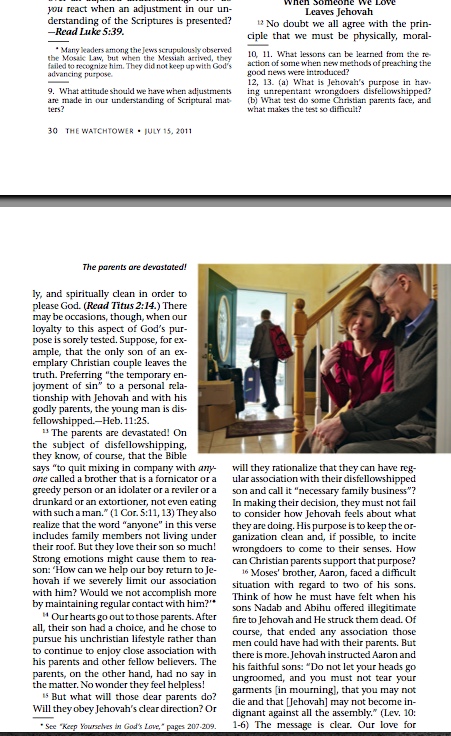
\”Suppose, for example, that the only son of an exemplary Christian couple leaves the truth. Preferring \”the temporary enjoyment of sin\” to a personal relationship with Jehovah and with his godly parents, the young man is disfellowshipped. … the Bible says \”to quit mixing in company with anyone called a brother that is a fornicator. … They also realise that the word \”anyone\” in this verse includes family members not living under their roof. … Our hearts go out to those parents. After all, their son had a choice, and he chose to pursue his unchristian lifestyle rather than to continue to enjoy close association with his parents and other fellow believers. The parents, on the other hand, had no say in the matter. … But what will those dear parents do? Will they obey Jehovah\’s clear direction? Or will they rationalize that they can have regular association with the disfellowshipped son and call it, \”necessary family business\”? In making their decision, they must not fail to consider how Jehovah feels about what they are doing. … Today, Jehovah does not immediately execute those who violate his laws. He lovingly gives them an opportunity to repent from their unrighteous works. How would Jehovah feel, though, if the parents of an unrepentant wrongdoer kept putting Him to the test by having unnecessary association with their disfellowshipped son or daughter?\” Watchtower 2011 Jul 15 p.31p.32

Evidence of Jehovah’s Blessing


                                          meetingBOX
                                          Treasures from God\’s Word 
                                          Living As Christians 
                                          Life and Ministry Meeting Workbook

TREASURES FROM GOD’S WORD | LEVITICUS 8-9

Evidence of Jehovah’s Blessing

8:6-9, 12; 9:1-5, 23, 24

Jehovah caused fire to consume the first burnt offering of the newly installed Aaronic priesthood. This demonstrated Jehovah’s support and approval of this arrangement. Jehovah thus encouraged the assembled nation of onlookers to give the priesthood its full support. Today, Jehovah is using the glorified Jesus Christ as the greater High Priest. (Heb 9:11, 12) In 1919, Jesus appointed a small group of anointed men as “the faithful and discreet slave.” (Mt 24:45) What evidence is there that the faithful slave has Jehovah’s blessing, support, and approval?

  • Despite relentless persecution, the faithful slave has continued to supply spiritual food

  • As prophesied, the good news is being preached “in all the inhabited earth.”​—Mt 24:14

How can we give the faithful and discreet slave our full support?

Collage: 1. The glorified Jesus Christ rules over the earth. 2. The faithful and discreet slave meets together to supply spiritual food. 3. A brother preaches the good news to a man.

Give Jehovah Your Best


                                          meetingBOX
                                          Treasures from God\’s Word 
                                          Living As Christians 
                                          Life and Ministry Meeting Workbook

Collage: Jehovah accepts various types of offerings from the Israelites. 1. Fine flour. 2. A dove. 3. A sheep is brought by a family to a priest.

TREASURES FROM GOD’S WORD | LEVITICUS 4-5

Give Jehovah Your Best

5:5-7, 11

Poverty denied no one in Israel the privilege of making peace with Jehovah. Even the poorest Israelites could give Jehovah an acceptable offering, as long as it was their best. They could offer flour, but Jehovah still expected it to be “fine,” the kind used for honored guests. (Ge 18:6) Today, Jehovah accepts our best “sacrifice of praise,” regardless of how much our personal circumstances may limit what we can give.​—Heb 13:15.

How can this encourage you if you cannot do all that you did before, perhaps because of declining health or stamina?

Collage: Two sisters giving their best ‘sacrifice of praise’ to Jehovah. 1. A sister serving in a foreign-language field talks to a woman at the market. 2. An older sister writes letters from her home.

Find Enjoyment in All Your Hard Work


                                          meetingBOX
                                          Treasures from God\’s Word 
                                          Living As Christians 
                                          Life and Ministry Meeting Workbook

TREASURES FROM GOD’S WORD | ECCLESIASTES 1-6

Find Enjoyment in All Your Hard Work

Jehovah wants us to enjoy our work and teaches us how to do so. A person can learn to enjoy work if he approaches it with the right attitude.

You can find enjoyment in your work when you . . .

  • A man enjoys his work
    cultivate a positive attitude
  • A man thinks about how his work helps others
    think about how your work helps others
  • A man has a meal with his family
    do your best at work, but when you leave your job, you focus on your family and your worship

Moses Carefully Followed Instructions


                                          meetingBOX
                                          Treasures from God\’s Word 
                                          Living As Christians 
                                          Life and Ministry Meeting Workbook

TREASURES FROM GOD’S WORD | EXODUS 39-40

Moses Carefully Followed Instructions

39:32, 43; 40:1, 2, 16

Moses conscientiously followed Jehovah’s detailed instructions for the construction and setting up of the tabernacle. We should likewise listen to any instructions we receive from Jehovah’s organization and obey promptly and wholeheartedly. This is true even if it does not seem important to follow them or we do not understand the reason for the instructions.​—Lu 16:10.

Why should we listen to and carefully follow instructions . . .

  • during meetings for field service?

  • regarding preparing for medical emergencies?

  • about disaster preparedness?

Collage: Brothers and sisters following instructions they have received. 1. A group meets for field service outside on a porch. 2. A sister records her medical decisions on a legal document. 3. A family puts emergency supplies into a go bag.

Tabernacle Altars and Their Role in True Worship

The tabernacle with coverings pulled back showing the interior and framework. Next to it are the copper basin and the altar of burnt offering.


                                          meetingBOX
                                          Treasures from God\’s Word 
                                          Living As Christians 
                                          Life and Ministry Meeting Workbook

TREASURES FROM GOD’S WORD | EXODUS 37-38

Tabernacle Altars and Their Role in True Worship

The tabernacle altars were built according to Jehovah’s instructions and had special significance.
  • The incense altar.
    Like the burning of skillfully blended incense, acceptable prayers offered up by Jehovah’s servants are pleasing to him
  • The altar of burnt offering.
    Jehovah accepted sacrifices made on the altar of burnt offering. Its location in front of the sanctuary reminds us that faith in the ransom sacrifice of Jesus is necessary for acceptance by God.​—Joh 3:16-18; Heb 10:5-10
How can we prepare our prayers as incense before God?​—Ps 141:2

Equipped to Do Jehovah’s Work

Bezalel and Oholiab crafting items of gold for the tabernacle. One man hammers fine details into a cherub’s wing, and the other hammers out a sheet of gold.


                                          meetingBOX
                                          Treasures from God\’s Word 
                                          Living As Christians 
                                          Life and Ministry Meeting Workbook

TREASURES FROM GOD’S WORD | EXODUS 35-36

Equipped to Do Jehovah’s Work

Jehovah’s holy spirit equipped Bezalel and Oholiab to carry out the detailed plans for the tabernacle. Jehovah’s powerful holy spirit is also available to his servants today. How can we benefit from it?
  • We must pray for holy spirit to heighten any abilities we have in Jehovah’s service
  • We must diligently feed on God’s inspired Word
  • We should pour our heart into any assignment we are given
Collage: Jehovah’s Witnesses handling various theocratic assignments. 1. Sisters help with construction work. 2. A brother prepares to conduct a ‘Watchtower’ Study lesson. 3. A brother preaches to a shopkeeper as the brother’s witnessing partner watches for opposers. 4. A couple attends the School for Kingdom Evangelizers.
For what assignments can Jehovah equip you?

*** w63 5/1 pp. 274-275 pars. 13-15 Using Theocratic Assets ***

13 Natural abilities and aptitudes are a great blessing. Some are gifted in art and music. Others have quick minds and strong bodies and have been able to train themselves for specialized activities. Natural abilities should not be taken for granted, but are qualities given in trust by God to be used to his praise. They can benefit your fellow Christians and build up the congregation or organization. Frequently work must be done in Kingdom Halls or at conventions of Jehovah’s witnesses. What better way could there be of using natural abilities than for the honor of Jehovah and the blessing of his servants? Natural abilities make men of the world puff up with pride, but not so the humble Christian who compares himself with Christ Jesus, the perfect man. Whether a Christian is a doctor, lawyer, engineer, farmer, artist or mechanic, he will find ways of using his talents for the advancement of God’s work. That is a part of Christian dedication. Never be stingy in giving of your natural abilities for the advancement of theocratic interests.—Ex. 35:30-35.

14 Knowledge, power of reasoning, being quick to discern the meaning of God’s Word and God’s principles—these will all be useful for his benefit and that of others. All who are diligent to attend regular study meetings for consideration of God’s purposes are bound to increase in knowledge and power of reasoning, but the value of things learned is to be judged by how they can be used. Paul impressed upon Timothy, at 2 Timothy 2:1, 2: “You, therefore, my child, keep on acquiring power in the undeserved kindness that is in connection with Christ Jesus, and the things you heard from me with the support of many witnesses, these things commit to faithful men, who, in turn, will be adequately qualified to teach others.” And, indeed, unselfish use of knowledge gained is a source of great joy and happiness.

15 The assets so far mentioned are more valuable than finances and material resources. Among the rich people of the world finances often appear to be a liability rather than an asset. This is not surprising in view of what Jesus said in Matthew 19:24: “Again I say to you, It is easier for a camel to get through a needle’s eye than for a rich man to get into the kingdom of God.” Did that mean that finances or material resources prevent all men from getting into God’s kingdom? Jesus’ statement raised a question: “Who really can be saved?” He answered: “With men this is impossible, but with God all things are possible.” (Matt. 19:25, 26) A young man had asked what he must do to get everlasting life. He was keeping all the laws of God, but lacked one thing: He did not want to dedicate his all to Jehovah’s work of helping the poor learn the truth, becoming a follower of Jesus in this work; so he went away grieved because of his many possessions. In the world many who are rich become arrogant, feel independent and seek exaltation, but this does not mean none could learn the truth and dedicate their assets to serving God. Evidently some wealthy persons did become Christians, because Paul told Timothy: “Give orders to those who are rich in the present system of things not to be high-minded, and to rest their hope, not on uncertain riches, but on God, who furnishes us all things richly for our enjoyment; to work at good, to be rich in fine works, to be liberal, ready to share, safely treasuring up for themselves a fine foundation for the future, in order that they may get a firm hold on the real life.”—1 Tim. 6:17-19.


Jehovah’s Endearing Qualities


                                          meetingBOX
                                          Treasures from God\’s Word 
                                          Living As Christians 
                                          Life and Ministry Meeting Workbook

TREASURES FROM GOD’S WORD | EXODUS 33-34

Jehovah’s Endearing Qualities

Appreciation for Jehovah’s qualities helped Moses to deal patiently with the Israelites. Similarly, if we deepen our understanding of Jehovah’s qualities, we can deal mercifully with fellow believers.
  • “Merciful and compassionate”: Jehovah looks after his worshippers with tender love and deep concern, just as parents look after their children
  • “Slow to anger”: Jehovah is patient with his servants, putting up with their shortcomings and giving them time to make changes
  • “Abundant in loyal love”: Jehovah forges an unfailing bond of loyal love with his people
Collage: Jehovah’s Witnesses imitating Jehovah’s qualities. 1. Two elders visit a family at their home and share Bible-based encouragement with them. 2. A sister comforts a sister who is crying.
ASK YOURSELF, ‘How can I imitate Jehovah’s mercy and compassion?’

*** w17 September p. 8 par. 1 Imitate Jehovah’s Compassion ***

ON ONE occasion, God revealed himself to Moses by declaring His own name and qualities. The first ones that he listed were mercy and compassion. (Read Exodus 34:5-7.) Jehovah could have stressed his power or his wisdom. Yet, to Moses, who was seeking reassurance of God’s backing, Jehovah emphasized instead qualities that underscore his willingness to help his servants. (Ex. 33:13) Do you not find it heartwarming that God mentioned these endearing traits ahead of any others? This article will focus on the quality of compassion, a sympathetic awareness of another’s suffering or adversity coupled with a desire to lessen it.


*** w09 5/1 p. 18 par. 6 When Jehovah Described Himself ***

Another great truth that Jehovah wants us to know about himself is that he pardons “error and transgression and sin.” (Verse 7) He is “ready to forgive” repentant sinners. (Psalm 86:5) At the same time, Jehovah never condones badness. He explains that “by no means will he give exemption from punishment.” (Verse 7) The holy and just God will not leave willful sinners unpunished. Sooner or later the consequences of their sinful behavior will catch up with them.


*** w82 4/15 p. 29 Meaning Well Is Not Enough! ***

Our Creator, Jehovah God, is balanced. At all times his actions harmonize perfectly with his four cardinal qualities of wisdom, justice, power and love. For instance, this can be seen by the description God gave of himself when his servant Moses asked to see His glory. After having been told that no one could see Him and yet live, Moses heard a voice describing God as follows: “Jehovah, Jehovah, a God merciful and gracious, slow to anger and abundant in loving-kindness and truth, preserving loving-kindness for thousands, pardoning error and transgression and sin.” But did Jehovah let matters go at that? No, lest some should presume on Jehovah’s mercy and loving-kindness. Fittingly, Moses heard these balancing words: “But by no means will he [Jehovah] give exemption from punishment.”—Exodus 34:6, 7.