Tag Archives: Treasures from God’s Word

How Can You Imitate the Nazirites?

 TREASURES FROM GOD’S WORD

How Can You Imitate the Nazirites?

Nazirites practiced self-denial (Nu 6:2-4it-2 477)
Special Vows. The person taking this special vow was “to live as a Nazirite [that is, dedicated, separated] to Jehovah” and not for the plaudits of men due to a showy display of fanatical asceticism. Rather, “all the days of his Naziriteship he is holy to Jehovah.”​—Nu 6:2, 8; compare Ge 49:26, ftn.
The requirements laid on Nazirites, therefore, had special significance and meaning in the worship of Jehovah. Like the high priest who, because of his holy office, was to touch no dead body, not even that of one of his closest relatives, so too the Nazirite. The high priest and the underpriests, because of the serious responsibility of their offices, were forbidden to drink wine or intoxicating liquor when performing their sacred duties before Jehovah.​—Le 10:8-11; 21:10, 11.
Nazirites were submissive to Jehovah’s will (Nu 6:5)
Furthermore, the Nazirite (Heb., na·zirʹ) “should prove holy by letting the locks of the hair of his head grow,” such serving as a crowning sign by which all could quickly recognize his holy Naziriteship. (Nu 6:5) The same Hebrew word na·zirʹ was used in regard to the “unpruned” vines during the sacred Sabbath and Jubilee years. (Le 25:5, 11
Nazirites remained clean before Jehovah (Nu 6:6, 7)
Interesting too is the fact that the gold plate on the front of the turban of the high priest, engraved with the words “Holiness belongs to Jehovah,” was called “the holy sign of dedication [Heb., neʹzer, from the same root as na·zirʹ].” (Ex 39:30, 31) Likewise, the official headpiece, or diadem, worn by Israel’s anointed kings was also called a neʹzer. (2Sa 1:10; 2Ki 11:12; see CROWNDEDICATION.)

Full-time servants today show a spirit of self-sacrifice and submission to Jehovah and his arrangements.

Collage: Brothers and sisters in the full-time service. 1. Two pioneer brothers preach to a man on a donkey. 2. A brother and sister perform construction work.

                                   DONATE BUTTON 

The Service of the Levites

 See Also Related Articles:

And Also Related Articles:

                                          meetingBOX
                                          Treasures from God\’s Word 
                                          Living As Christians 
                                          Life and Ministry Meeting Workbook

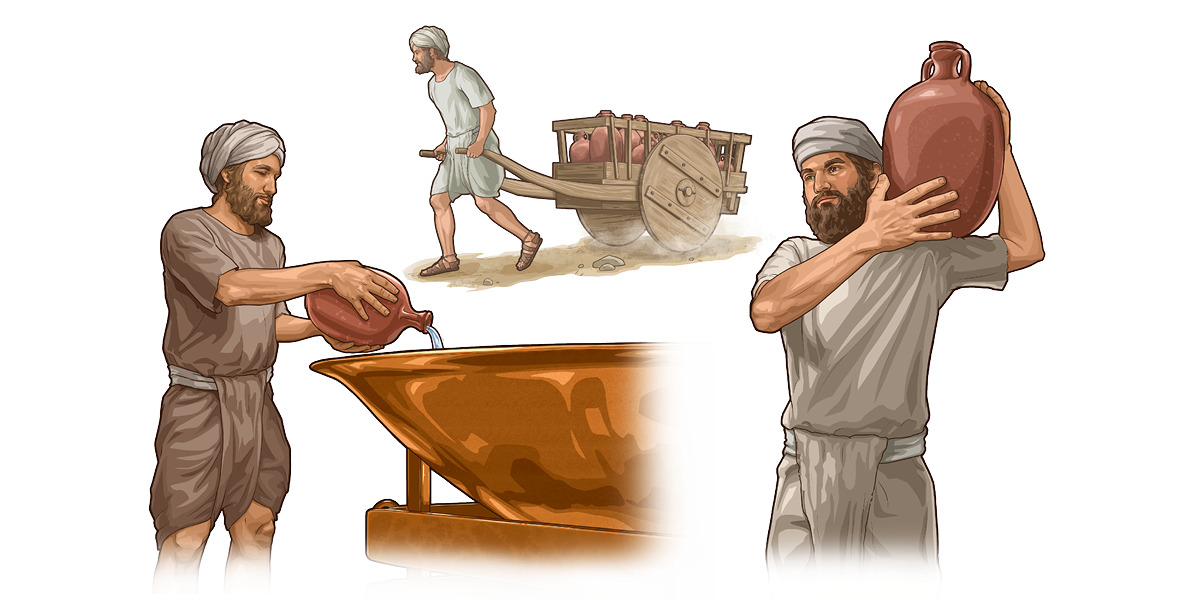
Collage: Levites performing various duties. 1. A Levite pours water into the copper basin. 2. A Levite pulls a wagon filled with clay jars. 3. A Levite carries a clay jar on his shoulder.

 TREASURES FROM GOD’S WORD

The Service of the Levites

Jehovah took the Levites in place of the firstborn males of Israel (Nu 3:11-13it-2 683 ¶3)
Evidently the family heads acted as priests among the offspring of Jacob (Israel) until the Levitical priesthood was established by God. Hence, when God led the people to Mount Sinai he commanded: “Let the priests also who regularly come near to Jehovah sanctify themselves, that Jehovah may not break out upon them.” (Ex 19:22) This was before the Levitical priesthood was established. But Aaron, though not yet designated as priest, was allowed to go partially up the mountain with Moses. This circumstance harmonized with the later appointment of Aaron and his posterity as priests. (Ex 19:24) Seen in retrospect, this was an early indication that God had in mind a superseding of the old arrangement (of family-head priesthood) by means of a priesthood of Aaron’s house.
The Levites enjoyed precious privileges (Nu 3:25, 26, 31, 36, 37it-2 241)
Duties. The Levites were made up of three families, from Levi’s sons Gershon (Gershom), Kohath, and Merari. (Ge 46:11; 1Ch 6:1, 16) Each of these families was assigned a place near the tabernacle in the wilderness. The Kohathite family of Aaron camped in front of the tabernacle to the east. The other Kohathites camped on the south side, the Gershonites on the west, and the Merarites on the north. (Nu 3:23, 29, 35, 38) Setting up, dismantling, and carrying the tabernacle was the work of the Levites. When it was time to move, Aaron and his sons took down the curtain dividing the Holy from the Most Holy and covered the ark of the testimony, the altars, and other sacred furniture and utensils. The Kohathites then carried these things. The Gershonites transported the tent cloths, coverings, screens, courtyard hangings, and tent cords (evidently the cords of the tabernacle itself), and the Merarites took care of the panel frames, pillars, socket pedestals, tent pins and cords (cords of the courtyard surrounding the tabernacle).​—Nu 1:50, 51; 3:25, 26, 30, 31, 36, 37; 4:4-33; 7:5-9.
The Levites cared for their full duties between 30 and 50 years of age (Nu 4:46-48it-2 241)
In Moses’ day it was at 30 years of age that a Levite assumed his full duties, such as bearing the tabernacle and its articles when it was being moved. (Nu 4:46-49) Some duties could be performed from the age of 25, but apparently not the laborious service, such as transporting the tabernacle. (Nu 8:24) In King David’s time the age was reduced to 20 years. The reason David gave was that the tabernacle (now to be replaced by the temple) would no longer have to be carried about. Assignments of obligatory service terminated at the age of 50 years. (Nu 8:25, 26; 1Ch 23:24-26; see AGE.) The Levites needed to be well versed in the Law, often being called upon to read it in public and to teach it to the common people.​—1Ch 15:27; 2Ch 5:12; 17:7-9; Ne 8:7-9.

The males in Aaron’s family performed priestly duties. The rest of the Levites assisted them. Likewise, in the Christian congregation today, some responsible men care for weighty spiritual concerns, while others care for necessary routine matters.

A young brother carefully checks the congregation’s literature order. An older brother observes him and smiles.

                                   DONATE BUTTON 

Jehovah Organizes His People

And Also Related Articles:

                                          meetingBOX
                                          Treasures from God\’s Word 
                                          Living As Christians 
                                          Life and Ministry Meeting Workbook


TREASURES FROM GOD’S WORD

Jehovah Organizes His People

[Play the video Introduction to Numbers.]

The Israelites camped according to three-tribe divisions (Nu 1:52, 53w94 12/1 9 ¶4)
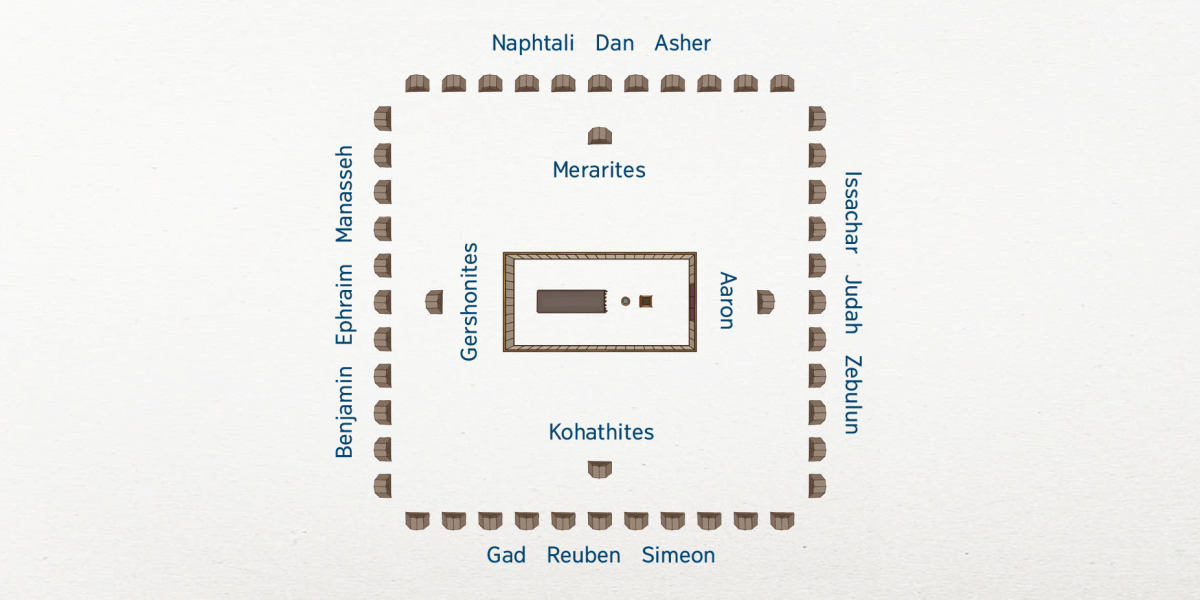
If you had had a bird’s-eye view of Israel encamped in the wilderness, what would you have seen? A vast, but orderly, array of tents housing possibly three million or more people, grouped according to three-tribe divisions to the north, south, east, and west. Peering closer, you would also have noticed another grouping nearer the middle of the camp. These four smaller clusters of tents housed the families of the tribe of Levi. At the very center of the camp, in an area cordoned off by a cloth wall, was a unique structure. This was the “tent of meeting,” or tabernacle, which “wise-hearted” Israelites had built according to Jehovah’s plan.​—Numbers 1:52, 53; 2:3, 10, 17, 18, 25; Exodus 35:10.
The Israelite camp may have totaled 3,000,000 or more (Nu 2:32, 33it-1 397 ¶4)
Out and beyond the Levitical tents, the 12 tribes camped in a quadrilateral arrangement oriented by the four points of the compass. It appears that the people in general were removed a considerable distance from the tabernacle; some commentators suggest some 900 m (3,000 ft), because there was to be a distance of “about two thousand cubits” between the people and the ark of the covenant when the crossing of the Jordan began. (Jos 3:4) The 12 tribes were divided into four grand divisions, each called by the name of the central tribe of the division. So the three-tribe division to the E of the tabernacle was called Judah, with Issachar on the one side of Judah and Zebulun on the other side. (Nu 2:3-8) When this arrangement was set up in 1512 B.C.E., this three-tribe division of Judah numbered 186,400 able-bodied males 20 years old and up. (Nu 1:1-3; 2:9) Clockwise to the S was the three-tribe division of Reuben, with Simeon and Gad alongside Reuben, and numbering 151,450 men of war. (Nu 2:10-16) These two divisions on the E and S, together with the Levites, were Jacob’s descendants by Leah and her handmaid Zilpah. (Ge 35:23, 26) Incidentally, with both Reuben and the Kohathites camping S of the sanctuary, the physical association between the Reubenite rebels Dathan and Abiram and the Kohathite Korah is explained. (Nu 16:1) Around to the W was the three-tribe division of Ephraim, flanked by Manasseh and Benjamin, all descendants of Rachel, and numbering 108,100 army men. (Nu 2:18-24) Finally, on the N was the three-tribe division of Dan, associated with Asher and Naphtali, and totaling 157,600 fighting men. (Nu 2:25-31) Dan and Naphtali were descendants of Rachel’s handmaid Bilhah, but Asher was of Leah’s maidservant Zilpah.​—Ge 35:25, 26.

Jehovah wants his people to worship him in an organized way. That was true for the nation of Israel, and it is true for us today.​—1Co 14:33, 40.

An overhead view of the layout of the camp of Israel. The tabernacle is at the center. Closest to the tabernacle are the families of the tribe of Levi: Aaron to the east, the Kohathites to the south, the Gershonites to the west, and the Merarites to the north. The 12 tribes of Israel are farther away. To the east are Issachar, Judah, and Zebulun. To the south are Gad, Reuben, and Simeon. To the west are Benjamin, Ephraim, and Manasseh. To the north are Naphtali, Dan, and Asher.

ASK YOURSELF, ‘How can I show my complete support for Jehovah’s organization?’

                                   DONATE BUTTON 

How to Receive Jehovah’s Blessing


See Also Related Articles:

                                          meetingBOX
                                          Treasures from God’s Word 
                                          Living As Christians 
                                          Life and Ministry Meeting Workbook


TREASURES FROM GOD’S WORD

How to Receive Jehovah’s Blessing

Reject worthless gods (Le 26:1w08 4/15 4 ¶8)

How can “Riches” become like a god? Well, as an example, think of a stone lying in a field in ancient Israel. Such a stone could be useful for the construction of a house or a wall. On the other hand, if it was set up as “a sacred pillar” or as “a showpiece,” it became a stumbling block to Jehovah’s people. (Lev. 26:1) Similarly, money has its place. We need it just to survive, and we can use it well in Jehovah’s service. (Eccl. 7:12; Luke 16:9) But if we place the pursuit of money ahead of our Christian service, money becomes, in effect, a god to us. (Read 1 Timothy 6:9, 10.) In this world, where the pursuit of financial gain is so important to people, we have to make sure that we keep a balanced view in this matter.​—1 Tim. 6:17-19.
Worship Jehovah as he directs (Le 26:2it-1 223 ¶3)

Because of the manner in which Jehovah used Moses and dealt with him, Moses exercised great awesomeness (Heb., moh·raʼʹ) before the eyes of God’s people. (De 34:10, 12; Ex 19:9) Those with faith had a wholesome fear of Moses’ authority. They realized that God spoke by means of him. Regarding Jehovah’s sanctuary, too, the Israelites were to be in awe. (Le 19:30; 26:2) This meant that they were to manifest a reverent regard for the sanctuary, carrying out worship in the manner that Jehovah directed and conducting themselves in harmony with all of his commands.
Obey his commandments (Le 26:3, 12w91 3/1 17 ¶10)
10 Jehovah told the nation: “If you continue walking in my statutes and keeping my commandments and you do carry them out, I shall also certainly give your showers of rain at their proper time, and the land will indeed give its yield, and the tree of the field will give its fruit. And I will put peace in the land, and you will indeed lie down, with no one making you tremble; and I will make the injurious wild beast cease out of the land, and a sword will not pass through your land. And I shall indeed walk in the midst of you and prove myself your God, and you, on your part, will prove yourselves my people.” (Leviticus 26:3, 4, 6, 12) Israel could enjoy peace in that they had security from their enemies, material abundance, and a close relationship with Jehovah. But this would depend on their adhering to Jehovah’s Law.​—Psalm 119:165.

Israelites who faithfully tried to keep Jehovah’s laws enjoyed peace with him and many other blessings.

A couple happily engaging in public witnessing while passersby are shopping and driving expensive cars.

Which of the following do you now enjoy because of Jehovah’s blessing?

  • Accurate knowledge of the Bible

  • Peace of mind

  • Happy family life

  • Hope for the future


                                    DONATE BUTTON 

                      
             DONATE BUTTON 

</scri

from Blogger http://meekspaceng.blogspot.com/2021/02/how-to-receive-jehovahs-blessing.html

How to Receive Jehovah’s Blessing

And Also Related Articles:

                                          meetingBOX
                                          Treasures from God\’s Word 
                                          Living As Christians 
                                          Life and Ministry Meeting Workbook

TREASURES FROM GOD’S WORD

How to Receive Jehovah’s Blessing

Reject worthless gods (Le 26:1w08 4/15 4 ¶8)

How can “Riches” become like a god? Well, as an example, think of a stone lying in a field in ancient Israel. Such a stone could be useful for the construction of a house or a wall. On the other hand, if it was set up as “a sacred pillar” or as “a showpiece,” it became a stumbling block to Jehovah’s people. (Lev. 26:1) Similarly, money has its place. We need it just to survive, and we can use it well in Jehovah’s service. (Eccl. 7:12; Luke 16:9) But if we place the pursuit of money ahead of our Christian service, money becomes, in effect, a god to us. (Read 1 Timothy 6:9, 10.) In this world, where the pursuit of financial gain is so important to people, we have to make sure that we keep a balanced view in this matter.​—1 Tim. 6:17-19.
Worship Jehovah as he directs (Le 26:2it-1 223 ¶3)

Because of the manner in which Jehovah used Moses and dealt with him, Moses exercised great awesomeness (Heb., moh·raʼʹ) before the eyes of God’s people. (De 34:10, 12; Ex 19:9) Those with faith had a wholesome fear of Moses’ authority. They realized that God spoke by means of him. Regarding Jehovah’s sanctuary, too, the Israelites were to be in awe. (Le 19:30; 26:2) This meant that they were to manifest a reverent regard for the sanctuary, carrying out worship in the manner that Jehovah directed and conducting themselves in harmony with all of his commands.
Obey his commandments (Le 26:3, 12w91 3/1 17 ¶10)
10 Jehovah told the nation: “If you continue walking in my statutes and keeping my commandments and you do carry them out, I shall also certainly give your showers of rain at their proper time, and the land will indeed give its yield, and the tree of the field will give its fruit. And I will put peace in the land, and you will indeed lie down, with no one making you tremble; and I will make the injurious wild beast cease out of the land, and a sword will not pass through your land. And I shall indeed walk in the midst of you and prove myself your God, and you, on your part, will prove yourselves my people.” (Leviticus 26:3, 4, 6, 12) Israel could enjoy peace in that they had security from their enemies, material abundance, and a close relationship with Jehovah. But this would depend on their adhering to Jehovah’s Law.​—Psalm 119:165.

Israelites who faithfully tried to keep Jehovah’s laws enjoyed peace with him and many other blessings.

A couple happily engaging in public witnessing while passersby are shopping and driving expensive cars.

Which of the following do you now enjoy because of Jehovah’s blessing?

  • Accurate knowledge of the Bible

  • Peace of mind

  • Happy family life

  • Hope for the future


                                   DONATE BUTTON 

The Jubilee Year and Future Liberty


 See Also Related Articles:

See Also Related Articles:

                                          meetingBOX
                                          Treasures from God\’s Word 
                                          Living As Christians 
                                          Life and Ministry Meeting Workbook

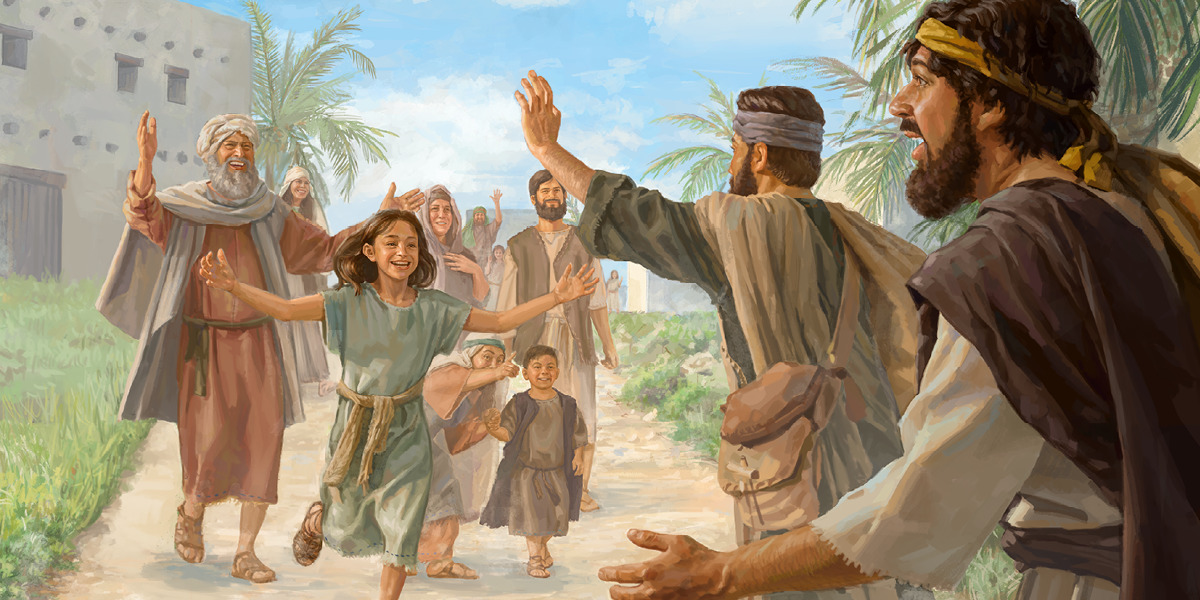
Israelite slaves joyfully greeting their families as they return home during the Jubilee.

Israelite slaves return to their family and land during the Jubilee

 TREASURES FROM GOD’S WORD

The Jubilee Year and Future Liberty

The Jubilee year helped to prevent endless debt and poverty in Israel (Le 25:10it-1 871; see cover picture)
The God of Freedom. Jehovah is the God of freedom. He freed the nation of Israel from bondage in Egypt. He told them that as long as they obeyed his commandments they would have freedom from want. (De 15:4, 5) David spoke of “freedom from care” within the dwelling towers of Jerusalem. (Ps 122:6, 7) However, the Law provided that in case a man became poor he could sell himself into slavery so as to provide the necessities for himself and his family. But freedom was granted by the Law to this Hebrew in the seventh year of his servitude. (Ex 21:2) In the Jubilee (occurring every 50th year), liberty was proclaimed in the land to all its inhabitants. Every Hebrew slave was freed, and each man was returned to his land inheritance.​—Le 25:10-19.
The sale of land was essentially a lease based on the value of crops the land would produce (Le 25:15it-1 1200 ¶2)
Hereditary lands. The inheritance of the sons of Israel was given to them by Jehovah, who outlined the boundaries of the land to Moses. (Nu 34:1-12; Jos 1:4) The sons of Gad, the sons of Reuben, and half of the tribe of Manasseh were granted their allotment of territory by Moses. (Nu 32:33; Jos 14:3) The rest of the tribes received their inheritance by lot at the direction of Joshua and Eleazar. (Jos 14:1, 2) In harmony with Jacob’s prophecy at Genesis 49:5, 7, Simeon and Levi were not given a separate section of territory as inheritance. Simeon’s territory consisted of land (along with enclave cities) inside the territory of Judah (Jos 19:1-9), while Levi was granted 48 cities throughout the entire territory of Israel. Since the Levites received the appointment to special service at the sanctuary, Jehovah was said to be their inheritance. They received the tithe as their portion or inheritance in return for their service. (Nu 18:20, 21; 35:6, 7) Families were given assignments within the territory of their tribe. As families would increase and sons would inherit, the land would be progressively divided up into smaller and smaller parcels.
Jehovah blessed his people when they obeyed the law of the Jubilee year (Le 25:18-22it-2 122-123)
The wonderful provision of the Jubilee year can better be appreciated when one considers not only the beneficial results to the individual Israelites but especially the effect on the nation as a whole. When the Jubilee arrangement was properly observed, the nation was restored in the Jubilee year to the full and proper theocratic state that God purposed and established at the beginning. Government was on a sound basis. The national economy would always be stable, and the nation would have no crushing debt. (De 15:6) The Jubilee brought about a stable standard of land values and also prevented a great internal debt and its resultant false prosperity that brings inflation, deflation, and business depression.
The Jubilee law, when obeyed, preserved the nation from gravitating to the sad state that we observe today in many lands, where there are virtually only two classes, the extremely rich and the extremely poor. The benefits to the individual strengthened the nation, for none would be underprivileged and crushed into unproductiveness by a bad economic situation, but all could contribute their talents and abilities to the national welfare. With Jehovah providing blessings of the yield of the ground and with the education that was provided, Israel, while obedient, would enjoy the perfect government and prosperity that only the true theocracy could provide.​—Isa 33:22.

In the near future, faithful humans will enjoy the full benefits of the symbolic Jubilee when they are completely liberated from sin and death.​—Ro 8:21.

Collage: People transforming the earth into a paradise. 1. Cleaning up debris. 2. Building houses and walkways. 3. Cultivating gardens.

What must each of us do to receive the freedom that Jehovah has promised?

                                   DONATE BUTTON 

Seasonal Festivals With Meaning for Us

And Also Related Articles:

                                          meetingBOX
                                          Treasures from God\’s Word 
                                          Living As Christians 
                                          Life and Ministry Meeting Workbook

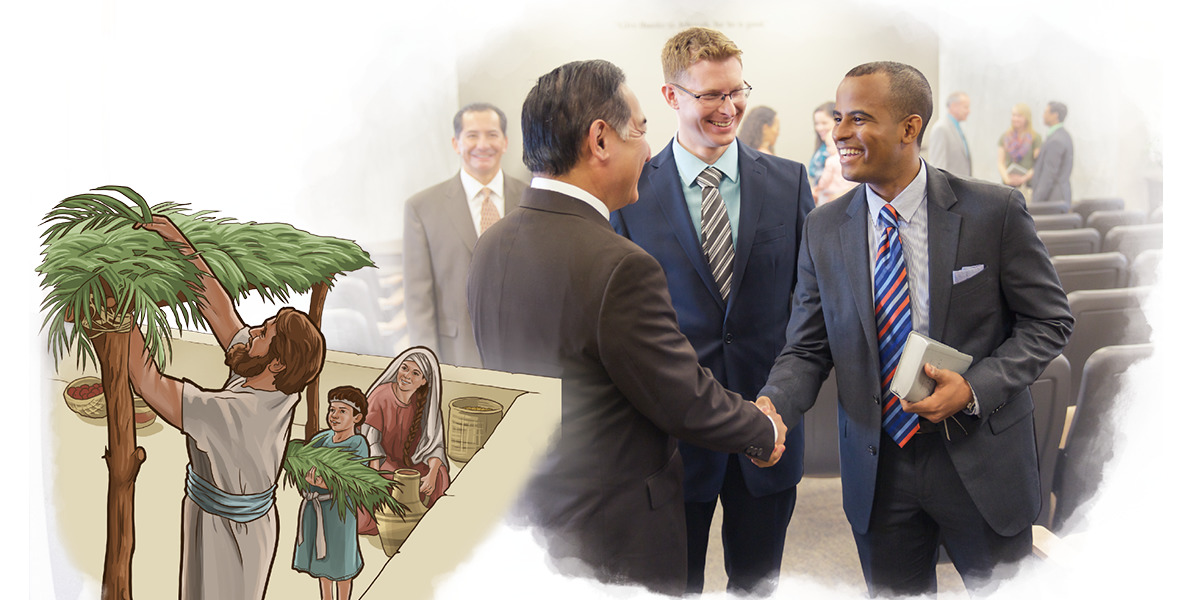
Collage: 1. An Israelite family joyfully build a booth on a rooftop. 2. Brothers shake hands to welcome each other at a congregation meeting.

 TREASURES FROM GOD’S WORD

Seasonal Festivals With Meaning for Us

The Passover and the Festival of Unleavened Bread (Festival of Unfermented Cakes) (Le 23:5, 6it-1 826-827)
The first day of the Festival of Unfermented Cakes was a solemn assembly, also a sabbath. On the second day, Nisan 16, a sheaf of the firstfruits of the barley harvest, the first crop to ripen in Palestine, was brought to the priest. Prior to this festival no new grain, bread, or roasted grain from the new harvest could be eaten. The priest offered such firstfruits to Jehovah symbolically by waving a sheaf of the grain to and fro, while a sound ram in its first year was offered as a burnt offering along with a grain offering moistened with oil and a drink offering. (Le 23:6-14) There was no command to burn any of the grain or its flour on the altar, as was practiced later by the priests. Not only was there a public or national firstfruit offering but provision was also made for each family and every individual who had a possession in Israel to offer thanksgiving sacrifices during this festive occasion.​—Ex 23:19; De 26:1, 2; see FIRSTFRUITS.
The Festival of Weeks (Pentecost) (Le 23:15, 16it-2 598 ¶2)

The Israelites were not allowed to begin the harvest until the firstfruits of the barley had been presented to Jehovah on Nisan 16. Therefore, in Deuteronomy 16:9, 10 the instructions are: “From when the sickle is first put to the standing grain you will start to count seven weeks. Then you must celebrate the festival of weeks to Jehovah your God.” Every male was required to attend, and it is also stated in connection with this festival: “You must rejoice before Jehovah your God, you and your son and your daughter and your man slave and your slave girl and the Levite who is inside your gates and the alien resident and the fatherless boy and the widow, who are in your midst, in the place that Jehovah your God will choose to have his name reside there.” (De 16:11) The Passover was a close family observance. The Festival of Harvest, or Pentecost, called for a more open and hospitable liberality, in this sense resembling the Festival of Booths.
The Festival of Booths (Le 23:34w14 5/15 29 ¶11)

11 Jehovah’s organization is acting in our best interests when it urges us to heed the apostle Paul’s counsel: “Let us consider one another so as to incite to love and fine works, not forsaking our meeting together, as some have the custom, but encouraging one another, and all the more so as you see the day drawing near.” (Heb. 10:24, 25) Annual festivals and other gatherings for worship built the Israelites up spiritually. Moreover, such events as the special Festival of Booths in Nehemiah’s day were joyful occasions. (Ex. 23:15, 16; Neh. 8:9-18) We derive similar benefits from our meetings, assemblies, and conventions. Let us take full advantage of these provisions for our spiritual health and happiness.​—Titus 2:2.

We can be “nothing but joyful” as we meditate on the meaning of ancient Jewish festivals and how Jehovah’s promises will be fulfilled.​—De 16:15.

                DONATE BUTTON 

                                   DONATE BUTTON 

Jehovah Sets His People Apart

And Also Related Articles:

                                          meetingBOX
                                          Treasures from God\’s Word 
                                          Living As Christians 
                                          Life and Ministry Meeting Workbook


TREASURES FROM GOD’S WORD

Jehovah Sets His People Apart

We must obey all of Jehovah’s laws (Le 20:22, 23w04 10/15 11 ¶12)

12 Still, there is something that we must not overlook. God told the Israelites: “You must keep the whole commandment that I am commanding you today, in order that you may grow strong and may indeed enter in and take possession of the land.” (Deuteronomy 11:8) At Leviticus 20:22, 24, that same land is mentioned: “You people must keep all my statutes and all my judicial decisions and do them, that the land to which I am bringing you to dwell in it may not vomit you out. Hence I said to you: ‘You, for your part, will take possession of their ground, and I, for my part, shall give it to you to take possession of it, a land flowing with milk and honey.’” Yes, possession of the Promised Land depended on a good relationship with Jehovah God. It was because the Israelites failed to obey him that God allowed the Babylonians to conquer them and remove them from their place of dwelling.
Jehovah promises an inheritance (Le 20:24it-1 1199)

Any property passing at the owner’s death to the heir or to those entitled to succeed; anything received from progenitors or predecessors as if by succession. The principal Hebrew verb used is na·chalʹ (noun, na·chalahʹ). It involves getting or giving an inheritance or hereditary possession, usually as a result of succession. (Nu 26:55; Eze 46:18) The verb ya·rashʹ is used at times in the sense “succeed as heir,” but more often, “take possession” apart from succession. (Ge 15:3; Le 20:24) It also has the meaning “dispossess; drive away,” involving military action. (De 2:12; 31:3) The Greek words having to do with inheritance are related to kleʹros, which originally meant “lot” but came to mean “share” and finally “inheritance.”​—Mt 27:35; Ac 1:17; 26:18.
In Israel the inheritance applied primarily to land possessions, although it was used with respect to movable property as well. The Bible speaks of the inheritance of things of a spiritual nature also. Spirit-begotten Christians are called “heirs indeed of God, but joint heirs with Christ.” They look forward, if they remain faithful, to “the everlasting inheritance.”​—Ro 8:17; Heb 9:15.
Jehovah expects clean worship from his people (Le 20:25, 26it-1 317 ¶2)

At the time of the Flood, Noah introduced into the ark for preservation pairs of birds “according to their kinds.” (Ge 6:7, 20; 7:3, 23) There is no certain way of knowing how many different “kinds” of birds then existed, some types of birds having become extinct even in recent times. However, it is of interest to note that the listing of birds according to present-day scientific classification presented in The New Encyclopædia Britannica (1985, Vol. 15, pp. 14-106) gives a total of only 221 bird “families,” including some that are now extinct or known only in fossil form. There are, of course, thousands of varieties included within these “families.”​—See ARK No. 1.

Jehovah blesses those who maintain a good relationship with him. To preserve his favor, we must remain separate from the world around us and its unclean practices.

A Hospital Liaison Committee member giving a public information kit to a doctor.

ASK YOURSELF, ‘What medical practices should I avoid that are displeasing to God?’

                                   DONATE BUTTON 

Maintain Moral Purity

 See Also Related Articles:

And Also Related Articles:

                                          meetingBOX
                                          Treasures from God\’s Word 
                                          Living As Christians 
                                          Life and Ministry Meeting Workbook

A husband and father turning away in disgust from his laptop computer and quickly closing it.

 TREASURES FROM GOD’S WORD

Maintain Moral Purity

Jehovah expects us to behave differently from people in the world (Le 18:3w19.06 28 ¶1)
In listing the perversions of nearby nations, Jehovah told the Israelites: “You must not do what they do in the land of Canaan, where I am bringing you. . . . The land is unclean, and I will bring punishment on it for its error.” To the holy God of Israel, the Canaanites’ lifestyle was so foul that the land they lived in had become unclean, contaminated.​—Lev. 18:3, 25.
Jehovah forbids such sins as incest, homosexuality, and bestiality (Le 18:6, 22, 23w17.02 20 ¶13)
13 How different those faithful kings were from the leaders of other nations, men who were guided by human wisdom and shortsighted strategy! Under Canaanite leadership, people did detestable things, which included incest, homosexuality, bestiality, child sacrifice, and gross idolatry. (Lev. 18:6, 21-25) Moreover, Babylonian and Egyptian leaders did not follow the scientifically sound practices on hygiene that God gave to Israel. (Num. 19:13) In contrast, God’s ancient people saw how their faithful leaders promoted spiritual, moral, and physical cleanness. Clearly, Jehovah was leading them.
Jehovah will destroy the unclean world around us (Le 18:24, 25; Pr 2:22w14 7/1 7 ¶2)
What about those who stubbornly refuse to change their ways and who insist on doing bad things? Reflect on this straightforward promise: “Only the upright will reside in the earth, and the blameless will remain in it. As for the wicked, they will be cut off from the earth, and the treacherous will be torn away from it.” (Proverbs 2:21, 22) Gone will be the influence of wicked humans. Under such peaceful conditions, obedient humans will gradually be set free from inherited imperfection.​—Romans 6:17, 18; 8:21.

Satan does not want us to enter God’s new world. But Jehovah’s principles can protect us from any satanic trap.

How can we show Jehovah that we hate immorality?

                                   DONATE BUTTON 

Atonement Day and You


TREASURES FROM GOD’S WORD | LEVITICUS 16-17

Atonement Day and You

16:12-15

What can we learn from the use of incense on Atonement Day?

  • The acceptable prayers of Jehovah’s faithful servants are like incense. (Ps 141:2) Just as the high priest brought the incense to Jehovah with great respect, we approach Jehovah in prayer with awe and respect
    The high priest entering the Most Holy, carrying incense and burning coals.

  • The high priest had to burn incense before he could offer up the sacrifices. Similarly, before Jesus could offer up his life as a sacrifice, he had to prepare the way for Jehovah to accept his sacrifice by living a life of integrity and loyalty

Collage: 1. A couple prays after preparing for field service. 2. The same couple preaches to a taxi driver, using a tablet.

How can I make sure that my sacrifices to Jehovah will be acceptable to him?

Design a site like this with WordPress.com
Get started