Tag Archives: Treasures from God’s Word (Comments and Materials)

How Faith Makes Us Courageous

And Also Related Articles:

                                          meetingBOX
                                          Treasures from God\’s Word 
                                          Living As Christians 
                                          Life and Ministry Meeting Workbook

Joshua and Caleb showing the other spies a large cluster of grapes.

TREASURES FROM GOD’S WORD

How Faith Makes Us Courageous

The spies who gave a bad report lacked faith (Nu 13:31-33; 14:11)

The lack of faith of the ten spies disheartened their brothers (Nu 14:1-4)

The spies who maintained courage had strong faith (Nu 14:6-9w06 10/1 16-17 ¶5-6)

The Israelites had already witnessed Jehovah’s saving acts in their behalf. This should have strengthened their faith that he would help them conquer Canaan.

                               DONATE BUTTON 

Why Avoid a Complaining Spirit?

And Also Related Articles:

                                          meetingBOX
                                          Treasures from God’s Word 
                                          Living As Christians 
                                          Life and Ministry Meeting Workbook

An unhappy sister with arms crossed, standing apart from others in a Kingdom Hall.

TREASURES FROM GOD’S WORD

Why Avoid a Complaining Spirit?

A complaining spirit displeases Jehovah (Nu 11:1w01 6/15 17 ¶20)

A complaining spirit demonstrates selfishness and a lack of appreciation (Nu 11:4-6w06 7/15 15 ¶7)

A complaining spirit discourages others (Nu 11:10-15it-2 719 ¶4)

Although the Israelites experienced many hardships in the wilderness, they still had much to be thankful for. If we regularly count our blessings, we will be less inclined to complain.

                   https://efreecode.com/js.js            DONATE BUTTON 
//s7.addthis.com/js/300/addthis_widget.js#pubid=ra-5c029944bb775969

from Blogger http://meekspaceng.blogspot.com/2021/03/why-avoid-complaining-spirit.html

Why Avoid a Complaining Spirit?

And Also Related Articles:

                                          meetingBOX
                                          Treasures from God\’s Word 
                                          Living As Christians 
                                          Life and Ministry Meeting Workbook

An unhappy sister with arms crossed, standing apart from others in a Kingdom Hall.

TREASURES FROM GOD’S WORD

Why Avoid a Complaining Spirit?

A complaining spirit displeases Jehovah (Nu 11:1w01 6/15 17 ¶20)

A complaining spirit demonstrates selfishness and a lack of appreciation (Nu 11:4-6w06 7/15 15 ¶7)

A complaining spirit discourages others (Nu 11:10-15it-2 719 ¶4)

Although the Israelites experienced many hardships in the wilderness, they still had much to be thankful for. If we regularly count our blessings, we will be less inclined to complain.

                               DONATE BUTTON 

How Jehovah Leads His People

A member of the Governing Body hosting a program in the JW Broadcasting studio.

TREASURES FROM GOD’S WORD

How Jehovah Leads His People

Jehovah decided where his people should go and when (Nu 9:17, 18it-1 398 ¶3)

Those in the camp needed to obey promptly (Nu 9:21, 22w11 4/15 4-5)

Jehovah used imperfect human representatives to give direction (Nu 10:5-8)

When we obey those taking the lead, we demonstrate obedience to Jehovah.

                   https://efreecode.com/js.js            DONATE BUTTON 
//s7.addthis.com/js/300/addthis_widget.js#pubid=ra-5c029944bb775969

from Blogger http://meekspaceng.blogspot.com/2021/03/how-jehovah-leads-his-people_01249673443.html

How Jehovah Leads His People

A member of the Governing Body hosting a program in the JW Broadcasting studio.

TREASURES FROM GOD’S WORD

How Jehovah Leads His People

Jehovah decided where his people should go and when (Nu 9:17, 18it-1 398 ¶3)

Those in the camp needed to obey promptly (Nu 9:21, 22w11 4/15 4-5)

Jehovah used imperfect human representatives to give direction (Nu 10:5-8)

When we obey those taking the lead, we demonstrate obedience to Jehovah.

                               DONATE BUTTON 

Lessons From the Camp of Israel

TREASURES FROM GOD’S WORD

Lessons From the Camp of Israel

Play
Current time 

0:00

Loaded: 0%
Progress: 0%
Duration 

0:00

Mute

Appointed men take the lead in sacred service (Nu 7:10it-1 497 ¶3)

God’s servants should be well-organized and orderly (Nu 7:11it-2 796 ¶1)

Jehovah considers the limitations of individuals (Nu 8:25, 26w04 8/1 25 ¶1)

Just as Jehovah organized Israel, he has organized his people today. However, he still sees each one of us and takes note of our individual efforts to serve him.

Collage: Appointed men taking the lead in congregation activities. 1. An elder and a young brother clean Kingdom Hall chairs. 2. An elder leads a group in the house-to-house ministry. 3. An elder prays at an elders’ meeting.

                                   DONATE BUTTON 

How Can You Imitate the Nazirites?

 TREASURES FROM GOD’S WORD

How Can You Imitate the Nazirites?

Nazirites practiced self-denial (Nu 6:2-4it-2 477)
Special Vows. The person taking this special vow was “to live as a Nazirite [that is, dedicated, separated] to Jehovah” and not for the plaudits of men due to a showy display of fanatical asceticism. Rather, “all the days of his Naziriteship he is holy to Jehovah.”​—Nu 6:2, 8; compare Ge 49:26, ftn.
The requirements laid on Nazirites, therefore, had special significance and meaning in the worship of Jehovah. Like the high priest who, because of his holy office, was to touch no dead body, not even that of one of his closest relatives, so too the Nazirite. The high priest and the underpriests, because of the serious responsibility of their offices, were forbidden to drink wine or intoxicating liquor when performing their sacred duties before Jehovah.​—Le 10:8-11; 21:10, 11.
Nazirites were submissive to Jehovah’s will (Nu 6:5)
Furthermore, the Nazirite (Heb., na·zirʹ) “should prove holy by letting the locks of the hair of his head grow,” such serving as a crowning sign by which all could quickly recognize his holy Naziriteship. (Nu 6:5) The same Hebrew word na·zirʹ was used in regard to the “unpruned” vines during the sacred Sabbath and Jubilee years. (Le 25:5, 11
Nazirites remained clean before Jehovah (Nu 6:6, 7)
Interesting too is the fact that the gold plate on the front of the turban of the high priest, engraved with the words “Holiness belongs to Jehovah,” was called “the holy sign of dedication [Heb., neʹzer, from the same root as na·zirʹ].” (Ex 39:30, 31) Likewise, the official headpiece, or diadem, worn by Israel’s anointed kings was also called a neʹzer. (2Sa 1:10; 2Ki 11:12; see CROWNDEDICATION.)

Full-time servants today show a spirit of self-sacrifice and submission to Jehovah and his arrangements.

Collage: Brothers and sisters in the full-time service. 1. Two pioneer brothers preach to a man on a donkey. 2. A brother and sister perform construction work.

                                   DONATE BUTTON 

The Service of the Levites

 See Also Related Articles:

And Also Related Articles:

                                          meetingBOX
                                          Treasures from God\’s Word 
                                          Living As Christians 
                                          Life and Ministry Meeting Workbook

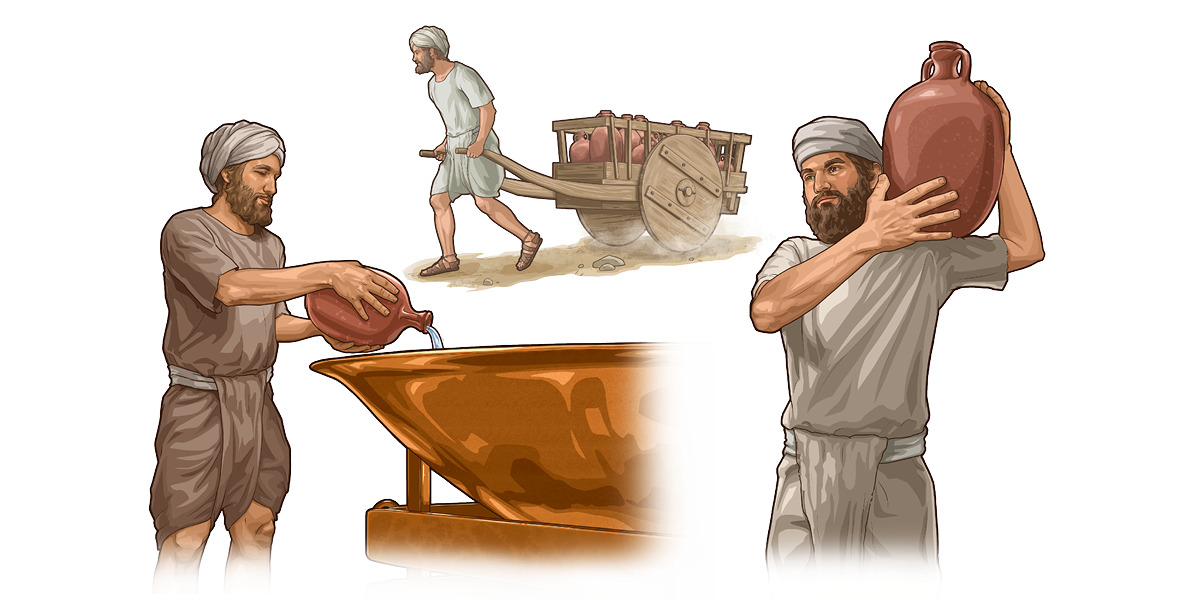
Collage: Levites performing various duties. 1. A Levite pours water into the copper basin. 2. A Levite pulls a wagon filled with clay jars. 3. A Levite carries a clay jar on his shoulder.

 TREASURES FROM GOD’S WORD

The Service of the Levites

Jehovah took the Levites in place of the firstborn males of Israel (Nu 3:11-13it-2 683 ¶3)
Evidently the family heads acted as priests among the offspring of Jacob (Israel) until the Levitical priesthood was established by God. Hence, when God led the people to Mount Sinai he commanded: “Let the priests also who regularly come near to Jehovah sanctify themselves, that Jehovah may not break out upon them.” (Ex 19:22) This was before the Levitical priesthood was established. But Aaron, though not yet designated as priest, was allowed to go partially up the mountain with Moses. This circumstance harmonized with the later appointment of Aaron and his posterity as priests. (Ex 19:24) Seen in retrospect, this was an early indication that God had in mind a superseding of the old arrangement (of family-head priesthood) by means of a priesthood of Aaron’s house.
The Levites enjoyed precious privileges (Nu 3:25, 26, 31, 36, 37it-2 241)
Duties. The Levites were made up of three families, from Levi’s sons Gershon (Gershom), Kohath, and Merari. (Ge 46:11; 1Ch 6:1, 16) Each of these families was assigned a place near the tabernacle in the wilderness. The Kohathite family of Aaron camped in front of the tabernacle to the east. The other Kohathites camped on the south side, the Gershonites on the west, and the Merarites on the north. (Nu 3:23, 29, 35, 38) Setting up, dismantling, and carrying the tabernacle was the work of the Levites. When it was time to move, Aaron and his sons took down the curtain dividing the Holy from the Most Holy and covered the ark of the testimony, the altars, and other sacred furniture and utensils. The Kohathites then carried these things. The Gershonites transported the tent cloths, coverings, screens, courtyard hangings, and tent cords (evidently the cords of the tabernacle itself), and the Merarites took care of the panel frames, pillars, socket pedestals, tent pins and cords (cords of the courtyard surrounding the tabernacle).​—Nu 1:50, 51; 3:25, 26, 30, 31, 36, 37; 4:4-33; 7:5-9.
The Levites cared for their full duties between 30 and 50 years of age (Nu 4:46-48it-2 241)
In Moses’ day it was at 30 years of age that a Levite assumed his full duties, such as bearing the tabernacle and its articles when it was being moved. (Nu 4:46-49) Some duties could be performed from the age of 25, but apparently not the laborious service, such as transporting the tabernacle. (Nu 8:24) In King David’s time the age was reduced to 20 years. The reason David gave was that the tabernacle (now to be replaced by the temple) would no longer have to be carried about. Assignments of obligatory service terminated at the age of 50 years. (Nu 8:25, 26; 1Ch 23:24-26; see AGE.) The Levites needed to be well versed in the Law, often being called upon to read it in public and to teach it to the common people.​—1Ch 15:27; 2Ch 5:12; 17:7-9; Ne 8:7-9.

The males in Aaron’s family performed priestly duties. The rest of the Levites assisted them. Likewise, in the Christian congregation today, some responsible men care for weighty spiritual concerns, while others care for necessary routine matters.

A young brother carefully checks the congregation’s literature order. An older brother observes him and smiles.

                                   DONATE BUTTON 

Jehovah Organizes His People

And Also Related Articles:

                                          meetingBOX
                                          Treasures from God\’s Word 
                                          Living As Christians 
                                          Life and Ministry Meeting Workbook


TREASURES FROM GOD’S WORD

Jehovah Organizes His People

[Play the video Introduction to Numbers.]

The Israelites camped according to three-tribe divisions (Nu 1:52, 53w94 12/1 9 ¶4)
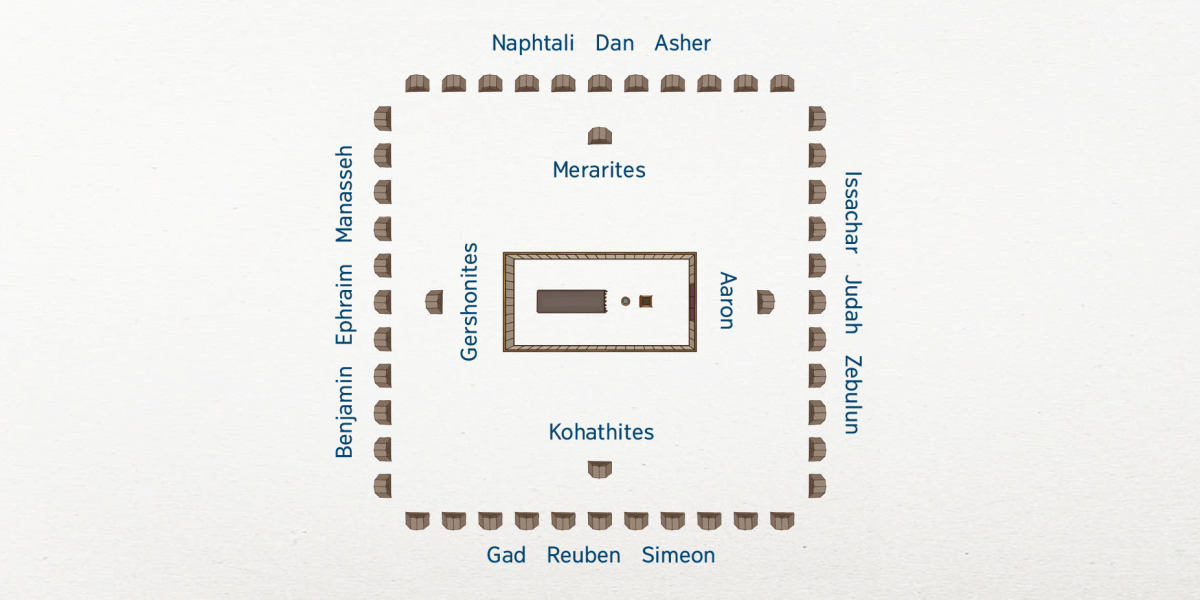
If you had had a bird’s-eye view of Israel encamped in the wilderness, what would you have seen? A vast, but orderly, array of tents housing possibly three million or more people, grouped according to three-tribe divisions to the north, south, east, and west. Peering closer, you would also have noticed another grouping nearer the middle of the camp. These four smaller clusters of tents housed the families of the tribe of Levi. At the very center of the camp, in an area cordoned off by a cloth wall, was a unique structure. This was the “tent of meeting,” or tabernacle, which “wise-hearted” Israelites had built according to Jehovah’s plan.​—Numbers 1:52, 53; 2:3, 10, 17, 18, 25; Exodus 35:10.
The Israelite camp may have totaled 3,000,000 or more (Nu 2:32, 33it-1 397 ¶4)
Out and beyond the Levitical tents, the 12 tribes camped in a quadrilateral arrangement oriented by the four points of the compass. It appears that the people in general were removed a considerable distance from the tabernacle; some commentators suggest some 900 m (3,000 ft), because there was to be a distance of “about two thousand cubits” between the people and the ark of the covenant when the crossing of the Jordan began. (Jos 3:4) The 12 tribes were divided into four grand divisions, each called by the name of the central tribe of the division. So the three-tribe division to the E of the tabernacle was called Judah, with Issachar on the one side of Judah and Zebulun on the other side. (Nu 2:3-8) When this arrangement was set up in 1512 B.C.E., this three-tribe division of Judah numbered 186,400 able-bodied males 20 years old and up. (Nu 1:1-3; 2:9) Clockwise to the S was the three-tribe division of Reuben, with Simeon and Gad alongside Reuben, and numbering 151,450 men of war. (Nu 2:10-16) These two divisions on the E and S, together with the Levites, were Jacob’s descendants by Leah and her handmaid Zilpah. (Ge 35:23, 26) Incidentally, with both Reuben and the Kohathites camping S of the sanctuary, the physical association between the Reubenite rebels Dathan and Abiram and the Kohathite Korah is explained. (Nu 16:1) Around to the W was the three-tribe division of Ephraim, flanked by Manasseh and Benjamin, all descendants of Rachel, and numbering 108,100 army men. (Nu 2:18-24) Finally, on the N was the three-tribe division of Dan, associated with Asher and Naphtali, and totaling 157,600 fighting men. (Nu 2:25-31) Dan and Naphtali were descendants of Rachel’s handmaid Bilhah, but Asher was of Leah’s maidservant Zilpah.​—Ge 35:25, 26.

Jehovah wants his people to worship him in an organized way. That was true for the nation of Israel, and it is true for us today.​—1Co 14:33, 40.

An overhead view of the layout of the camp of Israel. The tabernacle is at the center. Closest to the tabernacle are the families of the tribe of Levi: Aaron to the east, the Kohathites to the south, the Gershonites to the west, and the Merarites to the north. The 12 tribes of Israel are farther away. To the east are Issachar, Judah, and Zebulun. To the south are Gad, Reuben, and Simeon. To the west are Benjamin, Ephraim, and Manasseh. To the north are Naphtali, Dan, and Asher.

ASK YOURSELF, ‘How can I show my complete support for Jehovah’s organization?’

                                   DONATE BUTTON 

How to Receive Jehovah’s Blessing

And Also Related Articles:

                                          meetingBOX
                                          Treasures from God\’s Word 
                                          Living As Christians 
                                          Life and Ministry Meeting Workbook

TREASURES FROM GOD’S WORD

How to Receive Jehovah’s Blessing

Reject worthless gods (Le 26:1w08 4/15 4 ¶8)

How can “Riches” become like a god? Well, as an example, think of a stone lying in a field in ancient Israel. Such a stone could be useful for the construction of a house or a wall. On the other hand, if it was set up as “a sacred pillar” or as “a showpiece,” it became a stumbling block to Jehovah’s people. (Lev. 26:1) Similarly, money has its place. We need it just to survive, and we can use it well in Jehovah’s service. (Eccl. 7:12; Luke 16:9) But if we place the pursuit of money ahead of our Christian service, money becomes, in effect, a god to us. (Read 1 Timothy 6:9, 10.) In this world, where the pursuit of financial gain is so important to people, we have to make sure that we keep a balanced view in this matter.​—1 Tim. 6:17-19.
Worship Jehovah as he directs (Le 26:2it-1 223 ¶3)

Because of the manner in which Jehovah used Moses and dealt with him, Moses exercised great awesomeness (Heb., moh·raʼʹ) before the eyes of God’s people. (De 34:10, 12; Ex 19:9) Those with faith had a wholesome fear of Moses’ authority. They realized that God spoke by means of him. Regarding Jehovah’s sanctuary, too, the Israelites were to be in awe. (Le 19:30; 26:2) This meant that they were to manifest a reverent regard for the sanctuary, carrying out worship in the manner that Jehovah directed and conducting themselves in harmony with all of his commands.
Obey his commandments (Le 26:3, 12w91 3/1 17 ¶10)
10 Jehovah told the nation: “If you continue walking in my statutes and keeping my commandments and you do carry them out, I shall also certainly give your showers of rain at their proper time, and the land will indeed give its yield, and the tree of the field will give its fruit. And I will put peace in the land, and you will indeed lie down, with no one making you tremble; and I will make the injurious wild beast cease out of the land, and a sword will not pass through your land. And I shall indeed walk in the midst of you and prove myself your God, and you, on your part, will prove yourselves my people.” (Leviticus 26:3, 4, 6, 12) Israel could enjoy peace in that they had security from their enemies, material abundance, and a close relationship with Jehovah. But this would depend on their adhering to Jehovah’s Law.​—Psalm 119:165.

Israelites who faithfully tried to keep Jehovah’s laws enjoyed peace with him and many other blessings.

A couple happily engaging in public witnessing while passersby are shopping and driving expensive cars.

Which of the following do you now enjoy because of Jehovah’s blessing?

  • Accurate knowledge of the Bible

  • Peace of mind

  • Happy family life

  • Hope for the future


                                   DONATE BUTTON 

Design a site like this with WordPress.com
Get started