Tag Archives: Publications

Demonstrate Christlike Humility and Modesty

Download pdf format to Demonstrate Christlike Humility and Modesty here

Even though Jesus was the greatest man who ever lived, he showed humility and modesty by glorifying Jehovah. (Joh 7:16-18) On the other hand, Satan became the Devil, which means “Slanderer.” (Joh 8:44) Satan’s attitude was manifested by the Pharisees, whose pride caused them to belittle anyone who showed faith in the Messiah. (Joh 7:45-49) How can we imitate Jesus when we receive privileges or responsibilities in the congregation?

WATCH THE VIDEO “HAVE LOVE AMONG YOURSELVES”—AVOID JEALOUSY AND BRAGGING, PART 1, AND THEN DISCUSS THE FOLLOWING:

How did Alex manifest pride?

Bill!
Carl! How are you?
Good! And how are you?
Good.
Great! Alex! I had not told you yet, but the other week you did a really good speech.
It’s true you’ve been good!
Oh! Thanks guys, it’s that I’ve been so busy, that I almost did not have time to get ready.
Do not talk to me, the whole congregation has had a lot to do in this period.
Yes it’s true.
Yes but I have been particularly busy.
Why what have you done? It’s not that you’re bad, right?
No, it’s not for this. And that there are all these theocratic commitments, pioneers, assignments in the congregation, and other things like this Saturday, I have to come to the Kingdom Hall and stay there all afternoon.
Saturday in the hall, and why?
Wait a minute, I’ve already understood everything. Do not you do the circuit assembly tests this Saturday?
Ah yes, you’re right, so you have to do something.
I’m not sure I can tell you.
You just did it! So what is it you have to do a demonstration, an interview, now You can not leave us like that.
Ok, it’s not just an interview, I have to do my experience too. After the experience, they ask me questions. I will be on the podium for almost the whole part. In short, guys, the part is me.
Are you the part? Are you sure you’re not a little exaggerating?
No, I do not think so. Ok, the part of brother Jones lasts 10 minutes, I stand on the podium for 6. This means more than half the part. However, now I will tell you what I will do. They will ask me to tell that fantastic experience I had. I knock at the door, I ring the bell, but what happens? Does not work! So I knock so loud that …

WATCH THE VIDEO “HAVE LOVE AMONG YOURSELVES”—AVOID JEALOUSY AND BRAGGING, PART 2, AND THEN DISCUSS THE FOLLOWING:

In che modo Alex si è dimostrato umile?

Bill!
Carl! How are you?
Good! And how are you?
Good.
Great! Alex! I had not told you yet, but the other week you did a really good speech.
It’s true you’ve been good!
Thanks guys with Jehovah’s help, I did it. I was so busy that it was hard to find the time to get ready.
Do not talk to me or the whole congregation has had a lot to do during this time.
Yes indeed!

How did Alex manifest humility?

You know something. Are you doing the pioneers, are you? How is it going?
Very well. Yesterday I showed a person a video on jw.org. He said I can come back this Saturday. I think I could even start a study. Do you want to come with me Alex?
I’m sorry, but Saturday I’m busy almost all day. But maybe he can accompany you Bill.
What do you say, Bill?
Of course I have to do a visit too, we can go there together.
Perfect!
So Bill you found a nice visit too. Come on, tell me!
Yes, then I met a gentleman …

WATCH THE VIDEO “HAVE LOVE AMONG YOURSELVES”—REPUDIATE PRIDE AND INDECENCY, PART 1, AND THEN DISCUSS THE FOLLOWING:

How did Brother Harris fail to demonstrate modesty?

Excuse Tom would you have a minute?
Sure Faye, how can I help you?
Well maybe you already know, David and I got engaged last Saturday.
Yes, I knew! Congratulations! I’m really happy for you.
Thank you, and since I grew up here we would love to be able to marry in this hall of the kingdom. So since you are the coordinator of the elderly body, could you let us know today if we can use the hall? So David and I can start preparing invitations. David sends you this official letter of request from the hall.
So let’s see a little bit. I have yes, the letter is fine, with this I have all the information I need. Faye I can not imagine another place where you could get married. You can definitely use this room. Now I tell the other elders that I have already given my approval, but to David you can already say that we can not wait for the big day to come.
Thanks so much Tom, I was sure you would help us.

WATCH THE VIDEO “HAVE LOVE AMONG YOURSELVES”—REPUDIATE PRIDE AND INDECENCY, PART 2, AND THEN DISCUSS THE FOLLOWING:

How did Brother Harris demonstrate modesty?

Excuse Tom would you have a minute?
Sure Faye, how can I help you?
Well maybe you already know, David and I got engaged last Saturday.
Yes, I knew! Congratulations! I’m really happy for you.
Thank you, and since I grew up here we would love to be able to marry in this hall of the kingdom. So since you are the coordinator of the elderly body, could you let us know today if we can use the hall? So David and I can start preparing invitations. David sends you this official letter of request from the hall.
Ok! Yes, the letter is fine, there is all the information we need. Now I meet the other elders so we talk and let you know as soon as possible.

What did Brother Harris’ example teach Faye?

Ah! Do you mean that you can not let me know immediately? I thought that since you are the coordinator I had the authority to … well …
Yes, I understood, but there is a theocratic disposition that we must all take into account also the elderly, and according to the provision the service committee must talk and evaluate the matter carefully before giving its approval. So you understand, I do not have the authority to make this decision alone.
Of course it seems right to me.
Do not worry Faye, we’ll take care of it as soon as possible, so you can proceed with the wedding preparations.
Thank you so much Tom, I appreciate it very much.
Is a real pleasure.

Digging for Spiritual Gems: John 5-6 (Week September 17-23)

John 5-6
Digging for Spiritual Gems: (8 min.)
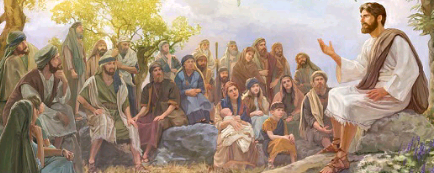
Joh 6:44​—How does the Father draw people to himself? (“draws him” study note on Joh 6:44, nwtsty)
draws him: Although the Greek verb for “draw” is used in reference to hauling in a net of fish (Joh 21:6, 11), it does not suggest that God drags people against their will. This verb can also mean “to attract,” and Jesus’ statement may allude to Jer 31:3, where Jehovah said to his ancient people: “I have drawn you to me with loyal love.” (The Septuagint uses the same Greek verb here.) Joh 12:32 shows that in a similar way, Jesus draws men of all sorts to himself. The Scriptures show that Jehovah has given humans free will. Everyone has a choice when it comes to serving Him. (De 30:19, 20) God gently draws to himself those who have a heart that is rightly disposed. (Ps 11:5; Pr 21:2; Ac 13:48) Jehovah does so through the Bible’s message and through his holy spirit. The prophecy from Isa 54:13, quoted in Joh 6:​45, applies to those who are drawn by the Father.—Compare Joh 6:65.

Joh 6:64​—In what sense did Jesus know “from the beginning” that Judas would betray him? (“Jesus knew . . . the one who would betray him,” “from the beginning” study notes on Joh 6:64, nwtsty)
Jesus knew . . . the one who would betray him: Jesus was referring to Judas Iscariot. Jesus spent the entire night in prayer to his Father before selecting the 12 apostles. (Lu 6:12-16) So at first, Judas was faithful to God. However, Jesus knew from Hebrew Scripture prophecies that he would be betrayed by a close associate. (Ps 41:9; 109:8; Joh 13:18, 19) When Judas started to go bad, Jesus, who could read hearts and thoughts, detected this change. (Mt 9:4) By use of his foreknowledge, God knew that a trusted companion of Jesus would turn traitor. But it is inconsistent with God’s qualities and past dealings to think that Judas had to be the one who would fail, as if his failure were predestined.
from the beginning: This expression does not refer to Judas’ birth or to his being selected as an apostle, which happened after Jesus had prayed the entire night. (Lu 6:12-16) Rather, it refers to the start of Judas’ acting treacherously, which Jesus immediately discerned. (Joh 2:24, 25; Re 1:1; 2:23; see study notes on Joh 6:70; 13:11.) This also shows that Judas’ actions were premeditated and planned, not the result of a sudden change of heart. The meaning of the term “beginning” (Greek, ar·kheʹ) in the Christian Greek Scriptures is relative, depending on the context. For example, at 2Pe 3:4, “beginning” refers to the start of creation. But in most instances, it is used in a more limited sense. For instance, Peter said that the holy spirit fell on the Gentiles “just as it did also on us in the beginning.” (Ac 11:15) Peter was not referring to the time of his birth or to the time when he was called to be an apostle. Rather, he was referring to the day of Pentecost 33 C.E., that is, “the beginning” of the outpouring of holy spirit for a specific purpose. (Ac 2:1-4) Other examples of how the context affects the meaning of the term “beginning” can be found at Lu 1:2; Joh 15:27; and 1Jo 2:7.

What has this week’s Bible reading taught you about Jehovah?

*** ws18 June p. 14 par. 18 May We All Be One as Jehovah and Jesus Are One ***
18 It is good for us to remember that we all used to be far away from God. (Ephesians 2:12) But Jehovah drew us to him with love. (Hosea 11:4; John 6:44) And Christ welcomed us. He made it possible for us to become part of God’s family. (Read Romans 15:7.) Even though we are imperfect, Jesus has kindly accepted us, so we should never even think of rejecting anyone!

*** w17 February p. 7 par. 18 Jehovah’s Purpose Will Be Fulfilled! ***
18 Satan’s rebellion did not stop Jehovah from extending his love to mankind, nor can it prevent even imperfect humans from being loyal to Jehovah. Through his provision of the ransom, Jehovah will help all of his children to become completely righteous. Imagine what life will be like when everyone “who recognizes the Son and exercises faith” will have everlasting life. (John 6:40) With great love and wisdom, Jehovah will bring the human family to perfection, according to his original purpose. Jehovah, our Father, will then become “all things to everyone.”—1 Cor. 15:28.

*** w17 February p. 10 par. 10 The Ransom—A “Perfect Present” From the Father ***
10 What about the billions of people who died without ever having an opportunity to know and serve Jehovah? The ransom makes possible the resurrection of the dead. Our loving heavenly Father will bring them back to life and give them an opportunity to learn about his purpose and to gain everlasting life. (Acts 24:15) Jehovah wants people to live, not die. As the Source of life, he becomes the Father of everyone who is resurrected. (Ps. 36:9) How appropriate, therefore, that Jesus taught us to pray: “Our Father in the heavens.” (Matt. 6:9) Jehovah has given Jesus an important share in resurrecting the dead. (John 6:40, 44) In Paradise, Jesus will fulfill his role as “the resurrection and the life.”—John 11:25.

*** w17 March p. 9 par. 4 Give Honor to Whom It Is Due ***
4 Honoring Jehovah and Christ is not optional. Our everlasting life depends on our doing so. Jesus’ words that we read at John 5:22, 23 help us to see that plainly: “The Father judges no one at all, but he has entrusted all the judging to the Son, so that all may honor the Son just as they honor the Father. Whoever does not honor the Son does not honor the Father who sent him.”—Read Psalm 2:11, 12.

*** w17 July p. 13 par. 4 “Weep With Those Who Weep” ***
4 Our Father of tender mercies has himself experienced the loss of loved ones, such as Abraham, Isaac, Jacob, Moses, and King David. (Num. 12:6-8; Matt. 22:31, 32; Acts 13:22) God’s Word assures us that Jehovah has eagerly anticipated—has had an earnest longing for—the time when he will bring them back to life. (Job 14:14, 15) They will be happy and in vibrant health. Consider, too, that God’s dearly beloved Son—“the one he was especially fond of”—died an agonizing death. (Prov. 8:22, 30) Words cannot express the pain Jehovah must have suffered.—John 5:20; 10:17.

*** w17 December p. 12 par. 21 “I Have Hope Toward God” ***
21 In the meantime, we should bolster our faith in Jehovah, who through Jesus assured us that the dead in God’s memory will rise. (John 5:28, 29; 11:23) Proving that Jehovah is capable of resurrecting the dead, Jesus once said that Abraham, Isaac, and Jacob “are all living to him.” (Luke 20:37, 38) Meanwhile, we have ample reason to say, as did Paul: “I have hope toward God . . . that there is going to be a resurrection.”—Acts 24:15.

*** w16 May p. 19 par. 6 Is the Bible Still Changing Your Life? ***
6 Our inherited imperfection does not need to prevent us from enjoying Jehovah’s friendship or continuing to serve him. Consider this: When Jehovah drew us into a relationship with him, he knew that we would err at times. (John 6:44) Since God knows our traits and what is in our heart, he surely was aware of what sort of imperfect tendencies would be particularly troublesome for us. And he knew that we would occasionally transgress. Yet, this did not prevent Jehovah from wanting us as his friends.

What other spiritual gems have you discovered in this week’s Bible reading?

*** w18 June p. 4 par. 5 “My Kingdom Is No Part of This World” ***
5 Such expectations about the Messiah doubtless led the people of Galilee to want Jesus to become their king. We can imagine that they were thinking that Jesus would be an ideal leader. He was an outstanding speaker; he could cure the sick; he could even supply food for the hungry. After Jesus fed about 5,000 men, he sensed the mood among the people. “Jesus, knowing that they were about to come and seize him to make him king, withdrew again to the mountain all alone.” (John 6:10-15) The following day on the other side of the Sea of Galilee, the enthusiasm may have died down some. Jesus then explained to the crowd the true nature of his work. He had come to bring spiritual, not material, benefits to the nation. “Work, not for the food that perishes, but for the food that remains for everlasting life,” he told them.—John 6:25-27.

*** w18 November p. 9 par. 5 “I Will Walk in Your Truth” ***
5 Sadly, some today have failed to hold on to the truth. Some were stumbled by an adjusted understanding of a Bible passage or by what a prominent brother said or did. Others were offended by Scriptural counsel they received, or they let go of the truth because of a personality clash with a fellow Christian. Still others took sides with apostates and other opposers who misrepresented our beliefs. As a result, some deliberately began “drawing away” from Jehovah and the congregation. (Heb. 3:12-14) How much better it would have been if they had maintained their faith and kept their confidence in Jesus, as the apostle Peter did! When Jesus asked the apostles if they wanted to leave, Peter immediately replied: “Lord, whom shall we go away to? You have sayings of everlasting life.”—John 6:67-69.

*** w16 March p. 7 pars. 16-17 Young Ones—Are You Ready to Get Baptized? ***
16 To illustrate, imagine that a friend gives you a car as a gift. He hands you the title and says: “The car is yours.” But suppose your friend adds: “I will keep the keys. And I will be the one who drives the car, not you.” How would you feel about this “gift”? How would you feel about the giver?
17 Now think about what Jehovah rightfully expects of a person who makes a dedication to him, a person who tells him: “I am giving you my life. I belong to you.” What if that person were to start living a double life, perhaps secretly dating an unbeliever? What if he were to accept employment that crippled his whole-souled service in the ministry or attendance at Christian meetings? Would that not be like keeping the keys to the car? A person who dedicates himself to Jehovah is, in effect, saying: “My life belongs to you more than to me. If there is ever a conflict between what you want and what I am inclined to want, what you want will win—every time.” That would reflect the thinking of Jesus, who while on earth stated: “I have come down from heaven to do, not my own will, but the will of him who sent me.”—John 6:38.

*** w16 April pp. 14-15 par. 7 “Let Endurance Complete Its Work” ***
7 Nourish your faith with spiritual food. On Mount Everest, the world’s tallest mountain, a climber burns about 6,000 calories a day, considerably more than the average person needs. To endure the ascent and reach their goal, climbers must consume as many calories as possible. Similarly, to endure in our Christian course and reach our goal, we must regularly take in as much spiritual food as possible. We need self-discipline to devote time to reading, study, and our Christian meetings. These activities nourish our faith with “the food that remains for everlasting life.”—John 6:27.

*** w16 April p. 28 par. 3 Maintain Your Neutrality in a Divided World ***
3 The Bible gives several reasons why God requires that we remain neutral. For example, we follow the teachings and example of his Son, Jesus Christ, by being “no part of the world,” avoiding its politics and wars. (John 6:15; 17:16) We must remain neutral in order to be loyal subjects of God’s Kingdom. Otherwise, how could we have a clean conscience when we preach the good news that only God’s Kingdom can solve mankind’s problems? Additionally, unlike false religions that divide their members by meddling in politics, true worship preserves our international brotherhood by helping us to remain neutral.—1 Pet. 2:17.

*** w15 2/15 p. 9 par. 16 Imitate Jesus’ Humility and Tenderness ***
16 Our tender words. Our tender affection for others moves us to “speak consolingly to those who are depressed.” (1 Thess. 5:14) What can we say to encourage such ones? We can lift their spirits by expressing our genuine care and concern for them. We can offer sincere commendation to help them see their positive qualities and abilities. We can remind them that Jehovah drew them to his Son, so they must be precious in his eyes. (John 6:44) We can reassure them that Jehovah deeply cares for his servants who are “brokenhearted” or “crushed in spirit.” (Ps. 34:18) Our tender words can have a healing effect on those who need comfort.—Prov. 16:24.

*** w15 4/15 p. 7 par. 20 Elders, How Do You Feel About Training Others? ***
20 Elders, remember: A successful teacher is someone who not only loves to train another person but also loves the person he is training. (Compare John 5:20.) That crucial aspect of a teacher’s disposition is quickly discerned by a learner and greatly affects the way he responds to the training he receives. Therefore, dear elders, as you give training, be more than a teacher—be a friend.—Prov. 17:17; John 15:15.

Nothing Was Wasted

Nothing Was Wasted

After Jesus miraculously fed 5,000 men plus women and children, he instructed his disciples: “Gather together the fragments left over, so that nothing is wasted.” (Joh 6:12) Jesus showed appreciation for Jehovah’s provisions by not wasting them.
In modern times, the Governing Body strives to imitate Jesus by making wise use of dedicated resources. For example, when building world headquarters in Warwick, New York, the brothers chose designs that allowed for the best use of donated funds.

HOW CAN WE AVOID WASTE . . .

HOW CAN WE AVOID WASTE . . . when we are at Christian meetings?

Ordinary and maintenance costs are the largest part of the total cost of a building. To the extent that we save water, paper, light, and energy in our Kingdom Hall, we can contribute as individuals to fully realize the benefits and goals of this building, and to exploit its potential. In this way we avoid waste, and at the same time help to give glory to the name of Jehovah.

HOW CAN WE AVOID WASTE . . . when we obtain publications for our personal use? (km 5/09 3 ¶4)


4 As for publications for personal use, request only what you actually need. Write your name in the space provided. That will help you keep track of your personal copy. If you use the Watchtower Library on CD-ROM and have saved your personal copies of the magazines, you may not feel a need to request personal copies of the Watchtower and Awake! bound volumes.

HOW CAN WE AVOID WASTE . . . when we pick up literature items for use in the ministry? (mwb17.02 “Make Wise Use of Bible Literature” ¶1)


 Jesus taught: “You received free, give free.” (Mt 10:8) We adhere to that clear direction by not charging people for a copy of the Bible or our Bible-based literature. (2Co 2:17) Nevertheless, these publications contain precious truths from God’s Word. Great effort and expense are involved in printing literature and shipping it to congregations around the world. Therefore, we should take only what we need.

when we share in the ministry? (mwb17.02 “Make Wise Use of Bible Literature” ¶2 and the box)


 Use discernment when giving literature to others, even at public witnessing locations. (Mt 7:6) Instead of simply handing out literature to passersby, make an effort to converse with them to determine their interest. Can you answer yes to at least one of the questions in the accompanying box? If you are unable to determine someone’s interest, it is best to give him a tract. Of course, if he asks for a magazine or another publication, we will gladly give him a copy.—Pr 3:27, 28.

Sample Conversations – Second Return Visit 09-2018

○○● SECOND RETURN VISIT

Question: How do we know that God understands us?

Scripture: Ps 139:1, 2, 4

Link: How can God’s care benefit us?

But how can we be sure that God understands us? Notice what King David said about God in Psalm 139. Let’s read verses 1, 2 and then 4. David said, “O Jehovah, you have scrutinized me, and you know me. You know when I sit down and when I get up; understand my thoughts from afar. Before even one word is on my tongue, you, O Jehovah, you already know everything. ” In these verses we have just read, do you think there is anything that can confirm the fact that God fully understands us?

Here he says, that God understands our thoughts.

Anna but thinks about it, sometimes it seems that others can not really understand each other. But God goes further, goes deep, knows our thoughts, our motivations, our concerns. It really understands us! Is not it comforting?

Yes, I would say yes! Thank you! Today, I really needed to hear it.

But let it be. If I’m not indiscreet, I understand that it’s not a good time for her.

In fact …

I’m really sorry. Anyway, rest assured that we love her, and the creator loves her too. Next time, I would like you to read another very encouraging verse, which answers the question: In what ways can God help us? Would you like it?

Look, I can not wait.

LIVING BY BIBLE PRINCIPLES Now I View People Differently

2018-09-17
LIVING BY BIBLE PRINCIPLES

Now I View People Differently

Sobantu studied Bible truths and left his violent lifestyle. He now visits his neighbors to teach them about a world free of crime and gangsters.

NEWS RELEASES Exhibition in Kassel, Germany, Marks 70th Anniversary of Landmark Witness Convention

2018-09-14
NEWS RELEASES

Exhibition in Kassel, Germany, Marks 70th Anniversary of Landmark Witness Convention

Jehovah’s Witnesses in Kassel held an exhibition marking the 70th anniversary of the largest gathering of Witnesses in Europe during the aftermath of World War II.

NEWS RELEASES Typhoon Jebi Strikes Japan

2018-09-13
NEWS RELEASES

Typhoon Jebi Strikes Japan

BIBLE QUESTIONS ANSWERED What Does the Bible Say About Anger?

2018-09-13
BIBLE QUESTIONS ANSWERED

What Does the Bible Say About Anger?

Is anger ever justified? What should you do when it starts to build?

Sample Conversations – First return visit 09-2018

Sample Conversations – First return visit 09-2018
○●○ FIRST RETURN VISIT

Question: To what extent does God pay attention to us as individuals?
Scripture: Mt 10:29-31
Link: How do we know that God understands us?
Hi Anna, I’m glad to see you again, how are things going?
Ah! Good morning. Yes come on, well enough, thank you. How are you?
We’re fine too, thank you! When we saw each other again, we left with the question: To what extent does God care about us, individually? We can understand the answer, thanks to something that Jesus said, is that it is reported here, in Matthew chapter 10 verses 29 to 31. Would you read these verses?
Ok. “Do not two sparrows sell themselves for a small coin? Yet not one of them will fall to the ground without your Father’s knowledge. 30 As for you, even the hairs of your head are all counted. 31 Therefore do not be afraid: you are worth more than many sparrows “.
Thank you! According to the verses we read, what does God know about every single sparrow?
And he knows, when one of them falls to the ground.
Yes, that’s right. And if you notice, each of these little birds, let alone how much you care about each of us. In fact, God is so interested in every single person that he even counts something. Did you notice what it is, based on what we read?
He says, the hair of our head.
Yes, indeed! Does not this prove that God knows perfectly, each one of us?
Oh yeah! It’s one thing I’ve never heard before.
Do not you think, that it is really nice to know, that God is interested, so much of each of us individually?
Yes, I think it’s very comforting.
The Bible teaches, another thing that is very comforting. In addition to taking care of each of us individually, God really understands us to the end. How do we know this? Next time, we will analyze together the answer given by the Bible.
Sure. All right, I’m glad.

Improving Our Skills in the Ministry—Starting Conversations That Can Lead to a Witness

Improving Our Skills in the Ministry—Starting Conversations That Can Lead to a Witness

Jesus was able to witness informally to a Samaritan woman because he started a conversation with her. How can we improve our skills at starting conversations with strangers?

Be friendly and speak to people. Although tired, Jesus started his conversation by simply asking for a drink. So you can begin with a warm greeting and then perhaps comment on the weather or a current event. Remember, the initial goal is just to start a conversation, so talk about any subject that might be of interest to the person. If he or she does not respond, nothing is lost. Try again with someone else. Ask Jehovah for courage.—Ne 2:4; Ac 4:29.

Be alert for an opportunity to introduce the good news, but do not be in a hurry. Allow the conversation to develop naturally. If you force matters, the person may become uneasy and stop conversing. Do not be disappointed if the conversation ends before you can give a witness. If the idea of trying to introduce the good news intimidates you, practice starting conversations without the goal of giving a witness. [Play and discuss video 1.]

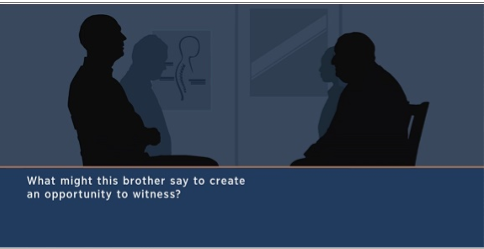
Try creating an opportunity for a witness by making a heartfelt statement about your faith that might prompt the listener to ask for an explanation. Jesus made intriguing statements that moved the woman to ask questions. When he eventually introduced the good news, he was merely answering her questions.

[Play and discuss video 2, and then play and discuss video 3.]

Starting a conversation is much like playing a game of catch. Both require at least two participants and are relatively easy to initiate. At your next opportunity, “toss” someone your words, and see if you can start a conversation.

Our Meetings and Ministry – Starting Conversations—Video 1

Excuse me, lady, can I sit here?
Sure!
What a beautiful day today. I really like this park so quiet.

What a beautiful day today!
It’s true! Today, you’re just fine.
I really like this park, it’s so peaceful.
Yes, indeed. I’ve been coming here since I was my daughter’s age. They often took me there, my parents.
Is it nice, and has the park changed a lot since the hour?
Not much. The trees and bushes are larger, and that driveway has been added for walking.
You know, I’ve been coming here for about a year. We moved to the area, shortly after my husband retired.

And where did you live before?
On the other side, of the city.
I do not go often, in those parts. Is there a nice park to walk around?
Yes, but it’s not as nice as this. I too often took my children when they were young.
Ah! How many children do you have?
We have two males, and one female.
It must have been difficult. I have only one daughter, and it’s really challenging. Sometimes I wonder if I can grow it well, but maybe you learn with time.
Look, my husband and I, we followed some advice, which in our case have always worked. Can I show you?

Our Meetings and Ministry – Starting Conversations—Video 2

I think today the doctor is a bit late with visits.
Already! I had an appointment 20 minutes ago, and he has not called me yet.
Anyway, I have to say, that I’m fine with this doctor. It’s not hurried when you visit. Maybe that’s why it’s late, because it takes all the time it takes to visit patients.
But it will be like that, but my arthritis is making itself felt today. I just wish it was hurried, so I can go home.


Eh, I understand it perfectly, I’ve had arthritis for a long time.
The Watchtower  |  No. 1 2019
Everyone is subject to sickness and death today, but that will not be the case much longer. God will soon apply the benefits of Jesus’ ransom sacrifice so that “everyone exercising faith in him might not be destroyed but have everlasting life.” (John 3:16) What will be the result?
Sickness will be eradicated. “No resident will say: ‘I am sick.’ The people dwelling in the land will be pardoned for their error.”—Isaiah 33:24.
THE WATCHTOWER No. 3 2018 | Does God Care About You?
God Will Soon End All Suffering 

Our Meetings and Ministry – Starting Conversations—Video 3

I understand it, perfectly. I too have been arthritis for a long time. I can not wait for the moment to come, when no one will have arthritis any more, or any other illness. You know, the day will come, when no one will get sick anymore.
What do you mean! Do you think doctors will find the cure for arthritis?
No! Honestly, I do not think doctors will ever succeed. But did he know that God promised to eliminate diseases?
I had none, never heard of it.
Look, I’ll show you.