Tag Archives: Our Christian Life and Ministry

Love Identifies True Christians—Rejoice With the Truth

WHY IMPORTANT: In imitation of Jesus, we must bear witness to the truth regarding God’s purposes. (Joh 18:37) We must also rejoice with the truth, speak the truth, and consider whatever things are true, despite living in a world full of falsehood and unrighteousness.—1Co 13:6; Php 4:8.

HOW TO DO IT:

Be determined not to listen to or spread harmful gossip.—1Th 4:11
Do not rejoice over another’s calamity
Take delight in positive, encouraging things

WATCH THE VIDEO “HAVE LOVE AMONG YOURSELVES”—REJOICE, NOT OVER UNRIGHTEOUSNESS, BUT WITH THE TRUTH, AND THEN ANSWER THE FOLLOWING QUESTIONS:

In what sense did Debbie “rejoice over unrighteousness”?

Oh Alice.
Oh Debbie, bye.
I absolutely must tell you what I heard yesterday.
Meaning?
You know Bethany, who years ago came from time to time in the hall?
Are you attending meetings again? Has it started again?
I would not say that. Do you know what he did? He left the man he lived with, he went to live with another.
No a moment! But do you keep hearing with her?
Well, no! I did not talk to her directly. But you know how the voices turn. However, does it seem possible to you?

How did Alice steer the conversation with Debbie in a positive direction?

Debbie, Bethany did a lot of things wrong since I stopped coming to meetings. And I sincerely hope that you make changes and come back soon. But until it happens, do you think it’s time to talk about the wrong things you’re doing now?
Well, probably not. I just thought that as we grew up together, I wanted to know how far it was from the truth.
But Debbie, we must never forget, that love does not rejoice in injustice but rejoices in the truth.
You know what you’re right. Why talk about this, let’s talk about encouraging things and better.
Yes, it’s true. Do you remember the lady we found together on duty? Well, I came back with Helen this morning and the lady was at home. He let us in, and even accepted a book.
Really?
Yes. Then we showed him a video and he said that maybe he will come to the meeting.
But it’s wonderful!

What are some of the good things that we can talk about?

*** w03 9/15 pp. 11-13 pars. 10-14 Spiritual Conversations Build Up ***
10 That which is true involves more than information that is correct and not false. It refers to something that is upright and trustworthy, such as the truth of God’s Word. Hence, when we talk to others about Bible truths that impressed us, discourses or talks that uplifted us, or Scriptural counsel that helped us, we are considering things that are true. On the other hand, we reject “the falsely called ‘knowledge,’” which gives only an appearance of truthfulness. (1 Timothy 6:20) And we avoid passing on gossip or relating dubious experiences that cannot be verified.
11 Things of serious concern are subjects that are dignified and consequential, not trivial or petty. They include concerns about our Christian ministry, the critical times in which we live, and the need for us to maintain fine conduct. When we discuss such serious matters, we reinforce our determination to keep awake spiritually, maintain our integrity, and continue preaching the good news. Indeed, interesting experiences in our ministry and current events that remind us that we are living in the last days provide a variety of material for stimulating conversations.—Acts 14:27; 2 Timothy 3:1-5.
12 The word righteous means being right in God’s eyes—meeting his standards. Chaste conveys the idea of purity in thought and conduct. Slander, obscene jokes, or sexual innuendos have no place in our conversations. (Ephesians 5:3; Colossians 3:8) In the workplace or at school, Christians wisely withdraw when conversations take on this tone.
13 When Paul recommends considering lovable things, he refers to matters that are pleasing and agreeable or that inspire love, as opposed to those that arouse hatred, bitterness, or contention. Things well spoken of refer to information that is reputable or of good report. Such good reports would include the life stories of faithful brothers and sisters, which appear regularly in the Watchtower and Awake! magazines. Why not share with others your impressions once you have read these faith-strengthening articles? And how encouraging it is to hear of the spiritual accomplishments of others! Such conversations will build love and unity in the congregation.
14 Paul speaks of “whatever virtue there is.” Virtue refers to goodness or moral excellence. We must be careful that our lips are guided by Scriptural principles and that they do not deviate from what is righteous, chaste, and virtuous. Praiseworthy means “commendable.” If you hear a good talk or notice a faithful example in the congregation, speak about it—both to the person involved and to others. The apostle Paul frequently praised the fine qualities of his fellow worshipers. (Romans 16:12; Philippians 2:19-22; Philemon 4-7) And, of course, the handiwork of our Creator is truly praiseworthy. There we find a wealth of subjects for upbuilding conversations.—Proverbs 6:6-8; 20:12; 26:2.

BIBLE EXAMPLE FOR MEDITATION: Lot was constantly tormented by the unrighteous conduct of people in Sodom and Gomorrah.—2Pe 2:8.

*** w90 4/15 p. 17 pars. 3-5 Prepare for Deliverance Into a New World ***
3 Lot had originally moved into the area near Sodom because of its potential for material prosperity. In time, he took up dwelling in the city itself. (Genesis 13:8-12; 14:12; 19:1) But he did not agree with the lewd practices of the men of the city, and those men did not view him as one of them, evidently because Lot and his family did not share in their social life. As 2 Peter 2:7, 8 says: “Lot . . . was greatly distressed by the indulgence of the law-defying people in loose conduct—for that righteous man by what he saw and heard while dwelling among them from day to day was tormenting his righteous soul by reason of their lawless deeds.” Those conditions constituted a severe trial for Lot because, as a righteous man, he abhorred such conduct.
4 In our day too, the moral level of human society has become degraded. In many lands, more and more engage in premarital or extramarital sex. Even many young people in school are deeply involved in this way of life, and they ridicule those who do not join them. Homosexuals outspokenly identify themselves and parade through the streets of large cities to demand recognition. The clergy have joined in the reveling. Officially, not many churches ordain known homosexuals and fornicators. Yet, in actuality, as news reports have repeatedly shown, it is not at all difficult to find homosexuals, fornicators, and adulterers in the ranks of the clergy. In fact, some religious leaders have been moved to other cities or have even been forced to resign over sex scandals. Lovers of righteousness are not in sympathy with such wickedness; they “abhor what is wicked.” (Romans 12:9) Especially are they grieved when the conduct of people who claim to serve God brings reproach on his name and causes uninformed people to turn away from all religion in disgust.—Romans 2:24.
5 Year after year the situation grows worse. Will there be an end to it? Yes, there will! What Jehovah did to ancient Sodom and Gomorrah shows clearly that, at his appointed time, he will execute judgment. He will utterly destroy the wicked, but he will deliver his loyal servants.

ASK YOURSELF, ‘In what ways can I show that I rejoice, not over unrighteousness, but with the truth?’

*** cl chap. 30 pp. 307-308 par. 20 “Go On Walking in Love” ***
20 “Love . . . does not rejoice over unrighteousness.” The New English Bible here reads: “Love . . . does not gloat over other men’s sins.” Moffatt’s translation says: “Love is never glad when others go wrong.” Love finds no pleasure in unrighteousness, so we do not wink at immorality of any kind. How do we react if a fellow believer is ensnared by sin and fares badly as a result? Love will not let us rejoice, as if to say ‘Good! He deserved it!’ (Proverbs 17:5) We do rejoice, however, when a brother who has erred takes positive steps to recover from his spiritual fall.

*** w93 10/15 p. 20 par. 13 Love (Agape)—What It Is Not and What It Is ***
13 Moreover, we are told that love “does not rejoice over unrighteousness.” The world rejoices over unrighteousness, as can be seen by the popularity of violent and pornographic literature, films, and TV programs. All such rejoicing is selfish, having no regard for God’s righteous principles or the welfare of others. All such selfish rejoicing is sowing to the flesh and in due time will reap corruption from the flesh.—Galatians 6:8.

*** w93 10/15 pp. 21-22 par. 17 Love (Agape)—What It Is Not and What It Is ***
17 Love does not rejoice over unrighteousness but “rejoices with the truth.” Love and truth go hand in hand—God is love, and at the same time, he is “the God of truth.” (Psalm 31:5) Love rejoices at seeing truth triumph over and expose falsehood; this accounts in part for the great increase taking place in the number of Jehovah’s worshipers today. However, since truth is contrasted with unrighteousness, the thought may also be that love rejoices with righteousness. Love rejoices at the triumph of righteousness, as Jehovah’s worshipers are commanded to do at the fall of Babylon the Great.—Revelation 18:20.


Love Identifies True Christians—Protect Precious Unity

Whom do we hurt the most if we keep account of the injury?

Love Identifies True Christians—Protect Precious Unity

WHY IMPORTANT: On the night before his death, Jesus prayed that his disciples would “be completely unified.” (Joh 17:23, ftn.) To remain united, we must display love, which “does not keep account of the injury.”—1Co 13:5.
HOW TO DO IT:

Imitate Jehovah by looking for the good in others
Forgive freely
After resolving a matter, do not bring it up again.—Pr 17:9

WATCH THE VIDEO “HAVE LOVE AMONG YOURSELVES”—DO NOT KEEP ACCOUNT OF THE INJURY, AND THEN ANSWER THE FOLLOWING QUESTIONS:

In the first part of the video, how did Helen indicate that she was ‘keeping account of the injury’?
We were so good today. I always like going out with you.
Me too. And I hope Ms. Johnson will come to the meeting on Sunday.
It would be beautiful.
Hey did you find your sunglasses then?
No! I looked everywhere. I have not the faintest idea where they are.
Hey!
Hey Susan!
Everything good?
I’m fine and you?
You left these at my house last night.
But you realize, I should have imagined it. I thank you so much.
Here it is. Susanna invited people to her house last night, and she did not say anything to me. As usual. I just do not understand.
I knew it was yours.
Thanks again. I always leave my things around.
Ah! Helen and how are you?
Well sorry, I have to go.
Helen? But what happened to him?
I have no idea.

__________

Hey Helen! I can sit down?
What do you want Susan?
Helen! Maybe I did something that made you sick, and I want to apologize if it happened. I hurt you somehow.
Am I wrong or did you invite a few people to your house last night?
Well! Yes, someone.
Tell me how it is possible that I will never be, never invited.
Helen, I’m sorry. I did not think that …
I did not think what? That I would not have noticed every single time he did not invite me to your house? Well, I noticed it. In the last two months, this is the third time you’ve invited people to your home without me. Not to mention the other 4 times this year.
I’m so sorry Helen, I did not mean to exclude you. I can assure you that there is nothing personal.
Nothing personal? But explain to me how you can invite practically all the congregation to your home, except me, and say that there is nothing personal.
Welcome brothers and sisters, please take a seat, the meeting will start in a few minutes.

In the second part of the video, how did Helen overcome her negative thinking and develop a positive viewpoint?
We were so good today. I always like going out with you.
Me too. And I hope Ms. Johnson will come to the meeting on Sunday.
It would be beautiful.
Hey did you find your sunglasses then?
No! I looked everywhere. I have not the faintest idea where they are.
Hey!
Hey Susan!
Everything good?
I’m fine and you?
You left these at my house last night.
But you realize, I should have imagined it. I thank you so much.
Here it is. Susan invited people to her house last night. But why did not you call me this time? A moment! I have to think that the important thing is another. She is so hospitable. I should pray that Jehovah will continue to bless you for this. And maybe I can do something too.

Ultimately, how did Helen add to the unity of the congregation?
Ah Helen, and how are you?
Well! And you Susan?
Very well.
Hey, would you like to go, and Elis too, would you like to go out on duty this Saturday, and then come to my house for lunch?
It seems like a great idea!
Would you like me? And how! I can not wait. Thanks Helen. What can I bring?
You do not have to bring anything, I think of everything.
OK perfect. Oh sorry, I have to go.

BIBLE EXAMPLE FOR MEDITATION: The apostle Paul recognized John Mark’s good qualities, even though John Mark had disappointed him earlier.—Ac 13:13; 15:37, 38; 2Ti 4:11.
*** w10 3/15 pp. 7-9 Mark—‘Useful for Ministering’ ***
Paul, Barnabas, and Mark traversed Cyprus, preaching as they went; then they headed for Asia Minor. There, John Mark made a decision that disappointed Paul. The account says that when the party arrived at Perga, “John withdrew from them and returned to Jerusalem.” (Acts 13:13) Why he did this is not stated.
A couple of years later, Paul, Barnabas, and Mark were back in Antioch. The two apostles were discussing a second missionary tour to build on the accomplishments of the first. Barnabas wanted to take his cousin along, but Paul would not hear of it because Mark had previously deserted them. This is what provoked the scene described in the introduction. Barnabas took Mark and went to work in his native Cyprus, while Paul headed for Syria. (Acts 15:36-41) Clearly, Paul and Barnabas differed in their view of Mark’s earlier decision.
Reconciliation
Mark was doubtless grieved by this experience. Yet, he remained a faithful minister. Some 11 or 12 years after this incident with Paul, Mark reappears in the history of early Christianity. Where? Where you would perhaps least expect to find him—with Paul!
Had Paul years before been overcritical of Mark? Had Mark benefited from needed discipline? Or was it perhaps a little of both? Whatever the case, their reconciliation testifies to the maturity of both Paul and Mark. They let bygones be bygones and worked together again. What an excellent example for anyone who has had a difference of opinion with a fellow Christian!
When Paul, during his second imprisonment in Rome about 65 C.E., wrote to call Timothy from Ephesus, Paul added: “Take Mark and bring him with you.” (2 Tim. 4:11) So Mark was then in Ephesus. And how can we doubt that he responded to Paul’s summons to return to Rome with Timothy? Travel was not easy back then, but Mark made those journeys willingly.

ASK YOURSELF, ‘How can I show confidence in someone who has disappointed me?’
*** w91 3/1 pp. 22-23 pars. 10-12 “Seek Peace and Pursue It” ***
10 Today, then, it is quite possible that someone may be offended by a tactless word or a perceived slight from a fellow Christian. A characteristic in one person may intensely irritate another. Personalities may clash. Someone may strongly disagree with a decision of the elders. On the body of elders itself, one elder may be very strong-minded and try to override the other elders. Despite the fact that such things happen, we still have to seek peace and pursue it. The challenge is to handle these problems in a Christian way so as to preserve “the uniting bond of peace.”—Ephesians 4:3.
11 The Bible says: “Let Jehovah be magnified, who takes delight in the peace of his servant.” (Psalm 35:27) Yes, Jehovah wants us to be at peace. Hence, he has made two outstanding provisions to help us preserve peace among ourselves and with him. One is holy spirit, of which peace is a fruit, along with related peaceable qualities, such as long-suffering, kindness, mildness, and self-control. (Galatians 5:22, 23) The other is divine wisdom, of which we read: “The wisdom from above is first of all chaste, then peaceable, reasonable, ready to obey, full of mercy and good fruits.”—James 3:17, 18.
12 Therefore, when our peace with others is disturbed, we should pray for wisdom from above to show us how to act, and we should ask for holy spirit to strengthen us to do what is right. (Luke 11:13; James 1:5; 1 John 3:22) In harmony with our prayer, we can then look into the source of divine wisdom, the Bible, for guidance, as well as check available Bible literature for counsel on how to apply the Scriptures. (2 Timothy 3:16) We may also wish to seek advice from elders in the congregation. A final step would be to follow the guidance received. Isaiah 54:13 says: “All your sons will be persons taught by Jehovah, and the peace of your sons will be abundant.” This implies that our peace depends on our putting into practice the things Jehovah teaches us.

Digging for Spiritual Gems: John 15-17 (Week October 22-28)

Joh 17:21-23—In what sense were Jesus’ followers to be “one”? (“one” study note on Joh 17:21, nwtsty; “be perfected into one” study note on Joh 17:23, nwtsty)
one: Or “at unity.” Jesus prayed that his true followers would be “one,” unitedly working together for the same purpose, just as he and his Father are “one,” demonstrating cooperation and unity of thought. (Joh 17:22) At 1Co 3:6-9, Paul describes this type of unity among Christian ministers as they work with one another and with God.—See 1Co 3:8 and study notes on Joh 10:30; 17:11.
be perfected into one: Or “be completely unified.” In this verse, Jesus connects perfect unity with being loved by the Father. This is in harmony with Col 3:14, which says: “Love . . . is a perfect bond of union.” This perfect unity is relative. It does not mean that all differences of personality, such as individual abilities, habits, and conscience, are eliminated. It does mean that Jesus’ followers are unified in action, belief, and teaching.—Ro 15:5, 6; 1Co 1:10; Eph 4:3; Php 1:27.

Joh 17:24—What is “the founding of the world”? (“founding of the world” study note on Joh 17:24, nwtsty)
founding of the world: The Greek word for “founding” is rendered “to conceive” at Heb 11:11, where it is used with “offspring.” Here used in the expression “founding of the world,” it apparently refers to the birth of children to Adam and Eve. Jesus associates “the founding of the world” with Abel, apparently the first redeemable human and the first to have his name “written in the scroll of life from the founding of the world.” (Lu 11:50, 51; Re 17:8) These words of Jesus in prayer to his Father also confirm that long ago—before Adam and Eve conceived offspring—God loved his only-begotten Son.

What has this week’s Bible reading taught you about Jehovah?

*** w18 May p. 18 par. 3 Why We “Keep Bearing Much Fruit” ***
3 The foremost reason why we share in the preaching work is to glorify Jehovah and sanctify his name before mankind. (Read John 15:1, 8.) Note that Jesus compared his Father, Jehovah, to a cultivator, or gardener, who grows grapes. Jesus likened himself to a vine, or stem, and his followers to branches. (John 15:5) Thus, the grapes fittingly illustrate the Kingdom fruitage that is produced by Christ’s followers. Jesus told his apostles: “My Father is glorified in this, that you keep bearing much fruit.” Just as vines that produce good grapes bring honor to a cultivator, so we bring honor, or glory, to Jehovah when we proclaim the Kingdom message to the best of our abilities.—Matt. 25:20-23.

*** w18 May p. 18 par. 5 Why We “Keep Bearing Much Fruit” ***
5 Read John 15:9, 10. Our heartfelt love for Jehovah and for Jesus is an important reason why we preach the Kingdom message. (Mark 12:30; John 14:15) Jesus told his disciples not only to be in his love but to “remain in [his] love.” Why? Because living as a true disciple of Christ year after year calls for endurance. Jesus stressed the need for endurance by using forms of the word “remain” over and over in the brief passage recorded at John 15:4-10.

*** w18 June p. 8 par. 1 May We All Be One as Jehovah and Jesus Are One ***
JESUS was concerned about unity during his final supper with his apostles. When praying with them, he spoke of his desire that all his disciples be one, just as he and his Father are one. (Read John 17:20, 21.) Their unity would give a powerful witness, offering clear evidence that Jehovah had sent Jesus to the earth to do God’s will. Love would be a mark of Jesus’ true disciples that would contribute to their unity.—John 13:34, 35.

*** w18 July p. 11 par. 17 Whose Recognition Do You Seek? ***
17 While on earth, Jesus expressed his desire to return to the glory he once had in heaven with his Father. (John 17:5) Nothing indicates that Jesus was hoping for more than that. He was not expecting some sort of heavenly “upgrade.” But what did Jehovah do? He honored Jesus in an unexpected way by resurrecting him to “a superior position” and giving him what no one else had received up until that time—immortal spirit life! (Phil. 2:9; 1 Tim. 6:16) What an outstanding acknowledgment of Jesus’ faithful course!

*** w18 November p. 10 par. 7 “I Will Walk in Your Truth” ***
7 To walk in the truth, we must accept and obey all of Jehovah’s sayings. We must give the truth priority in our lives and live according to Bible principles. In prayer to Jehovah, King David declared: “I will walk in your truth.” (Ps. 86:11) David was determined. We too must be firmly resolved to keep walking in God’s truth. If we are not, we could have second thoughts about what we paid for the truth and perhaps be tempted to begin taking back part of the payment. Rather, we carefully hold on to the complete truth. We recognize that we cannot pick which truths to accept and which to ignore. After all, we must walk in “all the truth.” (John 16:13) Let us reflect on five things that we may have paid for the truth. Doing so will strengthen our resolve not to be lured into taking back even part of our payment.—Matt. 6:19.

*** wp17 No. 2 pp. 6-7 How Will You Respond to God’s Greatest Gift? ***
Come to know the Giver. The ransom does not automatically bring everlasting life to all humans. Rather, Jesus said in prayer to God: “This means everlasting life, their coming to know you, the only true God, and the one whom you sent, Jesus Christ.” (John 17:3) If someone told you that a man saved your life when you were yet a child, would you not be interested in learning more about that man and why he saved you? Jehovah God, who gave the lifesaving gift of the ransom, wants you not only to know who he is but also to come into a close relationship with him. “Draw close to God,” the Bible urges, “and he will draw close to you.”—James 4:8.

*** w17 February p. 9 par. 4 The Ransom—A “Perfect Present” From the Father ***
4 Jesus, on the other hand, truly loved the name of Jehovah. (John 17:25, 26) Jesus contributed to the sanctification of the divine name. (Read Psalm 40:8-10.) By his perfect life course on earth, Jesus proved that it is reasonable and righteous for Jehovah to set standards for his intelligent creatures. Even when Satan subjected Jesus to an agonizing death, Jesus remained completely loyal to his heavenly Father. By being loyal, Jesus proved that a perfect human could maintain perfect obedience to God’s righteous standards.

*** w16 April p. 28 par. 3 Maintain Your Neutrality in a Divided World ***
3 The Bible gives several reasons why God requires that we remain neutral. For example, we follow the teachings and example of his Son, Jesus Christ, by being “no part of the world,” avoiding its politics and wars. (John 6:15; 17:16) We must remain neutral in order to be loyal subjects of God’s Kingdom. Otherwise, how could we have a clean conscience when we preach the good news that only God’s Kingdom can solve mankind’s problems? Additionally, unlike false religions that divide their members by meddling in politics, true worship preserves our international brotherhood by helping us to remain neutral.—1 Pet. 2:17.

*** w15 7/15 p. 22 par. 1 Maintain Your Loyalty to God’s Kingdom ***
LOYALTY and neutrality are always issues for true Christians, not just in times of war. Why? Because all who are dedicated to Jehovah have promised him their love, loyalty, and obedience. (1 John 5:3) We want to abide by God’s righteous standards wherever we live and whatever our background, nationality, or culture. Loyalty to Jehovah and to his Kingdom transcends any other attachment we may have. (Matt. 6:33) Such loyalty requires that Christians remain separate from all conflicts and controversies of this world.—Isa. 2:4; read John 17:11, 15, 16.

*** w15 8/15 p. 26 par. 11 Watch Your Associations in These Last Days ***
11 In contrast with what the world produces, the material produced by Jehovah’s organization in these last days encourages conduct that leads to eternal life. In prayer to Jehovah, Jesus said: “This means everlasting life, their coming to know you, the only true God, and the one whom you sent, Jesus Christ.” (John 17:3) Through his organization, our heavenly Father is providing an abundance of upbuilding spiritual food. How blessed we are to have magazines, brochures, books, videos, and Web pages that promote true worship! God’s organization also provides regular meetings in more than 110,000 congregations worldwide. At those meetings and at assemblies and conventions, we consider Bible-based material that builds faith in God and his promises.—Heb. 10:24, 25.

What other spiritual gems have you discovered in this week’s Bible reading?

*** wp18 No. 1 p. 15 The Bible and Your Future ***
How can you build such an eternal friendship with God? Keep learning about him through the pages of his Word, the Bible. (John 17:3; 2 Timothy 3:16) Seek his help to understand the Scriptures. The Bible assures us that if we sincerely “keep asking God” for wisdom, he will grant it to us. (James 1:5) Finally, strive to apply what you learn, letting God’s Word serve as both “a lamp to [your] foot” and a “light for [your] path”—now and throughout eternity.—Psalm 119:105.

*** w18 February p. 21 par. 12 What Does It Mean to Be a Spiritual Person? ***
12 Yet, of all the people who have lived, who is the most outstanding example of a spiritual person? It is Jesus, of course. Throughout his life and ministry, he showed that he wanted to imitate his Father, Jehovah. He thought, felt, and acted like Jehovah and lived in harmony with God’s will and standards. (John 8:29; 14:9; 15:10) Note, for example, how Jehovah’s feelings of compassion are described by the prophet Isaiah, and compare that description with what the Gospel writer Mark reports about Jesus’ feelings. (Read Isaiah 63:9; Mark 6:34.) Are we like Jesus, ever ready to show compassionate concern when we meet people who need help? In addition, Jesus devoted himself to the work of preaching and teaching the good news. (Luke 4:43) All such feelings and actions are marks of a spiritual person.

*** w18 May p. 24 par. 9 Know Your Enemy ***
9 What advantage do we gain from knowing the extent of Satan’s influence? It helps us keep a balanced view of secular authorities and motivates us in our witnessing work. We understand that Jehovah wants us to respect governmental authorities. (1 Pet. 2:17) And he expects us to obey the laws of human governments as long as those laws do not conflict with his standards. (Rom. 13:1-4) But we realize that we must remain neutral, never favoring one political party or human leader over another. (John 17:15, 16; 18:36) Because we see what Satan is trying to do to Jehovah’s name and reputation, we feel more compelled to teach others the truth about our God. We proudly bear and use his name, knowing that loving him is far more rewarding than loving money or things.—Isa. 43:10; 1 Tim. 6:6-10.

*** w18 June pp. 16-17 par. 3 Let God’s Laws and Principles Train Your Conscience ***
3 When a person’s conscience is not properly trained, it does not act as a restraint from wrongdoing. (1 Tim. 4:1, 2) Such a conscience might even convince us that “bad is good.” (Isa. 5:20) Jesus warned his followers: “The hour is coming when everyone who kills you will think he has offered a sacred service to God.” (John 16:2) That was true of those who murdered the disciple Stephen, and it has been true of others like them. (Acts 6:8, 12; 7:54-60) How ironic that in committing such evil crimes as murder, religious fanatics violate the very laws of the One whom they claim to worship! (Ex. 20:13) Clearly, their consciences are treacherous guides!

*** w18 September p. 12 par. 1 Keep Displaying Love—It Builds Up ***
ON HIS final night with his disciples, Jesus mentioned love nearly 30 times. He specifically indicated that his disciples should “love one another.” (John 15:12, 17) Their love for one another would be so outstanding that it would clearly distinguish them as his true followers. (John 13:34, 35) This love is not mere sentimentality. Jesus was referring to a most noble quality—self-sacrificing love. He said: “No one has love greater than this, that someone should surrender his life in behalf of his friends. You are my friends if you do what I am commanding you.”—John 15:13, 14.

*** w18 October p. 25 par. 12 Put Trust in Our Active Leader—The Christ ***
12 For some, it takes time to adjust to a clarification in understanding. Jewish Christians needed sufficient time to adjust their viewpoint. (John 16:12) Some found it hard to accept that circumcision was no longer a sign of a special relationship with God. (Gen. 17:9-12) Others, out of fear of persecution, were reluctant to stand out in Jewish communities. (Gal. 6:12) In time, though, Christ provided further guidance through inspired letters written by Paul.—Rom. 2:28, 29; Gal. 3:23-25.

*** w18 October p. 32 par. 3 Did You Know? ***
We may one day find ourselves facing threats and persecution. (John 15:20) By feeding regularly on God’s Word and by being active in the ministry, we allow Jehovah’s spirit to be at work in us. We will also find the strength to withstand opposition while maintaining our inner peace.—1 Pet. 4:12-14.

*** w18 November p. 6 par. 11 “Buy Truth and Never Sell It” ***
11 Personal relationships. When we choose to live according to Bible truth, our ties with friends and relatives may change. Why? Jesus prayed regarding his followers: “Sanctify them by means of the truth; your word is truth.” (John 17:17; ftn.) “Sanctify them” can also mean “set them apart.” When we accept the truth, we are set apart from the world because we no longer fit into its mold. People view us differently because our values have changed. We live by the standards of Bible truth. Though we do not want to cause division, some friends and close family members may distance themselves from us or even oppose our newfound faith. This does not surprise us. Jesus acknowledged: “Indeed, a man’s enemies will be those of his own household.” (Matt. 10:36) He also gave assurance that the rewards for buying truth far exceed any price we may pay.—Read Mark 10:28-30.

*** wp16 No. 4 p. 15 The Most Useful Comparison You May Ever Make ***
Jesus said that our worship of God must be based on truth—the truth found in the Bible. (John 4:24; 17:17) And the apostle Paul said that our salvation depends on our coming to “an accurate knowledge of truth.” (1 Timothy 2:4) So it is vital that our beliefs be based on accurate Bible truth. Why, our very salvation is at stake!

*** w15 4/15 p. 7 par. 20 Elders, How Do You Feel About Training Others? ***
20 Elders, remember: A successful teacher is someone who not only loves to train another person but also loves the person he is training. (Compare John 5:20.) That crucial aspect of a teacher’s disposition is quickly discerned by a learner and greatly affects the way he responds to the training he receives. Therefore, dear elders, as you give training, be more than a teacher—be a friend.—Prov. 17:17; John 15:15.

*** w15 8/15 p. 21 par. 10 Prepare Now for Life in the New World ***
10 We can also prepare for life in the new world by exercising patience regarding revealed truth. Are we studious and patient as our understanding of Bible truth is progressively clarified today? If so, we will likely have no difficulty showing patience in the new world as Jehovah makes known his requirements for mankind.—Prov. 4:18; John 16:12.

*** w15 9/15 p. 6 par. 11 Are You Reaching the Stature That Belongs to Christ? ***
11 During his life on earth as a perfect man, Jesus was surrounded by imperfect humans. He was raised by imperfect parents, and he spent years at home with imperfect relatives. Even his closest followers were influenced by the ambitious, manipulative spirit common around them. For example, on the evening before Jesus was executed, there “arose a heated dispute among them over which one of them was considered to be the greatest.” (Luke 22:24) But Jesus was confident that his imperfect followers could grow spiritually and form a united congregation. That same evening, Jesus prayed for the loving unity of his apostles, asking his heavenly Father: “May [they] all be one, just as you, Father, are in union with me and I am in union with you, that they also may be in union with us, . . . in order that they may be one just as we are one.”—John 17:21, 22.

*** w15 9/15 pp. 16-17 par. 16 “Stand Firm in the Faith” ***
16 Strengthen your confidence in the Bible. Jesus was convinced that the Bible is God’s Word, which provides the best guidance in life. (John 17:17) Following Jesus’ example, we must read the Bible daily, study it, and meditate on what we learn. Along with general Bible study, dig into topics about which you may have questions. To illustrate, you might increase your conviction that the end of this system of things really is near by studying in detail the Scriptural proof that we live in the last days. Strengthen your trust in the Bible’s promises for the future by investigating its many prophecies that have already come true. Develop your confidence in the practical value of the Bible by considering examples of how the Bible improves people’s lives.—1 Thess. 2:13.

*** w15 10/1 p. 12 Can We Really Find God? ***
“God is incomprehensible.”—Philo of Alexandria, first-century philosopher.
“[God] is not far off from each one of us.”—Saul of Tarsus, addressing first-century philosophers in Athens.
AS YOU read those two statements, which one describes your view? Many find the words of Saul of Tarsus, also called the apostle Paul, comforting and appealing. (Acts 17:26, 27) And the Bible contains other assurances like that one. For example, Jesus offered a prayer that contains a warm assurance that his followers can come to know God and receive his blessing.—John 17:3.

2018-11 | Initial Call—2Co 1:3, 4

2018-11 | First Return Visit—Ec 9:5, 10

2018-11 | Second Return Visit—Ac 24:15

Love Identifies True Christians—Reject Selfishness and Provocation

Love Identifies True Christians—Reject Selfishness and Provocation
WHY IMPORTANT: Jesus taught that love would identify his disciples. (Joh 13:34, 35) To display Christlike love, we must look out for the interests of others and avoid becoming provoked.—1Co 13:5.
HOW TO DO IT:
When someone says or does something hurtful, pause and analyze the cause of the problem and the consequences of your intended action.—Pr 19:11
Remember that we are all imperfect, and at times we say or do things that we later regret
Resolve differences promptly
WATCH THE VIDEO “HAVE LOVE AMONG YOURSELVES”—REJECT SELFISHNESS AND PROVOCATION, AND THEN ANSWER THE FOLLOWING QUESTIONS:
How did Larry overreact to Tom’s suggestion?
Excuse me! Larry, Frank, did you see Kevin tonight?
Yes, it was near the literary counter.
Ah OK.
I’ll call him if you want.
A would be great! Thanks a lot.
Larry, maybe you’ve already heard that Faye Carter and David Thomas just got engaged, right?
They asked the Kingdom Hall for their wedding, maybe I Kevin you, we can talk about a few minutes tonight after the meeting, so the two guys can proceed with the preparations.
Tonight? But why do you always have to do that Tom.
As well as?
Organize all these meetings at the last minute. Look, maybe you do not want to go home and be with your family, but we do.

How did pausing to reflect help Tom to avoid provocation?
 (I do not want to be with my family? And this, what would you say!) This time just exaggerated.Now I put it in place.No, wait, what I’m saying! If I answer him now, I would risk damaging our relationship and that of our families, and then if we do not show love among us elders, think what would happen to the congregation, what a disgrace it would be for Jehovah and Jesus. What the Bible says Do not leave your own place, love is not irritated). Ah, you’re right Larry. Oh, I’m sorry. I thought it would only take a few minutes, but we can plan to do it at another time, so tonight we all go home early.
How did Tom’s mild reply diffuse the tense situation?
No! Tom, I have to apologize instead, I exaggerated. Look, you’re right! Since we are all here, it seems to me an excellent idea to take care of it immediately, if possible!
Ok, ok.
Here comes Kevin. Let’s see if he is available too.
Agree.
Hey! Kevin?
Hi Tom.
Hello! How are you?
Well!

How do we benefit the congregation when we remain calm under provocation?
BIBLE EXAMPLE FOR MEDITATION: David did not retaliate when Shimei shouted curses at him.—2Sa 16:5-13.
ASK YOURSELF, ‘In what situations might I demonstrate greater self-restraint?’

Sample Conversations – Second return visit 10-2018 (Transcript)

○○● SECOND RETURN VISIT
Question: How does God feel about our suffering?
Scripture: Isa 63:9
Link: What will God do to end our suffering?
Hi Dario
Ah! Good morning. How is everything all right?
Yes, thank you and you?
All right, thank you.
The last time we left with the question, what God feels when we suffer. Notice the comforting response of the Bible, found in Isaiah 63:9. This verse describes what God felt and did, when in the biblical times the Israelites were suffering. Would you like to read it aloud?
All right. “During all their suffering, you suffer too. There he saved his own personal messenger. In his love he is in his compassion He redeems them, and I lift them up and carry them for all the ancient days “.
Thanks Dario. According to this verse, what does God feel when he saw that his people suffered? Did you notice, what does the first part of the verse say?
He says he also suffers.
Exact. So God understood them very well. He felt sorry and suffered too. But God did not just suffer with them, his love pushed him to do something. The verse explains it, did you notice what it is?
Here he says he saved them.
That’s right. At the right time, God did something to eliminate their suffering, and at the same time comfort them so that they could endure them. God does the same today. I remember the other time, he told me how much his family suffered.
Yes indeed, we have spent some really terrible moments.
You see Dario, this verse also concerns you. When she suffers, God suffers with her, and if she allows it, God will give her comfort and help.
Look, I would really like to believe it. It’s just that so difficult.
Sure, he’s right, but through the Bible, God makes her understand that she’s really interested in her. He, for example, has promised that he will soon eliminate suffering. If you like it, we’ll talk about it next time we visit you.

Digging for Spiritual Gems: John 13-14 (Week October 15-21)

Joh 14:6—How is Jesus “the way and the truth and the life”? (“I am the way and the truth and the life” study note on Joh 14:6, nwtsty)
I am the way and the truth and the life: Jesus is the way because it is only through him that it is possible to approach God in prayer. He is also “the way” for humans to be reconciled to God. (Joh 16:23; Ro 5:8) Jesus is the truth in that he spoke and lived in harmony with truth. He also fulfilled scores of prophecies that show his central role in the outworking of God’s purpose. (Joh 1:14; Re 19:10) These prophecies became “‘yes’ [or were fulfilled] by means of him.” (2Co 1:20) Jesus is the life because by means of the ransom, he made it possible for mankind to gain “the real life,” that is, “everlasting life.” (1Ti 6:12, 19; Eph 1:7; 1Jo 1:7) He will also prove to be “the life” for millions who will be resurrected with the prospect of living in Paradise forever.—Joh 5:28, 29.

Joh 14:12—How would those who exercise faith in Jesus “do works greater” than he did? (“works greater than these” study note on Joh 14:12, nwtsty)
works greater than these: Jesus is not saying that the miraculous works his disciples would perform would be greater than his own miraculous works. Rather, he humbly acknowledges that the extent of their preaching and teaching work would be greater than his. His followers would cover more territory, reach more people, and preach for a longer period of time than he would. Jesus’ words clearly show that he expected his followers to continue his work.

What has this week’s Bible reading taught you about Jehovah?

*** wp18 No. 3 p. 10 Suffering—Is It Punishment From God? ***
CONSIDER: Why would Jesus heal people who were sick if sickness and suffering were deserved punishments from God? Would that not amount to undermining God’s justice and righteousness? (Matthew 4:23, 24) Jesus would never counteract God’s actions. He said: “I always do the things pleasing to him” and, “I am doing just as the Father has commanded me to do.”—John 8:29; 14:31.

*** w18 May pp. 18-19 pars. 6-7 Why We “Keep Bearing Much Fruit” ***
6 How do we show that we want to remain in Christ’s love and keep his approval? By observing Jesus’ commandments. Simply put, Jesus tells us, ‘Be obedient to me.’ Yet, Jesus only asked us to do what he himself did, for he added: “Just as I have observed the commandments of the Father and remain in his love.” Jesus sets the example.—John 13:15.
7 As to the connection between obedience and love, Jesus earlier said to his apostles: “Whoever has my commandments and observes them is the one who loves me.” (John 14:21) Moreover, by carrying out Jesus’ command to go and preach, we too show our love for God because Jesus’ commandments reflect his Father’s thinking. (Matt. 17:5; John 8:28) In response to our expression of love, Jehovah and Jesus keep us in their love.

*** w18 June p. 19 par. 15 Let God’s Laws and Principles Train Your Conscience ***
15 The foremost law for Christians is the law of love. Jesus told his disciples: “By this all will know that you are my disciples—if you have love among yourselves.” (John 13:35) Jesus’ half brother James called love “the royal law.” (Jas. 2:8) Paul said: “Love is the law’s fulfillment.” (Rom. 13:10) This emphasis on love is not surprising, since the Bible tells us that “God is love.” (1 John 4:8) God’s love is not reflected merely in sentiment. John wrote: “By this the love of God was revealed in our case, that God sent his only-begotten Son into the world so that we might gain life through him.” (1 John 4:9) Yes, God’s love moved him to action. To the extent that we demonstrate love for Jehovah and his Son, for our Christian brothers, as well as for others of mankind, we give evidence of our Christian maturity.—Matt. 22:37-39.

*** w17 August p. 12 par. 15 “The Peace of God . . . Surpasses All Understanding” ***
15 How can we face challenges and still retain “the peace of God”? It is by maintaining a good relationship with our God, Jehovah. Such a relationship is possible only “by means of Christ Jesus,” who offered his life as a ransom sacrifice. The provision of that ransom is yet another one of the amazing works of our Father. Jehovah uses the ransom to cover our sins, enabling us to have a clean conscience and draw close to him.—John 14:6; Jas. 4:8; 1 Pet. 3:21.

*** w17 September p. 11 par. 12 Imitate Jehovah’s Compassion ***
12 Be helpful in everyday life. Showing compassion for one’s neighbor and Christian brothers is a basic requirement of those who strive to imitate Jesus. (John 13:34, 35; 1 Pet. 3:8) One meaning of compassion is “to suffer together.” A person who shows compassion is moved to relieve others’ suffering, perhaps by helping them out of their difficulties. Seek opportunities to do so! For example, could you help someone by offering to perform a necessary chore, maybe running an errand for him?—Matt. 7:12.

*** w17 October p. 9 par. 10 “Love . . . in Deed and Truth” ***
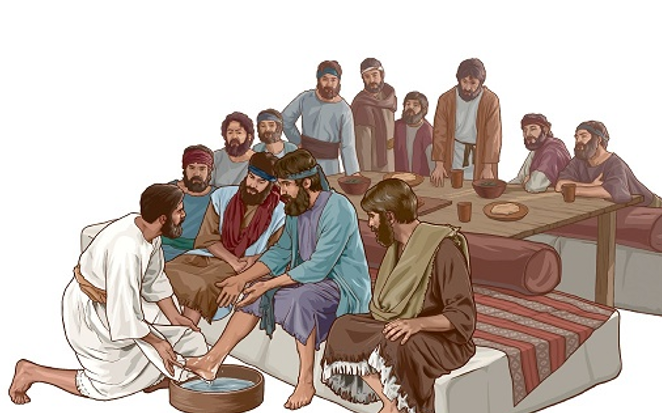
10 Take the lead in showing honor to others. (Read Romans 12:10.) Jesus set the pattern in honoring others by performing the lowliest of tasks. (John 13:3-5, 12-15) We may have to work hard to develop the humility needed to show honor to others in this way. Even the apostles could not fully understand Jesus’ actions until they received holy spirit. (John 13:7) We can show honor to others by not thinking too much of ourselves because of our education, material possessions, or privileges in Jehovah’s service. (Rom. 12:3) And rather than envying those who receive praise, we rejoice with them even if we feel that we deserve equal honor or a share of the credit for what was done.

What other spiritual gems have you discovered in this week’s Bible reading?

*** w18 January pp. 29-30 par. 11 See the Difference in People ***
11 In contrast with the people who show the widespread lack of love today, those who worship Jehovah have genuine love for their fellow man. This has always been true. Jesus said that love of neighbor, a form of a·gaʹpe, was the second most important commandment in the Mosaic Law, second only to love of God. (Matt. 22:38, 39) Jesus also said that love for one another would be the quality that would identify true Christians. (Read John 13:34, 35.) Such Christian love would even be extended to one’s enemies.—Matt. 5:43, 44.

*** w18 July p. 26 par. 15 We Belong to Jehovah ***
15 Our appreciation for Jehovah’s special friendship is shown in how we treat fellow worshippers. They too belong to Jehovah. If we never lose sight of that fact, we will always treat our brothers and sisters with kindness and love. (1 Thess. 5:15) Jesus said to his followers: “By this all will know that you are my disciples—if you have love among yourselves.”—John 13:35.

*** w18 August p. 28 Patience—Endurance With a Purpose ***
We can develop patience by examining and imitating Jesus’ perfect example. In harmony with that example, the apostle Paul under inspiration described “the new personality,” which includes “patience,” and then he urged us to “let the peace of the Christ rule in [our] hearts.” (Col. 3:10, 12, 15) We can let such peace “rule” in our hearts by imitating Jesus’ unbreakable faith that in His due time, God will correct matters that concern us. When we follow Jesus’ example, we will not be provoked into losing our patience, no matter what may be happening around us.—John 14:27; 16:33.

*** w18 September p. 4 par. 5 “If You Know These Things, Happy You Are if You Do Them” ***
5 Putting divine instruction into practice is essentially what wisdom means. (Ps. 107:43) The reward for wisdom is worth the effort. “Nothing you desire can compare to it. . . . It is a tree of life to those who take hold of it, and those who keep firm hold of it will be called happy.” (Prov. 3:13-18) Jesus said: “If you know these things, happy you are if you do them.” (John 13:17) The disciples’ happiness would last if they kept doing what Jesus instructed them to do. They did not embrace his teachings and example simply as an immediate response on that one occasion. It became their way of life.

*** wp17 No. 1 p. 15 Is It Just a Small Misunderstanding? ***
2. The Bible is directed to people who honestly want God’s help to understand it. Jesus showed that people would need help to understand fully what he taught. How would they receive it? Jesus explained: “The helper, the holy spirit, which the Father will send in my name, that one will teach you all things.” (John 14:26) So God provides his holy spirit—his powerful active force—to help people understand what they read in the Bible. However, God withholds his spirit from people who do not rely on him to help them, so the Bible often seems obscure to them. The holy spirit also moves more knowledgeable Christians to come to the aid of those seeking greater understanding.—Acts 8:26-35.

*** w17 January p. 31 par. 17 “These Things Entrust to Faithful Men” ***
17 In the matter of training others to take on increased responsibility, there is no better example than that of Jesus. He knew that his earthly ministry would come to an end and that others would carry on his work. Though his disciples were imperfect, he had confidence in them and told them that they would do works greater than he did. (John 14:12) He trained them thoroughly, and they spread the good news throughout the then-known world.—Col. 1:23.

*** w17 June p. 19 Will You Resolve Conflicts and Promote Peace? ***
Perhaps there is in your congregation a brother whose speech and actions irritate you. Still, you realize that Christ died for that person and you are to show love. (John 13:34, 35; Rom. 5:6-8) So rather than write off any friendship with that one or tend to avoid him, ask yourself: ‘Is my brother doing something that is clearly wrong Scripturally? Is he maliciously trying to cause me discomfort? Or do we just have different personalities?’ Also, of great importance is the question: ‘Which of his good qualities can I benefit from?’

*** w17 August p. 25 par. 12 How We Put On and Keep On the New Personality ***
12 To remain humble, we need to set aside time to meditate daily on what we read in God’s Word. (Deut. 17:18-20) In particular, we do well to reflect on Jesus’ teachings and his wonderful example of humble service. (Matt. 20:28) Jesus even washed the feet of his apostles. (John 13:12-17) We also need to pray frequently for God’s spirit to help us fight any tendency of feeling superior to others.—Gal. 6:3, 4; Phil. 2:3.

Sample Conversations – First return visit 10-2018

○●○ FIRST RETURN VISIT
Question: Why do we suffer?
Scripture: 1Jo 5:19
Link: How does God feel about our suffering?

Hi, Dario! I’m glad to find her at home, do you remember me? I’m Francesco.
I am Claudio.
Hi! Yes I remember you.
We came back to see her. Last time we left with the question because we suffer. Notice how the Bible answers here, first John 5 verse 19. Claudio would you please read.
Sure! He says: “We know that we originate from God but the whole world is in the power of the wicked”.
Thank you! So according to this verse, who controls the world thinks it’s God, or someone else?
Here we speak of the wicked, refers to the devil.
Yes, he is the true ruler of the world. Seeing everything that happens today, do you think it’s really like that?
I would say yes. The world today is full of delinquency and hatred.
There are no doubts. And other Bible verses explain that the influence of Satan has condemned mankind to sin and death.
I had never heard of it, but it seems a very logical thing.
He’s right, that’s right. So it is not God who causes suffering, he actually cares about us. Next time we can talk about how God feels when we suffer. This could help you find the answer to the questions you have asked about God.
OK it’s good.