Tag Archives: Featured

Preach in a Multilingual Territory

Love Identifies True Christians—Reject Selfishness and Provocation

Love Identifies True Christians—Reject Selfishness and Provocation
WHY IMPORTANT: Jesus taught that love would identify his disciples. (Joh 13:34, 35) To display Christlike love, we must look out for the interests of others and avoid becoming provoked.—1Co 13:5.
HOW TO DO IT:
When someone says or does something hurtful, pause and analyze the cause of the problem and the consequences of your intended action.—Pr 19:11
Remember that we are all imperfect, and at times we say or do things that we later regret
Resolve differences promptly
WATCH THE VIDEO “HAVE LOVE AMONG YOURSELVES”—REJECT SELFISHNESS AND PROVOCATION, AND THEN ANSWER THE FOLLOWING QUESTIONS:
How did Larry overreact to Tom’s suggestion?
Excuse me! Larry, Frank, did you see Kevin tonight?
Yes, it was near the literary counter.
Ah OK.
I’ll call him if you want.
A would be great! Thanks a lot.
Larry, maybe you’ve already heard that Faye Carter and David Thomas just got engaged, right?
They asked the Kingdom Hall for their wedding, maybe I Kevin you, we can talk about a few minutes tonight after the meeting, so the two guys can proceed with the preparations.
Tonight? But why do you always have to do that Tom.
As well as?
Organize all these meetings at the last minute. Look, maybe you do not want to go home and be with your family, but we do.

How did pausing to reflect help Tom to avoid provocation?
 (I do not want to be with my family? And this, what would you say!) This time just exaggerated.Now I put it in place.No, wait, what I’m saying! If I answer him now, I would risk damaging our relationship and that of our families, and then if we do not show love among us elders, think what would happen to the congregation, what a disgrace it would be for Jehovah and Jesus. What the Bible says Do not leave your own place, love is not irritated). Ah, you’re right Larry. Oh, I’m sorry. I thought it would only take a few minutes, but we can plan to do it at another time, so tonight we all go home early.
How did Tom’s mild reply diffuse the tense situation?
No! Tom, I have to apologize instead, I exaggerated. Look, you’re right! Since we are all here, it seems to me an excellent idea to take care of it immediately, if possible!
Ok, ok.
Here comes Kevin. Let’s see if he is available too.
Agree.
Hey! Kevin?
Hi Tom.
Hello! How are you?
Well!

How do we benefit the congregation when we remain calm under provocation?
BIBLE EXAMPLE FOR MEDITATION: David did not retaliate when Shimei shouted curses at him.—2Sa 16:5-13.
ASK YOURSELF, ‘In what situations might I demonstrate greater self-restraint?’

Sample Conversations – Second return visit 10-2018 (Transcript)

○○● SECOND RETURN VISIT
Question: How does God feel about our suffering?
Scripture: Isa 63:9
Link: What will God do to end our suffering?
Hi Dario
Ah! Good morning. How is everything all right?
Yes, thank you and you?
All right, thank you.
The last time we left with the question, what God feels when we suffer. Notice the comforting response of the Bible, found in Isaiah 63:9. This verse describes what God felt and did, when in the biblical times the Israelites were suffering. Would you like to read it aloud?
All right. “During all their suffering, you suffer too. There he saved his own personal messenger. In his love he is in his compassion He redeems them, and I lift them up and carry them for all the ancient days “.
Thanks Dario. According to this verse, what does God feel when he saw that his people suffered? Did you notice, what does the first part of the verse say?
He says he also suffers.
Exact. So God understood them very well. He felt sorry and suffered too. But God did not just suffer with them, his love pushed him to do something. The verse explains it, did you notice what it is?
Here he says he saved them.
That’s right. At the right time, God did something to eliminate their suffering, and at the same time comfort them so that they could endure them. God does the same today. I remember the other time, he told me how much his family suffered.
Yes indeed, we have spent some really terrible moments.
You see Dario, this verse also concerns you. When she suffers, God suffers with her, and if she allows it, God will give her comfort and help.
Look, I would really like to believe it. It’s just that so difficult.
Sure, he’s right, but through the Bible, God makes her understand that she’s really interested in her. He, for example, has promised that he will soon eliminate suffering. If you like it, we’ll talk about it next time we visit you.

Digging for Spiritual Gems: John 13-14 (Week October 15-21)

Joh 14:6—How is Jesus “the way and the truth and the life”? (“I am the way and the truth and the life” study note on Joh 14:6, nwtsty)
I am the way and the truth and the life: Jesus is the way because it is only through him that it is possible to approach God in prayer. He is also “the way” for humans to be reconciled to God. (Joh 16:23; Ro 5:8) Jesus is the truth in that he spoke and lived in harmony with truth. He also fulfilled scores of prophecies that show his central role in the outworking of God’s purpose. (Joh 1:14; Re 19:10) These prophecies became “‘yes’ [or were fulfilled] by means of him.” (2Co 1:20) Jesus is the life because by means of the ransom, he made it possible for mankind to gain “the real life,” that is, “everlasting life.” (1Ti 6:12, 19; Eph 1:7; 1Jo 1:7) He will also prove to be “the life” for millions who will be resurrected with the prospect of living in Paradise forever.—Joh 5:28, 29.

Joh 14:12—How would those who exercise faith in Jesus “do works greater” than he did? (“works greater than these” study note on Joh 14:12, nwtsty)
works greater than these: Jesus is not saying that the miraculous works his disciples would perform would be greater than his own miraculous works. Rather, he humbly acknowledges that the extent of their preaching and teaching work would be greater than his. His followers would cover more territory, reach more people, and preach for a longer period of time than he would. Jesus’ words clearly show that he expected his followers to continue his work.

What has this week’s Bible reading taught you about Jehovah?

*** wp18 No. 3 p. 10 Suffering—Is It Punishment From God? ***
CONSIDER: Why would Jesus heal people who were sick if sickness and suffering were deserved punishments from God? Would that not amount to undermining God’s justice and righteousness? (Matthew 4:23, 24) Jesus would never counteract God’s actions. He said: “I always do the things pleasing to him” and, “I am doing just as the Father has commanded me to do.”—John 8:29; 14:31.

*** w18 May pp. 18-19 pars. 6-7 Why We “Keep Bearing Much Fruit” ***
6 How do we show that we want to remain in Christ’s love and keep his approval? By observing Jesus’ commandments. Simply put, Jesus tells us, ‘Be obedient to me.’ Yet, Jesus only asked us to do what he himself did, for he added: “Just as I have observed the commandments of the Father and remain in his love.” Jesus sets the example.—John 13:15.
7 As to the connection between obedience and love, Jesus earlier said to his apostles: “Whoever has my commandments and observes them is the one who loves me.” (John 14:21) Moreover, by carrying out Jesus’ command to go and preach, we too show our love for God because Jesus’ commandments reflect his Father’s thinking. (Matt. 17:5; John 8:28) In response to our expression of love, Jehovah and Jesus keep us in their love.

*** w18 June p. 19 par. 15 Let God’s Laws and Principles Train Your Conscience ***
15 The foremost law for Christians is the law of love. Jesus told his disciples: “By this all will know that you are my disciples—if you have love among yourselves.” (John 13:35) Jesus’ half brother James called love “the royal law.” (Jas. 2:8) Paul said: “Love is the law’s fulfillment.” (Rom. 13:10) This emphasis on love is not surprising, since the Bible tells us that “God is love.” (1 John 4:8) God’s love is not reflected merely in sentiment. John wrote: “By this the love of God was revealed in our case, that God sent his only-begotten Son into the world so that we might gain life through him.” (1 John 4:9) Yes, God’s love moved him to action. To the extent that we demonstrate love for Jehovah and his Son, for our Christian brothers, as well as for others of mankind, we give evidence of our Christian maturity.—Matt. 22:37-39.

*** w17 August p. 12 par. 15 “The Peace of God . . . Surpasses All Understanding” ***
15 How can we face challenges and still retain “the peace of God”? It is by maintaining a good relationship with our God, Jehovah. Such a relationship is possible only “by means of Christ Jesus,” who offered his life as a ransom sacrifice. The provision of that ransom is yet another one of the amazing works of our Father. Jehovah uses the ransom to cover our sins, enabling us to have a clean conscience and draw close to him.—John 14:6; Jas. 4:8; 1 Pet. 3:21.

*** w17 September p. 11 par. 12 Imitate Jehovah’s Compassion ***
12 Be helpful in everyday life. Showing compassion for one’s neighbor and Christian brothers is a basic requirement of those who strive to imitate Jesus. (John 13:34, 35; 1 Pet. 3:8) One meaning of compassion is “to suffer together.” A person who shows compassion is moved to relieve others’ suffering, perhaps by helping them out of their difficulties. Seek opportunities to do so! For example, could you help someone by offering to perform a necessary chore, maybe running an errand for him?—Matt. 7:12.

*** w17 October p. 9 par. 10 “Love . . . in Deed and Truth” ***
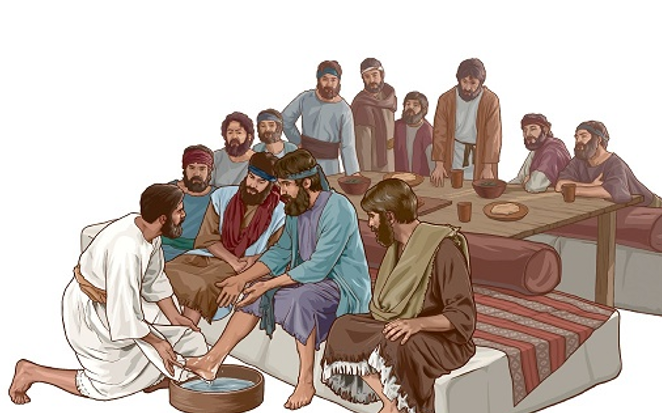
10 Take the lead in showing honor to others. (Read Romans 12:10.) Jesus set the pattern in honoring others by performing the lowliest of tasks. (John 13:3-5, 12-15) We may have to work hard to develop the humility needed to show honor to others in this way. Even the apostles could not fully understand Jesus’ actions until they received holy spirit. (John 13:7) We can show honor to others by not thinking too much of ourselves because of our education, material possessions, or privileges in Jehovah’s service. (Rom. 12:3) And rather than envying those who receive praise, we rejoice with them even if we feel that we deserve equal honor or a share of the credit for what was done.

What other spiritual gems have you discovered in this week’s Bible reading?

*** w18 January pp. 29-30 par. 11 See the Difference in People ***
11 In contrast with the people who show the widespread lack of love today, those who worship Jehovah have genuine love for their fellow man. This has always been true. Jesus said that love of neighbor, a form of a·gaʹpe, was the second most important commandment in the Mosaic Law, second only to love of God. (Matt. 22:38, 39) Jesus also said that love for one another would be the quality that would identify true Christians. (Read John 13:34, 35.) Such Christian love would even be extended to one’s enemies.—Matt. 5:43, 44.

*** w18 July p. 26 par. 15 We Belong to Jehovah ***
15 Our appreciation for Jehovah’s special friendship is shown in how we treat fellow worshippers. They too belong to Jehovah. If we never lose sight of that fact, we will always treat our brothers and sisters with kindness and love. (1 Thess. 5:15) Jesus said to his followers: “By this all will know that you are my disciples—if you have love among yourselves.”—John 13:35.

*** w18 August p. 28 Patience—Endurance With a Purpose ***
We can develop patience by examining and imitating Jesus’ perfect example. In harmony with that example, the apostle Paul under inspiration described “the new personality,” which includes “patience,” and then he urged us to “let the peace of the Christ rule in [our] hearts.” (Col. 3:10, 12, 15) We can let such peace “rule” in our hearts by imitating Jesus’ unbreakable faith that in His due time, God will correct matters that concern us. When we follow Jesus’ example, we will not be provoked into losing our patience, no matter what may be happening around us.—John 14:27; 16:33.

*** w18 September p. 4 par. 5 “If You Know These Things, Happy You Are if You Do Them” ***
5 Putting divine instruction into practice is essentially what wisdom means. (Ps. 107:43) The reward for wisdom is worth the effort. “Nothing you desire can compare to it. . . . It is a tree of life to those who take hold of it, and those who keep firm hold of it will be called happy.” (Prov. 3:13-18) Jesus said: “If you know these things, happy you are if you do them.” (John 13:17) The disciples’ happiness would last if they kept doing what Jesus instructed them to do. They did not embrace his teachings and example simply as an immediate response on that one occasion. It became their way of life.

*** wp17 No. 1 p. 15 Is It Just a Small Misunderstanding? ***
2. The Bible is directed to people who honestly want God’s help to understand it. Jesus showed that people would need help to understand fully what he taught. How would they receive it? Jesus explained: “The helper, the holy spirit, which the Father will send in my name, that one will teach you all things.” (John 14:26) So God provides his holy spirit—his powerful active force—to help people understand what they read in the Bible. However, God withholds his spirit from people who do not rely on him to help them, so the Bible often seems obscure to them. The holy spirit also moves more knowledgeable Christians to come to the aid of those seeking greater understanding.—Acts 8:26-35.

*** w17 January p. 31 par. 17 “These Things Entrust to Faithful Men” ***
17 In the matter of training others to take on increased responsibility, there is no better example than that of Jesus. He knew that his earthly ministry would come to an end and that others would carry on his work. Though his disciples were imperfect, he had confidence in them and told them that they would do works greater than he did. (John 14:12) He trained them thoroughly, and they spread the good news throughout the then-known world.—Col. 1:23.

*** w17 June p. 19 Will You Resolve Conflicts and Promote Peace? ***
Perhaps there is in your congregation a brother whose speech and actions irritate you. Still, you realize that Christ died for that person and you are to show love. (John 13:34, 35; Rom. 5:6-8) So rather than write off any friendship with that one or tend to avoid him, ask yourself: ‘Is my brother doing something that is clearly wrong Scripturally? Is he maliciously trying to cause me discomfort? Or do we just have different personalities?’ Also, of great importance is the question: ‘Which of his good qualities can I benefit from?’

*** w17 August p. 25 par. 12 How We Put On and Keep On the New Personality ***
12 To remain humble, we need to set aside time to meditate daily on what we read in God’s Word. (Deut. 17:18-20) In particular, we do well to reflect on Jesus’ teachings and his wonderful example of humble service. (Matt. 20:28) Jesus even washed the feet of his apostles. (John 13:12-17) We also need to pray frequently for God’s spirit to help us fight any tendency of feeling superior to others.—Gal. 6:3, 4; Phil. 2:3.

New Publications and Revised Websites and Apps

OCTOBER 8, 2018
WHAT’S NEW

New Publications and Revised Websites and Apps

At the annual meeting of the Watch Tower Bible and Tract Society of Pennsylvania on October 6, 2018, two new publications were released. The book Pure Worship of JehovahRestored At Last! is based on the prophecy of Ezekiel, and the brochure Apply Yourself to Reading and Teaching is designed to help Jehovah’s Witnesses improve their reading and teaching skills.
The Pure Worship book in English and the Teaching brochure in several languages are now available on the jw.org website and in the JW Library app. At a later time, the Pure Worship book will be released in additional languages.
It was also announced at the annual meeting that the Governing Body has approved a significant revision of our websites and applications. The jw.org website will be redesigned to include the content and features of JW Broadcasting and Watchtower ONLINE LIBRARYAdditionally, the JW Library app will be redesigned to incorporate the content and features of Watchtower Library as well as content that now appears only on the jw.org website. The overall appearance of the new website and the new app will be unified and become even more user-friendly. For example, to ensure that the redesigned website and app are not too hard to navigate, key aspects will be simplified to help users find spiritual food quickly. Planning and design work have already begun on this large project. You should begin to see certain improvements within a few months.

Pure Worship of Jehovah—Restored at Last!


Title Page/Publishers’ Page
A Letter From the Governing Body
Contents
Explanation of Special Features

CHAPTERS VIDEO DOWNLOAD LINKS

1. “It Is Jehovah Your God You Must Worship”
2. “God Approved” Their Gifts
3. “I Began to See Visions of God”
4. Who Are “the Living Creatures With Four Faces”?
5. “See the Evil, Detestable Things That They Are Doing”
6. “The End Is Now Upon You”
7. The Nations “Will Have to Know That I Am Jehovah”
8. “I Will Raise Up One Shepherd”
9. “I Will Give Them a Unified Heart”
10. “You Will Come to Life”
11. “I Have Appointed You as a Watchman”
12. “I Will Make Them One Nation”
13. “Describe the Temple”14. “This Is the Law of the Temple”
15. “I Will Bring an End to Your Prostitution”
16. “Put a Mark on the Foreheads”
17. “I Am Against You, O Gog”
18. “My Great Rage Will Flare Up”
19. “Everything Will Live Wherever the Stream Goes”
20. “Allot the Land as an Inheritance”
21. “The Name of the City . . . Will Be Jehovah Is There”
22. “Worship God”

Sample Conversations – First return visit 10-2018

○●○ FIRST RETURN VISIT
Question: Why do we suffer?
Scripture: 1Jo 5:19
Link: How does God feel about our suffering?

Hi, Dario! I’m glad to find her at home, do you remember me? I’m Francesco.
I am Claudio.
Hi! Yes I remember you.
We came back to see her. Last time we left with the question because we suffer. Notice how the Bible answers here, first John 5 verse 19. Claudio would you please read.
Sure! He says: “We know that we originate from God but the whole world is in the power of the wicked”.
Thank you! So according to this verse, who controls the world thinks it’s God, or someone else?
Here we speak of the wicked, refers to the devil.
Yes, he is the true ruler of the world. Seeing everything that happens today, do you think it’s really like that?
I would say yes. The world today is full of delinquency and hatred.
There are no doubts. And other Bible verses explain that the influence of Satan has condemned mankind to sin and death.
I had never heard of it, but it seems a very logical thing.
He’s right, that’s right. So it is not God who causes suffering, he actually cares about us. Next time we can talk about how God feels when we suffer. This could help you find the answer to the questions you have asked about God.
OK it’s good.

Jesus Is “the Resurrection and the Life”

Jesus Is “the Resurrection and the Life” (Joh 11:25): (15 min.) Discussion. Play the video ‘For a Certainty God Made Him Lord and Christ’—Part II, Excerpt. Then ask the audience the following questions: What does this account teach us about Jesus’ compassion? In what way is Jesus “the resurrection and the life”? What miracles will Jesus perform in the future?

What does this account teach us about Jesus’ compassion?

*** w08 12/1 p. 5 Jesus—The Perfect Model to Follow ***
He was empathetic and compassionate. One of Jesus’ greatest virtues was his ability to put himself in the place of others, to share their feelings, and to respond with helpful action. The apostle John relates that when Jesus saw Mary weeping over the death of her brother, Lazarus, Jesus “groaned in the spirit and became troubled” and “gave way to tears.” Onlookers could easily perceive the great affection Jesus felt for that family, an affection that he was not ashamed to manifest openly. And what compassion he showed when he then brought his friend back to life!—John 11:33-44.

*** w06 5/1 p. 28 par. 6 Loyally Serving Christ the King ***
6 Christ revealed some of his most tender feelings when his dear friend Lazarus died. He was so deeply moved by Mary and Martha’s anguish that he could not restrain a grief-stricken groan, and he “gave way to tears.” He “became troubled”—agitated by great heartache and sorrow—even though he knew that he was shortly going to bring Lazarus back to life. Then, moved by love and compassion, Jesus exercised his God-given authority and raised Lazarus from the dead.—John 11:11-15, 33-35, 38-44.

*** we p. 29 A Sure Hope for the Dead ***
The Greek word rendered “groaned” is from a verb (em·bri·maʹo·mai) that signifies to be painfully, or deeply, moved. One Bible scholar notes: “Here it can only mean that such deep emotion seized Jesus that an involuntary groan was wrung from His heart.” The expression translated “troubled” comes from a Greek word (ta·rasʹso) that indicates agitation. According to a lexicographer, it means “to cause one inward commotion, . . . to affect with great pain or sorrow.” The expression “gave way to tears” comes from a Greek verb (da·kryʹo) that means “to shed tears, weep silently.”

*** we pp. 29-30 A Sure Hope for the Dead ***
The response of Jesus to Lazarus’ death reveals a very tender side of the Son of God. His deep feelings on this occasion clearly indicate his intense desire to resurrect the dead. We read: “Mary, when she arrived where Jesus was and caught sight of him, fell at his feet, saying to him: ‘Lord, if you had been here, my brother would not have died.’ Jesus, therefore, when he saw her weeping and the Jews that came with her weeping, groaned in the spirit and became troubled; and he said: ‘Where have you laid him?’ They said to him: ‘Lord, come and see.’ Jesus gave way to tears. Therefore the Jews began to say: ‘See, what affection he used to have for him!’”—John 11:32-36.
Jesus’ heartfelt compassion is here indicated by three expressions: “groaned,” “became troubled,” and “gave way to tears.” The original-language words used in recording this touching scene indicate that Jesus was so deeply moved by the death of his dear friend Lazarus and the sight of Lazarus’ sister weeping that His eyes brimmed over with tears.
What is so remarkable is that Jesus had previously brought two others back to life. And he fully intended to do the same with Lazarus. (John 11:11, 23, 25) Yet, he “gave way to tears.” Restoring humans to life, then, is not a mere procedure for Jesus. His tender and deep feelings as manifested on this occasion clearly indicate his intense desire to undo the ravages of death.

*** w18 November pp. 29-30 Kindness—A Quality Expressed in Word and Action ***
To please God fully, we must develop kindness as a permanent part of our personality and way of life. For this reason, Jehovah tells us to “clothe” ourselves with kindness. (Col. 3:12) Admittedly, though, we do not always find it easy to make this godly quality a part of us. Why not? We may hold back from showing kindness because of shyness, insecurity, opposition, or lingering traces of selfishness. Nevertheless, we can overcome such difficulties by relying on holy spirit and by imitating Jehovah’s pattern of kindness.—1 Cor. 2:12.
Can we identify areas wherein we need to improve in showing kindness? We should ask ourselves: ‘Am I an empathetic listener? Am I alert to the needs of others? When was the last time I was kind to someone who is not a family member or a close friend?’ Then we can set goals, such as getting to know more about the people around us, especially in the Christian congregation. In this way we can become alert to their circumstances and their needs. Next, we should try to show kindness to others in ways that we would appreciate receiving it if we were in their place. (Matt. 7:12) Finally, Jehovah will bless our efforts to cultivate kindness if we ask him for help.—Luke 11:13.

*** w17 September pp. 11-12 Imitate Jehovah’s Compassion ***
CULTIVATING AND SHOWING APPROPRIATE COMPASSION
12 Be helpful in everyday life. Showing compassion for one’s neighbor and Christian brothers is a basic requirement of those who strive to imitate Jesus. (John 13:34, 35; 1 Pet. 3:8) One meaning of compassion is “to suffer together.” A person who shows compassion is moved to relieve others’ suffering, perhaps by helping them out of their difficulties. Seek opportunities to do so! For example, could you help someone by offering to perform a necessary chore, maybe running an errand for him?—Matt. 7:12.
13 Share in relief work. The sufferings of those struck by disasters move many to manifest compassion. Jehovah’s people are known for coming forward to help in such times of need. (1 Pet. 2:17) One Japanese sister lived in an area that was seriously damaged by the earthquake and tsunami of 2011. She says that she was “very encouraged and comforted” by the efforts of the many volunteers from elsewhere in Japan and from overseas to repair property damage. She writes: “This experience helped me to realize that Jehovah cares. And fellow Witnesses care about one another. Many brothers and sisters all over the world are praying for us.”
14 Assist the sick and the elderly. When we see others experiencing the effects of Adamic sin, we are rightly moved to show compassion. We long to see sickness and aging brought to an end. So we pray for God’s Kingdom to come. In the meantime, we do what we can to assist those in need. Consider what one author wrote about his elderly mother, who suffered from Alzheimer’s disease. One day, she soiled her clothes. As she was trying to clean up, the doorbell rang. The visitors turned out to be two Witnesses who regularly called on the woman. The sisters asked if there was anything they could do to help. “It is embarrassing but yes,” the woman replied. The visitors helped her to clean up. Then they made her a cup of tea and stayed for a chat. The son was most grateful. “Hats off to these Witnesses,” he wrote. “They practice what they preach.” Does your compassion for the sick and the elderly move you to do all you can to lessen their suffering?—Phil. 2:3, 4.
15 Help people spiritually. People’s problems and worries move us to want to help them spiritually. The best way we can do that is by teaching them about God and about what his Kingdom will do for mankind. Another way is by helping them to see the wisdom of living by godly standards. (Isa. 48:17, 18) Could you increase the share you are having in the ministry, a work that truly honors Jehovah and manifests your compassion for others?—1 Tim. 2:3, 4.
COMPASSION IS GOOD FOR YOU TOO!
16 Mental-health experts say that practicing compassion can improve your health, well-being, and relationships. When you relieve the suffering of others, you will feel happier, more optimistic, less lonely, and less inclined to think negative thoughts. Yes, your showing compassion will benefit you. (Eph. 4:31, 32) Christians who lovingly seek to help others are rewarded with a good conscience, knowing that they are acting in harmony with godly principles. Having such a disposition makes for a more caring parent, a better spouse, and a better friend. Those who are quick to show compassion are, in turn, more likely to receive help and support when they need it.—Read Matthew 5:7; Luke 6:38.
17 Knowing that compassion is good for you should not be your main reason for wanting to cultivate it. The principal reason should be your desire to imitate and glorify the Source of love and compassion, Jehovah God. (Prov. 14:31) He sets the perfect example for us. May we do all we can, then, to imitate him—to promote warm affection among our brothers and good relations with our neighbors by showing compassion.—Gal. 6:10; 1 John 4:16.

In what way is Jesus “the resurrection and the life”?

*** w89 5/1 p. 8 The Resurrection Hope ***
However, Jesus gives hope for immediate relief, replying: “I am the resurrection and the life.” He reminds Martha that God has given him power over death, saying: “He that exercises faith in me, even though he dies, will come to life; and everyone that is living and exercises faith in me will never die at all.”
Jesus is not suggesting to Martha that faithful ones then alive will never die. No, but the point he is making is that exercising faith in him can lead to everlasting life. Such life will be enjoyed by most people as a result of their being resurrected on the last day. But others who are faithful will survive the end of this system of things on earth, and for these Jesus’ words will be true in a very literal sense. They will never die at all! After this remarkable statement, Jesus asks Martha, “Do you believe this?”

What miracles will Jesus perform in the future?

*** w14 10/1 pp. 5-7 God’s Kingdom—What It Means to Jesus ***
Jesus, of course, knew that the relief he offered then was only temporary. He realized that sooner or later, all whom he healed would get sick again and all whom he resurrected would die again. However, Jesus also knew that God’s Kingdom would bring a permanent end to such problems. That is why Jesus did not just perform miracles; he also zealously declared “the good news of the Kingdom.” (Matthew 9:35) His miracles demonstrated on a small scale what God’s Kingdom will soon do earth wide. Consider what the Bible promises regarding that time.
No more health problems.
“At that time the eyes of the blind will be opened, and the ears of the deaf will be unstopped. At that time the lame will leap like the deer, and the tongue of the speechless will shout for joy.” Additionally, “no resident will say: ‘I am sick.’”—Isaiah 33:24; 35:5, 6.
No more death.
“The righteous will possess the earth, and they will live forever on it.”—Psalm 37:29.
“He will swallow up death forever, and the Sovereign Lord Jehovah will wipe away the tears from all faces.”—Isaiah 25:8.
Those who have died will return to life.
“All those in the memorial tombs will hear his voice and come out.”—John 5:28, 29.
“There is going to be a resurrection.”—Acts 24:15.
No more homelessness or unemployment.
“They will build houses and live in them, and they will plant vineyards and eat their fruitage. They will not build for someone else to inhabit, nor will they plant for others to eat. . . . The work of their hands my chosen ones will enjoy to the full.”—Isaiah 65:21, 22.
No more war.
“He is bringing an end to wars throughout the earth.”—Psalm 46:9.
“Nation will not lift up sword against nation, nor will they learn war anymore.”—Isaiah 2:4.

No more food shortages.
“The earth will give its produce; God, our God, will bless us.”—Psalm 67:6.
“There will be an abundance of grain on the earth; on the top of the mountains it will overflow.”—Psalm 72:16.
No more poverty.
“The poor will not always be forgotten.”—Psalm 9:18.
“He will rescue the poor who cry for help, also the lowly one and whoever has no helper. He will have pity on the lowly and the poor, and the lives of the poor he will save.”—Psalm 72:12, 13.
When you consider those promises regarding God’s Kingdom, can you see why the Kingdom means so much to Jesus? While on earth, he was eager to talk about God’s Kingdom to anyone who would listen, for he knew that the Kingdom would bring an end to all the distressing problems we see today.

Digging for Spiritual Gems:John 11-12 (Week October 8-14)


Joh 11:49—Who appointed Caiaphas as high priest, and for how long did he hold this office? (“high priest” study note on Joh 11:49, nwtsty)
high priest: When Israel functioned as an independent nation, the high priest held his office for life. (Nu 35:25) However, during the Roman occupation of Israel, the rulers assigned by Rome had authority to appoint and to depose the high priest. (See Glossary, “High priest.”) Caiaphas, appointed by the Romans, was a skillful diplomat who held his office longer than any of his immediate predecessors. He was appointed about 18 C.E. and remained in office until about 36 C.E. By saying that Caiaphas was high priest that year, that is, in 33 C.E., John apparently meant that Caiaphas’ term as high priest included the memorable year in which Jesus was executed.—See App. B12 for the possible location of Caiaphas’ house.

Joh 12:42—Why were some Jews afraid to acknowledge Jesus as the Christ? (“the rulers,” “expelled from the synagogue” study notes on Joh 12:42, nwtsty)
the rulers: Here the Greek word for “rulers” apparently refers to members of the Jewish high court, the Sanhedrin. The term is used at Joh 3:1 with reference to Nicodemus, a member of that court.—See study note on Joh 3:1.
expelled from the synagogue: Or “excommunicated; banned from the synagogue.” The Greek adjective a·po·sy·naʹgo·gos is used only here and at Joh 12:42 and 16:2. An expelled person would be shunned and scorned as a social outcast. Such cutting off of fellowship from other Jews would have severe economic consequences for the family. The synagogues, which were used primarily for education, to some extent were also used as places for local courts that had the power to inflict the penalties of scourging and excommunication.—See study note on Mt 10:17.

What has this week’s Bible reading taught you about Jehovah?

*** wp18 No. 3 p. 13 God Will Soon End All Suffering ***
Death: That Jehovah has the power to undo death is clearly shown by the three resurrections Jesus is recorded to have performed. One of those whom he brought back to life had been dead for four days.—Mark 5:35-42; Luke 7:11-16; John 11:3-44.

*** w18 June p. 11 par. 16 May We All Be One as Jehovah and Jesus Are One ***
16 Clearly, the apostles did learn from Jesus’ example to love “all sorts of men.” (John 12:32; 1 Tim. 4:10) Although it took time, they adjusted their way of thinking. The early Christians gained a reputation of loving one another. Tertullian, a second-century writer, quoted non-Christians as saying: “They love one another . . . They are ready even to die for one another.” Putting on “the new personality,” the early Christians came to view all people as equal in the sight of God.—Col. 3:10, 11.

*** wp17 No. 4 p. 6 What the Bible Says About Life and Death ***
WHERE ARE THE DEAD?
Simply put, the Bible says that the dead are in the grave, awaiting the resurrection. (John 5:28, 29) They are not suffering or in any kind of pain, for “the dead know nothing at all.” (Ecclesiastes 9:5) In his teachings, Jesus likened death to a deep sleep. (John 11:11-14) Thus, we have no need to fear those who have fallen asleep in death or to appease them by making offerings to them. They can neither help nor harm us, because “there is no work nor planning nor knowledge nor wisdom in the Grave.” (Ecclesiastes 9:10) By means of the resurrection, however, God will do away with death forever.—1 Corinthians 15:26, 55; Revelation 21:4.

*** w17 February p. 10 par. 10 The Ransom—A “Perfect Present” From the Father ***
10 What about the billions of people who died without ever having an opportunity to know and serve Jehovah? The ransom makes possible the resurrection of the dead. Our loving heavenly Father will bring them back to life and give them an opportunity to learn about his purpose and to gain everlasting life. (Acts 24:15) Jehovah wants people to live, not die. As the Source of life, he becomes the Father of everyone who is resurrected. (Ps. 36:9) How appropriate, therefore, that Jesus taught us to pray: “Our Father in the heavens.” (Matt. 6:9) Jehovah has given Jesus an important share in resurrecting the dead. (John 6:40, 44) In Paradise, Jesus will fulfill his role as “the resurrection and the life.”—John 11:25.

*** w17 December pp. 3-4 pars. 1-2 “I Know He Will Rise” ***
JESUS’ close friend and disciple Martha was grieving. Her brother, Lazarus, had died. Could anything ease her sorrow? Yes. Jesus assured her: “Your brother will rise.” That may not have erased all her sadness; yet, Martha accepted Jesus’ assurance. She said: “I know he will rise in the resurrection on the last day.” (John 11:20-24) She was sure that would occur in the future. Jesus then performed a miracle. He brought Lazarus back to life that very day.
2 We have no basis to expect that Jesus or his Father will now perform such a miracle for us. Are you, though, just as sure as Martha was of a future resurrection for a loved one? Maybe it is your deceased mate, your mother, your father, or a beloved grandparent. Or you may be grieving over the loss of a child. You long to hug, to speak with, and to laugh with that dear one. Happily, like Martha, you have good reason to say, ‘I know that my loved one will rise in the resurrection.’ Still, it will do each Christian good to reflect on why that is a valid conviction.

*** wp16 No. 1 p. 16 What Does the Bible Say? ***
WHAT ELSE CAN WE LEARN FROM THE BIBLE?
• The Bible often compares death to sleep. (John 11:11-14) God can awaken the dead, just as we can awaken a person from sleep.—Job 14:13-15.
• The Bible records several resurrections, thus giving us a solid basis for believing that the dead will be raised up.—1 Kings 17:17-24; Luke 7:11-17; John 11:39-44.

*** w16 October p. 29 pars. 10, 12 Exercise Your Faith in Jehovah’s Promises ***
10 For example, John explained: “The one who exercises faith in the Son has everlasting life; the one who disobeys the Son will not see life, but the wrath of God remains upon him.” (John 3:36) Christian faith includes a demonstration of obedience to Jesus’ commands. John often quoted Jesus’ words that show that exercising faith is an ongoing process.—John 3:16; 6:29, 40; 11:25, 26; 14:1, 12.
12 We should keep exercising our faith in Jehovah’s promises. We must do this in ways that are clearly evident to others. For example, we keep on preaching about God’s Kingdom and sharing in the work of making disciples. We also keep working “what is good toward all, but especially toward those related to us in the faith.” (Gal. 6:10) And we work hard to “strip off the old personality with its practices,” guarding against anything that could weaken us spiritually.—Col. 3:5, 8-10.

*** w15 1/1 p. 14 Should We Pray to Jesus? ***
HIS EXAMPLE: In line with the way he taught others to pray, Jesus personally prayed: “I publicly praise you, Father, Lord of heaven and earth.” (Luke 10:21) On another occasion, “Jesus raised his eyes heavenward and said: ‘Father, I thank you that you have heard me.’” (John 11:41) And as he was dying, Jesus prayed: “Father, into your hands I entrust my spirit.” (Luke 23:46) In praying to his heavenly Father—the “Lord of heaven and earth”—Jesus set a clear example for all to follow. (Matthew 11:25; 26:41, 42; 1 John 2:6) Is that how Jesus’ early disciples understood his instructions?

*** w15 4/15 p. 22 par. 13 How Real Is Your Relationship With Jehovah? ***
13 Consider this: From his prehuman existence, Jesus observed firsthand Jehovah’s response to the prayers of His human servants. Then, during his earthly ministry, Jesus used prayer as his means of communicating his feelings to his Father in heaven. Would he have done so—even spending an entire night in prayer—had he thought that Jehovah was not really listening? (Luke 6:12; 22:40-46) Would he have taught his disciples to pray had he thought that prayer was nothing more than a psychological crutch? Clearly, Jesus knew that prayer is real communication with Jehovah. On one occasion, Jesus said: “Father, I thank you that you have heard me. True, I knew that you always hear me.” We too can have confidence that Jehovah is the “Hearer of prayer.”—John 11:41, 42; Ps. 65:2.

What other spiritual gems have you discovered in this week’s Bible reading?

*** w18 May p. 26 par. 16 Know Your Enemy ***
16 Satan and the demons have other limitations. For example, nowhere do the Scriptures indicate that they can read the mind or heart of an individual. Only Jehovah and Jesus are spoken of as having that ability. (1 Sam. 16:7; Mark 2:8) What, though, about speaking or praying out loud? Should we fear that the Devil or the demons might hear our prayers and interfere? The answer is no. Why not? We are not afraid to do good works in Jehovah’s service just because the Devil might see us. Likewise, we should not be afraid to pray out loud just because the Devil might hear us. In fact, the Bible contains many examples of God’s servants who prayed out loud, and there is no hint that these ones feared that the Devil would hear them. (1 Ki. 8:22, 23; John 11:41, 42; Acts 4:23, 24) If we do our best to speak and act in harmony with God’s will, we can be confident that Jehovah will not allow the Devil to do us any lasting harm.—Read Psalm 34:7.

*** w18 June p. 7 par. 13 “My Kingdom Is No Part of This World” ***
13 When religion is mixed with politics, violence can easily erupt. Jesus taught his disciples that they must maintain neutrality in these circumstances. That is related to the reason why the chief priests and the Pharisees planned to kill Jesus. They saw him as a political and religious rival who threatened their position. “If we let him go on this way, they will all put faith in him, and the Romans will come and take away both our place and our nation,” they said. (John 11:48) Thus, High Priest Caiaphas took the lead in plotting Jesus’ death.—John 11:49-53; 18:14.

*** w18 July pp. 10-11 par. 15 Whose Recognition Do You Seek? ***
15 Jesus did not crave to be honored by the religious or political leaders of his day. But how encouraged he must have been when Jehovah acknowledged him on three separate occasions by speaking directly from heaven. Just after Jesus’ baptism in the Jordan River, Jehovah said: “This is my Son, the beloved, whom I have approved.” (Matt. 3:17) Evidently, John the Baptist was the only other person who heard those words. Then, about a year before Jesus’ death, three of his apostles heard Jehovah say about Jesus: “This is my Son, the beloved, whom I have approved. Listen to him.” (Matt. 17:5) Finally, just a few days before Jesus’ death, Jehovah again spoke to his Son from heaven.—John 12:28.

*** wp17 No. 3 p. 8 The Four Horsemen—Who Are They? ***
When Jesus lived on earth, he provided a heartwarming preview of future conditions under his rulership. He promoted peace, miraculously fed thousands, cured the sick, and even raised the dead to life again.—Matthew 12:15; 14:19-21; 26:52; John 11:43, 44.

*** w17 May pp. 8-9 par. 3 Helping the Children of “Foreign Residents” ***
3 Parents, your example is essential to start your children on the path to endless life. When your children see you “seeking first the Kingdom,” they learn to depend on Jehovah for their daily needs. (Matt. 6:33, 34) So live modestly. Sacrifice material things for spiritual benefits—not the other way around. Strive to stay out of debt. Seek “treasure in heaven”—Jehovah’s approval—and not riches or “the glory of men.”—Read Mark 10:21, 22; John 12:43.

*** w17 July pp. 13-14 pars. 9-10 “Weep With Those Who Weep” ***
9 When Jesus embarked on his ministry, it was with a remarkable depth of insight and fellow feeling. Take, for example, the time when his dear friend Lazarus died. Even though Jesus knew that he was going to resurrect Lazarus, he felt the painful sting of sorrow that overwhelmed Mary and Martha. He was so moved that a surge of strong empathetic feeling cut him to the heart and brought him to tears.—John 11:33-36.
10 How can Jesus’ expressions of sympathy and consolation help us today? The Scriptures reassure us that “Jesus Christ is the same yesterday and today, and forever.” (Heb. 13:8) Since “the Chief Agent of life” personally understands what it is like to feel grief, “he is able to come to the aid of those who are being put to the test.” (Acts 3:15; Heb. 2:10, 18) Therefore, we can be confident that Christ continues to be moved by the anguish of others, to understand their grief, and to provide them consolation “at the right time.”—Read Hebrews 4:15, 16.

*** w16 July p. 16 par. 11 Why Must We “Keep on the Watch”? ***
11 The Devil is lulling people into spiritual apathy. Shortly before his death, Jesus three times warned his disciples about “the ruler of this world.” (John 12:31; 14:30; 16:11) Jesus knew that the Devil would keep people in darkness mentally in order to undermine the sense of urgency that permeates God’s prophecies about the future. (Zeph. 1:14) Satan blinds people’s minds through the world empire of false religion. What have you detected in your conversations with others? Has the Devil not already “blinded the minds of the unbelievers” about the coming end of this system of things and the fact that Christ is now ruling God’s Kingdom? (2 Cor. 4:3-6) How often do you hear people say, “I’m not interested”? For the most part, they are apathetic when we try to tell them where this world is headed.

*** w15 2/15 p. 8 par. 12 Imitate Jesus’ Humility and Tenderness ***
12 How did Jesus show tenderness? His tender feelings and actions. Jesus felt tender compassion for others. When he saw his friend Mary and those with her weeping over the death of her brother, Lazarus, Jesus openly “gave way to tears.” (Read John 11:32-35.) Then, likely stirred by heartfelt pity—just as when he raised a widow’s son—he resurrected Lazarus. (Luke 7:11-15; John 11:38-44) By means of that tender act, Jesus may have put Lazarus in line to receive life in heaven. On an earlier occasion, Jesus “felt tender affection” for a crowd that came to him. Impelled by compassion, “he started to teach them many things.” (Mark 6:34; Kingdom Interlinear) What a life-changing experience that was for any who responded to his teachings! Note that Jesus’ tenderness was more than a feeling; it moved him to take the initiative to help others.—Matt. 15:32-38; 20:29-34; Mark 1:40-42.

*** w15 5/15 p. 16 par. 10 You Can Fight Satan—And Win! ***
10 Satan is “the ruler of this world,” and it is lying in his power. (John 12:31; 1 John 5:19) Therefore, much of what this world promotes runs counter to the standards set forth in the Bible. Of course, not everything the world offers is evil. However, we should expect that Satan would use his world to exploit our desires and try to induce us to sin or to develop love for the world and neglect our worship of Jehovah.—Read 1 John 2:15, 16.

*** w15 6/15 pp. 11-12 par. 13 He Loved People ***
13 Jesus’ heart was touched by the pain of others. Deeply moved by others’ reaction to the death of his friend Lazarus, Jesus “groaned” and “became troubled.” He felt that way even though he knew that he would shortly bring Lazarus back to life. (Read John 11:33-36.) Jesus was not ashamed to manifest strong emotions. Onlookers could see the affection Jesus felt for Lazarus and his family. What compassion Jesus showed by using his God-given power to bring his friend back to life!—John 11:43, 44.

*** w15 8/15 pp. 29-30 What We Can Learn From Joanna ***
Neither Jesus nor his apostles did secular work during their preaching tours. Hence, they probably did not have the means to pay for all the food and other things needed by a group of perhaps 20 people. Although they may have been received hospitably, the fact that Christ and his apostles carried a “money box” suggests that they did not always rely on hospitality. (John 12:6; 13:28, 29) Joanna and the other women may have made contributions to cover expenses.


THE WATCHTOWER—STUDY EDITION January 2019

2018-10-08
THE WATCHTOWER—STUDY EDITION

January 2019

This issue contains the study articles for March 4 to April 7, 2019
Design a site like this with WordPress.com
Get started