Tag Archives: Digging for Spiritual Gems

Digging for Spiritual Gems – John 1-2 (Week September 3-9

Digging for Spiritual Gems – John 1-2

Joh 1:1:  What reasons are there for saying that John did not mean that “the Word” was the same as Almighty God? (“the Word,” “with,” “the Word was a god” study notes on Joh 1:1, nwtsty) First, the preceding clause and the following clause both clearly state that “the Word” waswith God.”(In this context, the Greek preposition pros implies close proximity and fellowship. It also indicates separate persons, in this case, the Word and the only true God.) Also, the Greek word the·osʹoccurs three times in verses 1 and 2. In the first and third occurrences,the·osʹ is preceded by the definite article in Greek; in the second occurrence, there is no article. Many scholars agree that the absence of the definite article before the second the·osʹ is significant. When the article is used in this context, the·osʹ refers to God Almighty. On the other hand, the absence of the article in this grammatical construction makes the·osʹ qualitative in meaning and describes a characteristic of “the Word.” Therefore, a number of Bible translations in English, French, and German render the text in a way similar to the New World Translation, conveying the idea that “the Word” was “a goddivinea divine being; of divine kindgodlike.” Supporting this view, ancient translations of John’s Gospel into the Sahidic and the Bohairic dialects of the Coptic language, probably produced in the third and fourth centuries C.E., handle the first occurrence of the·osʹ at Joh 1:1 differently from the second occurrence. These renderings highlight aquality of “the Word,” that his nature was like that of God, but they do not equate him with his Father, the almighty God. In harmony with this verse, Col 2:9 describes Christ as having “all the fullness of the divine quality.” And according to 2Pe 1:4, even Christ’s joint heirs would “become sharers in divine nature.” Additionally, in the Septuaginttranslation, the Greek word the·osʹ is the usual equivalent of the Hebrew words rendered “God,” ʼel and ʼelo·himʹ, which are thought to convey the basic meaning “Mighty One; Strong One.” These Hebrew words are used with reference to the almighty God, other gods, and humans. (See study note on Joh 10:34.) Calling the Word “a god,” or “a mighty one,” would be in line with the prophecy at Isa 9:6, foretelling that the Messiah would be called “Mighty God” (not “Almighty God”) and that he would be the “Eternal Father” of all those privileged to live as his subjects. The zeal of his own Father, “Jehovah of armies,” would accomplish this.—Isa 9:7.
Joh 1:29  Why did John the Baptist call Jesus “the Lamb of God”? (“the Lamb of God” study note on Joh 1:29, nwtsty) This expression occurs only here and at Joh 1:36. (See App. A7.) Comparing Jesus to a lamb is fitting. Throughout the Bible, sheep were offered in recognition of sin and to gain approach to God. This foreshadowed the sacrifice that Jesus would make when he surrendered his perfect human life in behalf of mankind. The expression “the Lamb of God” could reflect a number of passages in the inspired Scriptures. In view of John the Baptist’s familiarity with the Hebrew Scriptures, his words may have alluded to one or more of the following: the male sheep that Abraham offered up instead of his own son Isaac (Ge 22:13), the Passover lamb that was slaughtered in Egypt for the deliverance of the enslaved Israelites (Ex 12:1-13), or the male lamb that was offered up on God’s altar in Jerusalem each morning and evening (Ex 29:38-42). John may also have had in mind Isaiah’s prophecy, where the one whom Jehovah calls “my servant” is said to be “brought like a sheep to the slaughter.” (Isa 52:13; 53:5, 7, 11) When the apostle Paul wrote his first letter to the Corinthians, he referred to Jesus as “our Passover lamb.” (1Co 5:7) The apostle Peter spoke of Christ’s “precious blood, like that of an unblemished and spotless lamb.” (1Pe 1:19) And more than 25 times in the book of Revelation, the glorified Jesus is spoken of figuratively as “the Lamb.”—Some examples are: Re 5:8; 6:1; 7:9; 12:11; 13:8; 14:1; 15:3; 17:14; 19:7; 21:9; 22:1.

What does this week’s Bible reading teach me about Jehovah?


Joh 1:3,10:  Jehovah is the creator and the true God. It was Jehovah who used his beloved Son to create all other things. For both verse show that Jehovah create THROUGH Jesus, not that Jesus did it on his own. 
Joh 1:14:  Jehovah shows his love for mankind by sending his only begotten Son to die for us. As John 3:16 it show this “For God loved the world so much that he gave his only-begotten Son,” May we shows our love in return for what Jehovah did for us. 

Joh 1:18:  No man has seen God because they would die if they see him according to  Exodus 33:20. This is because Jehovah is holy and so he used his angel to represent him. (Acts 7:38’; Gal 3:19)

Joh 1:23:  Jehovah is the fulfiller of prophecy about the one who would make the road straight at Isa 40:3.  Again showing Jehovah keeps his word and we can trust what Jehovah promises for the future.

Joh 1:33:  Jehovah gives Holy Spirit to ones that deserve it and in this case it was his beloved Son. Likewise Jehovah will give us Holy Spirit if we keep asking and if we are doing his will. (Luke 11:9-13)  

Joh 2:16:  It shows how Jehovah feels about those who try to contaminate the way he wants to be worship. He sees what we are doing because his name is involved. We are told at Jer 7:11 “this house that bears my name become a cave of robbers in your eyes? Here I have seen it for myself,” May we always worship Jehovah in truth.  
   
What other spiritual gems have you discovered in this week’s Bible reading?


Joh 1:1:  In The Interlinear Bible Hebrew & Greek English by Jay P. Green,Sr  C-1985   Preface show the Bible in the original languages does not “distinguished between upper and lower-case letters.” So how do we know the last God should not be capitalized, beside there being no definite articles. The Bible at John 20:17 shows Jesus has the same God and Father as we do so the Word cannot be God. 
  
Joh 1:3, 10:  Does not make Jesus the creator because we see the Jehovah created all things THROUGH Jesus as most Bibles shows. Also as Pr 8:30 show that Jesus was a master worker and without Jehovah power Jesus could not doing anything at all. (John 5:19, 30)

Joh 1:5:  Light stands for truth and righteousness, in contrast with darkness, which stands for error and unrighteousness. John shows that the darkness will not conquer the light. Proof of this is the light is now shining in 240 lands. This should encourage us to keep letting our light shin with the other millions.

Joh 1:6-7:  John the Baptist served as a prophet, a teacher (with disciples), and an evangelizer.—Lu 1:76, 77; 3:18; 11:1; Joh 1:35. John not only announced the approach of the Messiah and of God’s Kingdom, but also encouraged other to repent of their sins. May we imitate John example as servants doing Jehovah’s will.  

Joh 1:11:  When on earth Jesus was rejected by most of his own people, the Jews. They did not want their badness and hypocrisy exposed. They preferred darkness rather than light, much like most of the world today. Yet out of our love of neighbor, we must keep warning them so they maybe save.

Joh 1:14:  Jesus was flesh and human just like us, except without sin (1Pe 2:22; Heb 4:15) and not a Godman. Yet the scriptures help us see Jesus was like us “in all respects: as shown at Heb 2:17. (Php 2:7) 

Joh 1:14:  Jesus is “the only-begotten son,” which show Jesus is not part of a trinity. The Bible uses the term in describing the relation of sons and daughters to their parents. In this case this showing the relationship between Jehovah the Father and Jesus the Son.

Joh 1:18:  In this passage, John calls Jesus “the only-begotten god,” a term that emphasizes Jesus’ unique position in God’s arrangement. Jesus can rightly be called “a god” because of the way the term “god” is used in the Bible. This title conveys the basic idea of a mighty one,

Joh 1:18:  Jesus is spoken “at the Father’s side” or “in the bosom of the Father.” This expression refers to a position of special favor and close fellowship, not showing that Jesus is part of some Trinity of Gods.

Joh 1:23:  John would”make the way of Jehovah straight,” in the sense that he would be the forerunner of Jesus, who would represent his Father and come in his Father’s name. (John 5:43; 8:29)

Joh 1:29,36:  Here we see Jesus is the ”Lamb of God,” not God the Lamb. A sacrifice is  needed to be made to Jehovah, in order for sin to be taken away from mankind. So Jesus cannot be a Trinity God and the sacrifice to be offer up. 

Joh 1:51:  Son of man or “Son of a human.” This expression occurs about 80 times in the Gospels. Jesus used it to refer to himself, evidently emphasizing that he was truly human and not a God man or God the Son, (Da 7:13, 14)

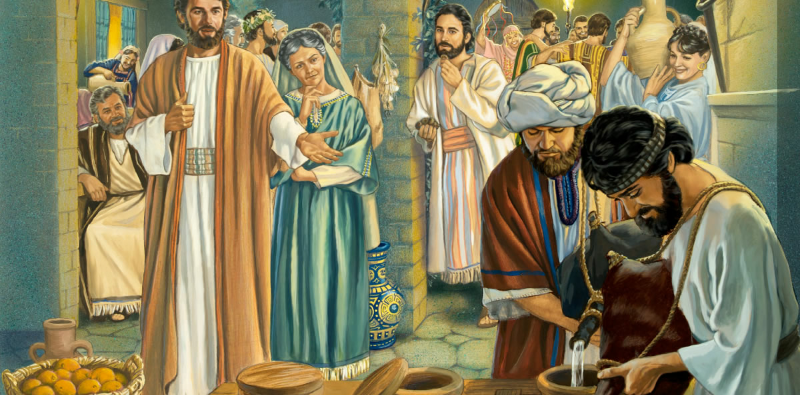
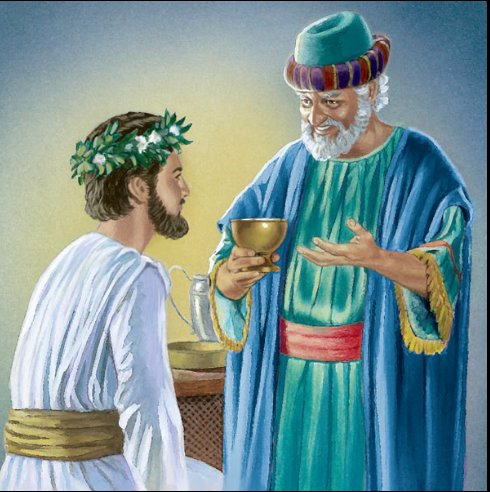
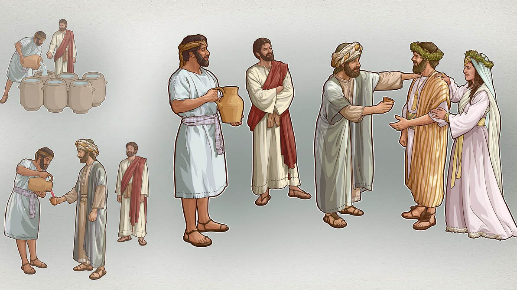
Joh 2:2-10:  Jesus performs his first miracle and demonstrates generosity.  Jesus was not obligated to perform this miracle, but he simply cared about people and was imitating his heavenly Father by being generous. Also the wine was real and not grape juice for the director said it was fine wine. 

Joh 2:14-16:  Jesus demonstrated that he and Jehovah will not tolerate contamination of pure worshiped to his Father. That is why few are worshipping Jehovah today compare to the world. Mt 7:13-14; Lu 13:24.

Joh 2:16:  Another scripture that show Jesus is not part of a trinity. Here we see Jesus call the Father “my Father,” which mean Jesus has a Father which was taught by his disciples at  Eph 1:3, 1Pe 1:3 and many other verses. 

Joh 2:17:  Jesus set the example for to make Jehovah house a place of pure worship and not place to carry on business. Even Jesus disciples recognized that Jesus was fulfilling prophecy at Ps 69:9.    

Joh 2:19-21:  Jesus was not saying he was going resurrected himself but was using figurative speech; he was comparing his anticipated death and resurrection to the demolition and reconstruction of the temple. The Bible clearly shows that it was God who resurrected him. (Ac 2:25-32; 3.15; 4.10; 5.30;10:40; Ro 8:11; Heb 13:20)

Jesus Died for Your Brother Too

Jesus sacrificed his life for imperfect people. (Ro 5:8) No doubt we personally appreciate that Jesus showed his love for us by giving his life in our behalf. Nevertheless, at times we may need to remind ourselves that Christ died for our brother too. How can we show Christlike love to our brothers and sisters, who just like us are imperfect? Consider three ways. First, we can expand our circle of friends to include those whose background is different from ours. (Ro 15:7; 2Co 6:12, 13) Second, we can be careful to avoid saying or doing things that may offend others. (Ro 14:13-15) Finally, if someone sins against us, we can be quick to forgive. (Lu 17:3, 4; 23:34) If we work hard to imitate Jesus in these ways, Jehovah will continue to bless the congregation with peace and unity.

WATCH THE VIDEO BECOME MORE BEAUTIFUL! AND THEN ANSWER THE FOLLOWING QUESTIONS:

How did Miki initially feel about her congregation?

My name is Miki, and I moved here a year ago. They were all so cute, friendly, or so it seemed to me the beginning. And you took me for your baby-sitter, but you did not see that we were talking. Hey, we’re not at the playground here. And the elderly are always busy, I’m not sure that here, they really want me.
What caused her feelings to change?
Then Yoko, a pioneer of my old congregation, came to see me. He asked me how it was going, and I told her, how I felt in the congregation. She told me that she had a similar experience, and she told me about an article in the watchtower, which had been very useful. So I decided to examine it, during my personal study.
What do you see when you look at others? Do you have the tendency to express categorical judgments about what they say or do, considering them either right or wrong, or white or black, as if there were no other colors and nuances? Who sees things in this way, is like a photographer who ignores, the wide variety of bright colors, and shadows, in an autumn landscape. As if they existed, only black and white images. Perhaps, I was seeing the congregation in black and white.
How did Jesus’ example help Miki to adjust her viewpoint? (Mr 14:38)
 The article then made me reflect on the example of Jesus. Certainly the spirit is eager, but the flesh is weak. Why did Jesus manage to use such kind words with his disciples? Are we perspicacious? Can we put ourselves in the shoes of others? And what Jesus did, with his disciples. And that’s what I have to do.
How can Proverbs 19:11 help us to view fellow Christians in a positive way?
At home, he must always stay behind the children, at least in the hall, he would need to enjoy a little, the company of the brothers. I do not think he wanted to be rude, maybe he just wanted to join us, and have a nice chat. The elders do a lot of work to take care of the congregation. I know they do their best, and I want to do everything possible to make their work lighter.
Miki, you’re really a nice person. We are happy to have you in our congregation. The perspicacity of a man certainly slows his anger, and it is beauty of his own, to pass over the transgression.

Digging for Spiritual Gems: Luke 23-24 (Week August 27 – September 2, 2018)

Lu 23:31:  What is Jesus apparently referring to in this verse? (“when the tree is moist, . . . when it is withered” study note on Lu 23:31, nwtsty) Jesus is apparently referring to the Jewish nation. It was like a dying tree that still had some moisture left, for Jesus was present and so were a number of Jews who believed in him. However, Jesus would soon be executed, and faithful Jews would be anointed with holy spirit and become part of spiritual Israel. (Ro 2:28, 29(who a Jew); Ga 6:16) At that time, the literal nation of Israel would be spiritually dead, resembling a withered tree.—Mt 21:43 “Kingdom of God will be taken from you and be given to a nation producing its fruits.”
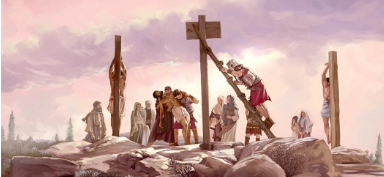
Lu 23:33:  What archaeological evidence indicates that in executions nails were likely used to fasten a person to a stake? (“Nail in a Heel Bone” media on Lu 23:33, nwtsty) A photograph of a replica of a human heel bone pierced by an iron nail that was 11.5 cm (4.5 in.) long. The original artifact was found in 1968, during excavations in northern Jerusalem, and dates to Roman times. It provides archaeological evidence that nails were likely used in executions to fasten the person to a wooden stake. This nail may be similar to the nails employed by the Roman soldiers to fasten Jesus Christ to the stake. The artifact was found in a stone box, called an ossuary, into which the dried bones of a deceased person were placed after the flesh had decomposed. This indicates that someone executed on a stake could be given a burial. Photo Clara Amit, Courtesy of the Israel Antiquities Authority
What does this week’s Bible reading teach me about Jehovah?

Lu 23:11:  Jehovah is the fulfiller of prophecies for we see they treated Jesus with contempt, and mocked fulfilling the prophecies at Isa 53:3 and Ps 22:7. Jehovah’s words will always come true, so we can trust that Jehovah’s Kingdom will put end to Satan world in the near future.    

Lu 23:34:  Jesus perfectly reflected his Father’s love in another important way like he was ready to forgive Roman soldiers who nailed him to the stake.” We are told at Ps 86:5 “For you, O Jehovah, are good and ready to forgive.”  May we imitate their example to other that may have done us wrong.   

Lu 23:35-39:  Jehovah prophesied that the Messiah would be reviled atPs 22:8-9. Yet Jehovah used his self-control not used his power on those who were insulting his Son while dying on the stake. We can be sure the paradise earth hope is not a dream but will be a reality because Jehovah said so. 

Lu 23:44-45:  Jehovah has great power and can even control the light of day. It is now “the sixth hour,” or noon and a strange darkness falls, not caused by a solar eclipse. This occurs at the time of the new moon on the Passover.  Also this darkness lasts much longer than the few minutes of an eclipse.  Jehovah caused this darkness and is the one we should put our trust in.

Lu 23:46:  Jehovah is the fulfiller of another prophecy dealing with his Son Jesus of the words he will speak before dying. Found at Ps 31:5 “Into your hand I entrust my spirit. You have redeemed me, O Jehovah, the God of truth.” We to can trust Jehovah with our future life if we remain faithful to him.

Lu 24:19:  Jehovah give power to his Son Jesus because he was faithful and was the one mankind could be save by. An Acts 2:22 show that is was Jehovah who did all the miracles through Jesus.  
Lu 24:49:  Jehovah is the giver of every good gift and giving his Holy Spirit is next greatest gift he could give faithful man to help them understand and gain the wisdom needed to do his will.

What other spiritual gems have you discovered in this week’s Bible reading?

Lu 23:2:  The religious leaders falsely accuse Jesus of subverting our nation, and forbidding the paying of taxes to Caesar.  Yet Jesus three days before at Luke 20:20-25 told them “pay back Caesar’s things to Caesar.” This is a warning for us to be cautious with our words for we live in a world that hates Jehovah Witnesses.

Lu 23:4:  Governments know that Jehovah’s people didn’t commit any crime and yet they are persecuted and throw in prison. They did this to Jesus because he was “no part of the world,” as we are not. (John 17:14, 16, 15:18, 20)

Lu 23:15-16, 24:  Example of what can happen from peer pressure: Herod and Pilate find Jesus did not commit any crime deserving of death and yet they allow the Jew to put Jesus to death. Likewise peer pressure can move one to do what is bad in Jehovah eye which can lead us in damaging our relationship with Jehovah and future life.

Lu 23:21,26:  Three time the Greek word stau·rosʹ is used which mean an upright stake or pole, such as the one on which Jesus was executed. There is no evidence that the Greek word meant a cross, such as the pagans used as a religious symbol for many centuries before Christ.

Lu 23:34:  Jesus teaches us a valuable lesson for imperfect humans to forgiving others. When a personal problem between Christians arises, ask should ourselves, ‘Is not gaining God’s forgiveness far more important than proving that a brother or a sister was wrong? (Mt 6:15)    

Lu 23:34:  Another scripture that show Jesus is not part of a trinity. First Jesus is praying to the Father and asking him to forgive the Roman soldiers for what they are doing. If Jesus is the Almighty God why would he have to pray to someone else and have him  forgive them? This is because Jesus is not the Almighty God and not part of a trinity.

Lu 23:35-39:  Jesus was being reviled while suffering on the torture stake, yet he bore all of this with dignity. What a fine example for us when we may be being belittle whether at the door or by the governments.

Lu 23:43: Reasons why the comma should go after the word “today:” First Jesus would not be raised up until the third day. Second it was 40 days after Jesus’ resurrection that he began his ascent to heaven. (Acts 1:3, 6-11) So Jesus was not talking about that day.   

Lu 23:46:  Another scripture that show Jesus is not part of a trinity. It show Jesus is trust his future life in his Father hand. This show two separate individual one is trusting the other. Also we see no third person involve.

Lu 24:3-7,15:  The resurrection of Jesus had witnesses that it did happen and the numbers kept growing too over 500 according to 1Co 15:6. We should never doubt that this did not happen, else our faith is worthless as shown 1Co 15:13-14.   

Lu 24:19:  Jesus is call a prophet not God, so Jesus cannot be part of Trinity. Other Bibles say the same because Jesus is a servant of Jehovah. (Acts 3:13,26; 4:24,27,30)

Lu 24:31-43:  Jesus could not have the same physical body that he die in. For one thing a physical body cannot suddenly disappear and appear when his disciples are behind lock door. They could see his body of flesh and could touch him, feeling the bones; he also ate in their presence, just like the angels did in the pass. (Ge 6:4; 19:1-3)  

Lu 24:34:  When Jesus was resurrected he made a personal visit to Peter showing he forgave him for denying him. Jesus may have wanted to assure the repentant Peter that he was still loved him and was valued to his Lord. We can be sure that if we stumble and repentant we also can be forgiven.

Lu 24:49:  Another scripture that show Jesus is not part of a trinity. For Jesus speak of having a Father with the word “my Father.”  Also Jesus shows that the pouring out of the Holy Spirit was something that his Father has promise not Jesus.  Again show two separate individuals. 

Digging for Spiritual Gems: Luke 21-22 (Week August 20-26, 2018) – EXPANDED

Lu 21:33—How might Jesus’ words in this verse be understood? (“Heaven and earth will pass away,” “my words will by no means pass away” study notes on Lu 21:33, nwtsty)
Heaven and earth will pass away: Other scriptures show that heaven and earth will endure forever. (Ge 9:16; Ps 104:5; Ec 1:4) So Jesus’ words here could be understood as hyperbole, meaning that even if the impossible happened and heaven and earth did pass away, Jesus’ words would still be fulfilled. (Compare Mt 5:18.) However, the heaven and earth here may well refer to the figurative heavens and earth that are called “the former heaven and the former earth” at Re 21:1.
my words will by no means pass away: Or “my words will certainly not pass away.” The use of two Greek negatives with the verb emphatically expresses rejection of an idea, vividly emphasizing the permanence of Jesus’ words.

Lu 22:28-30—What covenant did Jesus make, with whom did he make it, and what does it accomplish? (w14 10/15 16-17 ¶15-16)
15 After instituting the Lord’s Evening Meal, Jesus made a covenant with his faithful disciples, often referred to as the Kingdom covenant. (Read Luke 22:28-30.) Unlike other covenants, in which Jehovah is one of the parties to the covenant, this is a personal covenant between Jesus and his anointed followers. When saying, “just as my Father has made a covenant with me,” Jesus was apparently alluding to the covenant that Jehovah had made with him to be “a priest forever in the manner of Melchizedek.”—Heb. 5:5, 6.
16 The 11 faithful apostles had ‘stuck with Jesus in his trials.’ The Kingdom covenant assured them that they would be with him in heaven and sit on thrones to rule as kings and serve as priests. However, those 11 would not be the only ones to have that privilege. The glorified Jesus appeared to the apostle John in a vision and said: “To the one who conquers I will grant to sit down with me on my throne, just as I conquered and sat down with my Father on his throne.” (Rev. 3:21) Thus, the Kingdom covenant is made with the 144,000  anointed Christians. (Rev. 5:9, 10; 7:4) This is the covenant that forms a legal basis for them to rule with Jesus in heaven. This is similar to a bride from a noble family who might marry a ruling king and come into position to share in his ruling power. In fact, the Scriptures refer to anointed Christians as “the bride” of Christ, “a chaste virgin” promised in marriage to the Christ.—Rev. 19:7, 8; 21:9; 2 Cor. 11:2.
What has this week’s Bible reading taught you about Jehovah?

*** w18 February pp. 25-26 par. 12 Move Forward as a Spiritual Person! ***

12 As we work at cultivating spirituality, holy spirit will give us the power to transform our mind. With the spirit’s help, we can gradually begin to think more and more as Christ did. (Rom. 15:5) Additionally, it will help us root out fleshly desires and cultivate qualities pleasing to God. (Gal. 5:16, 22, 23) If we find that our mind pushes us toward materialistic thinking or fleshly desires, we should not give up. Keep asking for the spirit, and Jehovah will help you to redirect your mental attitude to focus on proper things. (Luke 11:13) Remember the apostle Peter. Several times in his life, he did not respond as a spiritual man should. (Matt. 16:22, 23; Luke 22:34, 54-62; Gal. 2:11-14) But he did not give up. Gradually, with Jehovah’s help, Peter developed Christlike thinking. We can do the same.

*** w18 March pp. 26-27 par. 16 Discipline—Evidence of God’s Love ***

16 Jesus always listened obediently to his Father, even when doing so was very difficult. (Matt. 26:39) And he gave his Father the credit for his teachings and wisdom. (John 5:19, 30) Jesus’ humility and obedience drew people of honest heart to him and helped to make him a compassionate and gracious teacher. (Read Matthew 11:29.) His kind words heartened those who were figuratively like a bruised reed or the wick of an oil lamp about to go out. (Matt. 12:20) Even when his patience was tested, Jesus was kind and loving. This was evident when he corrected his apostles for showing a selfish, ambitious spirit.—Mark 9:33-37; Luke 22:24-27.

*** w18 April p. 16 par. 7 Imitating Jehovah—A God Who Gives Encouragement ***

7 Jesus’ apostles often quarreled over who was the greatest among them, but Jesus patiently encouraged them to humble themselves and to become servants, not bosses. (Luke 22:24-26) Peter in particular disappointed Jesus several times. (Matt. 16:21-23; 26:31-35, 75) Rather than reject Peter, Jesus encouraged him and even commissioned him to strengthen his brothers.—John 21:16.

*** w18 June p. 7 par. 14 “My Kingdom Is No Part of This World” ***

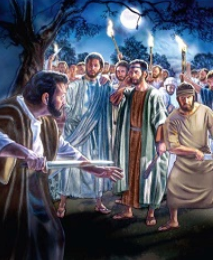
14 Caiaphas sent soldiers to arrest Jesus under the cover of night. Jesus was aware of this shameful strategy, so during his final meal with the apostles, he asked them to get some swords. Two would be sufficient to teach them a vital lesson. (Luke 22:36-38) Later that night, Peter used a sword to attack a member of the mob. No doubt, he was incensed at the injustice of Jesus’ nighttime arrest. (John 18:10) But Jesus told Peter: “Return your sword to its place, for all those who take up the sword will perish by the sword.” (Matt. 26:52, 53) This powerful lesson was in harmony with what Jesus prayed about earlier that night—they must be no part of the world. (Read John 17:16.) Fighting injustice was something to be left to God.

*** w18 June pp. 8-9 pars. 2-3 May We All Be One as Jehovah and Jesus Are One ***

2 Jesus’ emphasis on unity is understandable. He had noticed a lack of unity or harmony among the apostles, such as during his final meal with them. As had happened before, a dispute arose over “which one of them was considered to be the greatest.” (Luke 22:24-27; Mark 9:33, 34) Another time, James and John requested that Jesus give them prominent places alongside him in his Kingdom.—Mark 10:35-40.
3 Desire for prominence, however, was not the only potential cause of disunity among Christ’s disciples. The people of the land were divided by animosity and prejudice. Jesus’ disciples would need to overcome those feelings. In this article, we will consider the following questions: How did Jesus deal with prejudice? How did he help his followers learn to treat others impartially and be truly united? And how will his teaching help us to keep united?

*** w18 July p. 8 par. 3 Whose Recognition Do You Seek? ***

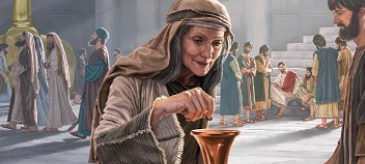
3 In Jesus’ day, some religious leaders had the wrong view of recognition. Jesus warned his followers: “Beware of the scribes who like to walk around in robes and who love greetings in the marketplaces and front [“best,” ftn.] seats in the synagogues and the most prominent places at evening meals.” He went on to say: “These will receive a more severe judgment.” (Luke 20:46, 47) By contrast, Jesus commended a poor widow whose small contribution was likely not recognized by others. (Luke 21:1-4) Jesus’ view of recognition was obviously very different from that of others. This article will help us maintain the right view, the one that Jehovah God accepts.

*** w18 September pp. 26-27 par. 16 Almighty yet Considerate ***

16 Today, too, Jehovah cares for his people as a group—spiritually and physically. He will continue to do so during the fast-approaching great tribulation. (Rev. 7:9, 10) Hence, whether young or old, sound in body or disabled, God’s people will not panic or cower in fear during the tribulation. In fact, they will do the very opposite! They will bear in mind these words of Jesus Christ: “Stand up straight and lift up your heads, because your deliverance is getting near.” (Luke 21:28) They will maintain that confidence even in the face of the attack by Gog—a coalition of nations that will wield far more power than did ancient Pharaoh. (Ezek. 38:2, 14-16) Why will God’s people remain confident? They know that Jehovah does not change. He will again prove to be a caring and considerate Savior.—Isa. 26:3, 20.

*** w17 January p. 11 par. 17 “Trust in Jehovah and Do What Is Good” ***

17 Think, too, of the needy widow in Jesus’ day. (Read Luke 21:1-4.) She could hardly do anything about the corrupt practices being carried on at the temple. (Matt. 21:12, 13) And there was likely little she could do to improve her financial situation. Yet, she voluntarily contributed those “two small coins,” which were “all the means of living she had.” That faithful woman demonstrated wholehearted trust in Jehovah, knowing that if she put spiritual things first, he would provide for her physical needs. The widow’s trust moved her to support the existing arrangement for true worship. Likewise, we trust that if we seek first the Kingdom, Jehovah will make sure that we have what we need.—Matt. 6:33.

*** w17 February p. 21 par. 17 Jehovah Leads His People ***

17 Angels assisted Jesus. Shortly after Jesus was baptized, “angels came and began to minister to him.” (Matt. 4:11) Hours before his death, “an angel from heaven appeared to him and strengthened him.” (Luke 22:43) Jesus was confident that Jehovah would send angelic help whenever he needed it to accomplish God’s will.—Matt. 26:53.

*** w15 11/15 p. 14 Show Appreciation for Jehovah’s Generosity ***

How can we show appreciation for all that Jehovah and his Son have done and will yet do for us? One way is by being generous in the giving of our time, energy, and resources to advance the pure worship of Jehovah, whether it is a small amount or a greater portion.—1 Chron. 22:14; 29:3-5; Luke 21:1-4.

What other spiritual gems have you discovered in this week’s Bible reading?

*** wp18 No. 2 p. 7 Prophecies That Have Come True ***

Luke 21:11: “There will be great earthquakes.”
Each year, some 50,000 earthquakes are large enough to be felt by humans. About 100 bring substantial damage to buildings, and one very great earthquake occurs about every year. According to one estimate, between 1975 and 2000, earthquakes claimed the lives of 471,000 people.

*** wp18 No. 2 p. 8 A Silent Witness to Accurate Prophecy ***

Jesus’ words evidently puzzled his disciples. Two days later, on viewing Jerusalem’s temple, one of them exclaimed: “Teacher, see! what wonderful stones and buildings!” Indeed, some temple stones were reportedly over 35 feet (11 m) long, 15 feet (5 m) wide, and 10 feet (3 m) high! Yet, Jesus replied: “As for these things that you now see, the days will come when not a stone will be left upon a stone and not be thrown down.”—Mark 13:1; Luke 21:6.
Jesus further told them: “When you see Jerusalem surrounded by encamped armies, then know that the desolating of her has drawn near. Then let those in Judea begin fleeing to the mountains, let those in the midst of her leave, and let those in the countryside not enter into her.” (Luke 21:20, 21) Did Jesus’ words come true?

*** wp17 No. 6 p. 9 What Did Jesus Really Look Like? ***

Religious leaders of Jesus’ day contrived ways to draw attention to themselves and underscore their authority. (Numbers 15:38-40; Matthew 23:5-7) Unlike them, Jesus instructed his apostles not to “lord it over” others. (Luke 22:25, 26) In fact, Jesus warned: “Beware of the scribes who want to walk around in robes and want greetings in the marketplaces.”—Mark 12:38.

*** w17 January p. 13 par. 4 Treasure Your Gift of Free Will ***

4 When Jehovah began his creative works, he lovingly chose to bestow free will on his intelligent creatures. The first one to receive this gift was his firstborn Son, “the image of the invisible God.” (Col. 1:15) Even before coming to earth, Jesus chose to remain loyal to his Father and not join Satan in his rebellion. Later, when Jesus was on earth, he exercised his free will to reject the temptations of the great Adversary. (Matt. 4:10) In earnest prayer the night before his death, Jesus reaffirmed his determination to do the will of God. He said: “Father, if you want to, remove this cup from me. Nevertheless, let, not my will, but yours take place.” (Luke 22:42) May we imitate Jesus and use our free will to honor Jehovah and to do his will! Is that really possible?

*** w17 December p. 13 Do You Remember? ***

What factors should affect a Christian’s view of keeping a firearm for protection against other humans?
Some are: God views life as sacred. Jesus did not urge his followers to get swords for protection. (Luke 22:36, 38) We are to beat our swords into plowshares. Life is more valuable than material things. We respect the conscience of others, and we want to be exemplary. (2 Cor. 4:2)—w17.07, pp. 31-32.

*** wp16 No. 2 p. 4 Did It Really Happen? ***

Jesus himself is mentioned by secular writers of the first and second centuries. His manner of death, as described in the Gospels, agrees with Roman executional methods of the time. Moreover, events are related in a factual and candid manner—even portraying some of Jesus’ disciples unfavorably. (Matthew 26:56; Luke 22:24-26; John 18:10, 11) All these factors strongly indicate that the Gospel writers were honest and accurate in what they wrote about Jesus.

*** w16 April pp. 13-14 par. 2 “Let Endurance Complete Its Work” ***

2 We too are fighting a relentless battle. Our enemies include Satan, his world, and our own imperfections. Some of us have battled for decades, and with Jehovah’s help, we gained victories. At times, though, we may get tired of battling our enemies and of waiting for the end of this system of things. Indeed, we have not yet won the complete victory. Jesus warned that we who live in the last days would face severe trials and cruel mistreatment, but he also said that gaining the victory would depend on our endurance. (Read Luke 21:19.) What is endurance? What will help us to endure? What can we learn from those who have endured? And how can we “let endurance complete its work”?—Jas. 1:4.

*** w16 June pp. 8-9 par. 10 Appreciating Jehovah as Our Potter ***

10 Like a highly skilled potter, Jehovah knows the type and quality of “the clay” that is before him, and he molds it accordingly. (Read Psalm 103:10-14.) Indeed, he deals with us as individuals, taking into account our particular weaknesses, limitations, and level of spiritual growth. His attitude toward imperfect servants was demonstrated by his Son. Consider how Jesus dealt with his apostles’ shortcomings, especially their inclination to argue among themselves over position. If you had witnessed the apostles’ heated disputes, would you have viewed these men as meek and malleable? Yet, Jesus did not adopt a negative view. He knew that his faithful apostles could be molded by kind, patient counsel and by their observing his example of humility. (Mark 9:33-37; 10:37, 41-45; Luke 22:24-27) After Jesus was resurrected and the holy spirit was poured out, the apostles focused, not on position or prominence, but on the work he had given them to do.—Acts 5:42.

*** w16 June p. 26 par. 10 Do Not Let the Faults of Others Stumble You ***

10 The Bible provides us with accounts of servants of God who remained loyal to Jehovah and his people despite the serious faults of others around them. For example, after spending a night in prayer to his Father, Jesus selected the 12 apostles. Judas Iscariot was one of those. When Judas later betrayed him, Christ did not let that defection mar his own relationship with his Father, Jehovah; nor did Jesus allow Peter’s denial to do that. (Luke 6:12-16; 22:2-6, 31, 32) Jesus knew that those actions were not the fault of Jehovah or his people in general. Jesus continued his wonderful work despite the disappointment that some of his followers caused him. Jehovah rewarded him by resurrecting him from the dead, thus opening the way for Jesus to become King of the heavenly Kingdom.—Matt. 28:7, 18-20.

*** w16 July p. 14 par. 3 Why Must We “Keep on the Watch”? ***

3 As Jehovah’s Witnesses, we take seriously Jesus’ warning. We know that we are living deep in “the time of the end” and that there cannot be much time left before the “great tribulation” begins! (Dan. 12:4; Matt. 24:21) We see distressing wars, increasing immorality and lawlessness, religious confusion, food shortages, pestilences, and earthquakes taking place around the world. We know that a phenomenal Kingdom-preaching work is being accomplished by Jehovah’s people everywhere. (Matt. 24:7, 11, 12, 14; Luke 21:11) We eagerly anticipate what the Lord’s coming will mean for us and for the accomplishment of God’s purpose.—Mark 13:26, 27.

*** w16 August p. 28 pars. 13-14 Do You See the Need to Train Others? ***

13 Bible accounts highlight the privilege we have of showing “brotherly affection” and serving one another. (Read 1 Peter 1:22; Luke 22:24-27.) The Son of God gave everything, including his life, in ministering to others. (Matt. 20:28) Dorcas “abounded in good deeds and gifts of mercy.” (Acts 9:36, 39) Mary, a sister in Rome, “worked hard” in behalf of those in the congregation. (Rom. 16:6) How can we help new ones grasp the importance of helping their brothers and sisters?
14 Mature Witnesses can invite new ones to come along when visiting the sick and the elderly. If appropriate, parents can take their children on such visits. Elders can work with others in making sure that our dear older ones have good food and that their homes are maintained. In these ways, younger ones and those newly associated learn to perform acts of kindness for others. While preaching, one elder would briefly visit the Witnesses living in his rural territory to see how they were doing. A young brother who often accompanied him thus learned that all in the congregation should feel loved.—Rom. 12:10.

*** w16 September p. 16 Defending the Good News Before High Officials ***

Yet, even today Jehovah’s name can be glorified when Christians make a defense of their faith. As Paul was, we should try to be calm, sincere, and convincing. Jesus told his followers that they would not have to ‘rehearse beforehand how to make their defense, for he would give them words and wisdom that all their opposers together would not be able to resist or dispute.’—Luke 21:14, 15; 2 Tim. 3:12; 1 Pet. 3:15.
When Christians defend their faith before kings, governors, or other officials, they can give a witness to people whom it might otherwise have been difficult to reach with the Christian message. Some favorable court decisions have refined legal codes, thus protecting freedom of speech and of worship. But whatever the outcome of such cases, the courage God’s servants display under trial makes God rejoice.

*** w16 October p. 27 par. 5 Exercise Your Faith in Jehovah’s Promises ***

5 Clearly, our prospect of enjoying eternal life in God’s new world depends on our having faith and keeping it strong. The need to keep our faith healthy can be likened to a plant’s need for water. Unlike an artificial plant, a living plant keeps changing. A live plant either withers because of a lack of water or continues to thrive with a regular supply of moisture. If deprived of sufficient water, a once healthy plant will eventually die. So, too, our faith. It will wither and die if neglected. (Luke 22:32; Heb. 3:12) But if we give it due attention, our faith will stay alive and keep “growing,” and we will be “healthy in faith.”—2 Thess. 1:3; Titus 2:2.

*** w16 November p. 6 par. 9 “Keep On Encouraging One Another Each Day” ***

9 Jesus. On the night when Jesus instituted the Memorial, pride was one negative trait that he saw in his apostles. Jesus humbly washed their feet, but they were still arguing about which one of them was the greatest; and Peter was overconfident. (Luke 22:24, 33, 34) Yet, Jesus commended his faithful apostles for sticking with him in his trials. He predicted that they would do works greater than his, and he assured them that God had affection for them. (Luke 22:28; John 14:12; 16:27) We might ask ourselves, ‘Shouldn’t I imitate Jesus by commending my children and others for what they do well instead of focusing on their shortcomings?’

*** w15 4/15 p. 22 par. 13 How Real Is Your Relationship With Jehovah? ***

13 Consider this: From his prehuman existence, Jesus observed firsthand Jehovah’s response to the prayers of His human servants. Then, during his earthly ministry, Jesus used prayer as his means of communicating his feelings to his Father in heaven. Would he have done so—even spending an entire night in prayer—had he thought that Jehovah was not really listening? (Luke 6:12; 22:40-46) Would he have taught his disciples to pray had he thought that prayer was nothing more than a psychological crutch? Clearly, Jesus knew that prayer is real communication with Jehovah. On one occasion, Jesus said: “Father, I thank you that you have heard me. True, I knew that you always hear me.” We too can have confidence that Jehovah is the “Hearer of prayer.”—John 11:41, 42; Ps. 65:2.

*** w15 5/15 p. 18 par. 18 You Can Fight Satan—And Win! ***

18 How can we fight Satan and win? Jesus told his disciples: “By your endurance you will preserve your lives.” (Luke 21:19) Nothing that any human can do will cause us permanent harm. Nobody can take away our precious friendship with God unless we allow that to happen. (Rom. 8:38, 39) Even the death of Jehovah’s servants does not score a victory for Satan, for Jehovah will see to it that they are resurrected! (John 5:28, 29) On the other hand, Satan’s prospects are bleak indeed. After the destruction of his ungodly system, Satan will be abyssed for 1,000 years. (Rev. 20:1-3) At the end of Jesus’ Thousand Year Reign, Satan will be “released from his prison” for a short time to make a final attempt to mislead perfect mankind. After that, the Devil will be destroyed. (Rev. 20:7-10) Satan faces certain doom, but that is not true of you! Take your stand against Satan, firm in the faith. You can fight Satan and win!

*** w15 8/15 p. 15 par. 4 Keep in Expectation! ***

4 The Bible leaves no doubt about what our attitude should be toward the impending destruction of this system of things. Jesus told his followers to “keep on the watch” and to “keep awake.” (Matt. 24:42; Luke 21:34-36) That in itself is a good reason to remain in expectation—Jesus told us to do so! In this regard, Jehovah’s organization has set an example. Its publications have consistently exhorted us to “await and keep close in mind the presence of the day of Jehovah” and to fix our hope on God’s promised new world.—Read 2 Peter 3:11-13.

*** w15 9/1 p. 16 Bible Questions Answered ***

How do Bible prophecies help us?
Some prophecies warn God’s servants to take action. For example, when first-century Christians saw certain prophecies fulfilled, they left Jerusalem. Later, when the city was destroyed because most of its people had rejected Jesus, the Christians were far away in a safe place.—Read Luke 21:20-22.
Today, fulfilled prophecies show that God’s Kingdom will soon bring an end to human kingdoms and governments. (Daniel 2:44; Luke 21:31) So it is urgent that each person act now to gain the approval of the King, Jesus Christ, whom God has appointed.—Read Luke 21:34-36.


*** w15 11/1 p. 6 God’s View of War in the First Century ***

Thus, like God’s servants of the ancient past, those first-century Christians were to wait until God’s time to bring an end to wickedness and oppression. In the meantime, they were not authorized by God to take it upon themselves to engage in warfare against their enemies. Jesus Christ made this clear in his teachings. For example, he did not direct his followers to engage in warfare, but instead he told them: “Continue to love your enemies and to pray for those who persecute you.” (Matthew 5:44) Foretelling the time when first-century Jerusalem would be attacked by Roman armies, Jesus instructed his disciples, not to stay and fight, but to flee—which they did.—Luke 21:20, 21.

Digging for Spiritual Gems: Week August 20-26, 2018 – Luke 21-22

Lu 21:33:  How might Jesus’ words in this verse be understood? (“Heaven and earth will pass away,” “my words will by no means pass away” study notes on Lu 21:33, nwtsty)  “Heaven and earth will pass away”- Jesus’ words here could be understood as hyperbole, meaning that even if the impossible happened and heaven and earth did pass away, Jesus’ words would still be fulfilled. (Compare Mt 5:18.) However, the heaven and earth here may well refer to the figurative heavens and earth that are called “the former heaven and the former earth” at Re 21:1.
Or “my words will certainly not pass away” The use of two Greek negatives with the verb emphatically expresses rejection of an idea, vividly emphasizing the permanence of Jesus’ words.
Lu 22:28-30:  What covenant did Jesus make, with whom did he make it, and what does it accomplish? (WT14 10/15 pg16-17 par15-16) (“for they are all living to him” study note on Lu 20:38, nwtsty) the Kingdom covenant.  Unlike other covenants, in which Jehovah is one of the parties to the covenant, this is a personal covenant between Jesus and his anointed followers. When saying, “just as my Father has made a covenant with me,” Jesus was apparently alluding to the covenant that Jehovah had made with him to be “a priest forever in the manner of Melchizedek.”—Heb. 5:5, 6.  16 The 11 faithful apostles had ‘stuck with Jesus in his trials.’ The Kingdom covenant assured them that they would be with him in heaven and sit on thrones to rule as kings and serve as priests. However, those 11 would not be the only ones to have that privilege. The glorified Jesus appeared to the apostle John in a vision and said: “To the one who conquers I will grant to sit down with me on my throne, just as I conquered and sat down with my Father on his throne.” (Rev. 3:21) Thus, the Kingdom covenant is made with the 144,000 anointed Christians. (Rev. 5:9, 10; 7:4)
What does this week’s Bible reading teach me about Jehovah?

Lu 21:1-4:  Jehovah value what we can give no matter how little it may seem to us. Jehovah is pleased to accept the best that we can give. Jehovah “sees into the heart,” so he is fully aware of the yearnings of your heart. 1Sa 16:7.

Lu 21:9-11:  Jehovah is the fulfiller of prophecies for these words started being fulfilled in 1914 on Jehovah time table. Even though words spoke by Jesus they were still Jehovah words as shown at John12:49, 50. We can be sure that Jehovah promises will be fulfill.  

Lu 21:12:  Jehovah sees and knows the hate the world show toward Jehovah’s faithful servants because of his name.” Jesus’ name represents as God’s appointed Ruler, the King of kings, to whom all the nations should submission, but are not willing to do. Yet Ps 2:1-7 show they cannot stand again Jehovah so our trust should be in Jehovah.

Lu 21:14-15:  Jehovah cares about servants that he has provide us with his instruction from his Word, organization and even his holy spirit to help us. This spirit can equip us with the “power beyond what is normal,” enabling us to serve God faithfully despite obstacles and what to speak to opposers. 2Co 4:7; Luke 11:13; Acts 15:8; Eph 4:30.    

Lu 21:17-18:  Jehovah wants us to know that his faithful servants are very valuable to him, and they will never perish in his eyes. For Jehovah has put in place the means to resurrect then and they live in his heart and mind.   

Lu 21:17-18:  Jehovah has the power to darken the sun, the moon not give its light, the stars fall from heaven, and the powers of the heavens be shaken. During the great tribulation Jehovah can display such power to cause such cataclysmic effects as he did in the pass, and he can do it again. Ex 10:21-23; Jos 10:12-14; Jg 5:20.

Lu 21:27:  Jehovah shares his power with his appointed judge Jesus, his begotten Sons who comes with power and glory. With this authority Jesus will accomplish Jehovah’s will, to bring an end to Satan’s world. Jesus was given all authority at Mt 28:18 and at 1Co 15:27 show Jesus has no authority of his Father.   

Lu 22:28-30:  Jehovah foretold a new arrangement for his people at Jer. 31:31-33 of a new covenant with a spiritual Israel. Jehovah used his beloved Son as mediator this new covenant. We see Jehovah keeps words and we know all this promised will all come true.     

Lu 22:34:  Jehovah the “Reveler of secrets’ as shown Da 2:28-29, 47. How else could Jesus know that Peter was going to “disown” him three times? For it was Jehovah that did all the miracles through Jesus as shown at Acts 2:22. So it was by Jehovah powers that reveal these this to Jesus.  So we can be sure all Jehovah’s words will come true.    

Lu 22:42-43:  Jehovah is the one who answer prayer and that why Jesus pray to the “Hearer of prayer” as shown in Ps 65:2; 66:19.  Also Jehovah has the power to act in behalf of the petitioners. So let us always pray to Jehovah to give us strength to be faithful to him to the end.

Lu 22:63-64:  Jehovah fulfilled word in what they do to his beloved Son Jesus according to Isa 50:6-9. Here Jehovah shows self-restraint, long-suffering, and patience as he watch what they did to his innocent Som. Soon all Jehovah promise will be fulfill and that why we need to put trust in one who keep his word and show our loyal love by doing his will. 
What other spiritual gems have you discovered in this week’s Bible reading?

Lu 21:1-4:  The example of the poor widow teaches us that we should be unselfish in supporting true worship of what we are able to give.

Lu 21:6-7:  Jesus is talking about to different fulfillments. First question: “When will these actually be?” or when will Jerusalem and its temple be destroyed? Second question deals with when the end of this system of things was at hand. Mt 24:3; Mr 13:4

Lu 21:12:  The truths about God’s have caused many to hated Jehovah Witnesses. Today in 33 lands Jehovah Witnesses have been ban, and almost all continents Jehovah’s people have been persecute even the U.S. during WWII.  We must ask ourselves, will I stand firm for Jehovah?

Lu 21:15-17:  We have been warned that the world will hate us and possible even our love ones could hate us because of Jehovah’s name. We must ask ourselves, who do we love more, Jehovah or those who cannot give us life? May we all choose Jehovah who always love us and wants us to be saved and gain everlasting life.  

Lu 21:19:  Once save always save is a false teaching. Only those who endure to the end in either this system or to death will be saved. This shows true believers will have to put a hard fight for their faith to the end of Satan’s world. Mt 10:22, Mk 13:13 Lu 21:19; Heb 10:36.

Lu 21:20-22, 24: This had it first fulfillment in 66 C.E. when the Roman army attacked Jerusalem and its temple (a place holy in the eyes of the Jews). In the larger fulfillment, the “standing” will occur when the United Nations (the modern-day “disgusting thing”) attacks as shown in Re 17:16-18.

Lu 21:33:  These words are referring to two groups of anointed Christians. The first group was on hand in 1914, and discerned the sign of Christ’s presence in that year. The second group included in “this generation,” is anointed contemporaries of the first group. They were not simply alive during the lifetime of those in the first group.

 Lu 21:34-35:  Jesus cautioned us against becoming absorbed by the mundane concerns of life.  If our concern is over material things and that begin to dominate our thinking, we are in danger of losing our focus on Kingdom realities. (Mt. 6:19-24, 31-33) Let us not be like the world that passing away and took no note and die.1Jo 2:17.

Lu 22:20:  Jesus is the mediator of the new covenant, between Jehovah and anointed Christians, was made operative by Jesus’ sacrifice. Jesus’ blood made valid the new covenant that Jehovah would make with spiritual Israel. That covenant went into effect at Pentecost 33 C.E.—Heb 9:14, 15.

Lu 22:3-6,47-48:  Example that once saved, always saved is not true. Judas new the truth and yet he betray his loving teacher. Two other example is found at 1Ti 1:18-20.  Other scriptures that show once saved, always save in not true: 1Ti 4:1-3; Acts 20:29-30; 2Ti 4:3-4; Jude 3-5; Re 2:5,16; 3:3, 11, 15-16.

Lu 22:24-26:    Human imperfection and a religious background that emphasized position made Jesus’ disciples overly concerned about greatness. We should cultivate humility as we guard against sinful tendencies and maintain a proper view of privileges and responsibilities.

Lu 22:28-30:  Another scriptures show that Jesus is not part of a trinity. We see Jesus has a Father by the words “my Father,” and this Father make a covenant with Jesus for a Kingdom. This show Jehovah and Jesus are two separate individual making an agreement between them.   

Lu 22:36-38:  Jesus did not ask his disciples to carry a weapon for protection or self-defense. Rather, their having swords on hand on the night of his betrayal made it possible for Jesus to teach them a vital lesson: “All those who take the sword will perish by the sword.”(Mt. 26:52.)

Lu 22:56-62:  Peter’s tragic experience shows that even a person of faith and devotion can be thrown off balance if he is not properly prepared for unexpected trials or temptations. May what Peter went through serve as a warning to keep close to Jehovah and pray constantly that we do not give into Satan tactics.

Lu 22:69:  Jesus helps us to see that he is not part of a trinity by telling us he is “the Son of God and not God the Son. Also Jesus show he will be sitting at the right hand of someone else and that one has authority over Jesus 1Co 15:27. 

Digging for Spiritual Gems: Luke 19-20 (Week August 13-19)

The week of  Aug 13 – 19Digging for Spiritual Gems


Lu 19:43:  How were Jesus’ words fulfilled? (“fortification of pointed stakes” study note on Lu 19:43, nwtsty) Jesus’ words came true in the year 70 C.E. when the Romans, commanded by Titus, erected a siege wall, or palisade, around Jerusalem. Titus’ objective was threefold—to prevent the Jews from fleeing, to encourage their surrender, and to starve the inhabitants into submission. To provide materials for the construction of this fortification around Jerusalem, Roman troops stripped the countryside of trees.
Lu 20:38:  How does Jesus’ statement strengthen our confidence in the resurrection? (“for they are all living to him” study note on Lu 20:38, nwtsty) Approved servants of God who die are still living from Jehovah’s standpoint, since his purpose to resurrect them is sure of fulfillment. Ro 4:16, 17.
 
What does this week’s Bible reading teach me about Jehovah?

Lu 19:28-36:  Jehovah is the fulfiller of prophecies, for he foretold that his promised King would come into Jerusalem on a colt at Zec 9:9 “Humble and riding on a donkey, On a colt, the foal of a female donkey.” Yes, nothing can stop Jehovah promises from being fulfilled.

Lu 19:41-44:  Jehovah fulfill the prophecies that his son Jesus spoke about Jerusalem destruction in 70 C.E. in every detail.  We can be sure that all Jehovah words will be fulfill in every detail concerning the Kingdom.

Lu 19:46:  It show Jehovah feel about those who try to contaminate the way he is to be worship for he see what we are doing because his name is involve. We are told at Jer 7:11  “this house upon which my name has been called become a mere cave of robbers in YOUR eyes? Here I myself also have seen [it]…”

Lu 20:16:  Show that Jehovah has the right to repay the evil ones for their action for justice sake. That is what Jehovah has promise to do at 2Th 1:6 “it is righteous on God’s part to repay tribulation to those who make tribulation for you.  (2Th 1:7-9; Ro 12:19)

Lu 20:17:  Jehovah loves mankind so much that he wanted to save them from sin and death, so he sent his only begotten Son to save us as shown at John 3:16.  Now Jehovah has given Jesus the power to save mankind because he was faithful to the end and is our cornerstone to approach Jehovah.

Lu 20:21:  Jehovah is the greatest teacher and he is the one who taught Jesus the truth  and seen his Father was not partial.  John 5:19. 8:28  12:49,50 ;Acts 15:34

Lu 20:37-38:  Jehovah sees his faithful servants as alive even if they should die, since his purpose to resurrect them is a sure fulfillment in his eyes. Ro 4:16, 17.  

Lu 20:47:  We see the religious leader display of false holiness by “making long prayers.”  Jesus said to pray in privacy, without vain repetition, and he gave them a simple model prayer. (Mt 6:6-8; John 14:6, 14; 1Pe 3:12; Mt 6:9-13)
What other spiritual gems have you discovered in this week’s Bible reading?

Lu 19:7-8:  Jesus sees the potential for repentance in sinners.  May we never judge people because of what we heard or what we know about a person, for it is Jehovah who sees the hearts, and their potential and knows if one can be a sheep.     

Lu 19:10:  Jesus loved those who were despised by others and was willing to show mercy to those. Jesus exercising mercy toward sinners is not condoning of their sins, but knew that people could change. May we do the same as we preach.   

Lu 19:15-22:  Shows that Jesus expected all to be diligent in serving to the best of their ability in the ministry. Each of us has our own circumstances that can allow one to do more for Jehovah, while another cannot do as much, yet both are look on favorably.   

Lu 19:37-38:  We see here that Jehovah and Jesus do not mind the disciples giving praise to their creator, whether they do it in witnessing to others or in song.

Lu 19:38:  Jesus comes in Jehovah name by doing his Father will and speaking what his Father him to speak. John 4:34, 6:38, 8:28,38, 12:49.

Lu 19:39:  May we learn not to be like those religious leaders of Jesus day, instead of looking for the good that Jesus and his disciples did, they were look for what they thought was bad or wrong. We are all imperfect and make mistake, so in love, look at all the good our brothers and sisters are doing.     

Lu 19:47:  The chief priests, scribes, and principal ones of the people hear what Jesus has done, and they respond with renewed efforts to have him killed.  We can be sure they will do the same today to those who speak the truth about Jehovah and his son Jesus.  

Lu 20:2, 8:  Just like in Jesus’ day they question his authority of what he does, yet his works and teaching show his authority came from Jehovah. Likewise today Jehovah people get their authority form Jehovah’s Word like Acts 15:14 shows Jehovah has a people for his name and they do his will and glorified his name.  
Lu 20:9-14:  Another scriptures show that Jesus is not part of a trinity.The owner of vineyard is Jehovah (Isa 5:7), and the vineyard is the nation of Israel, and Jehovah sent his Son Jesus who the religious leaders killed. (John 17:3; 3:16; 13:16) two separate being one is doing the sending is greater than the one sent.   

Lu 20:20:  Haters of Jehovah will look for way to trap his people in words, just like they try to do with Jesus.  They will look for ways to try to stop the truths about Jehovah and his son Jesus being made known as shown at John 15:20, 21. This is going on in 33 lands.

Lu 20:25:  Jesus shows us that we must submit to authority of the government under which we live by obeying its laws, respecting its officials, and paying the taxes it levies. This authority is not absolute, for we cannot disobey God laws if they asked us to as shown at Acts 5:29.   

Lu 20:35:  Jesus show that there is going to be a resurrection and that it is going to be in the future with the words “For when they rise from the dead. This is what he taught all along at John 6:39-40,43, 54; 5:28-29. 

Luke 17 – 18 Digging for Spiritual Gems

Luke 17 – 18 Digging for Spiritual Gems (Alternative)
Week August 6-12, 2018


Lu 17:7-10:  What is the point of Jesus’ illustration? (“good-for-nothing” study note on Lu 17:10, nwtsty) The point of Jesus’ illustration is notthat the slaves, his disciples, are to consider themselves useless or worthless. According to the context, “good-for-nothing” conveys the idea that the slaves would view themselves modestly, not as deserving special credit or praiseSome scholars consider the term as it is used here to be hyperbole meaning “we are merely slaves deserving no special attention.”
Lu 18:8:  What kind of faith is Jesus referring to in this verse? (“this faith” study note on Lu 18:8, nwtsty) The use of the Greek definite article before the word “faith” indicates that Jesus was referring, not to faith in a general sense, but to a particular kind of faith, like that of the widow in Jesus’ illustration. (Lu 18:1-8) This would include having faith in the power of prayer as well as faith that God will cause justice to be done to his chosen ones. Jesus apparently left the question about faith unanswered so that his disciples would think about the quality of their own faith. The illustration about prayer and faith was particularly appropriate because Jesus had just been describing the tests his disciples would face. Lu 17:22-37.
What does this week’s Bible reading teach me about Jehovah?

Lu 17:5-6: Jehovah can give us more faith that is need by giving us his holy spirit. We see this request was answered, at Pentecost 33 C.E., when the promised holy spirit came upon the disciples and gave them deeper insight into God’s Word and purpose. (Act 2:14-21)

Lu 17:9-10:  Jehovah does appreciate what we do in his service, no matter how little it maybe because of our circumstances. We can be sure Jehovah will not forget our works and love we shown for his name as shown in Heb 6:10. 

Lu 17:12-14:  Jehovah has the power to cure all diseases in the whole world. That is a promise by Jehovah at Isa 33:24. See Re 21:3-4, De7:15.

Lu 18:7-8:  Jehovah is the hearer of prayer and we must keep asking for his help and in time Jehovah will cause justice to be done.  Ps 65:2, 145

Lu 18:14:  Jehovah love humble people and this will help us to draw close to him.  We can see this in Jesus case, for Jehovah exalts Jesus to a superior position. We to can be close to Jehovah, if we stay humble and do Jehovah’s will he will exalt us to life everlasting in a paradise earth. 

Lu 18:16-17:  Jehovah has tender concern for each of his worshippers including the “little ones” even those who may seem unimportant from the standpoint of the world.

Lu 18:18:  Jehovah the true God is the source of all good things. Moreover, Jesus drew attention to the fundamental truth that the Creator of all things, Jehovah God, alone has the right to set the standards of good and bad.

Lu 18:27:  Jehovah has the power to make the impossible to be possible for we are told here “impossible with men are possible with God.” So we can put our trust in Jehovah for he can make it possible for some of the rich to enter his kingdom, if they do his will. Ge 18:14; Job 42:2; Zec 5:6. 

Lu 18:31-33:  Jehovah is the fulfiller of prophecies, who foretold all what will happen to his beloved Son like: Ps 22:7; Isa 50:6, 53:5,7.  Yes good reason for us to trust in Jehovah to fulfilled his promises to the faithful ones about new heaven and new earth of peace.

Lu 18:41-43:  Jehovah never wanted his earthly children to suffer with illness like blindness. Yet Jehovah has promise to do away with blindness for at Isa35:5 “At that time the eyes of the blind will be opened.” Yes Jehovah is the greatest healer and shows his power through Jesus. Ps 146:8
What other spiritual gems have you discovered in this week’s Bible reading?

Lu 17:3-4:  The offended one is encouraged to try to forgive if there is sincere repentance. Jehovah himself views matters this way; to receive divine forgiveness, we must be sincerely repentant.

Lu 17:9-10:  As slaves of Jehovah we need not think that what all we do makes us better than other. Rather, we should look at what we do for Jehovah is what we can do because our circumstances allow it.  

 Lu 17:12:  In Bible times, lepers evidently congregated together or lived in groups, making it possible for them to help one another as we see 10 lepers here. (2Ki 7:3-5) God’s Law required that lepers live in isolation, to warn others of their presence and stay at a distance. (Le 13:45, 46)

Lu 17:15:  We should glorify Jehovah for all the good things he has done for us and express it in our prayers to him.  

Lu 17:16-19:  We do not want to be like the nine lepers who did not show appreciation for what Jesus did for them. Rather, when someone treats us well, we should be quick to say thank you and, where appropriate we can show appreciation by sending a note.   

Lu 17:21:   Many Bible translate that the Kingdom of God ”inside you,” yet this cannot be true for Jesus was talking to the Pharisees who did not believe in him and wanted to Kill him.  Jesus was God’s royal representative, and anointed by God; hence, so it could be said that “the Kingdom” was in their midst.

Lu 17:24-31:  Jesus is not saying that people in Noah’s and in Lot’s day were destroyed simply because they pursued the normal activities of life. Rather they went about without paying any attention to God’s will, May we stay awake of the time we live in and not be destroy. 

Lu 17:34-35:  Those taken in this context, it evidently refers to receiving a favorable standing with the “Lord” and being saved like Noah and Lot.  Yet those that are being abandoned would then mean to be judged worthy of destruction like those in Noah’s day.

Lu 18:10-14:  Jesus emphasizes the need for his disciples to be humble. Being reared in a society in which the self-righteous Pharisees are so influential and position and rank are always stressed, yet we see that Jesus’ was not affected. May we do the same of being humble.  

Lu 18:18:  Jesus here recognizes Jehovah as the ultimate standard of what is good, the one who has the sovereign right to determine what is good and what is bad. It also show that Jesus is not the one who set the standard of what is good and bad, so he cannot be God.

Lu 18:22-25:  A warning for those who put the love of money or material things before their love of Jehovah. Satan wants Jehovah’s people to love the temporary things of life so they will lose out on the permanent things that bring everlasting happiness.    

Lu 18:29-30:  Jesus promises, wherever in the world his disciples go, they enjoy a relationship with fellow Christians that is closer and more precious than that enjoyed with natural family members.

Digging for Spiritual Gems: Luke 17-18 – (Week August 6-12)

Luke 17-18
Digging for Spiritual Gems: (8 min.)

Lu 17:7-10—What is the point of Jesus’ illustration? (“good-for-nothing” study note on Lu 17:10, nwtsty)
good-for-nothing: Lit., “useless; worthless.” The point of Jesus’ illustration is not that the slaves, his disciples, are to consider themselves useless or worthless. According to the context, “good-for-nothing” conveys the idea that the slaves would view themselves modestly, not as deserving special credit or praise. Some scholars consider the term as it is used here to be hyperbole meaning “we are merely slaves deserving no special attention.”

Lu 18:8—What kind of faith is Jesus referring to in this verse? (“this faith” study note on Lu 18:8, nwtsty)
this faith: Or “this kind of faith.” Lit., “the faith.” The use of the Greek definite article before the word “faith” indicates that Jesus was referring, not to faith in a general sense, but to a particular kind of faith, like that of the widow in Jesus’ illustration. (Lu 18:1-8) This would include having faith in the power of prayer as well as faith that God will cause justice to be done to his chosen ones. Jesus apparently left the question about faith unanswered so that his disciples would think about the quality of their own faith. The illustration about prayer and faith was particularly appropriate because Jesus had just been describing the tests his disciples would face.—Lu 17:22-37.

What has this week’s Bible reading taught you about Jehovah?

*** wp17 No. 2 p. 6 How Will You Respond to God’s Greatest Gift? ***
AN EXTRAORDINARY gift should compel us to express gratitude. Jesus highlighted that lesson after he healed ten men of a debilitating disease that had no cure at the time. One of the ten men “turned back, glorifying God with a loud voice.” Jesus said: “All ten were cleansed, were they not? Where, then, are the other nine?” (Luke 17:12-17) The lesson? How quickly we can forget the kind deeds others do for us!

*** w17 November pp. 14-15 pars. 6-7 Imitate Jehovah’s Justice and Mercy ***
6 The Pharisees, in contrast, were reluctant to extend mercy. For example, according to tradition, they were unwilling to forgive the same offense more than three times. Jesus highlighted their attitude toward offenders by relating an illustration of a Pharisee who prayed: “O God, I thank you that I am not like everyone else—extortioners, unrighteous, adulterers—or even like this tax collector”—a tax collector who was humbly praying for God’s mercy. Why were the Pharisees so unwilling to show mercy? The Bible says that they “considered others as nothing.”—Luke 18:9-14.
7 Imitate Jehovah, not the Pharisees. Show compassion. (Read Colossians 3:13.) One way to do so is to make it easy for others to seek your forgiveness. (Luke 17:3, 4) Ask yourself: ‘Is my forgiveness within reach of people who have wronged me, even repeatedly? Am I eager to restore peace with someone who has offended me or who has hurt me?’

*** w16 May p. 16 par. 13 How Do You Make Personal Decisions? ***
13 Consider an example that shows how knowledge of Jehovah’s thinking can help us to make wise decisions. As Kingdom publishers, we may desire to enter the full-time ministry as regular pioneers. In order to make this possible, we begin taking steps to simplify our life. At the same time, we may find ourselves worrying about whether we could be genuinely happy with less in a material way. Of course, there is no Bible command that we pioneer; we could continue serving Jehovah as faithful publishers. However, Jesus assures us that those who make sacrifices for the Kingdom will receive abundant blessings. (Read Luke 18:29, 30.) Moreover, the Scriptures show that it pleases Jehovah when we make “voluntary offerings of praise” to him and cheerfully do what we can to advance true worship. (Ps. 119:108; 2 Cor. 9:7) From these Scriptural points, along with prayers for guidance, can we not perceive Jehovah’s thinking? Reflecting on these thoughts may help us come to a decision that will be practical for us and will have our heavenly Father’s blessing.

*** w14 7/1 p. 16 Bible Questions Answered ***
Why should we pray?
Jehovah God wants us to feel free to speak regularly to him about our concerns. (Luke 18:1-7) He listens because he is interested in us. Since our heavenly Father kindly invites us to pray, why would we not accept his invitation?—Read Philippians 4:6.
Prayer is not simply a way to ask for help. Rather, prayer helps us to draw close to God. (Psalm 8:3, 4) When we regularly express our feelings to God, we develop a closer friendship with him.—Read James 4:8.

*** w13 6/15 p. 20 par. 15 Appreciate Jehovah’s Loyalty and Forgiveness ***
15 We can imitate Jehovah’s forgiveness by choosing to be forgiving toward one another whenever there is a basis for doing so. (Read Luke 17:3, 4.) Recall that when Jehovah forgives, he forgets our sins in the sense that he does not thereafter hold them against us. When we forgive others, we too can forget by putting the matter behind us and not bringing it up again in the future.

*** w12 6/1 pp. 27-28 “Impossible!”—What Does It Mean? ***
In view of the many astounding developments taking place, Professor John Brobeck observed: “A scientist is no longer able to say honestly something is impossible. He can only say it is improbable. But he may be able to say something is impossible to explain in terms of our present knowledge.” If something appears impossible to us, the professor went on to say, “one thing that needs to be added is a source of energy unknown to us in our biological and physiological sciences. In our Scriptures this source of energy is identified as the power of God.”
All Things Are Possible With God
Long before this observation was made by Professor Brobeck, Jesus of Nazareth, who has been described as the greatest man who ever lived, said: “The things impossible with men are possible with God.” (Luke 18:27) God’s holy spirit is the most powerful force in the universe. It cannot be measured in any technological way. Holy spirit can enable us to do things that are impossible in our own strength.

What other spiritual gems have you discovered in this week’s Bible reading?

*** w16 January p. 24 par. 9 “We Want to Go With You” ***
9 How should you treat someone who partakes of the Memorial emblems? Jesus told his disciples: “All of you are brothers.” He went on to say: “Whoever exalts himself will be humbled, and whoever humbles himself will be exalted.” (Matt. 23:8-12) Therefore, it would be wrong to exalt individuals, even if they are anointed brothers of Christ. Speaking about Christian elders, the Bible encourages us to imitate the faith of those who take the lead, but it never commands us to elevate any human as our leader. (Heb. 13:7) True, the Scriptures speak of some as being “considered worthy of double honor.” However, such ones are worthy of honor, not because they are anointed, but because they “preside in a fine way” and “work hard in speaking and teaching.” (1 Tim. 5:17) Therefore, it would be embarrassing for those with a heavenly calling if others were to give them undue praise or attention. Worse still, if they received special treatment, anointed Christians might find it difficult to remain humble. (Rom. 12:3) None of us would want to cause one of Christ’s brothers to stumble!—Luke 17:2.

*** w15 2/15 p. 23 par. 19 Preparing the Nations for “the Teaching of Jehovah” ***
19 Four centuries earlier, the Greek philosopher Plato had one of his literary characters say: “It would be a hard task to discover the maker and father of this universe of ours, and even if we did find him, it would be impossible to speak of him to everyone.” However, Jesus said: “The things impossible with men are possible with God.” (Luke 18:27) The Creator of the universe wants people to find him and get to know him. Furthermore, Jesus told his followers: “Make disciples of people of all the nations.” (Matt. 28:19) With Jehovah God’s help, fulfilling that commission is possible. The following article will show how that work is being done in our day.

*** w15 7/1 pp. 6-7 Anxiety About Family ***
Yes, prayer does more than simply make us feel better for having expressed our anxiety. Jehovah, the “Hearer of prayer,” also acts on behalf of all who seek him in faith. (Psalm 65:2) That is why Jesus taught his followers “always to pray and not to give up.” (Luke 18:1) We must keep asking God for his direction and help, confident that he will reward our faith. We need never doubt his desire or ability to act. To “pray constantly” in this way shows we have genuine faith.—1 Thessalonians 5:17.

*** w15 8/15 p. 15 par. 7 Keep in Expectation! ***
7 But how bad do you expect conditions to become before “the great tribulation”? (Rev. 7:14) For example, do you expect that there will be a war in every country, no food on anyone’s table, and illness in every household? Under those conditions, even skeptics would likely feel compelled to admit that Bible prophecy was undergoing fulfillment. However, Jesus said that most people would take “no note” of his presence, carrying on with life’s normal activities until it is too late. (Read Matthew 24:37-39.) Thus, the Scriptures indicate that world conditions during the last days would not become so extreme that people would be forced to believe that the end is near.—Luke 17:20; 2 Pet. 3:3, 4.

*** w15 9/15 pp. 15-16 par. 10 “Stand Firm in the Faith” ***
10 Do I struggle to forgive personal offenses? When others offend or hurt us, we could focus on how we feel and then be tempted to tell them off or to cut them off by not speaking to them. On the other hand, if we forgive, we show our faith in Jehovah. How so? Those who sin against us owe us a debt, just as our sins put us in debt to God. (Luke 11:4) When we forgive others, we have to trust that gaining God’s favor by doing so is worth more than making them pay back their debt. Jesus’ disciples recognized that forgiving others requires faith. When he told them to forgive even those who had sinned against them repeatedly, they begged: “Give us more faith.”—Luke 17:1-5.

*** w12 3/15 p. 25 pars. 1-2 Do Not Look at “the Things Behind” ***
“REMEMBER the wife of Lot.” (Luke 17:32) That warning given by Jesus Christ nearly 2,000 years ago is now more important than ever. But what did Jesus mean by this solemn warning? His Jewish audience needed no further explanation. They knew what had happened to Lot’s wife. While fleeing Sodom with her family, she had disobediently looked back and was turned into a pillar of salt.—Read Genesis 19:17, 26.
2 But why did Lot’s wife look back? Was she curious about what was happening? Did she turn back because of disbelief or lack of faith? Or, rather, was hers a longing gaze for all the things that she had left behind in Sodom? (Luke 17:31) Whatever the reason for her looking back, she paid for her disobedient act with her life. Just think of it! She died the same day as those perverted inhabitants of Sodom and Gomorrah. No wonder Jesus said: “Remember the wife of Lot”!

*** w12 4/15 p. 16 par. 13 Maintain a Complete Heart Toward Jehovah ***
13 The lesson is obvious. It is commendable if we share regularly in such wholesome and satisfying activities as attending congregation meetings and participating in field service. But serving Jehovah with a complete heart involves more. (2 Chron. 25:1, 2, 27) If deep down in his heart a Christian continues to love “the things behind”—that is, certain aspects of the world’s way of life—he is in danger of losing his good standing with God. (Luke 17:32) Only if we truly “abhor what is wicked [and] cling to what is good” will we be “well fitted for the kingdom of God.” (Rom. 12:9; Luke 9:62) All of us, therefore, need to make sure that nothing in Satan’s world, no matter how useful or pleasant it may seem to be, holds us back from being wholehearted in caring for Kingdom interests.—2 Cor. 11:14; read Philippians 3:13, 14.

*** w12 5/15 p. 28 “Watch Out for the Leaven of the Pharisees” ***
This self-righteousness figures in one of Jesus’ parables. He said: “The Pharisee stood and began to pray these things to himself, ‘O God, I thank you I am not as the rest of men, extortioners, unrighteous, adulterers, or even as this tax collector. I fast twice a week, I give the tenth of all things I acquire.’ But the tax collector standing at a distance was not willing even to raise his eyes heavenward, but kept beating his breast, saying, ‘O God, be gracious to me a sinner.’”—Luke 18:11-13.
Jesus praised the tax collector’s humble attitude, saying: “I tell you, This man went down to his home proved more righteous than [the Pharisee]; because everyone that exalts himself will be humiliated, but he that humbles himself will be exalted.” (Luke 18:14) Although tax collectors had a reputation for dishonesty, Jesus sought to help those among them who listened to him. At least two tax collectors—Matthew and Zacchaeus—became his followers.
What if we were to think that we are better than others because of our God-given abilities or privileges or because of the failures and weaknesses of others? We should quickly dismiss such thoughts, for the Scriptures say: “Love is patient; love is kind and envies no one. Love is never boastful, nor conceited, nor rude; never selfish, not quick to take offence. Love keeps no score of wrongs; does not gloat over other men’s sins, but delights in the truth.”—1 Cor. 13:4-6, The New English Bible.

*** w11 3/15 p. 9 par. 10 Receive God’s Spirit, Not the World’s ***
10 What is my attitude toward material possessions? (Read Luke 18:24-30.) The spirit of the world promotes “the desire of the eyes” by encouraging greed and materialism. (1 John 2:16) It has nurtured in many a determination to be rich. (1 Tim. 6:9, 10) That spirit would have us believe that a stockpile of material things will provide lasting security. (Prov. 18:11) However, if we allow a love for money to supplant our love for God, Satan will have gained a victory. We should ask ourselves, ‘Has my life become focused on a quest for material comforts and pleasures?’

*** w11 9/15 p. 21 pars. 4-5 “Run . . . That You May Attain It” ***
4 Paul’s counsel was to “put off every weight.” That includes everything that might prevent us from giving our full attention and best effort to the race we are running. What might such weights be? Looking at Noah—one of those examples cited by Paul—we recall what Jesus said: “Just as it occurred in the days of Noah, so it will be also in the days of the Son of man.” (Luke 17:26) Jesus was not speaking primarily about the unprecedented destruction that is to come; he was referring to the people’s way of life. (Read Matthew 24:37-39.) The majority of the people in Noah’s day did not show interest in God, let alone endeavor to please him. What had distracted them? Nothing extraordinary. Eating, drinking, and marrying—things that are normal aspects of life. The real problem was that “they took no note,” as Jesus said.
5 Like Noah and his family, we have much to do every day. We need to make a living and to take care of ourselves and our family. That can occupy a large portion of our time, energy, and resources. Especially in economically challenging times, it is easy to become anxious about life’s necessities. As dedicated Christians, we also have important theocratic responsibilities. We share in the ministry, prepare for and attend Christian meetings, and keep spiritually strong by personal study and family worship. Despite all that Noah had to do in serving God, “he did just so.” (Gen. 6:22) Surely, keeping the weight we have to carry to a minimum, as well as avoiding taking on any unnecessary burden, is vital if we are to run the Christian race to the finish.

Digging for Spiritual Gems: Luke 14-16 (Week July 30 – August 05, 2018)

Lu 14:26—What does the word “hate” mean in this context? (“hate” study note on Lu 14:26, nwtsty)
hate: In the Bible, the term “hate” has several shades of meaning. It may denote a feeling of hostility that is motivated by malice, prompting someone to harm others. Or it may refer to an intense feeling of dislike for or strong aversion to someone or something, thus causing a person to avoid having anything to do with that person or thing. Or the term may simply mean to love to a lesser degree. For example, when Jacob is said to have “hated” Leah and loved Rachel, the meaning is that he loved Leah less than he loved Rachel (Ge 29:31, ftn.; De 21:15, ftn.), and the term is used in this sense in other ancient Jewish literature. Therefore, Jesus did not mean that his followers were to feel hostility or loathing toward their families and toward themselves, as this would contradict the rest of the Scriptures. (Compare Mr 12:29-31; Eph 5:28, 29, 33.) In this context, the term “hate” could be rendered “love to a lesser degree.”

Lu 16:10-13—What was Jesus’ point regarding “unrighteous riches”? (w17.07 8-9 ¶7-8)
7 Read Luke 16:10-13. The steward in Jesus’ illustration made friends for personal benefit. However, Jesus urged his followers to make friends in heaven for unselfish purposes. The verses that follow the illustration connect the use of “unrighteous riches” with faithfulness to God. Jesus’ point was that we can ‘prove ourselves faithful’ with, or control, those riches once we obtain them. How so?
8 An obvious way to prove ourselves faithful with our material things is by contributing financially to the worldwide  preaching work that Jesus foretold would take place. (Matt. 24:14) A young girl in India kept a small money box and gradually added coins, even giving up toys to do so. When the box was full, she handed the money over to be used for the preaching work. A brother in India who has a coconut farm contributed a large number of coconuts to the Malayalam remote translation office, reasoning that since the office needs to buy coconuts, his supplying them directly will help his contribution to go further than it would if he gave cash. That is practical wisdom. Likewise, brothers in Greece regularly contribute olive oil, cheese, and other foods for the Bethel family.

What has this week’s Bible reading taught you about Jehovah?

*** wp18 No. 1 pp. 14-15 The Bible and Your Future ***
We find the greatest happiness when we give without expecting anything in return. One author noted: “It is virtually impossible to give yourself away without getting back more than you give—provided you give away with no thought of any reward.” Yet, when we give of ourselves—especially to those who have no way of returning the favor—we do receive a reward. We become part of a bigger picture. Indeed, we are working hand in hand with the Creator himself, who views such acts of kindness as a loan made to him. (Proverbs 19:17) He greatly values what we do for the lowly, and he promises to repay us with nothing less than eternal life in a paradise earth—truly a thrilling hope for the future!—Psalm 37:29; Luke 14:12-14.

*** w17 April p. 29 par. 4 May Your Volunteer Spirit Bring Praise to Jehovah! ***
4 Jehovah considers acts of loyal love expressed toward his servants as being rendered to him personally. “The one showing favor to the lowly is lending to Jehovah, and He will repay him for what he does,” says Proverbs 19:17. Is this scripture implying that Jehovah takes note of every act of kindness performed in behalf of lowly ones? Can we conclude that the Creator of the universe considers himself to be indebted to mere humans who perform deeds of mercy and that he views such giving as loans that he repays with favor and blessings? Yes, and this was verified by God’s own Son.—Read Luke 14:13, 14.

*** w17 October pp. 9-10 par. 12 “Love . . . in Deed and Truth” ***
12 Be hospitable. Jehovah commands us to be generous toward our brothers and sisters. (Read 1 John 3:17.) Yet, we must do so with a pure motive, avoiding any trace of selfishness. We can ask ourselves: ‘Do I offer hospitality primarily to close friends, prominent ones, or those who might be able to return a favor somehow? Or do I instead look for ways to be generous toward brothers and sisters whom I do not know well or who have nothing with which to repay me?’ (Luke 14:12-14) Or suppose a fellow Christian falls into need because of poor planning or fails to thank us for our hospitality. In such situations, we should apply the counsel: “Be hospitable to one another without grumbling.” (1 Pet. 4:9) If you follow this advice, you will gain the reward of happiness that comes from giving with the right motive.—Acts 20:35.

*** w15 4/15 p. 30 Why Disfellowshipping Is a Loving Provision ***
Disfellowshipping may bring the wrongdoer to his senses. Jesus once spoke of a young man who left his father’s home and squandered his inheritance on a life of debauchery. The prodigal son learned the hard way that life outside his father’s home was empty and heartless. The son finally came to his senses, repented, and took the initiative to return to his family. (Luke 15:11-24) Jesus’ description of the loving father who rejoiced at his son’s change of heart helps us understand Jehovah’s feelings. “I take no pleasure in the death of the wicked, but rather that someone wicked changes his way and keeps living,” he assures us.—Ezek. 33:11.

*** w13 6/15 p. 31 Elders—Will You Refresh “the Tired Soul”? ***

Similarly, would the illustration about the lost drachma coin touch a sister who has drifted away from the congregation or has slowed down? (Luke 15:8-10) The missing coin may have been part of a precious necklace made up of many silver coins. By your discussing that illustration, she could be helped to see that she is a valuable part of the Christian congregation. After discussing that, you might highlight how much Jehovah cares for her as one of his little sheep.

*** w13 7/1 p. 6 Can You Trust Religion Regarding Morals? ***
The Bible shows that God has feelings and that our conduct matters greatly to him. When the Israelites of old rebelled against God, “they would make him feel hurt.” (Psalm 78:40) However, there is great “joy in heaven” when a person sincerely changes his wrong behavior. (Luke 15:7) When a person comes to appreciate our heavenly Father’s beautiful qualities, his love for God will grow, motivating him to love what God loves and hate what God hates.—Amos 5:15.

*** w13 9/15 p. 25 par. 12 Make Personal Decisions Wisely ***
12 As mentioned earlier, each day we must make numerous decisions, big and small. According to one study, over 40 percent of our actions are not based on deliberate forethought but are the result of ingrained habits. For example, every morning you probably have to decide what clothes to wear. You might view this as a small thing, and you make your choice without much deliberation, especially if you are in a hurry. But it is important to think about whether what you put on befits your role as a servant of Jehovah. (2 Cor. 6:3, 4) When you shop for clothes, you may think about styles and trends but what about modesty and cost? Making the right choices in these matters will contribute to training our perceptive powers, which can help us to make right decisions in weightier matters.—Luke 16:10; 1 Cor. 10:31.

*** w13 11/15 p. 13 par. 16 How Can We Maintain “a Waiting Attitude”? ***
16 Help those who have become inactive. Jesus said that there is joy in heaven when just one lost sheep is found. (Matt. 18:14; Luke 15:3-7) Obviously, Jehovah cares deeply about all those who have expressed love for his name, even if they are not actively serving him at present. When we help such ones return to the congregation, we contribute to making Jehovah and the angels rejoice.

*** w12 10/15 p. 31 par. 15 Let Your Yes Mean Yes ***
15 Proving true to our dedication vow means that we must also be faithful in other important matters. For example: Are you married? Then continue to honor the precious vow you made to love and cherish your marriage mate. Have you signed a business contract or filled out an application form for theocratic privileges? Then be true to your commitments and to what you have promised. Have you accepted an invitation to a meal by someone of humble means? Then do not cancel it if a seemingly better invitation is made by someone else. Or have you promised someone you met in the house-to-house ministry that you would call again to give that person further spiritual help? Then by all means let your Yes mean Yes, and Jehovah will bless your ministry.—Read Luke 16:10.

*** w10 4/1 p. 7 What Jesus Taught About God ***
Merciful and willing to forgive Jesus knew that imperfect humans need Jehovah’s abundant mercy. In his parable of the prodigal son, Jesus compared Jehovah to a compassionate, forgiving father who opens his arms to receive back a repentant son. (Luke 15:11-32) Jesus’ words thus assure us that Jehovah looks for any change of heart on the part of a sinful human that would provide a basis for Him to show mercy. Jehovah is eager to forgive a repentant sinner. “I tell you,” explained Jesus, “that thus there will be more joy in heaven over one sinner that repents than over ninety-nine righteous ones who have no need of repentance.” (Luke 15:7) Who would not feel drawn to such a merciful God?

What other spiritual gems have you discovered in this week’s Bible reading?

*** w18 August p. 22 pars. 16-17 Generous Givers Are Happy People ***
16 Truly generous people do not give in order to get something in return. Jesus had this in mind when he taught: “When you spread a feast, invite the poor, the crippled, the lame, the blind; and you will be happy, because they have nothing with which to repay you.” (Luke 14:13, 14) “The generous person will be blessed,” said one inspired writer. Another said: “Happy is anyone who shows consideration to the lowly one.” (Prov. 22:9; Ps. 41:1) Indeed, we should give because we derive pleasure from helping others.
17 When Paul quoted Jesus’ words “there is more happiness in giving than there is in receiving,” Paul was referring not only to sharing material things but also to giving encouragement, guidance, and assistance to those in need of these. (Acts 20:31-35) By word and example, the apostle taught us to give of ourselves—our time, our energy, our attention, our love.

*** wp17 No. 5 p. 8 How Angels Can Help You ***
The book of Revelation indicates that angels would be diligently helping people earth wide to learn about Jehovah God and his purpose for mankind. The apostle John wrote: “I saw another angel flying in midheaven, and he had everlasting good news to declare to those who dwell on the earth, to every nation and tribe and tongue and people. He was saying in a loud voice: ‘Fear God and give him glory, because the hour of judgment by him has arrived, so worship the One who made the heaven and the earth and the sea and the springs of water.’” (Revelation 14:6, 7) Many modern-day experiences give evidence that angels are supporting the worldwide Kingdom-preaching work. Indeed, when even one sinner repents and turns to Jehovah, “joy arises among the angels of God.”—Luke 15:10.

*** w17 January p. 11 par. 16 “Trust in Jehovah and Do What Is Good” ***
16 What about faithful parents whose children have gone astray? Elderly Samuel could not force his adult sons to remain loyal to the righteous standards he taught them. (1 Sam. 8:1-3) He had to leave the matter in Jehovah’s hands. Even so, Samuel could maintain his own integrity and please his heavenly Father, Jehovah. (Prov. 27:11) Today, a number of Christian parents find themselves in a similar situation. They trust that like the father in the parable of the prodigal son, Jehovah is ever on the lookout to welcome back sinners who repent. (Luke 15:20) At the same time, such parents work hard to remain loyal to Jehovah, hoping that their example will move their children to return to the fold.

*** w17 January p. 18 par. 5 Why Modesty Still Matters ***
5 Presumptuous acts are more serious than innocent mistakes. First, when we act immodestly, we fail to honor Jehovah as our rightful Sovereign. Second, if we act beyond the scope of our authority, we are likely to get into conflict with others. (Prov. 13:10) And third, when it becomes clear that we have acted presumptuously, we may be embarrassed or even humiliated. (Luke 14:8, 9) Presumptuous acts do not turn out well. As the Scriptures show, modesty is always the right course.

*** w16 January pp. 9-10 par. 12 Be Determined to “Let Your Brotherly Love Continue”! ***
12 Do we extend hospitality to others by inviting them to our home for a meal or for some association and encouragement? We would not need to make elaborate or expensive arrangements to be considered hospitable; nor would we want to invite only those who might repay us in some way. (Luke 10:42; 14:12-14) Our goal should be to encourage, not to impress! Even though we may not know our circuit overseer and his wife very well, do we eagerly show them hospitality? (3 John 5-8) With our busy schedules as well as the stresses of daily living, how important it is that we “do not forget hospitality”!

*** w16 January p. 15 par. 14 Be Compelled by God’s “Indescribable Free Gift” ***
14 The Memorial season provides an opportunity to imitate Jesus by taking time to consider the brothers and sisters in your own congregation. As you do so, you will no doubt see some who could benefit from your love. Perhaps there are elderly brothers and sisters who need help. Could you visit these dear ones? Could you bring them a meal, help them with a household chore, offer them a ride to the meeting, or invite them to share with you in the ministry? (Read Luke 14:12-14.) We must let God’s love move us to reach out and express our love for our brothers.

*** w16 March pp. 3-4 par. 2 Young Ones—Are You Ready to Get Baptized? ***
2 God’s Word indicates that the steps of dedication and baptism are the start of a life during which Christians will experience blessings from Jehovah but also opposition from Satan. (Prov. 10:22; 1 Pet. 5:8) Therefore, Christian parents take time to teach their children what is involved in being a disciple of Christ. In the case of young ones who have no Christian parents, the elders in the congregation will lovingly help them to count the cost of discipleship. (Read Luke 14:27-30.) Just as it takes planning to complete a building project successfully, so it requires preparation to serve Jehovah faithfully “to the end.” (Matt. 24:13) But what can young ones themselves do to become determined to serve Jehovah for the rest of their life? Let us see.

*** w16 March pp. 23-24 Can You Help in Your Congregation? ***
We do not have any of the 12 apostles of Jesus with us on earth today, but many servants of Jehovah manifest a missionary spirit. To the invitation to expand their preaching work, they respond: “Here I am! Send me!” (Isa. 6:8) Some, such as thousands of graduates of Gilead School, have moved to faraway lands. Others have moved to a different area of their native country. Many have learned a new language in order to be part of congregations and groups looking after the needs of those speaking that language. These brothers and sisters who move to where there is a particular need or who learn a new language may not have had the most favorable circumstances and may not have had an easy time. They needed a spirit of self-sacrifice to manifest their love for Jehovah and for their neighbor. Having calculated the cost, they gave of themselves to help. (Luke 14:28-30) Brothers and sisters taking such steps are filling a real need.

*** w10 4/15 p. 26 pars. 9-10 Are You Fully Following the Christ? ***
9 While eating a meal in the home of a ruler of the Pharisees, Jesus gave an illustration about a grand evening meal. In that illustration, he described the opportunity extended to different ones to come in line for the Kingdom of the heavens. He also illustrated what it means to “beg off.” (Read Luke 14:16-21.) The invited guests in Jesus’ illustration gave excuses for not attending the feast. One said that he needed to go and examine a field he had just bought. Another said that he bought some cattle and wanted to examine them. Still another said: ‘I cannot come. I just got married.’ These were poor excuses. One who buys a field or livestock normally examines them beforehand, so there is no great urgency to examine them afterward. And why should a recent marriage prevent one from accepting such an important invitation? No wonder the host in the illustration was incensed!
10 All of God’s people can learn a lesson from Jesus’ parable. What is it? We should never allow personal matters, such as those mentioned in Jesus’ illustration, to become so important to us that they push aside our service to God. If a Christian does not keep personal affairs in their proper place, his zeal in the ministry will gradually diminish. (Read Luke 8:14.) To prevent that from happening, we live by Jesus’ admonition: “Keep on, then, seeking first the kingdom and his righteousness.” (Matt. 6:33) How encouraging it is to observe that God’s servants—young and old alike—are applying that vital counsel! In fact, many have taken steps to simplify their lifestyle so that they can give more time to the ministry. They learn firsthand that zealously seeking first the Kingdom brings true happiness and great satisfaction.

LIFE AND MINISTRY MEETING WORKBOOK | October 2018