Tag Archives: Blogger

Examining the Scriptures Daily 2021 05 15

from Blogger https://ift.tt/3tKbglT
via IFTTT

TRANSCRIPTS | Why Reach Out?


1 Timothy 3:1 
“This statement is trustworthy: If a man is reaching out to be an overseer, he is desirous of a fine work.” 

from Blogger https://ift.tt/3y761QR
via IFTTT

TRANSCRIPTS | Learn Endurance From Creation


from Blogger https://ift.tt/3bqZoyW
via IFTTT

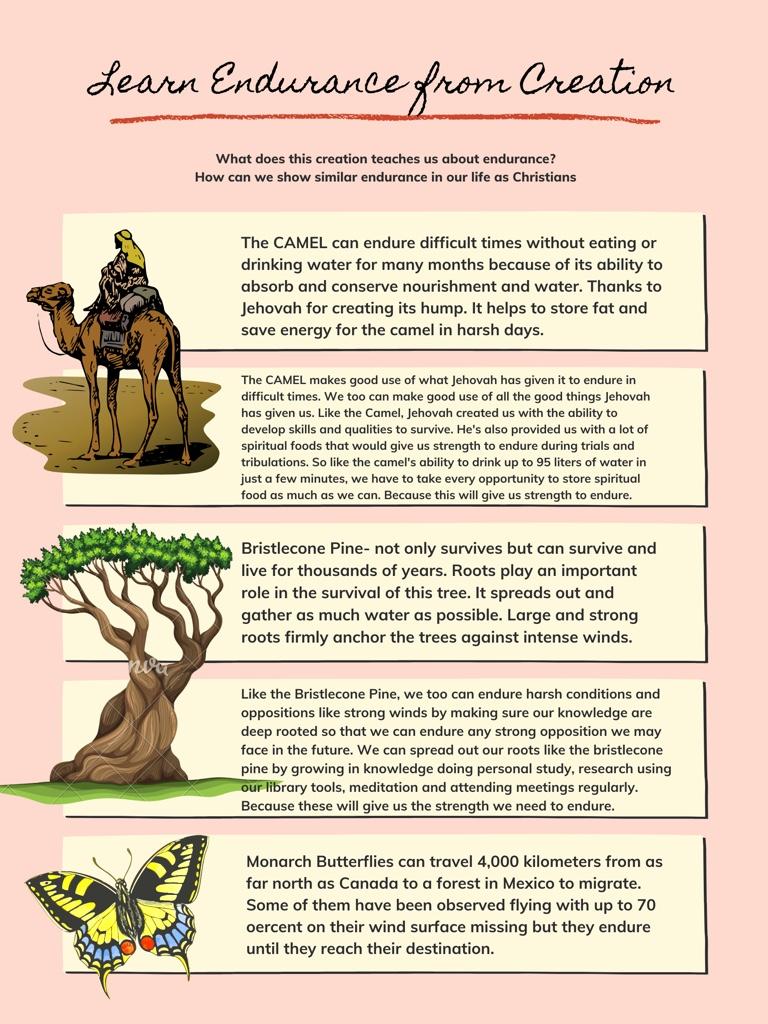
Learn Endurance from Creation

from Blogger https://ift.tt/33IqOMH
via IFTTT

TRANSCRIPTS | The King of the North’ in the Time of the End


from Blogger https://ift.tt/33Iwl5R
via IFTTT

Sample Conversations | What is God’s purpose for humans?


Sample Conversations

Initial Call

Question: What is God’s purpose for humans?

Scripture: Ge 1:28

Reference in the Enjoy Life Forever book…


Lesson 25 (PDF copy page 103)

What Is God’s Purpose for Us?


The Bible acknowledges that for humans, life is ‘short and filled with trouble.’ (Job 14:1) Is this really what God wants for us? If not, what is his purpose for us? Will it ever be fulfilled? Consider the Bible’s comforting answers.


1. What kind of life does Jehovah want for us?


Jehovah wants us to have the best life possible. When he created the first humans, Adam and Eve, he placed them in a beautiful paradise, the Garden of Eden. Then “God blessed them, and God said to them: ‘Be fruitful and become many, fill the earth and subdue it.’” (Genesis 1:28) Jehovah wanted them to have children, to make the whole earth a paradise, and to take care of the animals. His purpose was for all people to enjoy perfect health and live forever.


Although things did not work out that way, God’s purpose has not changed. (Isaiah 46:10, 11) He still wants obedient humans to live forever in perfect conditions.—Read Revelation 21:3, 4.

from Blogger https://ift.tt/33L6iLj
via IFTTT

Exemplary vs In Good Standing

Can someone be “in good standing”, but not an “exemplary” publisher or vice versa?

There are those publishers who are “not” in good standing (marked, reproved, etc).  There are the majority of publishers who are in good standing and doing God’s will.  Then there are those who are “exemplary” in faith and conduct.  To be exemplary, the publisher’s life and ministry must be worthy of being an example for others to imitate or follow.

Any special service, Audio or Video, Watchtower Reader, Zoom Host and so on need to be exemplary (not just a good reader or a fine electrician or computer tech).  


Something like unilaterally cancelling an engagement may cause one to be “un-exemplary”.  It is an entire life of a Christian that is considered.


Some references are:  December 15, 2000 Watchtower pages 26-29… God’s Love (LVS) book pages 250-251

from Blogger https://ift.tt/3uLQPqb
via IFTTT

Numbers 30:10-12​—How do we know that Elkanah approved of Hannah’s vow to offer Samuel to Jehovah’s service? (1Sa 1:11; it-2 28 ¶1)

Spiritual Gems: (10 min.)

Numbers 30:10-12​—How do we know that Elkanah approved of Hannah’s vow to offer Samuel to Jehovah’s service? (1Sa 1:11it-2 28 ¶1)

Persons could be devoted to Jehovah’s exclusive service in connection with the sanctuary. It was a right that parents could exercise. Samuel was one such person, promised to tabernacle service by a vow of his mother Hannah before his birth. This vow was approved by her husband Elkanah. As soon as Samuel was weaned, Hannah offered him at the sanctuary. Along with him, Hannah brought an animal sacrifice. (1Sa 1:11, 22-28; 2:11) Samson was another child specially devoted to God’s service as a Nazirite.​—Jg 13:2-5, 11-14; compare the father’s authority over a daughter as outlined in Nu 30:3-5, 16.

What spiritual gems from this week’s Bible reading would you like to share regarding Jehovah, the field ministry, or something else?


*** it-2 p. 1162 Vow ***

Voluntary, but Binding When Once Made. Vows were wholly voluntary. However, once a man made a vow, fulfillment was compulsory by divine law. Thus a vow was spoken of as being ‘bound upon his soul,’ implying that his very life became surety for the performance of his word. (Nu 30:2; see also Ro 1:31, 32.) Since life is at stake, it is understandable why the Scriptures urge one to use extreme caution before making a vow, carefully considering the obligations to be assumed. The Law stated: “In case you vow a vow to Jehovah . . . God will without fail require it of you, and it would indeed become a sin on your part. But in case you omit making a vow, it will not become a sin on your part.”—De 23:21, 22.


(Numbers 30:14, 15) 14 But if her husband offers no objection at all from day to day, he also establishes all her vows or all her abstinence vows that are upon her. He establishes them because he did not object on the day he heard her make them. 15 But if he annuls them later, sometime after the day he heard them, he will bear the consequences of her guilt.


*** it-2 p. 1162 Vow ***

Vows of women, under the Law. The laws regulating vows made by women are outlined at Numbers 30:3-15: The vow of a daughter was binding once her father heard it and raised no objection; or, instead, he could annul it. The vow of a wife (or an engaged girl) likewise depended on her husband (or fiancé) for validation. If the man annulled the vow after first letting it stand, he bore her error. (Nu 30:14, 15)


*** it-2 p. 1163 Vow ***

After Jerusalem’s destruction, Jeremiah reminded the Jews in Egypt that one reason for the calamity that befell them was their making vows to the “queen of the heavens” and offering sacrifices to her. The women who were taking a prominent part in this idol worship were quick to point out that their vows and worship to the “queen of the heavens” had been approved by their husbands and that they were determined to carry out their vows to this goddess. They thus made the excuse that they were acting in harmony with the Law regarding vows for women (Nu 30:10-15), but Jeremiah denounced their actions as being really law defying, since they were idolatrous.—Jer 44:19, 23-25; 2Co 6:16-18.


(Numbers 31:29) 29 You should take it from their half and give it to El·e·aʹzar the priest as Jehovah’s contribution.


*** it-2 p. 528 Offerings ***

Sacred portions (heave offerings). The Hebrew word teru·mahʹ is sometimes translated “sacred portion” when referring to the part of the sacrifice that was lifted up, or heaved, off the sacrifice as the portion belonging to the priests. (Ex 29:27, 28; Le 7:14, 32; 10:14, 15) The word is also frequently rendered “contribution,” when referring to the things given to the sanctuary, which, with the exception of that which was sacrificed on the altar, also went to the priests for their sustenance.—Nu 18:8-13, 19, 24, 26-29; 31:29; De 12:6, 11.


(Numbers 31:17, 18) 17 Now you should kill every male among the children and kill every woman who has had sexual relations with a man. 18 But you may keep alive all the young girls who have not had sexual relations with a man.


*** it-1 p. 850 Foreigner ***

Marriage alliances with foreigners were prohibited, primarily because of the danger of corruption of pure worship. (Ex 34:16; De 7:3, 24; Jos 23:12, 13) All inhabitants of cities of the seven Canaanite nations were to be destroyed. (De 7:1; 20:15-18) But in the capture of a city not of the seven proscribed Canaanite nations, an Israelite soldier could take a virgin from the city as a wife after she had undergone a period of purification. In such cases no actual alliance would be formed with a foreign tribe or family, her parents having been slain when her city was taken.—De 21:10-14; Nu 31:17, 18; De 20:14.


(Numbers 31:21-24) 21 El·e·aʹzar the priest then said to the men of the army who had gone into the battle: “This is the statute of the law that Jehovah commanded Moses, 22 ‘Only the gold, the silver, the copper, the iron, the tin, and the lead, 23 everything that can be processed with fire, you should pass through the fire, and it will be clean. However, it should also be purified by the water for cleansing. Everything that cannot be processed with fire, you should pass through the water. 24 And you should wash your garments on the seventh day and be clean, and then you may come into the camp.’”


*** it-1 p. 480 Clean, Cleanness ***

Spoils of war had to be cleansed before they could be brought in. Combustible articles were washed with water, but metal objects had to pass through the fire.—Nu 31:21-24.



NOTE: 
The references below are taken from the 1986-2021 Index. Many verses have additional references that have not been included due to time & space. We are encouraged you to do additional personal research.

from Blogger https://ift.tt/3ogrOB0
via IFTTT

Examining the Scriptures Daily 2021 05 11

from Blogger https://ift.tt/3hhpf01
via IFTTT

Pay Your Vows

Israelite vows were voluntary but binding (Nu 30:2it-2 1162)

Vows may include abstaining from things not prohibited (Nu 30:3, 4it-2 1162)

A solemn promise made to God to perform some act, make some offering or gift, enter some service or condition, or abstain from certain things not unlawful in themselves. A vow was a voluntary expression made of one’s own free will. Being a solemn promise, a vow carried the force of an oath or a swearing, and at times the two expressions accompany each other in the Bible. (Nu 30:2; Mt 5:33) “Vow” is more the declaration of intent, while “oath” denotes the appeal made to a higher authority attesting to the truthfulness or binding nature of the declaration. Oaths often accompanied attestation to a covenant.​—Ge 26:28; 31:44, 53.

Jehovah now deals with his worshippers individually (Nu 30:6-9w04 8/1 27 ¶3)

30:6-8—Can a Christian man set aside his wife’s vows? With regard to vows, Jehovah now deals with his worshipers individually. For example, dedication to Jehovah is a personal vow. (Galatians 6:5) A husband does not have the authority to set aside or cancel such a vow. A wife, though, should avoid making a vow that conflicts with God’s Word or her duties toward her husband.

The two most important vows a Christian can make today are the dedication vow and the marriage vow.

ASK YOURSELF, ‘Am I living up to the vows that I have made?’ (w01 2/1 pp. 14-19 10)

10 How do we view our dedication to God to do his will? Is it the first thing in our life? Regardless of our circumstances, whether young or old, married or single, healthy or sick, we should strive to live up to our dedication, in accordance with our circumstances. One person’s situation may allow him to serve in the full-time ministry as a pioneer, as a volunteer in a branch office of the Watch Tower Society, as a missionary, or in the traveling ministry. Some parents, on the other hand, may have their hands full, caring for the physical and spiritual needs of the family. Are their relatively few hours spent in the ministry each month worth any less in Jehovah’s eyes than the many hours spent by a full-time servant? No. God never expects from us what we do not have. The apostle Paul stated this principle: “If the readiness is there first, it is especially acceptable according to what a person has, not according to what a person does not have.”​—2 Corinthians 8:12.

from Blogger https://ift.tt/3hdXWDS
via IFTTT