
See Also Related Articles:
|
|
|
And Also Related Articles:
TREASURES FROM GOD’S WORD
Jehovah Organizes His People
[Play the video Introduction to Numbers.]
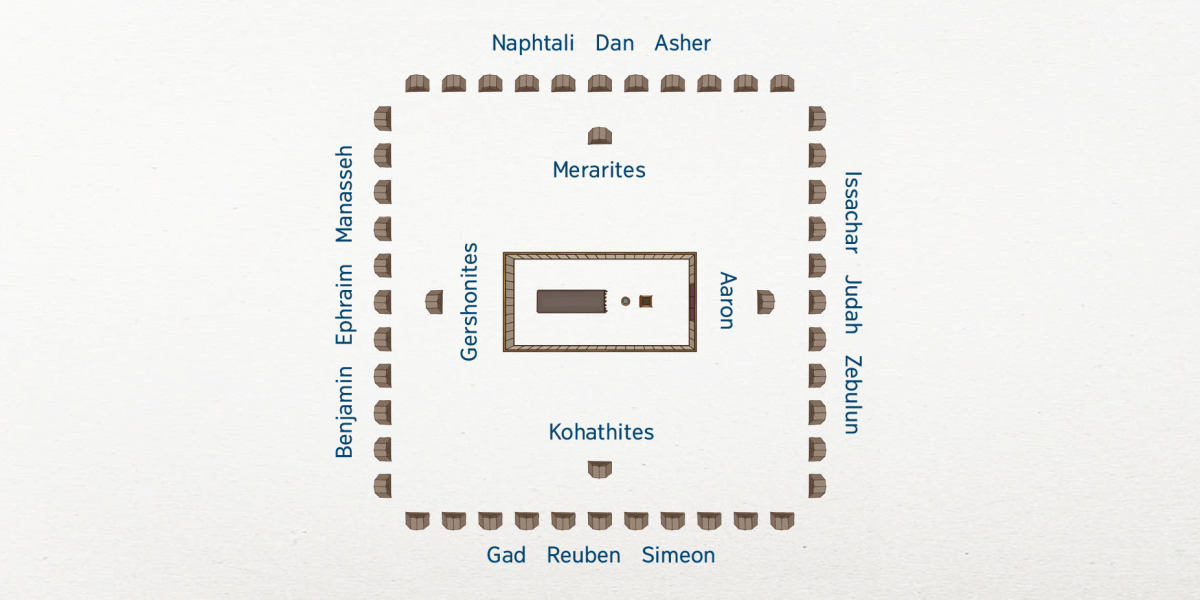
The Israelites camped according to three-tribe divisions (Nu 1:52, 53; w94 12/1 9 ¶4)
4 If you had had a bird’s-eye view of Israel encamped in the wilderness, what would you have seen? A vast, but orderly, array of tents housing possibly three million or more people, grouped according to three-tribe divisions to the north, south, east, and west. Peering closer, you would also have noticed another grouping nearer the middle of the camp. These four smaller clusters of tents housed the families of the tribe of Levi. At the very center of the camp, in an area cordoned off by a cloth wall, was a unique structure. This was the “tent of meeting,” or tabernacle, which “wise-hearted” Israelites had built according to Jehovah’s plan.—Numbers 1:52, 53; 2:3, 10, 17, 18, 25; Exodus 35:10.
4 If you had had a bird’s-eye view of Israel encamped in the wilderness, what would you have seen? A vast, but orderly, array of tents housing possibly three million or more people, grouped according to three-tribe divisions to the north, south, east, and west. Peering closer, you would also have noticed another grouping nearer the middle of the camp. These four smaller clusters of tents housed the families of the tribe of Levi. At the very center of the camp, in an area cordoned off by a cloth wall, was a unique structure. This was the “tent of meeting,” or tabernacle, which “wise-hearted” Israelites had built according to Jehovah’s plan.—Numbers 1:52, 53; 2:3, 10, 17, 18, 25; Exodus 35:10.
The Israelite camp may have totaled 3,000,000 or more (Nu 2:32, 33; it-1 397 ¶4)
Out and beyond the Levitical tents, the 12 tribes camped in a quadrilateral arrangement oriented by the four points of the compass. It appears that the people in general were removed a considerable distance from the tabernacle; some commentators suggest some 900 m (3,000 ft), because there was to be a distance of “about two thousand cubits” between the people and the ark of the covenant when the crossing of the Jordan began. (Jos 3:4) The 12 tribes were divided into four grand divisions, each called by the name of the central tribe of the division. So the three-tribe division to the E of the tabernacle was called Judah, with Issachar on the one side of Judah and Zebulun on the other side. (Nu 2:3-8) When this arrangement was set up in 1512 B.C.E., this three-tribe division of Judah numbered 186,400 able-bodied males 20 years old and up. (Nu 1:1-3; 2:9) Clockwise to the S was the three-tribe division of Reuben, with Simeon and Gad alongside Reuben, and numbering 151,450 men of war. (Nu 2:10-16) These two divisions on the E and S, together with the Levites, were Jacob’s descendants by Leah and her handmaid Zilpah. (Ge 35:23, 26) Incidentally, with both Reuben and the Kohathites camping S of the sanctuary, the physical association between the Reubenite rebels Dathan and Abiram and the Kohathite Korah is explained. (Nu 16:1) Around to the W was the three-tribe division of Ephraim, flanked by Manasseh and Benjamin, all descendants of Rachel, and numbering 108,100 army men. (Nu 2:18-24) Finally, on the N was the three-tribe division of Dan, associated with Asher and Naphtali, and totaling 157,600 fighting men. (Nu 2:25-31) Dan and Naphtali were descendants of Rachel’s handmaid Bilhah, but Asher was of Leah’s maidservant Zilpah.—Ge 35:25, 26.
Out and beyond the Levitical tents, the 12 tribes camped in a quadrilateral arrangement oriented by the four points of the compass. It appears that the people in general were removed a considerable distance from the tabernacle; some commentators suggest some 900 m (3,000 ft), because there was to be a distance of “about two thousand cubits” between the people and the ark of the covenant when the crossing of the Jordan began. (Jos 3:4) The 12 tribes were divided into four grand divisions, each called by the name of the central tribe of the division. So the three-tribe division to the E of the tabernacle was called Judah, with Issachar on the one side of Judah and Zebulun on the other side. (Nu 2:3-8) When this arrangement was set up in 1512 B.C.E., this three-tribe division of Judah numbered 186,400 able-bodied males 20 years old and up. (Nu 1:1-3; 2:9) Clockwise to the S was the three-tribe division of Reuben, with Simeon and Gad alongside Reuben, and numbering 151,450 men of war. (Nu 2:10-16) These two divisions on the E and S, together with the Levites, were Jacob’s descendants by Leah and her handmaid Zilpah. (Ge 35:23, 26) Incidentally, with both Reuben and the Kohathites camping S of the sanctuary, the physical association between the Reubenite rebels Dathan and Abiram and the Kohathite Korah is explained. (Nu 16:1) Around to the W was the three-tribe division of Ephraim, flanked by Manasseh and Benjamin, all descendants of Rachel, and numbering 108,100 army men. (Nu 2:18-24) Finally, on the N was the three-tribe division of Dan, associated with Asher and Naphtali, and totaling 157,600 fighting men. (Nu 2:25-31) Dan and Naphtali were descendants of Rachel’s handmaid Bilhah, but Asher was of Leah’s maidservant Zilpah.—Ge 35:25, 26.
Jehovah wants his people to worship him in an organized way. That was true for the nation of Israel, and it is true for us today.—1Co 14:33, 40.
ASK YOURSELF, ‘How can I show my complete support for Jehovah’s organization?’


 MeekSpaceNG