
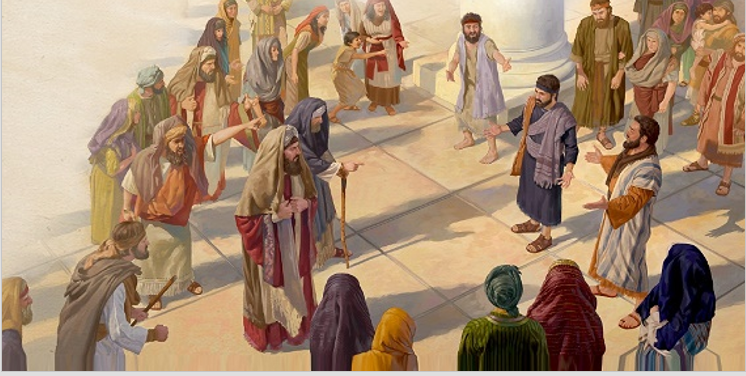
Ac 4:11—In what way is Jesus “the chief cornerstone”? (it-1 514 ¶4)
Psalm 118:22 discloses that the stone rejected by the builders would become “the head of the corner” (Heb., roʼsh pin·nahʹ). Jesus quoted and applied this prophecy to himself as “the chief cornerstone” (Gr., ke·pha·leʹ go·niʹas, head of the corner). (Mt 21:42; Mr 12:10, 11; Lu 20:17) Just as the topmost stone of a building is conspicuous, so Jesus Christ is the crowning stone of the Christian congregation of anointed ones, which is likened to a spiritual temple. Peter also applied Psalm 118:22 to Christ, showing that he was “the stone” rejected by men but chosen by God to become “the head of the corner.”—Ac 4:8-12; see also 1Pe 2:4-7.
Ac 5:1—Why did Ananias and Sapphira sell some of their property? (w13 3/1 15 ¶4)
Ananias and his wife sell some property to get money to help the newly baptized ones. When Ananias brings the money to the apostles, he says it is the total amount from the sale. But it is not! He keeps some money for himself! God lets Peter know this, so Peter tells Ananias: “You have played false, not to men, but to God.” At that, Ananias falls down dead! About three hours later, his wife comes in. Not knowing what has happened to her husband, she also tells a lie and falls down dead.
What has this week’s Bible reading taught you about Jehovah?
*** w18 May p. 21 par. 17 Why We “Keep Bearing Much Fruit” ***
17 The gift of answered prayers. Jesus stated: “No matter what you ask the Father in my name, he [will] give it to you.” (John 15:16) How strengthening this promise must have been for the apostles! Though they did not clearly grasp it, their Leader’s life on earth would soon end, but they would not be left without support. Jehovah was ready to answer their prayers for any help they needed to carry out the command to preach the Kingdom message. And indeed, shortly thereafter, they experienced how Jehovah answered their prayers for help.—Acts 4:29, 31.
*** w17 October p. 9 par. 9 “Love . . . in Deed and Truth” ***
9 Be happy to serve in the background. We should be willing to perform acts of love for our brothers “in secret,” or out of the limelight, when this is possible. (Read Matthew 6:1-4.) Ananias and Sapphira failed to do that. Not content to donate anonymously, they blatantly exaggerated their offering and suffered disaster for their hypocrisy. (Acts 5:1-10) In contrast, genuine love moves us to find joy in serving our brothers without fanfare or recognition. For instance, the brothers who support the Governing Body in helping to prepare spiritual food do so anonymously, not drawing attention to themselves or revealing the material they have worked on.
*** w17 October pp. 14-15 par. 10 The Truth Brings, “Not Peace, But a Sword” ***
10 At times, unbelieving mates will demand that children share in pagan celebrations or be taught false religious beliefs. Some husbands may forbid the Christian wife to teach the children from the Bible. Even so, a Christian wife does what she can to teach the children Bible truth. (Acts 16:1; 2 Tim. 3:14, 15) For example, the husband of a Witness wife might not allow her to conduct a formal Bible study with her minor children or to take them with her to Christian meetings. While respecting his decisions, she can still express her faith in the presence of her children as opportunities arise, thus giving them moral training and knowledge about Jehovah. (Acts 4:19, 20) Of course, her children must eventually make their own decision regarding worship.—Deut. 30:19, 20.
*** wp16 No. 2 p. 4 Did It Really Happen? ***
At the risk of being arrested and killed, the disciples courageously proclaimed Jesus’ resurrection to all—even to the very ones who had executed him. (Acts 4:1-3, 10, 19, 20; 5:27-32) Would so many disciples have been so bold if they were not absolutely sure that Jesus had really been resurrected? In fact, the reality of the resurrection of Jesus is the driving force behind the impact that Christianity has had on the world both then and now.
*** w16 April p. 21 par. 15 Why Should We Meet Together for Worship? ***
15 Our meeting attendance demonstrates that we support God’s sovereignty. Although Jehovah commands us to attend meetings, he does not force us to comply. (Isa. 43:23) Therefore, it is up to us to show Jehovah how deeply we love him from our heart and how firmly we support his rule. (Rom. 6:17) For example, we may be pressured by an employer who insists that we sacrifice regular meeting attendance for secular work. We may be opposed by a government that threatens us with fines, imprisonment, or worse if we meet together for worship. Or we may be tempted to engage in recreation rather than attend a meeting. In each of these situations, we face a choice: Whom will we serve? (Acts 5:29) When we choose to support Jehovah’s sovereignty, we make his heart rejoice.—Prov. 27:11.
*** w16 April p. 27 par. 1 Maintain Your Neutrality in a Divided World ***
GOD’S WORD tells us to be obedient to human governments, yet it also teaches that we must obey God rather than men. (Acts 5:29; Titus 3:1) Is this a contradiction? Not at all! The principle of relative subjection helps us to understand and obey these commands. Jesus summarized this principle when he said: “Pay back, therefore, Caesar’s things to Caesar, but God’s things to God.” (Matt. 22:21) How do we follow Jesus’ direction? We submit to the authority of the government under which we live by obeying its laws, respecting its officials, and paying the taxes it levies. (Rom. 13:7) However, if government authorities tell us to disobey God, we respectfully refuse to comply.
*** w15 2/15 p. 12 par. 8 Imitate Jesus’ Courage and Discernment ***
8 In our ministry. As true Christians, we need to keep “speaking with boldness by the authority of Jehovah.” (Acts 14:3) What reasons do we have to preach with boldness, or courage? We know that what we preach is the truth because it is based on the Bible. (John 17:17) We recognize that “we are God’s fellow workers” and that we have the backing of holy spirit. (1 Cor. 3:9; Acts 4:31) We understand that by witnessing zealously, we demonstrate our devotion to Jehovah and our love for our neighbor. (Matt. 22:37-39) Imbued with courage, we will not be silenced. On the contrary, we are determined to expose the religious lies that blind people to the truth. (2 Cor. 4:4) And we will persevere in preaching the good news despite apathy, ridicule, or opposition.—1 Thess. 2:1, 2.
What other spiritual gems have you discovered in this week’s Bible reading?
*** w18 January p. 19 par. 9 Why Give to the One Who Has Everything? ***
9 Of course, the sources of such donations varied. When contributing for the building of the tabernacle in the wilderness, what the Israelites gave likely included what they had brought with them from Egypt. (Ex. 3:21, 22; 35:22-24) In the first century, some Christians sold items that they owned, such as fields or houses, and brought the money to the apostles. The apostles distributed these funds to those in need. (Acts 4:34, 35) Others set aside money and gave regular donations to support the work. (1 Cor. 16:2) Thus, people of all walks of life—from the very wealthy to the very poor—had a share.—Luke 21:1-4.
*** w18 February p. 28 Joy—A Quality We Acquire From God ***
Joy, in contrast, is a deep-seated quality of the heart. It has been defined as “the emotion excited by the acquisition or expectation of good.” Joy is a state of happiness or gladness that remains whether the conditions around us are pleasant or not. (1 Thess. 1:6) In fact, a person can be disturbed about something but still have joy in his heart. For example, the apostles were flogged for speaking about the Christ. Yet, they “went out from before the Sanhedrin, rejoicing because they had been counted worthy to be dishonored in behalf of his name.” (Acts 5:41) Obviously, they were not rejoicing over the flogging they had received. But as servants of God, they found true joy in keeping their integrity to him.
*** w18 June p. 9 par. 5 May We All Be One as Jehovah and Jesus Are One ***
5 Jewish leaders likewise heaped scorn on Jesus’ followers. The Pharisees classed them as among the “accursed people.” (John 7:47-49) Yes, they considered anyone who had not studied at the rabbinic schools or who did not keep their traditions to be contemptible and ordinary. (Acts 4:13, ftn.) The prejudice that Jesus and his disciples suffered was rooted in religious, social, and ethnic divisions. The disciples too were affected by prejudice. To be united, they would have to change their mind-set.
*** w17 March p. 27 par. 17 Will You Apply Your Heart to the Things Written? ***
17 If a problem arises, we ought to consider what Bible principles are involved and apply them in a balanced way. In some cases, we may want to consult with the elders. We may have given thought to what we already know about the subject, and we may even have done research in our publications. Yet, there may be other Bible principles to take into consideration, which an elder might help us to analyze. For example, a sister knows that she has the responsibility to preach the good news. (Acts 4:20) However, suppose she plans to go out in the field service on a certain day, but her unbelieving husband wants her to stay home. He says that they have not had much time together lately, and he would like them to do something as a couple. She might consider relevant Bible texts, such as obeying God and the command to make disciples. (Matt. 28:19, 20; Acts 5:29) But she also needs to think about wifely subjection and being reasonable. (Eph. 5:22-24; Phil. 4:5) Is her husband completely opposed to her going out in service, or is he asking her to do something else just that one day? We need balance as we seek to do God’s will and strive to have a good conscience.
*** w17 September p. 29 par. 8 “Be Courageous . . . and Go to Work” ***
8 Jesus’ faithful apostles set a fine example of courage. They had seen the courage Jesus displayed. (Matt. 8:28-32; John 2:13-17; 18:3-5) That example helped them to build courage. When opposed by the Sadducees, the apostles would not stop teaching on the basis of Jesus’ name.—Acts 5:17, 18, 27-29.
*** w16 May p. 10 par. 10 “Go, . . . and Make Disciples of People of All the Nations” ***
10 What methods did Jesus and his disciples use to preach the good news? They went to the people wherever they could be found—in public areas and in private homes. The preaching work included searching for deserving ones from house to house. (Matt. 10:11; Luke 8:1; Acts 5:42; 20:20) This systematic method showed impartiality.
*** w15 1/1 p. 14 Should We Pray to Jesus? ***
Within weeks of Jesus’ return to heaven, his disciples were being harassed and threatened by their opposers. (Acts 4:18) Of course, they reached out in prayer—but to whom did they turn? “They raised their voices with one accord to God,” praying that he would continue helping them “through the name of [his] holy servant Jesus.” (Acts 4:24, 30) So the disciples followed Jesus’ guidelines on prayer. They prayed to God, not to Jesus.
 MeekSpaceNG