
Digging for Spiritual Gems: (8 min.)
Joh 20:17—What is the meaning of Jesus’ words to Mary Magdalene? (“Stop clinging to me” study note on Joh 20:17, nwtsty)
Stop clinging to me: The Greek verb haʹpto·mai can mean either “to touch” or “to cling to; to hang on to.” Some translations render Jesus’ words: “Do not touch me.” However, Jesus was not objecting to Mary Magdalene’s merely touching him, since he did not object when other women who saw him after he was resurrected “took hold of his feet.” (Mt 28:9) It appears that Mary Magdalene feared that Jesus was about to ascend to heaven. Moved by her strong desire to be with her Lord, she was holding fast to Jesus, not letting him go. To assure her that he was not yet leaving, Jesus instructed Mary to stop clinging to him and, instead, to go to his disciples and declare the news of his resurrection.
Joh 20:28—Why did Thomas call Jesus “my Lord and my God”? (“My Lord and my God!” study note on Joh 20:28, nwtsty)
My Lord and my God!: Lit., “The Lord of me and the God [ho the·osʹ] of me!” Some scholars view this expression as an exclamation of astonishment spoken to Jesus but actually directed to God, his Father. Others claim that the original Greek requires that the words be viewed as being directed to Jesus. Even if this is so, the intent of the expression “my Lord and my God” is best understood in the context of the rest of the inspired Scriptures. Since the record shows that Jesus had previously sent his disciples the message, “I am ascending to my Father and your Father and to my God and your God,” there is no reason to believe that Thomas thought that Jesus was the almighty God. (See study note on Joh 20:17.) Thomas had heard Jesus pray to his “Father,” calling him “the only true God.” (Joh 17:1-3) So Thomas may have addressed Jesus as “my God” for the following reasons: He viewed Jesus as being “a god” though not the almighty God. (See study note on Joh 1:1.) Or he may have addressed Jesus in a manner similar to the way that servants of God addressed angelic messengers of Jehovah, as recorded in the Hebrew Scriptures. Thomas would have been familiar with accounts in which individuals, or at times the Bible writer of the account, responded to or spoke of an angelic messenger as though he were Jehovah God. (Compare Ge 16:7-11, 13; 18:1-5, 22-33; 32:24-30; Jg 6:11-15; 13:20-22.) Therefore, Thomas may have called Jesus “my God” in this sense, acknowledging Jesus as the representative and spokesman of the true God.
Some argue that the use of the Greek definite article before the words for “lord” and “god” indicates that these words refer to the almighty God. However, in this context the use of the article may simply reflect Greek grammar. Cases where a nominative noun with the definite article is used as vocative in Greek can be illustrated by a literal translation of such scriptures as Lu 12:32 (lit., “the little flock”) and Col 3:18–4:1 (“lit., “the wives”; “the husbands”; “the children”; “the fathers”; “the slaves”; “the masters”). In a similar way, a literal translation of 1Pe 3:7 would read: “The husbands.” So the use of the article here may not be of significance in determining what Thomas had in mind when he made his statement.
What has this week’s Bible reading taught you about Jehovah?
*** w15 1/1 p. 14 Should We Pray to Jesus? ***
HIS TEACHING: When one of his disciples asked Jesus, “Lord, teach us how to pray,” Jesus replied: “Whenever you pray, say: ‘Father.’” (Luke 11:1, 2) Further, in his famous Sermon on the Mount, Jesus urged his listeners to pray. He said: “Pray to your Father.” He also reassured them by saying: “Your Father knows what you need even before you ask him.” (Matthew 6:6, 8) On his final night as a human, Jesus told his disciples: “If you ask the Father for anything, he will give it to you in my name.” (John 16:23) Jesus thus taught us to pray to the one who is both his Father and our Father, Jehovah God.—John 20:17.
*** w14 8/15 p. 5 Are You Receiving “Food at the Proper Time”? ***
It is also worth noting that much of what Jesus said and did while on earth is not recorded in the Gospel accounts. The apostle John wrote: “There are also, in fact, many other things that Jesus did, which if ever they were written in full detail, I suppose the world itself could not contain the scrolls written.” (John 21:25) Even though Jesus’ first-century followers had more information about the perfect man Jesus than we do, we are not deprived. Jehovah has made sure that we know enough about Jesus for us to be his footstep followers.—1 Pet. 2:21.
*** w13 5/1 p. 14 pars. 3-4 Does Jehovah Really Care About You? ***
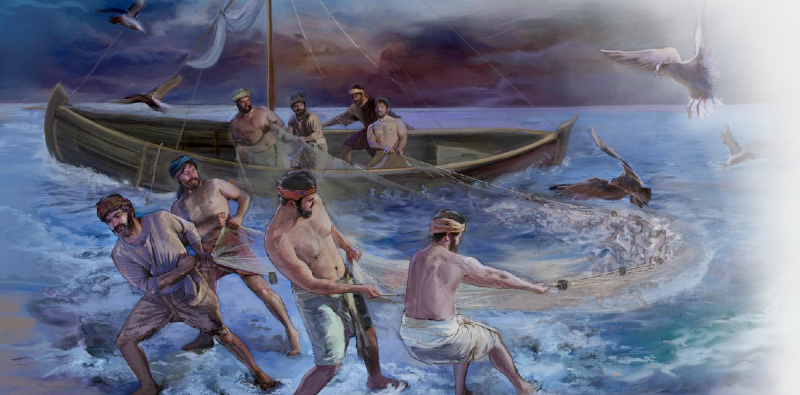
What does it mean that Jehovah draws us? The Greek verb rendered “draws” is also used in reference to hauling in a net of fishes. (John 21:6, 11) Does Jehovah drag us against our will, forcing us to serve him? No. Jehovah gave us free will, so he does not force our heart open. (Deuteronomy 30:19, 20) One scholar puts it this way: “There is no handle on the outside of the door of the human heart. It must be opened from within.” Jehovah searches through the billions of hearts in this world, looking for individuals who are inclined toward him. (1 Chronicles 28:9) When he finds such a person, he responds in a touching way. How so?
Jehovah gently attracts, or tugs at, the heart of an individual who is “rightly disposed.” (Acts 13:48) Jehovah does so in two ways—through the Bible’s message of good news, which reaches us as individuals, and through his holy spirit. When Jehovah sees a heart that is responsive to Bible truth, he uses his spirit to help the individual to grasp and apply that truth in his life. (1 Corinthians 2:11, 12) Without divine help, we could never become genuine followers of Jesus and devoted worshippers of Jehovah.
*** w13 7/15 p. 16 par. 7 Feeding Many Through the Hands of a Few ***
7 What would be the role of the apostles? As Pentecost 33 C.E. drew near, it was clear that the apostles would serve in an “office of oversight.” (Acts 1:20) What, though, would be their primary concern? Following his resurrection, Jesus provided a clue in a conversation he had with the apostle Peter. (Read John 21:1, 2, 15-17.) In the presence of some of the other apostles, Jesus told Peter: “Feed my little sheep.” Jesus thereby indicated that his apostles would be among the few through whom he would provide spiritual food to the many. What a touching and telling indication of how Jesus feels about his “little sheep”!
*** w13 11/1 p. 5 The Lie That Made God a Mystery ***
WHAT MANY BELIEVE The Christian religion “in its three classic forms of Roman Catholicism, Eastern Orthodoxy, and Protestantism acknowledges one God in three Persons: God the Father, God the Son, and God the Holy Spirit. According to Christian theology, this acknowledgment is not a recognition of three gods but that these three persons are essentially one.”—The New Encyclopædia Britannica.
THE TRUTH FROM THE BIBLE Jesus, the Son of God, never claimed to be equal to or of the same substance as his Father. Rather, he said: “I am going my way to the Father, because the Father is greater than I am.” (John 14:28) He also told one of his followers: “I am ascending to my Father and your Father and to my God and your God.”—John 20:17.
What other spiritual gems have you discovered in this week’s Bible reading?
*** w18 April p. 16 par. 7 Imitating Jehovah—A God Who Gives Encouragement ***
7 Jesus’ apostles often quarreled over who was the greatest among them, but Jesus patiently encouraged them to humble themselves and to become servants, not bosses. (Luke 22:24-26) Peter in particular disappointed Jesus several times. (Matt. 16:21-23; 26:31-35, 75) Rather than reject Peter, Jesus encouraged him and even commissioned him to strengthen his brothers.—John 21:16.
*** w17 May pp. 22-23 par. 2 “Do You Love Me More Than These?” ***
2 After serving them breakfast, Jesus turned to Simon Peter and said: “Simon son of John, do you love me more than these?” To what was Jesus referring? Peter was quite attached to fishing. So it seems that Jesus was asking him where his true affection lay. Did he have greater affection for the fish and the fishing business than for Jesus and the things that he taught? In answer, Peter said: “Yes, Lord, you know I have affection for you.” (John 21:15) Peter certainly lived up to his word. From that point forward, he proved his love for Christ by busying himself in the disciple-making work, becoming a pillar in the first-century Christian congregation.
*** w11 6/15 p. 22 par. 11 “Shepherd the Flock of God in Your Care” ***
11 Peter next reminded the older men how the shepherding work should and should not be done. Elders are to shepherd the flock of God, “not under compulsion, but willingly.” What moves elders to serve their brothers willingly? Well, what moved Peter to shepherd and feed Jesus’ sheep? A key was his love and affection for the Lord. (John 21:15-17) Because of love, elders “live no longer for themselves, but for him who died for them.” (2 Cor. 5:14, 15) This love, combined with their love for God and their brothers, compels elders to serve the flock, devoting their efforts, resources, and time to doing so. (Matt. 22:37-39) They give of themselves, not grudgingly, but willingly.
*** w11 11/15 p. 28 par. 1 Train Others to Reach Out ***
CONCLUDING his Gospel account, the apostle John wrote: “There are, in fact, many other things also which Jesus did, which, if ever they were written in full detail, I suppose, the world itself could not contain the scrolls written.” (John 21:25) Among all the things that Jesus accomplished during his short but dynamic ministry was the locating, training, and organizing of men who would take the lead after his earthly sojourn. When he returned to heaven in 33 C.E., Jesus left behind the foundation of a remarkable congregation that would quickly number into the thousands.—Acts 2:41, 42; 4:4; 6:7.
 MeekSpaceNG