
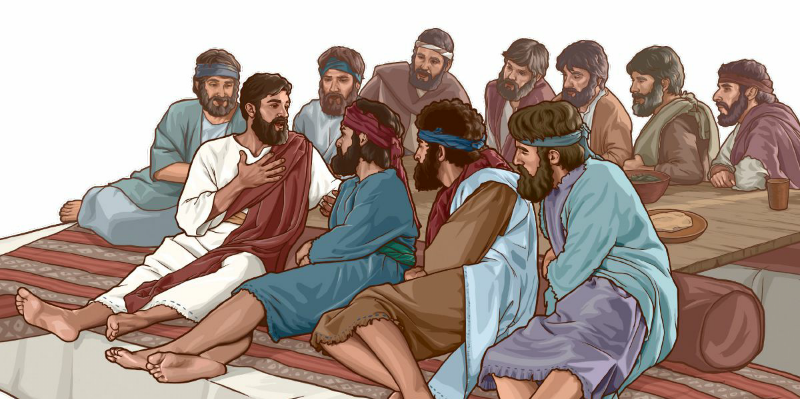
Joh 17:21-23—In what sense were Jesus’ followers to be “one”? (“one” study note on Joh 17:21, nwtsty; “be perfected into one” study note on Joh 17:23, nwtsty)
one: Or “at unity.” Jesus prayed that his true followers would be “one,” unitedly working together for the same purpose, just as he and his Father are “one,” demonstrating cooperation and unity of thought. (Joh 17:22) At 1Co 3:6-9, Paul describes this type of unity among Christian ministers as they work with one another and with God.—See 1Co 3:8 and study notes on Joh 10:30; 17:11.
be perfected into one: Or “be completely unified.” In this verse, Jesus connects perfect unity with being loved by the Father. This is in harmony with Col 3:14, which says: “Love . . . is a perfect bond of union.” This perfect unity is relative. It does not mean that all differences of personality, such as individual abilities, habits, and conscience, are eliminated. It does mean that Jesus’ followers are unified in action, belief, and teaching.—Ro 15:5, 6; 1Co 1:10; Eph 4:3; Php 1:27.
Joh 17:24—What is “the founding of the world”? (“founding of the world” study note on Joh 17:24, nwtsty)
founding of the world: The Greek word for “founding” is rendered “to conceive” at Heb 11:11, where it is used with “offspring.” Here used in the expression “founding of the world,” it apparently refers to the birth of children to Adam and Eve. Jesus associates “the founding of the world” with Abel, apparently the first redeemable human and the first to have his name “written in the scroll of life from the founding of the world.” (Lu 11:50, 51; Re 17:8) These words of Jesus in prayer to his Father also confirm that long ago—before Adam and Eve conceived offspring—God loved his only-begotten Son.
What has this week’s Bible reading taught you about Jehovah?
*** w18 May p. 18 par. 3 Why We “Keep Bearing Much Fruit” ***
3 The foremost reason why we share in the preaching work is to glorify Jehovah and sanctify his name before mankind. (Read John 15:1, 8.) Note that Jesus compared his Father, Jehovah, to a cultivator, or gardener, who grows grapes. Jesus likened himself to a vine, or stem, and his followers to branches. (John 15:5) Thus, the grapes fittingly illustrate the Kingdom fruitage that is produced by Christ’s followers. Jesus told his apostles: “My Father is glorified in this, that you keep bearing much fruit.” Just as vines that produce good grapes bring honor to a cultivator, so we bring honor, or glory, to Jehovah when we proclaim the Kingdom message to the best of our abilities.—Matt. 25:20-23.
*** w18 May p. 18 par. 5 Why We “Keep Bearing Much Fruit” ***
5 Read John 15:9, 10. Our heartfelt love for Jehovah and for Jesus is an important reason why we preach the Kingdom message. (Mark 12:30; John 14:15) Jesus told his disciples not only to be in his love but to “remain in [his] love.” Why? Because living as a true disciple of Christ year after year calls for endurance. Jesus stressed the need for endurance by using forms of the word “remain” over and over in the brief passage recorded at John 15:4-10.
*** w18 June p. 8 par. 1 May We All Be One as Jehovah and Jesus Are One ***
JESUS was concerned about unity during his final supper with his apostles. When praying with them, he spoke of his desire that all his disciples be one, just as he and his Father are one. (Read John 17:20, 21.) Their unity would give a powerful witness, offering clear evidence that Jehovah had sent Jesus to the earth to do God’s will. Love would be a mark of Jesus’ true disciples that would contribute to their unity.—John 13:34, 35.
*** w18 July p. 11 par. 17 Whose Recognition Do You Seek? ***
17 While on earth, Jesus expressed his desire to return to the glory he once had in heaven with his Father. (John 17:5) Nothing indicates that Jesus was hoping for more than that. He was not expecting some sort of heavenly “upgrade.” But what did Jehovah do? He honored Jesus in an unexpected way by resurrecting him to “a superior position” and giving him what no one else had received up until that time—immortal spirit life! (Phil. 2:9; 1 Tim. 6:16) What an outstanding acknowledgment of Jesus’ faithful course!
*** w18 November p. 10 par. 7 “I Will Walk in Your Truth” ***
7 To walk in the truth, we must accept and obey all of Jehovah’s sayings. We must give the truth priority in our lives and live according to Bible principles. In prayer to Jehovah, King David declared: “I will walk in your truth.” (Ps. 86:11) David was determined. We too must be firmly resolved to keep walking in God’s truth. If we are not, we could have second thoughts about what we paid for the truth and perhaps be tempted to begin taking back part of the payment. Rather, we carefully hold on to the complete truth. We recognize that we cannot pick which truths to accept and which to ignore. After all, we must walk in “all the truth.” (John 16:13) Let us reflect on five things that we may have paid for the truth. Doing so will strengthen our resolve not to be lured into taking back even part of our payment.—Matt. 6:19.
*** wp17 No. 2 pp. 6-7 How Will You Respond to God’s Greatest Gift? ***
Come to know the Giver. The ransom does not automatically bring everlasting life to all humans. Rather, Jesus said in prayer to God: “This means everlasting life, their coming to know you, the only true God, and the one whom you sent, Jesus Christ.” (John 17:3) If someone told you that a man saved your life when you were yet a child, would you not be interested in learning more about that man and why he saved you? Jehovah God, who gave the lifesaving gift of the ransom, wants you not only to know who he is but also to come into a close relationship with him. “Draw close to God,” the Bible urges, “and he will draw close to you.”—James 4:8.
*** w17 February p. 9 par. 4 The Ransom—A “Perfect Present” From the Father ***
4 Jesus, on the other hand, truly loved the name of Jehovah. (John 17:25, 26) Jesus contributed to the sanctification of the divine name. (Read Psalm 40:8-10.) By his perfect life course on earth, Jesus proved that it is reasonable and righteous for Jehovah to set standards for his intelligent creatures. Even when Satan subjected Jesus to an agonizing death, Jesus remained completely loyal to his heavenly Father. By being loyal, Jesus proved that a perfect human could maintain perfect obedience to God’s righteous standards.
*** w16 April p. 28 par. 3 Maintain Your Neutrality in a Divided World ***
3 The Bible gives several reasons why God requires that we remain neutral. For example, we follow the teachings and example of his Son, Jesus Christ, by being “no part of the world,” avoiding its politics and wars. (John 6:15; 17:16) We must remain neutral in order to be loyal subjects of God’s Kingdom. Otherwise, how could we have a clean conscience when we preach the good news that only God’s Kingdom can solve mankind’s problems? Additionally, unlike false religions that divide their members by meddling in politics, true worship preserves our international brotherhood by helping us to remain neutral.—1 Pet. 2:17.
*** w15 7/15 p. 22 par. 1 Maintain Your Loyalty to God’s Kingdom ***
LOYALTY and neutrality are always issues for true Christians, not just in times of war. Why? Because all who are dedicated to Jehovah have promised him their love, loyalty, and obedience. (1 John 5:3) We want to abide by God’s righteous standards wherever we live and whatever our background, nationality, or culture. Loyalty to Jehovah and to his Kingdom transcends any other attachment we may have. (Matt. 6:33) Such loyalty requires that Christians remain separate from all conflicts and controversies of this world.—Isa. 2:4; read John 17:11, 15, 16.
*** w15 8/15 p. 26 par. 11 Watch Your Associations in These Last Days ***
11 In contrast with what the world produces, the material produced by Jehovah’s organization in these last days encourages conduct that leads to eternal life. In prayer to Jehovah, Jesus said: “This means everlasting life, their coming to know you, the only true God, and the one whom you sent, Jesus Christ.” (John 17:3) Through his organization, our heavenly Father is providing an abundance of upbuilding spiritual food. How blessed we are to have magazines, brochures, books, videos, and Web pages that promote true worship! God’s organization also provides regular meetings in more than 110,000 congregations worldwide. At those meetings and at assemblies and conventions, we consider Bible-based material that builds faith in God and his promises.—Heb. 10:24, 25.
What other spiritual gems have you discovered in this week’s Bible reading?
*** wp18 No. 1 p. 15 The Bible and Your Future ***
How can you build such an eternal friendship with God? Keep learning about him through the pages of his Word, the Bible. (John 17:3; 2 Timothy 3:16) Seek his help to understand the Scriptures. The Bible assures us that if we sincerely “keep asking God” for wisdom, he will grant it to us. (James 1:5) Finally, strive to apply what you learn, letting God’s Word serve as both “a lamp to [your] foot” and a “light for [your] path”—now and throughout eternity.—Psalm 119:105.
*** w18 February p. 21 par. 12 What Does It Mean to Be a Spiritual Person? ***
12 Yet, of all the people who have lived, who is the most outstanding example of a spiritual person? It is Jesus, of course. Throughout his life and ministry, he showed that he wanted to imitate his Father, Jehovah. He thought, felt, and acted like Jehovah and lived in harmony with God’s will and standards. (John 8:29; 14:9; 15:10) Note, for example, how Jehovah’s feelings of compassion are described by the prophet Isaiah, and compare that description with what the Gospel writer Mark reports about Jesus’ feelings. (Read Isaiah 63:9; Mark 6:34.) Are we like Jesus, ever ready to show compassionate concern when we meet people who need help? In addition, Jesus devoted himself to the work of preaching and teaching the good news. (Luke 4:43) All such feelings and actions are marks of a spiritual person.
*** w18 May p. 24 par. 9 Know Your Enemy ***
9 What advantage do we gain from knowing the extent of Satan’s influence? It helps us keep a balanced view of secular authorities and motivates us in our witnessing work. We understand that Jehovah wants us to respect governmental authorities. (1 Pet. 2:17) And he expects us to obey the laws of human governments as long as those laws do not conflict with his standards. (Rom. 13:1-4) But we realize that we must remain neutral, never favoring one political party or human leader over another. (John 17:15, 16; 18:36) Because we see what Satan is trying to do to Jehovah’s name and reputation, we feel more compelled to teach others the truth about our God. We proudly bear and use his name, knowing that loving him is far more rewarding than loving money or things.—Isa. 43:10; 1 Tim. 6:6-10.
*** w18 June pp. 16-17 par. 3 Let God’s Laws and Principles Train Your Conscience ***
3 When a person’s conscience is not properly trained, it does not act as a restraint from wrongdoing. (1 Tim. 4:1, 2) Such a conscience might even convince us that “bad is good.” (Isa. 5:20) Jesus warned his followers: “The hour is coming when everyone who kills you will think he has offered a sacred service to God.” (John 16:2) That was true of those who murdered the disciple Stephen, and it has been true of others like them. (Acts 6:8, 12; 7:54-60) How ironic that in committing such evil crimes as murder, religious fanatics violate the very laws of the One whom they claim to worship! (Ex. 20:13) Clearly, their consciences are treacherous guides!
*** w18 September p. 12 par. 1 Keep Displaying Love—It Builds Up ***
ON HIS final night with his disciples, Jesus mentioned love nearly 30 times. He specifically indicated that his disciples should “love one another.” (John 15:12, 17) Their love for one another would be so outstanding that it would clearly distinguish them as his true followers. (John 13:34, 35) This love is not mere sentimentality. Jesus was referring to a most noble quality—self-sacrificing love. He said: “No one has love greater than this, that someone should surrender his life in behalf of his friends. You are my friends if you do what I am commanding you.”—John 15:13, 14.
*** w18 October p. 25 par. 12 Put Trust in Our Active Leader—The Christ ***
12 For some, it takes time to adjust to a clarification in understanding. Jewish Christians needed sufficient time to adjust their viewpoint. (John 16:12) Some found it hard to accept that circumcision was no longer a sign of a special relationship with God. (Gen. 17:9-12) Others, out of fear of persecution, were reluctant to stand out in Jewish communities. (Gal. 6:12) In time, though, Christ provided further guidance through inspired letters written by Paul.—Rom. 2:28, 29; Gal. 3:23-25.
*** w18 October p. 32 par. 3 Did You Know? ***
We may one day find ourselves facing threats and persecution. (John 15:20) By feeding regularly on God’s Word and by being active in the ministry, we allow Jehovah’s spirit to be at work in us. We will also find the strength to withstand opposition while maintaining our inner peace.—1 Pet. 4:12-14.
*** w18 November p. 6 par. 11 “Buy Truth and Never Sell It” ***
11 Personal relationships. When we choose to live according to Bible truth, our ties with friends and relatives may change. Why? Jesus prayed regarding his followers: “Sanctify them by means of the truth; your word is truth.” (John 17:17; ftn.) “Sanctify them” can also mean “set them apart.” When we accept the truth, we are set apart from the world because we no longer fit into its mold. People view us differently because our values have changed. We live by the standards of Bible truth. Though we do not want to cause division, some friends and close family members may distance themselves from us or even oppose our newfound faith. This does not surprise us. Jesus acknowledged: “Indeed, a man’s enemies will be those of his own household.” (Matt. 10:36) He also gave assurance that the rewards for buying truth far exceed any price we may pay.—Read Mark 10:28-30.
*** wp16 No. 4 p. 15 The Most Useful Comparison You May Ever Make ***
Jesus said that our worship of God must be based on truth—the truth found in the Bible. (John 4:24; 17:17) And the apostle Paul said that our salvation depends on our coming to “an accurate knowledge of truth.” (1 Timothy 2:4) So it is vital that our beliefs be based on accurate Bible truth. Why, our very salvation is at stake!
*** w15 4/15 p. 7 par. 20 Elders, How Do You Feel About Training Others? ***
20 Elders, remember: A successful teacher is someone who not only loves to train another person but also loves the person he is training. (Compare John 5:20.) That crucial aspect of a teacher’s disposition is quickly discerned by a learner and greatly affects the way he responds to the training he receives. Therefore, dear elders, as you give training, be more than a teacher—be a friend.—Prov. 17:17; John 15:15.
*** w15 8/15 p. 21 par. 10 Prepare Now for Life in the New World ***
10 We can also prepare for life in the new world by exercising patience regarding revealed truth. Are we studious and patient as our understanding of Bible truth is progressively clarified today? If so, we will likely have no difficulty showing patience in the new world as Jehovah makes known his requirements for mankind.—Prov. 4:18; John 16:12.
*** w15 9/15 p. 6 par. 11 Are You Reaching the Stature That Belongs to Christ? ***
11 During his life on earth as a perfect man, Jesus was surrounded by imperfect humans. He was raised by imperfect parents, and he spent years at home with imperfect relatives. Even his closest followers were influenced by the ambitious, manipulative spirit common around them. For example, on the evening before Jesus was executed, there “arose a heated dispute among them over which one of them was considered to be the greatest.” (Luke 22:24) But Jesus was confident that his imperfect followers could grow spiritually and form a united congregation. That same evening, Jesus prayed for the loving unity of his apostles, asking his heavenly Father: “May [they] all be one, just as you, Father, are in union with me and I am in union with you, that they also may be in union with us, . . . in order that they may be one just as we are one.”—John 17:21, 22.
*** w15 9/15 pp. 16-17 par. 16 “Stand Firm in the Faith” ***
16 Strengthen your confidence in the Bible. Jesus was convinced that the Bible is God’s Word, which provides the best guidance in life. (John 17:17) Following Jesus’ example, we must read the Bible daily, study it, and meditate on what we learn. Along with general Bible study, dig into topics about which you may have questions. To illustrate, you might increase your conviction that the end of this system of things really is near by studying in detail the Scriptural proof that we live in the last days. Strengthen your trust in the Bible’s promises for the future by investigating its many prophecies that have already come true. Develop your confidence in the practical value of the Bible by considering examples of how the Bible improves people’s lives.—1 Thess. 2:13.
*** w15 10/1 p. 12 Can We Really Find God? ***
“God is incomprehensible.”—Philo of Alexandria, first-century philosopher.
“[God] is not far off from each one of us.”—Saul of Tarsus, addressing first-century philosophers in Athens.
AS YOU read those two statements, which one describes your view? Many find the words of Saul of Tarsus, also called the apostle Paul, comforting and appealing. (Acts 17:26, 27) And the Bible contains other assurances like that one. For example, Jesus offered a prayer that contains a warm assurance that his followers can come to know God and receive his blessing.—John 17:3.
 MeekSpaceNG