Joh 14:6—How is Jesus “the way and the truth and the life”? (“I am the way and the truth and the life” study note on Joh 14:6, nwtsty)
I am the way and the truth and the life: Jesus is the way because it is only through him that it is possible to approach God in prayer. He is also “the way” for humans to be reconciled to God. (Joh 16:23; Ro 5:8) Jesus is the truth in that he spoke and lived in harmony with truth. He also fulfilled scores of prophecies that show his central role in the outworking of God’s purpose. (Joh 1:14; Re 19:10) These prophecies became “‘yes’ [or were fulfilled] by means of him.” (2Co 1:20) Jesus is the life because by means of the ransom, he made it possible for mankind to gain “the real life,” that is, “everlasting life.” (1Ti 6:12, 19; Eph 1:7; 1Jo 1:7) He will also prove to be “the life” for millions who will be resurrected with the prospect of living in Paradise forever.—Joh 5:28, 29.
Joh 14:12—How would those who exercise faith in Jesus “do works greater” than he did? (“works greater than these” study note on Joh 14:12, nwtsty)
works greater than these: Jesus is not saying that the miraculous works his disciples would perform would be greater than his own miraculous works. Rather, he humbly acknowledges that the extent of their preaching and teaching work would be greater than his. His followers would cover more territory, reach more people, and preach for a longer period of time than he would. Jesus’ words clearly show that he expected his followers to continue his work.
What has this week’s Bible reading taught you about Jehovah?
*** wp18 No. 3 p. 10 Suffering—Is It Punishment From God? ***
CONSIDER: Why would Jesus heal people who were sick if sickness and suffering were deserved punishments from God? Would that not amount to undermining God’s justice and righteousness? (Matthew 4:23, 24) Jesus would never counteract God’s actions. He said: “I always do the things pleasing to him” and, “I am doing just as the Father has commanded me to do.”—John 8:29; 14:31.
*** w18 May pp. 18-19 pars. 6-7 Why We “Keep Bearing Much Fruit” ***
6 How do we show that we want to remain in Christ’s love and keep his approval? By observing Jesus’ commandments. Simply put, Jesus tells us, ‘Be obedient to me.’ Yet, Jesus only asked us to do what he himself did, for he added: “Just as I have observed the commandments of the Father and remain in his love.” Jesus sets the example.—John 13:15.
7 As to the connection between obedience and love, Jesus earlier said to his apostles: “Whoever has my commandments and observes them is the one who loves me.” (John 14:21) Moreover, by carrying out Jesus’ command to go and preach, we too show our love for God because Jesus’ commandments reflect his Father’s thinking. (Matt. 17:5; John 8:28) In response to our expression of love, Jehovah and Jesus keep us in their love.
*** w18 June p. 19 par. 15 Let God’s Laws and Principles Train Your Conscience ***
15 The foremost law for Christians is the law of love. Jesus told his disciples: “By this all will know that you are my disciples—if you have love among yourselves.” (John 13:35) Jesus’ half brother James called love “the royal law.” (Jas. 2:8) Paul said: “Love is the law’s fulfillment.” (Rom. 13:10) This emphasis on love is not surprising, since the Bible tells us that “God is love.” (1 John 4:8) God’s love is not reflected merely in sentiment. John wrote: “By this the love of God was revealed in our case, that God sent his only-begotten Son into the world so that we might gain life through him.” (1 John 4:9) Yes, God’s love moved him to action. To the extent that we demonstrate love for Jehovah and his Son, for our Christian brothers, as well as for others of mankind, we give evidence of our Christian maturity.—Matt. 22:37-39.
*** w17 August p. 12 par. 15 “The Peace of God . . . Surpasses All Understanding” ***
15 How can we face challenges and still retain “the peace of God”? It is by maintaining a good relationship with our God, Jehovah. Such a relationship is possible only “by means of Christ Jesus,” who offered his life as a ransom sacrifice. The provision of that ransom is yet another one of the amazing works of our Father. Jehovah uses the ransom to cover our sins, enabling us to have a clean conscience and draw close to him.—John 14:6; Jas. 4:8; 1 Pet. 3:21.
*** w17 September p. 11 par. 12 Imitate Jehovah’s Compassion ***
12 Be helpful in everyday life. Showing compassion for one’s neighbor and Christian brothers is a basic requirement of those who strive to imitate Jesus. (John 13:34, 35; 1 Pet. 3:8) One meaning of compassion is “to suffer together.” A person who shows compassion is moved to relieve others’ suffering, perhaps by helping them out of their difficulties. Seek opportunities to do so! For example, could you help someone by offering to perform a necessary chore, maybe running an errand for him?—Matt. 7:12.
*** w17 October p. 9 par. 10 “Love . . . in Deed and Truth” ***
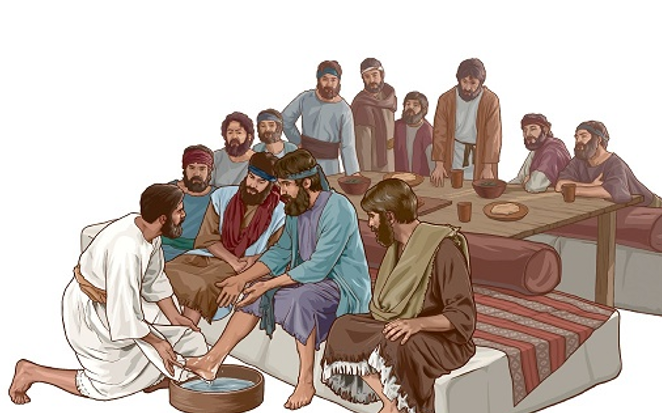
10 Take the lead in showing honor to others. (Read Romans 12:10.) Jesus set the pattern in honoring others by performing the lowliest of tasks. (John 13:3-5, 12-15) We may have to work hard to develop the humility needed to show honor to others in this way. Even the apostles could not fully understand Jesus’ actions until they received holy spirit. (John 13:7) We can show honor to others by not thinking too much of ourselves because of our education, material possessions, or privileges in Jehovah’s service. (Rom. 12:3) And rather than envying those who receive praise, we rejoice with them even if we feel that we deserve equal honor or a share of the credit for what was done.
What other spiritual gems have you discovered in this week’s Bible reading?
*** w18 January pp. 29-30 par. 11 See the Difference in People ***
11 In contrast with the people who show the widespread lack of love today, those who worship Jehovah have genuine love for their fellow man. This has always been true. Jesus said that love of neighbor, a form of a·gaʹpe, was the second most important commandment in the Mosaic Law, second only to love of God. (Matt. 22:38, 39) Jesus also said that love for one another would be the quality that would identify true Christians. (Read John 13:34, 35.) Such Christian love would even be extended to one’s enemies.—Matt. 5:43, 44.
*** w18 July p. 26 par. 15 We Belong to Jehovah ***
15 Our appreciation for Jehovah’s special friendship is shown in how we treat fellow worshippers. They too belong to Jehovah. If we never lose sight of that fact, we will always treat our brothers and sisters with kindness and love. (1 Thess. 5:15) Jesus said to his followers: “By this all will know that you are my disciples—if you have love among yourselves.”—John 13:35.
*** w18 August p. 28 Patience—Endurance With a Purpose ***
We can develop patience by examining and imitating Jesus’ perfect example. In harmony with that example, the apostle Paul under inspiration described “the new personality,” which includes “patience,” and then he urged us to “let the peace of the Christ rule in [our] hearts.” (Col. 3:10, 12, 15) We can let such peace “rule” in our hearts by imitating Jesus’ unbreakable faith that in His due time, God will correct matters that concern us. When we follow Jesus’ example, we will not be provoked into losing our patience, no matter what may be happening around us.—John 14:27; 16:33.
*** w18 September p. 4 par. 5 “If You Know These Things, Happy You Are if You Do Them” ***
5 Putting divine instruction into practice is essentially what wisdom means. (Ps. 107:43) The reward for wisdom is worth the effort. “Nothing you desire can compare to it. . . . It is a tree of life to those who take hold of it, and those who keep firm hold of it will be called happy.” (Prov. 3:13-18) Jesus said: “If you know these things, happy you are if you do them.” (John 13:17) The disciples’ happiness would last if they kept doing what Jesus instructed them to do. They did not embrace his teachings and example simply as an immediate response on that one occasion. It became their way of life.
*** wp17 No. 1 p. 15 Is It Just a Small Misunderstanding? ***
2. The Bible is directed to people who honestly want God’s help to understand it. Jesus showed that people would need help to understand fully what he taught. How would they receive it? Jesus explained: “The helper, the holy spirit, which the Father will send in my name, that one will teach you all things.” (John 14:26) So God provides his holy spirit—his powerful active force—to help people understand what they read in the Bible. However, God withholds his spirit from people who do not rely on him to help them, so the Bible often seems obscure to them. The holy spirit also moves more knowledgeable Christians to come to the aid of those seeking greater understanding.—Acts 8:26-35.
*** w17 January p. 31 par. 17 “These Things Entrust to Faithful Men” ***
17 In the matter of training others to take on increased responsibility, there is no better example than that of Jesus. He knew that his earthly ministry would come to an end and that others would carry on his work. Though his disciples were imperfect, he had confidence in them and told them that they would do works greater than he did. (John 14:12) He trained them thoroughly, and they spread the good news throughout the then-known world.—Col. 1:23.
*** w17 June p. 19 Will You Resolve Conflicts and Promote Peace? ***
Perhaps there is in your congregation a brother whose speech and actions irritate you. Still, you realize that Christ died for that person and you are to show love. (John 13:34, 35; Rom. 5:6-8) So rather than write off any friendship with that one or tend to avoid him, ask yourself: ‘Is my brother doing something that is clearly wrong Scripturally? Is he maliciously trying to cause me discomfort? Or do we just have different personalities?’ Also, of great importance is the question: ‘Which of his good qualities can I benefit from?’
*** w17 August p. 25 par. 12 How We Put On and Keep On the New Personality ***
12 To remain humble, we need to set aside time to meditate daily on what we read in God’s Word. (Deut. 17:18-20) In particular, we do well to reflect on Jesus’ teachings and his wonderful example of humble service. (Matt. 20:28) Jesus even washed the feet of his apostles. (John 13:12-17) We also need to pray frequently for God’s spirit to help us fight any tendency of feeling superior to others.—Gal. 6:3, 4; Phil. 2:3.



 MeekSpaceNG