
Digging for Spiritual Gems: (8 min.)
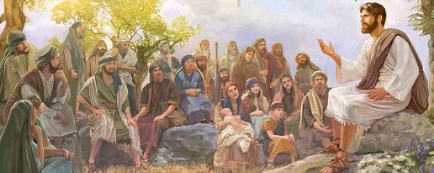
Joh 6:44—How does the Father draw people to himself? (“draws him” study note on Joh 6:44, nwtsty)
draws him: Although the Greek verb for “draw” is used in reference to hauling in a net of fish (Joh 21:6, 11), it does not suggest that God drags people against their will. This verb can also mean “to attract,” and Jesus’ statement may allude to Jer 31:3, where Jehovah said to his ancient people: “I have drawn you to me with loyal love.” (The Septuagint uses the same Greek verb here.) Joh 12:32 shows that in a similar way, Jesus draws men of all sorts to himself. The Scriptures show that Jehovah has given humans free will. Everyone has a choice when it comes to serving Him. (De 30:19, 20) God gently draws to himself those who have a heart that is rightly disposed. (Ps 11:5; Pr 21:2; Ac 13:48) Jehovah does so through the Bible’s message and through his holy spirit. The prophecy from Isa 54:13, quoted in Joh 6:45, applies to those who are drawn by the Father.—Compare Joh 6:65.
Joh 6:64—In what sense did Jesus know “from the beginning” that Judas would betray him? (“Jesus knew . . . the one who would betray him,” “from the beginning” study notes on Joh 6:64, nwtsty)
Jesus knew . . . the one who would betray him: Jesus was referring to Judas Iscariot. Jesus spent the entire night in prayer to his Father before selecting the 12 apostles. (Lu 6:12-16) So at first, Judas was faithful to God. However, Jesus knew from Hebrew Scripture prophecies that he would be betrayed by a close associate. (Ps 41:9; 109:8; Joh 13:18, 19) When Judas started to go bad, Jesus, who could read hearts and thoughts, detected this change. (Mt 9:4) By use of his foreknowledge, God knew that a trusted companion of Jesus would turn traitor. But it is inconsistent with God’s qualities and past dealings to think that Judas had to be the one who would fail, as if his failure were predestined.
from the beginning: This expression does not refer to Judas’ birth or to his being selected as an apostle, which happened after Jesus had prayed the entire night. (Lu 6:12-16) Rather, it refers to the start of Judas’ acting treacherously, which Jesus immediately discerned. (Joh 2:24, 25; Re 1:1; 2:23; see study notes on Joh 6:70; 13:11.) This also shows that Judas’ actions were premeditated and planned, not the result of a sudden change of heart. The meaning of the term “beginning” (Greek, ar·kheʹ) in the Christian Greek Scriptures is relative, depending on the context. For example, at 2Pe 3:4, “beginning” refers to the start of creation. But in most instances, it is used in a more limited sense. For instance, Peter said that the holy spirit fell on the Gentiles “just as it did also on us in the beginning.” (Ac 11:15) Peter was not referring to the time of his birth or to the time when he was called to be an apostle. Rather, he was referring to the day of Pentecost 33 C.E., that is, “the beginning” of the outpouring of holy spirit for a specific purpose. (Ac 2:1-4) Other examples of how the context affects the meaning of the term “beginning” can be found at Lu 1:2; Joh 15:27; and 1Jo 2:7.
What has this week’s Bible reading taught you about Jehovah?
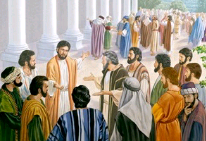
*** ws18 June p. 14 par. 18 May We All Be One as Jehovah and Jesus Are One ***
18 It is good for us to remember that we all used to be far away from God. (Ephesians 2:12) But Jehovah drew us to him with love. (Hosea 11:4; John 6:44) And Christ welcomed us. He made it possible for us to become part of God’s family. (Read Romans 15:7.) Even though we are imperfect, Jesus has kindly accepted us, so we should never even think of rejecting anyone!
*** w17 February p. 7 par. 18 Jehovah’s Purpose Will Be Fulfilled! ***
18 Satan’s rebellion did not stop Jehovah from extending his love to mankind, nor can it prevent even imperfect humans from being loyal to Jehovah. Through his provision of the ransom, Jehovah will help all of his children to become completely righteous. Imagine what life will be like when everyone “who recognizes the Son and exercises faith” will have everlasting life. (John 6:40) With great love and wisdom, Jehovah will bring the human family to perfection, according to his original purpose. Jehovah, our Father, will then become “all things to everyone.”—1 Cor. 15:28.
*** w17 February p. 10 par. 10 The Ransom—A “Perfect Present” From the Father ***
10 What about the billions of people who died without ever having an opportunity to know and serve Jehovah? The ransom makes possible the resurrection of the dead. Our loving heavenly Father will bring them back to life and give them an opportunity to learn about his purpose and to gain everlasting life. (Acts 24:15) Jehovah wants people to live, not die. As the Source of life, he becomes the Father of everyone who is resurrected. (Ps. 36:9) How appropriate, therefore, that Jesus taught us to pray: “Our Father in the heavens.” (Matt. 6:9) Jehovah has given Jesus an important share in resurrecting the dead. (John 6:40, 44) In Paradise, Jesus will fulfill his role as “the resurrection and the life.”—John 11:25.
*** w17 March p. 9 par. 4 Give Honor to Whom It Is Due ***
4 Honoring Jehovah and Christ is not optional. Our everlasting life depends on our doing so. Jesus’ words that we read at John 5:22, 23 help us to see that plainly: “The Father judges no one at all, but he has entrusted all the judging to the Son, so that all may honor the Son just as they honor the Father. Whoever does not honor the Son does not honor the Father who sent him.”—Read Psalm 2:11, 12.
*** w17 July p. 13 par. 4 “Weep With Those Who Weep” ***
4 Our Father of tender mercies has himself experienced the loss of loved ones, such as Abraham, Isaac, Jacob, Moses, and King David. (Num. 12:6-8; Matt. 22:31, 32; Acts 13:22) God’s Word assures us that Jehovah has eagerly anticipated—has had an earnest longing for—the time when he will bring them back to life. (Job 14:14, 15) They will be happy and in vibrant health. Consider, too, that God’s dearly beloved Son—“the one he was especially fond of”—died an agonizing death. (Prov. 8:22, 30) Words cannot express the pain Jehovah must have suffered.—John 5:20; 10:17.
*** w17 December p. 12 par. 21 “I Have Hope Toward God” ***
21 In the meantime, we should bolster our faith in Jehovah, who through Jesus assured us that the dead in God’s memory will rise. (John 5:28, 29; 11:23) Proving that Jehovah is capable of resurrecting the dead, Jesus once said that Abraham, Isaac, and Jacob “are all living to him.” (Luke 20:37, 38) Meanwhile, we have ample reason to say, as did Paul: “I have hope toward God . . . that there is going to be a resurrection.”—Acts 24:15.
*** w16 May p. 19 par. 6 Is the Bible Still Changing Your Life? ***
6 Our inherited imperfection does not need to prevent us from enjoying Jehovah’s friendship or continuing to serve him. Consider this: When Jehovah drew us into a relationship with him, he knew that we would err at times. (John 6:44) Since God knows our traits and what is in our heart, he surely was aware of what sort of imperfect tendencies would be particularly troublesome for us. And he knew that we would occasionally transgress. Yet, this did not prevent Jehovah from wanting us as his friends.
What other spiritual gems have you discovered in this week’s Bible reading?

*** w18 June p. 4 par. 5 “My Kingdom Is No Part of This World” ***
5 Such expectations about the Messiah doubtless led the people of Galilee to want Jesus to become their king. We can imagine that they were thinking that Jesus would be an ideal leader. He was an outstanding speaker; he could cure the sick; he could even supply food for the hungry. After Jesus fed about 5,000 men, he sensed the mood among the people. “Jesus, knowing that they were about to come and seize him to make him king, withdrew again to the mountain all alone.” (John 6:10-15) The following day on the other side of the Sea of Galilee, the enthusiasm may have died down some. Jesus then explained to the crowd the true nature of his work. He had come to bring spiritual, not material, benefits to the nation. “Work, not for the food that perishes, but for the food that remains for everlasting life,” he told them.—John 6:25-27.
*** w18 November p. 9 par. 5 “I Will Walk in Your Truth” ***
5 Sadly, some today have failed to hold on to the truth. Some were stumbled by an adjusted understanding of a Bible passage or by what a prominent brother said or did. Others were offended by Scriptural counsel they received, or they let go of the truth because of a personality clash with a fellow Christian. Still others took sides with apostates and other opposers who misrepresented our beliefs. As a result, some deliberately began “drawing away” from Jehovah and the congregation. (Heb. 3:12-14) How much better it would have been if they had maintained their faith and kept their confidence in Jesus, as the apostle Peter did! When Jesus asked the apostles if they wanted to leave, Peter immediately replied: “Lord, whom shall we go away to? You have sayings of everlasting life.”—John 6:67-69.
*** w16 March p. 7 pars. 16-17 Young Ones—Are You Ready to Get Baptized? ***
16 To illustrate, imagine that a friend gives you a car as a gift. He hands you the title and says: “The car is yours.” But suppose your friend adds: “I will keep the keys. And I will be the one who drives the car, not you.” How would you feel about this “gift”? How would you feel about the giver?
17 Now think about what Jehovah rightfully expects of a person who makes a dedication to him, a person who tells him: “I am giving you my life. I belong to you.” What if that person were to start living a double life, perhaps secretly dating an unbeliever? What if he were to accept employment that crippled his whole-souled service in the ministry or attendance at Christian meetings? Would that not be like keeping the keys to the car? A person who dedicates himself to Jehovah is, in effect, saying: “My life belongs to you more than to me. If there is ever a conflict between what you want and what I am inclined to want, what you want will win—every time.” That would reflect the thinking of Jesus, who while on earth stated: “I have come down from heaven to do, not my own will, but the will of him who sent me.”—John 6:38.
*** w16 April pp. 14-15 par. 7 “Let Endurance Complete Its Work” ***
7 Nourish your faith with spiritual food. On Mount Everest, the world’s tallest mountain, a climber burns about 6,000 calories a day, considerably more than the average person needs. To endure the ascent and reach their goal, climbers must consume as many calories as possible. Similarly, to endure in our Christian course and reach our goal, we must regularly take in as much spiritual food as possible. We need self-discipline to devote time to reading, study, and our Christian meetings. These activities nourish our faith with “the food that remains for everlasting life.”—John 6:27.
*** w16 April p. 28 par. 3 Maintain Your Neutrality in a Divided World ***
3 The Bible gives several reasons why God requires that we remain neutral. For example, we follow the teachings and example of his Son, Jesus Christ, by being “no part of the world,” avoiding its politics and wars. (John 6:15; 17:16) We must remain neutral in order to be loyal subjects of God’s Kingdom. Otherwise, how could we have a clean conscience when we preach the good news that only God’s Kingdom can solve mankind’s problems? Additionally, unlike false religions that divide their members by meddling in politics, true worship preserves our international brotherhood by helping us to remain neutral.—1 Pet. 2:17.
*** w15 2/15 p. 9 par. 16 Imitate Jesus’ Humility and Tenderness ***
16 Our tender words. Our tender affection for others moves us to “speak consolingly to those who are depressed.” (1 Thess. 5:14) What can we say to encourage such ones? We can lift their spirits by expressing our genuine care and concern for them. We can offer sincere commendation to help them see their positive qualities and abilities. We can remind them that Jehovah drew them to his Son, so they must be precious in his eyes. (John 6:44) We can reassure them that Jehovah deeply cares for his servants who are “brokenhearted” or “crushed in spirit.” (Ps. 34:18) Our tender words can have a healing effect on those who need comfort.—Prov. 16:24.
*** w15 4/15 p. 7 par. 20 Elders, How Do You Feel About Training Others? ***
20 Elders, remember: A successful teacher is someone who not only loves to train another person but also loves the person he is training. (Compare John 5:20.) That crucial aspect of a teacher’s disposition is quickly discerned by a learner and greatly affects the way he responds to the training he receives. Therefore, dear elders, as you give training, be more than a teacher—be a friend.—Prov. 17:17; John 15:15.







 MeekSpaceNG