
Digging for Spiritual Gems – John 1-2
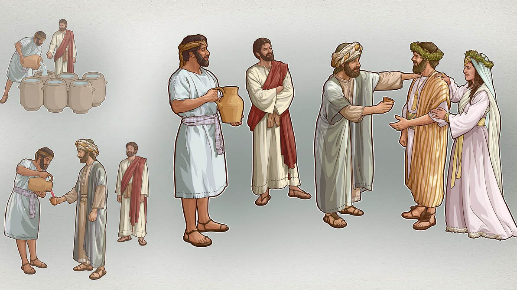
Joh 1:1: What reasons are there for saying that John did not mean that “the Word” was the same as Almighty God? (“the Word,” “with,” “the Word was a god” study notes on Joh 1:1, nwtsty) First, the preceding clause and the following clause both clearly state that “the Word” was“with God.”(In this context, the Greek preposition pros implies close proximity and fellowship. It also indicates separate persons, in this case, the Word and the only true God.) Also, the Greek word the·osʹoccurs three times in verses 1 and 2. In the first and third occurrences,the·osʹ is preceded by the definite article in Greek; in the second occurrence, there is no article. Many scholars agree that the absence of the definite article before the second the·osʹ is significant. When the article is used in this context, the·osʹ refers to God Almighty. On the other hand, the absence of the article in this grammatical construction makes the·osʹ qualitative in meaning and describes a characteristic of “the Word.” Therefore, a number of Bible translations in English, French, and German render the text in a way similar to the New World Translation, conveying the idea that “the Word” was “a god; divine; a divine being; of divine kind; godlike.” Supporting this view, ancient translations of John’s Gospel into the Sahidic and the Bohairic dialects of the Coptic language, probably produced in the third and fourth centuries C.E., handle the first occurrence of the·osʹ at Joh 1:1 differently from the second occurrence. These renderings highlight aquality of “the Word,” that his nature was like that of God, but they do not equate him with his Father, the almighty God. In harmony with this verse, Col 2:9 describes Christ as having “all the fullness of the divine quality.” And according to 2Pe 1:4, even Christ’s joint heirs would “become sharers in divine nature.” Additionally, in the Septuaginttranslation, the Greek word the·osʹ is the usual equivalent of the Hebrew words rendered “God,” ʼel and ʼelo·himʹ, which are thought to convey the basic meaning “Mighty One; Strong One.” These Hebrew words are used with reference to the almighty God, other gods, and humans. (See study note on Joh 10:34.) Calling the Word “a god,” or “a mighty one,” would be in line with the prophecy at Isa 9:6, foretelling that the Messiah would be called “Mighty God” (not “Almighty God”) and that he would be the “Eternal Father” of all those privileged to live as his subjects. The zeal of his own Father, “Jehovah of armies,” would accomplish this.—Isa 9:7.
Joh 1:29 Why did John the Baptist call Jesus “the Lamb of God”? (“the Lamb of God” study note on Joh 1:29, nwtsty) This expression occurs only here and at Joh 1:36. (See App. A7.) Comparing Jesus to a lamb is fitting. Throughout the Bible, sheep were offered in recognition of sin and to gain approach to God. This foreshadowed the sacrifice that Jesus would make when he surrendered his perfect human life in behalf of mankind. The expression “the Lamb of God” could reflect a number of passages in the inspired Scriptures. In view of John the Baptist’s familiarity with the Hebrew Scriptures, his words may have alluded to one or more of the following: the male sheep that Abraham offered up instead of his own son Isaac (Ge 22:13), the Passover lamb that was slaughtered in Egypt for the deliverance of the enslaved Israelites (Ex 12:1-13), or the male lamb that was offered up on God’s altar in Jerusalem each morning and evening (Ex 29:38-42). John may also have had in mind Isaiah’s prophecy, where the one whom Jehovah calls “my servant” is said to be “brought like a sheep to the slaughter.” (Isa 52:13; 53:5, 7, 11) When the apostle Paul wrote his first letter to the Corinthians, he referred to Jesus as “our Passover lamb.” (1Co 5:7) The apostle Peter spoke of Christ’s “precious blood, like that of an unblemished and spotless lamb.” (1Pe 1:19) And more than 25 times in the book of Revelation, the glorified Jesus is spoken of figuratively as “the Lamb.”—Some examples are: Re 5:8; 6:1; 7:9; 12:11; 13:8; 14:1; 15:3; 17:14; 19:7; 21:9; 22:1.
What does this week’s Bible reading teach me about Jehovah?
Joh 1:3,10: Jehovah is the creator and the true God. It was Jehovah who used his beloved Son to create all other things. For both verse show that Jehovah create THROUGH Jesus, not that Jesus did it on his own.
Joh 1:14: Jehovah shows his love for mankind by sending his only begotten Son to die for us. As John 3:16 it show this “For God loved the world so much that he gave his only-begotten Son,” May we shows our love in return for what Jehovah did for us.
Joh 1:18: No man has seen God because they would die if they see him according to Exodus 33:20. This is because Jehovah is holy and so he used his angel to represent him. (Acts 7:38’; Gal 3:19)
Joh 1:23: Jehovah is the fulfiller of prophecy about the one who would make the road straight at Isa 40:3. Again showing Jehovah keeps his word and we can trust what Jehovah promises for the future.
Joh 1:33: Jehovah gives Holy Spirit to ones that deserve it and in this case it was his beloved Son. Likewise Jehovah will give us Holy Spirit if we keep asking and if we are doing his will. (Luke 11:9-13)
Joh 2:16: It shows how Jehovah feels about those who try to contaminate the way he wants to be worship. He sees what we are doing because his name is involved. We are told at Jer 7:11 “this house that bears my name become a cave of robbers in your eyes? Here I have seen it for myself,” May we always worship Jehovah in truth.
What other spiritual gems have you discovered in this week’s Bible reading?
Joh 1:1: In The Interlinear Bible Hebrew & Greek English by Jay P. Green,Sr C-1985 Preface show the Bible in the original languages does not “distinguished between upper and lower-case letters.” So how do we know the last God should not be capitalized, beside there being no definite articles. The Bible at John 20:17 shows Jesus has the same God and Father as we do so the Word cannot be God.
Joh 1:3, 10: Does not make Jesus the creator because we see the Jehovah created all things THROUGH Jesus as most Bibles shows. Also as Pr 8:30 show that Jesus was a master worker and without Jehovah power Jesus could not doing anything at all. (John 5:19, 30)
Joh 1:5: Light stands for truth and righteousness, in contrast with darkness, which stands for error and unrighteousness. John shows that the darkness will not conquer the light. Proof of this is the light is now shining in 240 lands. This should encourage us to keep letting our light shin with the other millions.
Joh 1:6-7: John the Baptist served as a prophet, a teacher (with disciples), and an evangelizer.—Lu 1:76, 77; 3:18; 11:1; Joh 1:35. John not only announced the approach of the Messiah and of God’s Kingdom, but also encouraged other to repent of their sins. May we imitate John example as servants doing Jehovah’s will.
Joh 1:11: When on earth Jesus was rejected by most of his own people, the Jews. They did not want their badness and hypocrisy exposed. They preferred darkness rather than light, much like most of the world today. Yet out of our love of neighbor, we must keep warning them so they maybe save.
Joh 1:14: Jesus was flesh and human just like us, except without sin (1Pe 2:22; Heb 4:15) and not a Godman. Yet the scriptures help us see Jesus was like us “in all respects: as shown at Heb 2:17. (Php 2:7)
Joh 1:14: Jesus is “the only-begotten son,” which show Jesus is not part of a trinity. The Bible uses the term in describing the relation of sons and daughters to their parents. In this case this showing the relationship between Jehovah the Father and Jesus the Son.
Joh 1:18: In this passage, John calls Jesus “the only-begotten god,” a term that emphasizes Jesus’ unique position in God’s arrangement. Jesus can rightly be called “a god” because of the way the term “god” is used in the Bible. This title conveys the basic idea of a mighty one,
Joh 1:18: Jesus is spoken “at the Father’s side” or “in the bosom of the Father.” This expression refers to a position of special favor and close fellowship, not showing that Jesus is part of some Trinity of Gods.
Joh 1:23: John would”make the way of Jehovah straight,” in the sense that he would be the forerunner of Jesus, who would represent his Father and come in his Father’s name. (John 5:43; 8:29)
Joh 1:29,36: Here we see Jesus is the ”Lamb of God,” not God the Lamb. A sacrifice is needed to be made to Jehovah, in order for sin to be taken away from mankind. So Jesus cannot be a Trinity God and the sacrifice to be offer up.
Joh 1:51: Son of man or “Son of a human.” This expression occurs about 80 times in the Gospels. Jesus used it to refer to himself, evidently emphasizing that he was truly human and not a God man or God the Son, (Da 7:13, 14)
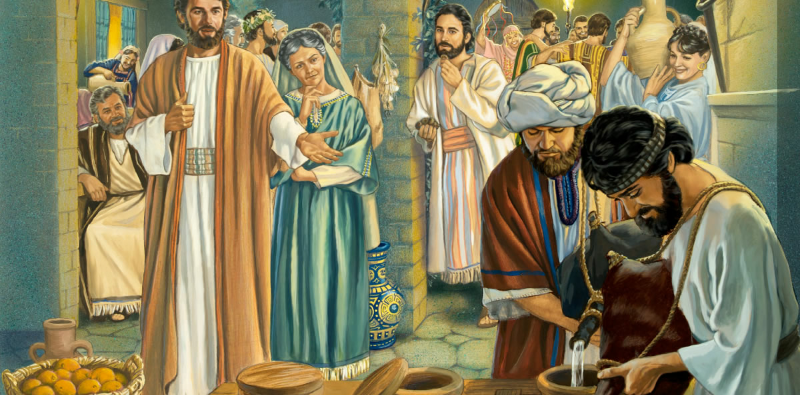
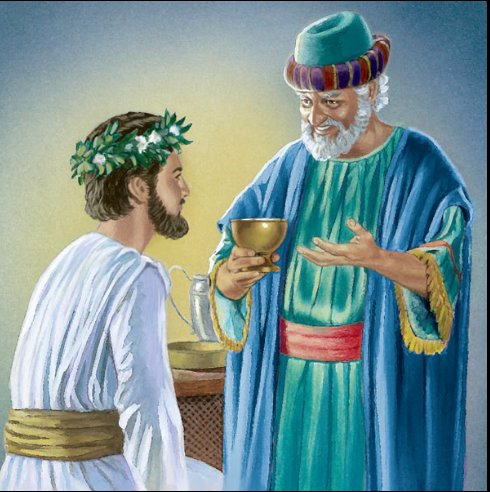
Joh 2:2-10: Jesus performs his first miracle and demonstrates generosity. Jesus was not obligated to perform this miracle, but he simply cared about people and was imitating his heavenly Father by being generous. Also the wine was real and not grape juice for the director said it was fine wine.
Joh 2:14-16: Jesus demonstrated that he and Jehovah will not tolerate contamination of pure worshiped to his Father. That is why few are worshipping Jehovah today compare to the world. Mt 7:13-14; Lu 13:24.
Joh 2:16: Another scripture that show Jesus is not part of a trinity. Here we see Jesus call the Father “my Father,” which mean Jesus has a Father which was taught by his disciples at Eph 1:3, 1Pe 1:3 and many other verses.
Joh 2:17: Jesus set the example for to make Jehovah house a place of pure worship and not place to carry on business. Even Jesus disciples recognized that Jesus was fulfilling prophecy at Ps 69:9.
Joh 2:19-21: Jesus was not saying he was going resurrected himself but was using figurative speech; he was comparing his anticipated death and resurrection to the demolition and reconstruction of the temple. The Bible clearly shows that it was God who resurrected him. (Ac 2:25-32; 3.15; 4.10; 5.30;10:40; Ro 8:11; Heb 13:20)
 MeekSpaceNG