Monthly Archives: August 2018

Digging for Spiritual Gems: Week August 20-26, 2018 – Luke 21-22

Lu 21:33:  How might Jesus’ words in this verse be understood? (“Heaven and earth will pass away,” “my words will by no means pass away” study notes on Lu 21:33, nwtsty)  “Heaven and earth will pass away”- Jesus’ words here could be understood as hyperbole, meaning that even if the impossible happened and heaven and earth did pass away, Jesus’ words would still be fulfilled. (Compare Mt 5:18.) However, the heaven and earth here may well refer to the figurative heavens and earth that are called “the former heaven and the former earth” at Re 21:1.
Or “my words will certainly not pass away” The use of two Greek negatives with the verb emphatically expresses rejection of an idea, vividly emphasizing the permanence of Jesus’ words.
Lu 22:28-30:  What covenant did Jesus make, with whom did he make it, and what does it accomplish? (WT14 10/15 pg16-17 par15-16) (“for they are all living to him” study note on Lu 20:38, nwtsty) the Kingdom covenant.  Unlike other covenants, in which Jehovah is one of the parties to the covenant, this is a personal covenant between Jesus and his anointed followers. When saying, “just as my Father has made a covenant with me,” Jesus was apparently alluding to the covenant that Jehovah had made with him to be “a priest forever in the manner of Melchizedek.”—Heb. 5:5, 6.  16 The 11 faithful apostles had ‘stuck with Jesus in his trials.’ The Kingdom covenant assured them that they would be with him in heaven and sit on thrones to rule as kings and serve as priests. However, those 11 would not be the only ones to have that privilege. The glorified Jesus appeared to the apostle John in a vision and said: “To the one who conquers I will grant to sit down with me on my throne, just as I conquered and sat down with my Father on his throne.” (Rev. 3:21) Thus, the Kingdom covenant is made with the 144,000 anointed Christians. (Rev. 5:9, 10; 7:4)
What does this week’s Bible reading teach me about Jehovah?

Lu 21:1-4:  Jehovah value what we can give no matter how little it may seem to us. Jehovah is pleased to accept the best that we can give. Jehovah “sees into the heart,” so he is fully aware of the yearnings of your heart. 1Sa 16:7.

Lu 21:9-11:  Jehovah is the fulfiller of prophecies for these words started being fulfilled in 1914 on Jehovah time table. Even though words spoke by Jesus they were still Jehovah words as shown at John12:49, 50. We can be sure that Jehovah promises will be fulfill.  

Lu 21:12:  Jehovah sees and knows the hate the world show toward Jehovah’s faithful servants because of his name.” Jesus’ name represents as God’s appointed Ruler, the King of kings, to whom all the nations should submission, but are not willing to do. Yet Ps 2:1-7 show they cannot stand again Jehovah so our trust should be in Jehovah.

Lu 21:14-15:  Jehovah cares about servants that he has provide us with his instruction from his Word, organization and even his holy spirit to help us. This spirit can equip us with the “power beyond what is normal,” enabling us to serve God faithfully despite obstacles and what to speak to opposers. 2Co 4:7; Luke 11:13; Acts 15:8; Eph 4:30.    

Lu 21:17-18:  Jehovah wants us to know that his faithful servants are very valuable to him, and they will never perish in his eyes. For Jehovah has put in place the means to resurrect then and they live in his heart and mind.   

Lu 21:17-18:  Jehovah has the power to darken the sun, the moon not give its light, the stars fall from heaven, and the powers of the heavens be shaken. During the great tribulation Jehovah can display such power to cause such cataclysmic effects as he did in the pass, and he can do it again. Ex 10:21-23; Jos 10:12-14; Jg 5:20.

Lu 21:27:  Jehovah shares his power with his appointed judge Jesus, his begotten Sons who comes with power and glory. With this authority Jesus will accomplish Jehovah’s will, to bring an end to Satan’s world. Jesus was given all authority at Mt 28:18 and at 1Co 15:27 show Jesus has no authority of his Father.   

Lu 22:28-30:  Jehovah foretold a new arrangement for his people at Jer. 31:31-33 of a new covenant with a spiritual Israel. Jehovah used his beloved Son as mediator this new covenant. We see Jehovah keeps words and we know all this promised will all come true.     

Lu 22:34:  Jehovah the “Reveler of secrets’ as shown Da 2:28-29, 47. How else could Jesus know that Peter was going to “disown” him three times? For it was Jehovah that did all the miracles through Jesus as shown at Acts 2:22. So it was by Jehovah powers that reveal these this to Jesus.  So we can be sure all Jehovah’s words will come true.    

Lu 22:42-43:  Jehovah is the one who answer prayer and that why Jesus pray to the “Hearer of prayer” as shown in Ps 65:2; 66:19.  Also Jehovah has the power to act in behalf of the petitioners. So let us always pray to Jehovah to give us strength to be faithful to him to the end.

Lu 22:63-64:  Jehovah fulfilled word in what they do to his beloved Son Jesus according to Isa 50:6-9. Here Jehovah shows self-restraint, long-suffering, and patience as he watch what they did to his innocent Som. Soon all Jehovah promise will be fulfill and that why we need to put trust in one who keep his word and show our loyal love by doing his will. 
What other spiritual gems have you discovered in this week’s Bible reading?

Lu 21:1-4:  The example of the poor widow teaches us that we should be unselfish in supporting true worship of what we are able to give.

Lu 21:6-7:  Jesus is talking about to different fulfillments. First question: “When will these actually be?” or when will Jerusalem and its temple be destroyed? Second question deals with when the end of this system of things was at hand. Mt 24:3; Mr 13:4

Lu 21:12:  The truths about God’s have caused many to hated Jehovah Witnesses. Today in 33 lands Jehovah Witnesses have been ban, and almost all continents Jehovah’s people have been persecute even the U.S. during WWII.  We must ask ourselves, will I stand firm for Jehovah?

Lu 21:15-17:  We have been warned that the world will hate us and possible even our love ones could hate us because of Jehovah’s name. We must ask ourselves, who do we love more, Jehovah or those who cannot give us life? May we all choose Jehovah who always love us and wants us to be saved and gain everlasting life.  

Lu 21:19:  Once save always save is a false teaching. Only those who endure to the end in either this system or to death will be saved. This shows true believers will have to put a hard fight for their faith to the end of Satan’s world. Mt 10:22, Mk 13:13 Lu 21:19; Heb 10:36.

Lu 21:20-22, 24: This had it first fulfillment in 66 C.E. when the Roman army attacked Jerusalem and its temple (a place holy in the eyes of the Jews). In the larger fulfillment, the “standing” will occur when the United Nations (the modern-day “disgusting thing”) attacks as shown in Re 17:16-18.

Lu 21:33:  These words are referring to two groups of anointed Christians. The first group was on hand in 1914, and discerned the sign of Christ’s presence in that year. The second group included in “this generation,” is anointed contemporaries of the first group. They were not simply alive during the lifetime of those in the first group.

 Lu 21:34-35:  Jesus cautioned us against becoming absorbed by the mundane concerns of life.  If our concern is over material things and that begin to dominate our thinking, we are in danger of losing our focus on Kingdom realities. (Mt. 6:19-24, 31-33) Let us not be like the world that passing away and took no note and die.1Jo 2:17.

Lu 22:20:  Jesus is the mediator of the new covenant, between Jehovah and anointed Christians, was made operative by Jesus’ sacrifice. Jesus’ blood made valid the new covenant that Jehovah would make with spiritual Israel. That covenant went into effect at Pentecost 33 C.E.—Heb 9:14, 15.

Lu 22:3-6,47-48:  Example that once saved, always saved is not true. Judas new the truth and yet he betray his loving teacher. Two other example is found at 1Ti 1:18-20.  Other scriptures that show once saved, always save in not true: 1Ti 4:1-3; Acts 20:29-30; 2Ti 4:3-4; Jude 3-5; Re 2:5,16; 3:3, 11, 15-16.

Lu 22:24-26:    Human imperfection and a religious background that emphasized position made Jesus’ disciples overly concerned about greatness. We should cultivate humility as we guard against sinful tendencies and maintain a proper view of privileges and responsibilities.

Lu 22:28-30:  Another scriptures show that Jesus is not part of a trinity. We see Jesus has a Father by the words “my Father,” and this Father make a covenant with Jesus for a Kingdom. This show Jehovah and Jesus are two separate individual making an agreement between them.   

Lu 22:36-38:  Jesus did not ask his disciples to carry a weapon for protection or self-defense. Rather, their having swords on hand on the night of his betrayal made it possible for Jesus to teach them a vital lesson: “All those who take the sword will perish by the sword.”(Mt. 26:52.)

Lu 22:56-62:  Peter’s tragic experience shows that even a person of faith and devotion can be thrown off balance if he is not properly prepared for unexpected trials or temptations. May what Peter went through serve as a warning to keep close to Jehovah and pray constantly that we do not give into Satan tactics.

Lu 22:69:  Jesus helps us to see that he is not part of a trinity by telling us he is “the Son of God and not God the Son. Also Jesus show he will be sitting at the right hand of someone else and that one has authority over Jesus 1Co 15:27. 

Mark Sanderson: Be Prepared (Jas. 4:14)

2018-09 | Initial Call—1Pe 5:6, 7

2018-09 | First Return Visit—Mt 10:29-31

2018-09 | Second Return Visit—Ps 139:1, 2, 4

JW Broadcasting—July 2018

Improving Our Skills in the Ministry—Navigating JW.ORG

WHY IMPORTANT: Every publication in our Teaching Toolbox refers to jw.org. In fact, the main purpose of the contact card and the tract Where Can We Find Answers to Life’s Big Questions? is to direct people to our website. You can place a publication from our Teaching Toolbox with someone by using jw.org to e-mail an electronic copy or share a link. This can be especially helpful when witnessing to someone who speaks another language. Additionally, people may ask questions that are answered by publications not found in our Teaching Toolbox. If we can navigate the website, we can be more effective in our ministry.

HOW TO DO IT:
Use the “BIBLE TEACHINGS” tab. Suppose that you are witnessing to a parent who would like more information about child-rearing. Go to BIBLE TEACHINGS > MARRIAGE & FAMILY.
Use the “PUBLICATIONS” tab. Suppose that you are witnessing informally at school and you want to share with a classmate the brochure Answers to 10 Questions Young People Ask. Go to PUBLICATIONS > BOOKS & BROCHURES.
Use the “ABOUT US” tab. Suppose that you are witnessing to a coworker who would like to read a brief explanation of our beliefs. Go to ABOUT US > FREQUENTLY ASKED QUESTIONS.

WATCH THE VIDEO NAVIGATING JW.ORG, AND THEN CONSIDER WHERE YOU WOULD GO ON THE WEBSITE TO HELP:

Before offering a printed publication in the Ministry, we try to know its contents. Likewise, when we address people to the jw.org site, using the teacher’s kit publications, we need to know how to navigate well on the site.

For example, if we give someone a business card, and we simply say that the site will find some interesting content, maybe the person will not be motivated enough to visit the site. Saying something specific instead could stimulate your curiosity.

You could say, maybe you’ll be surprised to know, that one of the most asked questions on our website is: What does the Bible say about tattoos?
Another question that intrigues many is: Has the day of our death been established? I think he will find the answer interesting, which is given.
These articles can be found by typing tattoos, I have day / death, in the search bar of the site.

You can use the site, also to help people looking for the answer to specific questions.

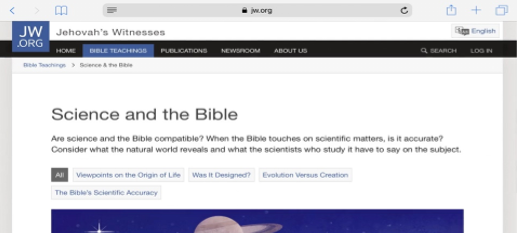
An Atheist

 For example, where you can find information, which could be of interest to those who question the existence of God. On the homepage, click on “BIBLE TEACHINGS”, and then on science and the Bible. In this section, you will find interviews, accurate articles, to support the existence of a creator.

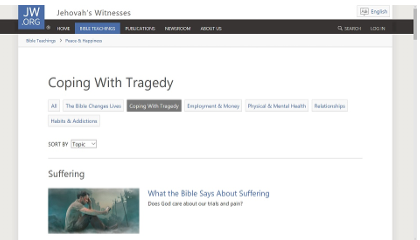
Someone Who Has Just Suffered a Tragedy

Where you can find information, which could help, to those affected by a tragedy. On the homepage, click on “BIBLE TEACHINGS”, and then on peace and Happiness. In this section, under the coping with tragedy you will find accurate articles on how to help someone who has just been hit by a tragedy.

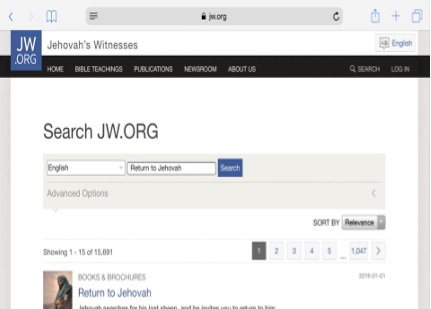
An Inactive Brother or Sister

Where you can find information that could help an inactive publisher. To find the booklet, Return to Jehovah, type the brochure title in the search bar, and then click on search.

A Return Visit Who Wonders How Our Work Is Financed

 And if someone asks you, how our work is financed. At the top of the home page, click “ABOUT US”, and then, about Jehovah’s Witnesses. You will find the link to the article, How is the Work of Jehovah’s Witnesses Financed?

A Person From Another Country Who Wants to Attend a Meeting in His Homeland

And if a person of another nationality wants to attend a meeting in his country of origin. At the top of the home page, click “ABOUT US”, and then, on meetings.

Click on Find a location near you, in the search bars, enter the language, and enter an address or location, and then click on search.

If we know how to navigate well on jw.org, we can help people of all kinds to accept the good news.

Digging for Spiritual Gems: Luke 19-20 (Week August 13-19)

The week of  Aug 13 – 19Digging for Spiritual Gems


Lu 19:43:  How were Jesus’ words fulfilled? (“fortification of pointed stakes” study note on Lu 19:43, nwtsty) Jesus’ words came true in the year 70 C.E. when the Romans, commanded by Titus, erected a siege wall, or palisade, around Jerusalem. Titus’ objective was threefold—to prevent the Jews from fleeing, to encourage their surrender, and to starve the inhabitants into submission. To provide materials for the construction of this fortification around Jerusalem, Roman troops stripped the countryside of trees.
Lu 20:38:  How does Jesus’ statement strengthen our confidence in the resurrection? (“for they are all living to him” study note on Lu 20:38, nwtsty) Approved servants of God who die are still living from Jehovah’s standpoint, since his purpose to resurrect them is sure of fulfillment. Ro 4:16, 17.
 
What does this week’s Bible reading teach me about Jehovah?

Lu 19:28-36:  Jehovah is the fulfiller of prophecies, for he foretold that his promised King would come into Jerusalem on a colt at Zec 9:9 “Humble and riding on a donkey, On a colt, the foal of a female donkey.” Yes, nothing can stop Jehovah promises from being fulfilled.

Lu 19:41-44:  Jehovah fulfill the prophecies that his son Jesus spoke about Jerusalem destruction in 70 C.E. in every detail.  We can be sure that all Jehovah words will be fulfill in every detail concerning the Kingdom.

Lu 19:46:  It show Jehovah feel about those who try to contaminate the way he is to be worship for he see what we are doing because his name is involve. We are told at Jer 7:11  “this house upon which my name has been called become a mere cave of robbers in YOUR eyes? Here I myself also have seen [it]…”

Lu 20:16:  Show that Jehovah has the right to repay the evil ones for their action for justice sake. That is what Jehovah has promise to do at 2Th 1:6 “it is righteous on God’s part to repay tribulation to those who make tribulation for you.  (2Th 1:7-9; Ro 12:19)

Lu 20:17:  Jehovah loves mankind so much that he wanted to save them from sin and death, so he sent his only begotten Son to save us as shown at John 3:16.  Now Jehovah has given Jesus the power to save mankind because he was faithful to the end and is our cornerstone to approach Jehovah.

Lu 20:21:  Jehovah is the greatest teacher and he is the one who taught Jesus the truth  and seen his Father was not partial.  John 5:19. 8:28  12:49,50 ;Acts 15:34

Lu 20:37-38:  Jehovah sees his faithful servants as alive even if they should die, since his purpose to resurrect them is a sure fulfillment in his eyes. Ro 4:16, 17.  

Lu 20:47:  We see the religious leader display of false holiness by “making long prayers.”  Jesus said to pray in privacy, without vain repetition, and he gave them a simple model prayer. (Mt 6:6-8; John 14:6, 14; 1Pe 3:12; Mt 6:9-13)
What other spiritual gems have you discovered in this week’s Bible reading?

Lu 19:7-8:  Jesus sees the potential for repentance in sinners.  May we never judge people because of what we heard or what we know about a person, for it is Jehovah who sees the hearts, and their potential and knows if one can be a sheep.     

Lu 19:10:  Jesus loved those who were despised by others and was willing to show mercy to those. Jesus exercising mercy toward sinners is not condoning of their sins, but knew that people could change. May we do the same as we preach.   

Lu 19:15-22:  Shows that Jesus expected all to be diligent in serving to the best of their ability in the ministry. Each of us has our own circumstances that can allow one to do more for Jehovah, while another cannot do as much, yet both are look on favorably.   

Lu 19:37-38:  We see here that Jehovah and Jesus do not mind the disciples giving praise to their creator, whether they do it in witnessing to others or in song.

Lu 19:38:  Jesus comes in Jehovah name by doing his Father will and speaking what his Father him to speak. John 4:34, 6:38, 8:28,38, 12:49.

Lu 19:39:  May we learn not to be like those religious leaders of Jesus day, instead of looking for the good that Jesus and his disciples did, they were look for what they thought was bad or wrong. We are all imperfect and make mistake, so in love, look at all the good our brothers and sisters are doing.     

Lu 19:47:  The chief priests, scribes, and principal ones of the people hear what Jesus has done, and they respond with renewed efforts to have him killed.  We can be sure they will do the same today to those who speak the truth about Jehovah and his son Jesus.  

Lu 20:2, 8:  Just like in Jesus’ day they question his authority of what he does, yet his works and teaching show his authority came from Jehovah. Likewise today Jehovah people get their authority form Jehovah’s Word like Acts 15:14 shows Jehovah has a people for his name and they do his will and glorified his name.  
Lu 20:9-14:  Another scriptures show that Jesus is not part of a trinity.The owner of vineyard is Jehovah (Isa 5:7), and the vineyard is the nation of Israel, and Jehovah sent his Son Jesus who the religious leaders killed. (John 17:3; 3:16; 13:16) two separate being one is doing the sending is greater than the one sent.   

Lu 20:20:  Haters of Jehovah will look for way to trap his people in words, just like they try to do with Jesus.  They will look for ways to try to stop the truths about Jehovah and his son Jesus being made known as shown at John 15:20, 21. This is going on in 33 lands.

Lu 20:25:  Jesus shows us that we must submit to authority of the government under which we live by obeying its laws, respecting its officials, and paying the taxes it levies. This authority is not absolute, for we cannot disobey God laws if they asked us to as shown at Acts 5:29.   

Lu 20:35:  Jesus show that there is going to be a resurrection and that it is going to be in the future with the words “For when they rise from the dead. This is what he taught all along at John 6:39-40,43, 54; 5:28-29. 

Don’t Run So Fast

Don’t Run So Fast

Our ministry and other aspects of life often improve when we slow down and take our time.

Let’s Take the Leap

Let’s Take the Leap

Expanding our ministry, in whatever form, can bring us great joy as servants of Jehovah