Lu 21:33—How might Jesus’ words in this verse be understood? (“Heaven and earth will pass away,” “my words will by no means pass away” study notes on Lu 21:33, nwtsty)
Heaven and earth will pass away: Other scriptures show that heaven and earth will endure forever. (Ge 9:16; Ps 104:5; Ec 1:4) So Jesus’ words here could be understood as hyperbole, meaning that even if the impossible happened and heaven and earth did pass away, Jesus’ words would still be fulfilled. (Compare Mt 5:18.) However, the heaven and earth here may well refer to the figurative heavens and earth that are called “the former heaven and the former earth” at Re 21:1.
my words will by no means pass away: Or “my words will certainly not pass away.” The use of two Greek negatives with the verb emphatically expresses rejection of an idea, vividly emphasizing the permanence of Jesus’ words.
Lu 22:28-30—What covenant did Jesus make, with whom did he make it, and what does it accomplish? (w14 10/15 16-17 ¶15-16)
15 After instituting the Lord’s Evening Meal, Jesus made a covenant with his faithful disciples, often referred to as the Kingdom covenant. (Read Luke 22:28-30.) Unlike other covenants, in which Jehovah is one of the parties to the covenant, this is a personal covenant between Jesus and his anointed followers. When saying, “just as my Father has made a covenant with me,” Jesus was apparently alluding to the covenant that Jehovah had made with him to be “a priest forever in the manner of Melchizedek.”—Heb. 5:5, 6.
16 The 11 faithful apostles had ‘stuck with Jesus in his trials.’ The Kingdom covenant assured them that they would be with him in heaven and sit on thrones to rule as kings and serve as priests. However, those 11 would not be the only ones to have that privilege. The glorified Jesus appeared to the apostle John in a vision and said: “To the one who conquers I will grant to sit down with me on my throne, just as I conquered and sat down with my Father on his throne.” (Rev. 3:21) Thus, the Kingdom covenant is made with the 144,000 anointed Christians. (Rev. 5:9, 10; 7:4) This is the covenant that forms a legal basis for them to rule with Jesus in heaven. This is similar to a bride from a noble family who might marry a ruling king and come into position to share in his ruling power. In fact, the Scriptures refer to anointed Christians as “the bride” of Christ, “a chaste virgin” promised in marriage to the Christ.—Rev. 19:7, 8; 21:9; 2 Cor. 11:2.

What has this week’s Bible reading taught you about Jehovah?
*** w18 February pp. 25-26 par. 12 Move Forward as a Spiritual Person! ***
12 As we work at cultivating spirituality, holy spirit will give us the power to transform our mind. With the spirit’s help, we can gradually begin to think more and more as Christ did. (Rom. 15:5) Additionally, it will help us root out fleshly desires and cultivate qualities pleasing to God. (Gal. 5:16, 22, 23) If we find that our mind pushes us toward materialistic thinking or fleshly desires, we should not give up. Keep asking for the spirit, and Jehovah will help you to redirect your mental attitude to focus on proper things. (Luke 11:13) Remember the apostle Peter. Several times in his life, he did not respond as a spiritual man should. (Matt. 16:22, 23; Luke 22:34, 54-62; Gal. 2:11-14) But he did not give up. Gradually, with Jehovah’s help, Peter developed Christlike thinking. We can do the same.
*** w18 March pp. 26-27 par. 16 Discipline—Evidence of God’s Love ***
16 Jesus always listened obediently to his Father, even when doing so was very difficult. (Matt. 26:39) And he gave his Father the credit for his teachings and wisdom. (John 5:19, 30) Jesus’ humility and obedience drew people of honest heart to him and helped to make him a compassionate and gracious teacher. (Read Matthew 11:29.) His kind words heartened those who were figuratively like a bruised reed or the wick of an oil lamp about to go out. (Matt. 12:20) Even when his patience was tested, Jesus was kind and loving. This was evident when he corrected his apostles for showing a selfish, ambitious spirit.—Mark 9:33-37; Luke 22:24-27.
*** w18 April p. 16 par. 7 Imitating Jehovah—A God Who Gives Encouragement ***
7 Jesus’ apostles often quarreled over who was the greatest among them, but Jesus patiently encouraged them to humble themselves and to become servants, not bosses. (Luke 22:24-26) Peter in particular disappointed Jesus several times. (Matt. 16:21-23; 26:31-35, 75) Rather than reject Peter, Jesus encouraged him and even commissioned him to strengthen his brothers.—John 21:16.
*** w18 June p. 7 par. 14 “My Kingdom Is No Part of This World” ***
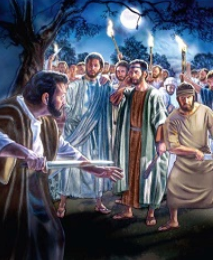
14 Caiaphas sent soldiers to arrest Jesus under the cover of night. Jesus was aware of this shameful strategy, so during his final meal with the apostles, he asked them to get some swords. Two would be sufficient to teach them a vital lesson. (Luke 22:36-38) Later that night, Peter used a sword to attack a member of the mob. No doubt, he was incensed at the injustice of Jesus’ nighttime arrest. (John 18:10) But Jesus told Peter: “Return your sword to its place, for all those who take up the sword will perish by the sword.” (Matt. 26:52, 53) This powerful lesson was in harmony with what Jesus prayed about earlier that night—they must be no part of the world. (Read John 17:16.) Fighting injustice was something to be left to God.
*** w18 June pp. 8-9 pars. 2-3 May We All Be One as Jehovah and Jesus Are One ***
2 Jesus’ emphasis on unity is understandable. He had noticed a lack of unity or harmony among the apostles, such as during his final meal with them. As had happened before, a dispute arose over “which one of them was considered to be the greatest.” (Luke 22:24-27; Mark 9:33, 34) Another time, James and John requested that Jesus give them prominent places alongside him in his Kingdom.—Mark 10:35-40.
3 Desire for prominence, however, was not the only potential cause of disunity among Christ’s disciples. The people of the land were divided by animosity and prejudice. Jesus’ disciples would need to overcome those feelings. In this article, we will consider the following questions: How did Jesus deal with prejudice? How did he help his followers learn to treat others impartially and be truly united? And how will his teaching help us to keep united?
*** w18 July p. 8 par. 3 Whose Recognition Do You Seek? ***
3 In Jesus’ day, some religious leaders had the wrong view of recognition. Jesus warned his followers: “Beware of the scribes who like to walk around in robes and who love greetings in the marketplaces and front [“best,” ftn.] seats in the synagogues and the most prominent places at evening meals.” He went on to say: “These will receive a more severe judgment.” (Luke 20:46, 47) By contrast, Jesus commended a poor widow whose small contribution was likely not recognized by others. (Luke 21:1-4) Jesus’ view of recognition was obviously very different from that of others. This article will help us maintain the right view, the one that Jehovah God accepts.
*** w18 September pp. 26-27 par. 16 Almighty yet Considerate ***

16 Today, too, Jehovah cares for his people as a group—spiritually and physically. He will continue to do so during the fast-approaching great tribulation. (Rev. 7:9, 10) Hence, whether young or old, sound in body or disabled, God’s people will not panic or cower in fear during the tribulation. In fact, they will do the very opposite! They will bear in mind these words of Jesus Christ: “Stand up straight and lift up your heads, because your deliverance is getting near.” (Luke 21:28) They will maintain that confidence even in the face of the attack by Gog—a coalition of nations that will wield far more power than did ancient Pharaoh. (Ezek. 38:2, 14-16) Why will God’s people remain confident? They know that Jehovah does not change. He will again prove to be a caring and considerate Savior.—Isa. 26:3, 20.
*** w17 January p. 11 par. 17 “Trust in Jehovah and Do What Is Good” ***
17 Think, too, of the needy widow in Jesus’ day. (Read Luke 21:1-4.) She could hardly do anything about the corrupt practices being carried on at the temple. (Matt. 21:12, 13) And there was likely little she could do to improve her financial situation. Yet, she voluntarily contributed those “two small coins,” which were “all the means of living she had.” That faithful woman demonstrated wholehearted trust in Jehovah, knowing that if she put spiritual things first, he would provide for her physical needs. The widow’s trust moved her to support the existing arrangement for true worship. Likewise, we trust that if we seek first the Kingdom, Jehovah will make sure that we have what we need.—Matt. 6:33.
*** w17 February p. 21 par. 17 Jehovah Leads His People ***
17 Angels assisted Jesus. Shortly after Jesus was baptized, “angels came and began to minister to him.” (Matt. 4:11) Hours before his death, “an angel from heaven appeared to him and strengthened him.” (Luke 22:43) Jesus was confident that Jehovah would send angelic help whenever he needed it to accomplish God’s will.—Matt. 26:53.
*** w15 11/15 p. 14 Show Appreciation for Jehovah’s Generosity ***
How can we show appreciation for all that Jehovah and his Son have done and will yet do for us? One way is by being generous in the giving of our time, energy, and resources to advance the pure worship of Jehovah, whether it is a small amount or a greater portion.—1 Chron. 22:14; 29:3-5; Luke 21:1-4.
What other spiritual gems have you discovered in this week’s Bible reading?
*** wp18 No. 2 p. 7 Prophecies That Have Come True ***
Luke 21:11: “There will be great earthquakes.”
Each year, some 50,000 earthquakes are large enough to be felt by humans. About 100 bring substantial damage to buildings, and one very great earthquake occurs about every year. According to one estimate, between 1975 and 2000, earthquakes claimed the lives of 471,000 people.
*** wp18 No. 2 p. 8 A Silent Witness to Accurate Prophecy ***
Jesus’ words evidently puzzled his disciples. Two days later, on viewing Jerusalem’s temple, one of them exclaimed: “Teacher, see! what wonderful stones and buildings!” Indeed, some temple stones were reportedly over 35 feet (11 m) long, 15 feet (5 m) wide, and 10 feet (3 m) high! Yet, Jesus replied: “As for these things that you now see, the days will come when not a stone will be left upon a stone and not be thrown down.”—Mark 13:1; Luke 21:6.
Jesus further told them: “When you see Jerusalem surrounded by encamped armies, then know that the desolating of her has drawn near. Then let those in Judea begin fleeing to the mountains, let those in the midst of her leave, and let those in the countryside not enter into her.” (Luke 21:20, 21) Did Jesus’ words come true?
*** wp17 No. 6 p. 9 What Did Jesus Really Look Like? ***

Religious leaders of Jesus’ day contrived ways to draw attention to themselves and underscore their authority. (Numbers 15:38-40; Matthew 23:5-7) Unlike them, Jesus instructed his apostles not to “lord it over” others. (Luke 22:25, 26) In fact, Jesus warned: “Beware of the scribes who want to walk around in robes and want greetings in the marketplaces.”—Mark 12:38.
*** w17 January p. 13 par. 4 Treasure Your Gift of Free Will ***
4 When Jehovah began his creative works, he lovingly chose to bestow free will on his intelligent creatures. The first one to receive this gift was his firstborn Son, “the image of the invisible God.” (Col. 1:15) Even before coming to earth, Jesus chose to remain loyal to his Father and not join Satan in his rebellion. Later, when Jesus was on earth, he exercised his free will to reject the temptations of the great Adversary. (Matt. 4:10) In earnest prayer the night before his death, Jesus reaffirmed his determination to do the will of God. He said: “Father, if you want to, remove this cup from me. Nevertheless, let, not my will, but yours take place.” (Luke 22:42) May we imitate Jesus and use our free will to honor Jehovah and to do his will! Is that really possible?
*** w17 December p. 13 Do You Remember? ***
What factors should affect a Christian’s view of keeping a firearm for protection against other humans?
Some are: God views life as sacred. Jesus did not urge his followers to get swords for protection. (Luke 22:36, 38) We are to beat our swords into plowshares. Life is more valuable than material things. We respect the conscience of others, and we want to be exemplary. (2 Cor. 4:2)—w17.07, pp. 31-32.
*** wp16 No. 2 p. 4 Did It Really Happen? ***
Jesus himself is mentioned by secular writers of the first and second centuries. His manner of death, as described in the Gospels, agrees with Roman executional methods of the time. Moreover, events are related in a factual and candid manner—even portraying some of Jesus’ disciples unfavorably. (Matthew 26:56; Luke 22:24-26; John 18:10, 11) All these factors strongly indicate that the Gospel writers were honest and accurate in what they wrote about Jesus.
*** w16 April pp. 13-14 par. 2 “Let Endurance Complete Its Work” ***
2 We too are fighting a relentless battle. Our enemies include Satan, his world, and our own imperfections. Some of us have battled for decades, and with Jehovah’s help, we gained victories. At times, though, we may get tired of battling our enemies and of waiting for the end of this system of things. Indeed, we have not yet won the complete victory. Jesus warned that we who live in the last days would face severe trials and cruel mistreatment, but he also said that gaining the victory would depend on our endurance. (Read Luke 21:19.) What is endurance? What will help us to endure? What can we learn from those who have endured? And how can we “let endurance complete its work”?—Jas. 1:4.
*** w16 June pp. 8-9 par. 10 Appreciating Jehovah as Our Potter ***

10 Like a highly skilled potter, Jehovah knows the type and quality of “the clay” that is before him, and he molds it accordingly. (Read Psalm 103:10-14.) Indeed, he deals with us as individuals, taking into account our particular weaknesses, limitations, and level of spiritual growth. His attitude toward imperfect servants was demonstrated by his Son. Consider how Jesus dealt with his apostles’ shortcomings, especially their inclination to argue among themselves over position. If you had witnessed the apostles’ heated disputes, would you have viewed these men as meek and malleable? Yet, Jesus did not adopt a negative view. He knew that his faithful apostles could be molded by kind, patient counsel and by their observing his example of humility. (Mark 9:33-37; 10:37, 41-45; Luke 22:24-27) After Jesus was resurrected and the holy spirit was poured out, the apostles focused, not on position or prominence, but on the work he had given them to do.—Acts 5:42.
*** w16 June p. 26 par. 10 Do Not Let the Faults of Others Stumble You ***
10 The Bible provides us with accounts of servants of God who remained loyal to Jehovah and his people despite the serious faults of others around them. For example, after spending a night in prayer to his Father, Jesus selected the 12 apostles. Judas Iscariot was one of those. When Judas later betrayed him, Christ did not let that defection mar his own relationship with his Father, Jehovah; nor did Jesus allow Peter’s denial to do that. (Luke 6:12-16; 22:2-6, 31, 32) Jesus knew that those actions were not the fault of Jehovah or his people in general. Jesus continued his wonderful work despite the disappointment that some of his followers caused him. Jehovah rewarded him by resurrecting him from the dead, thus opening the way for Jesus to become King of the heavenly Kingdom.—Matt. 28:7, 18-20.
*** w16 July p. 14 par. 3 Why Must We “Keep on the Watch”? ***
3 As Jehovah’s Witnesses, we take seriously Jesus’ warning. We know that we are living deep in “the time of the end” and that there cannot be much time left before the “great tribulation” begins! (Dan. 12:4; Matt. 24:21) We see distressing wars, increasing immorality and lawlessness, religious confusion, food shortages, pestilences, and earthquakes taking place around the world. We know that a phenomenal Kingdom-preaching work is being accomplished by Jehovah’s people everywhere. (Matt. 24:7, 11, 12, 14; Luke 21:11) We eagerly anticipate what the Lord’s coming will mean for us and for the accomplishment of God’s purpose.—Mark 13:26, 27.
*** w16 August p. 28 pars. 13-14 Do You See the Need to Train Others? ***

13 Bible accounts highlight the privilege we have of showing “brotherly affection” and serving one another. (Read 1 Peter 1:22; Luke 22:24-27.) The Son of God gave everything, including his life, in ministering to others. (Matt. 20:28) Dorcas “abounded in good deeds and gifts of mercy.” (Acts 9:36, 39) Mary, a sister in Rome, “worked hard” in behalf of those in the congregation. (Rom. 16:6) How can we help new ones grasp the importance of helping their brothers and sisters?
14 Mature Witnesses can invite new ones to come along when visiting the sick and the elderly. If appropriate, parents can take their children on such visits. Elders can work with others in making sure that our dear older ones have good food and that their homes are maintained. In these ways, younger ones and those newly associated learn to perform acts of kindness for others. While preaching, one elder would briefly visit the Witnesses living in his rural territory to see how they were doing. A young brother who often accompanied him thus learned that all in the congregation should feel loved.—Rom. 12:10.
*** w16 September p. 16 Defending the Good News Before High Officials ***

Yet, even today Jehovah’s name can be glorified when Christians make a defense of their faith. As Paul was, we should try to be calm, sincere, and convincing. Jesus told his followers that they would not have to ‘rehearse beforehand how to make their defense, for he would give them words and wisdom that all their opposers together would not be able to resist or dispute.’—Luke 21:14, 15; 2 Tim. 3:12; 1 Pet. 3:15.
When Christians defend their faith before kings, governors, or other officials, they can give a witness to people whom it might otherwise have been difficult to reach with the Christian message. Some favorable court decisions have refined legal codes, thus protecting freedom of speech and of worship. But whatever the outcome of such cases, the courage God’s servants display under trial makes God rejoice.
*** w16 October p. 27 par. 5 Exercise Your Faith in Jehovah’s Promises ***
5 Clearly, our prospect of enjoying eternal life in God’s new world depends on our having faith and keeping it strong. The need to keep our faith healthy can be likened to a plant’s need for water. Unlike an artificial plant, a living plant keeps changing. A live plant either withers because of a lack of water or continues to thrive with a regular supply of moisture. If deprived of sufficient water, a once healthy plant will eventually die. So, too, our faith. It will wither and die if neglected. (Luke 22:32; Heb. 3:12) But if we give it due attention, our faith will stay alive and keep “growing,” and we will be “healthy in faith.”—2 Thess. 1:3; Titus 2:2.
*** w16 November p. 6 par. 9 “Keep On Encouraging One Another Each Day” ***

9 Jesus. On the night when Jesus instituted the Memorial, pride was one negative trait that he saw in his apostles. Jesus humbly washed their feet, but they were still arguing about which one of them was the greatest; and Peter was overconfident. (Luke 22:24, 33, 34) Yet, Jesus commended his faithful apostles for sticking with him in his trials. He predicted that they would do works greater than his, and he assured them that God had affection for them. (Luke 22:28; John 14:12; 16:27) We might ask ourselves, ‘Shouldn’t I imitate Jesus by commending my children and others for what they do well instead of focusing on their shortcomings?’
*** w15 4/15 p. 22 par. 13 How Real Is Your Relationship With Jehovah? ***
13 Consider this: From his prehuman existence, Jesus observed firsthand Jehovah’s response to the prayers of His human servants. Then, during his earthly ministry, Jesus used prayer as his means of communicating his feelings to his Father in heaven. Would he have done so—even spending an entire night in prayer—had he thought that Jehovah was not really listening? (Luke 6:12; 22:40-46) Would he have taught his disciples to pray had he thought that prayer was nothing more than a psychological crutch? Clearly, Jesus knew that prayer is real communication with Jehovah. On one occasion, Jesus said: “Father, I thank you that you have heard me. True, I knew that you always hear me.” We too can have confidence that Jehovah is the “Hearer of prayer.”—John 11:41, 42; Ps. 65:2.
*** w15 5/15 p. 18 par. 18 You Can Fight Satan—And Win! ***
18 How can we fight Satan and win? Jesus told his disciples: “By your endurance you will preserve your lives.” (Luke 21:19) Nothing that any human can do will cause us permanent harm. Nobody can take away our precious friendship with God unless we allow that to happen. (Rom. 8:38, 39) Even the death of Jehovah’s servants does not score a victory for Satan, for Jehovah will see to it that they are resurrected! (John 5:28, 29) On the other hand, Satan’s prospects are bleak indeed. After the destruction of his ungodly system, Satan will be abyssed for 1,000 years. (Rev. 20:1-3) At the end of Jesus’ Thousand Year Reign, Satan will be “released from his prison” for a short time to make a final attempt to mislead perfect mankind. After that, the Devil will be destroyed. (Rev. 20:7-10) Satan faces certain doom, but that is not true of you! Take your stand against Satan, firm in the faith. You can fight Satan and win!
*** w15 8/15 p. 15 par. 4 Keep in Expectation! ***
4 The Bible leaves no doubt about what our attitude should be toward the impending destruction of this system of things. Jesus told his followers to “keep on the watch” and to “keep awake.” (Matt. 24:42; Luke 21:34-36) That in itself is a good reason to remain in expectation—Jesus told us to do so! In this regard, Jehovah’s organization has set an example. Its publications have consistently exhorted us to “await and keep close in mind the presence of the day of Jehovah” and to fix our hope on God’s promised new world.—Read 2 Peter 3:11-13.
*** w15 9/1 p. 16 Bible Questions Answered ***
How do Bible prophecies help us?
Some prophecies warn God’s servants to take action. For example, when first-century Christians saw certain prophecies fulfilled, they left Jerusalem. Later, when the city was destroyed because most of its people had rejected Jesus, the Christians were far away in a safe place.—Read Luke 21:20-22.
Today, fulfilled prophecies show that God’s Kingdom will soon bring an end to human kingdoms and governments. (Daniel 2:44; Luke 21:31) So it is urgent that each person act now to gain the approval of the King, Jesus Christ, whom God has appointed.—Read Luke 21:34-36.
*** w15 11/1 p. 6 God’s View of War in the First Century ***
Thus, like God’s servants of the ancient past, those first-century Christians were to wait until God’s time to bring an end to wickedness and oppression. In the meantime, they were not authorized by God to take it upon themselves to engage in warfare against their enemies. Jesus Christ made this clear in his teachings. For example, he did not direct his followers to engage in warfare, but instead he told them: “Continue to love your enemies and to pray for those who persecute you.” (Matthew 5:44) Foretelling the time when first-century Jerusalem would be attacked by Roman armies, Jesus instructed his disciples, not to stay and fight, but to flee—which they did.—Luke 21:20, 21.






































 MeekSpaceNG