
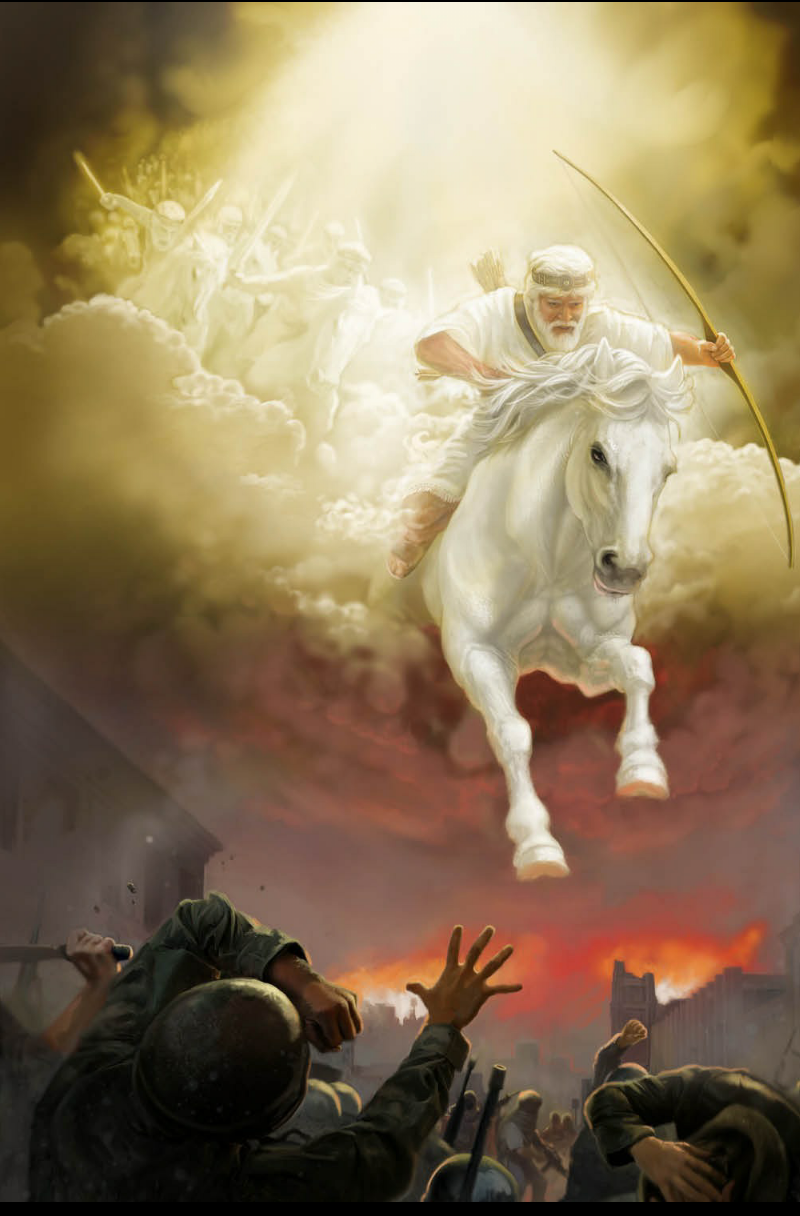
Lu 21:33: How might Jesus’ words in this verse be understood? (“Heaven and earth will pass away,” “my words will by no means pass away” study notes on Lu 21:33, nwtsty) “Heaven and earth will pass away”- Jesus’ words here could be understood as hyperbole, meaning that even if the impossible happened and heaven and earth did pass away, Jesus’ words would still be fulfilled. (Compare Mt 5:18.) However, the heaven and earth here may well refer to the figurative heavens and earth that are called “the former heaven and the former earth” at Re 21:1.
Or “my words will certainly not pass away” The use of two Greek negatives with the verb emphatically expresses rejection of an idea, vividly emphasizing the permanence of Jesus’ words.
Lu 22:28-30: What covenant did Jesus make, with whom did he make it, and what does it accomplish? (WT14 10/15 pg16-17 par15-16) (“for they are all living to him” study note on Lu 20:38, nwtsty) the Kingdom covenant. Unlike other covenants, in which Jehovah is one of the parties to the covenant, this is a personal covenant between Jesus and his anointed followers. When saying, “just as my Father has made a covenant with me,” Jesus was apparently alluding to the covenant that Jehovah had made with him to be “a priest forever in the manner of Melchizedek.”—Heb. 5:5, 6. 16 The 11 faithful apostles had ‘stuck with Jesus in his trials.’ The Kingdom covenant assured them that they would be with him in heaven and sit on thrones to rule as kings and serve as priests. However, those 11 would not be the only ones to have that privilege. The glorified Jesus appeared to the apostle John in a vision and said: “To the one who conquers I will grant to sit down with me on my throne, just as I conquered and sat down with my Father on his throne.” (Rev. 3:21) Thus, the Kingdom covenant is made with the 144,000 anointed Christians. (Rev. 5:9, 10; 7:4)
What does this week’s Bible reading teach me about Jehovah?
Lu 21:1-4: Jehovah value what we can give no matter how little it may seem to us. Jehovah is pleased to accept the best that we can give. Jehovah “sees into the heart,” so he is fully aware of the yearnings of your heart. 1Sa 16:7.
Lu 21:9-11: Jehovah is the fulfiller of prophecies for these words started being fulfilled in 1914 on Jehovah time table. Even though words spoke by Jesus they were still Jehovah words as shown at John12:49, 50. We can be sure that Jehovah promises will be fulfill.
Lu 21:12: Jehovah sees and knows the hate the world show toward Jehovah’s faithful servants because of his name.” Jesus’ name represents as God’s appointed Ruler, the King of kings, to whom all the nations should submission, but are not willing to do. Yet Ps 2:1-7 show they cannot stand again Jehovah so our trust should be in Jehovah.
Lu 21:14-15: Jehovah cares about servants that he has provide us with his instruction from his Word, organization and even his holy spirit to help us. This spirit can equip us with the “power beyond what is normal,” enabling us to serve God faithfully despite obstacles and what to speak to opposers. 2Co 4:7; Luke 11:13; Acts 15:8; Eph 4:30.
Lu 21:17-18: Jehovah wants us to know that his faithful servants are very valuable to him, and they will never perish in his eyes. For Jehovah has put in place the means to resurrect then and they live in his heart and mind.
Lu 21:17-18: Jehovah has the power to darken the sun, the moon not give its light, the stars fall from heaven, and the powers of the heavens be shaken. During the great tribulation Jehovah can display such power to cause such cataclysmic effects as he did in the pass, and he can do it again. Ex 10:21-23; Jos 10:12-14; Jg 5:20.
Lu 21:27: Jehovah shares his power with his appointed judge Jesus, his begotten Sons who comes with power and glory. With this authority Jesus will accomplish Jehovah’s will, to bring an end to Satan’s world. Jesus was given all authority at Mt 28:18 and at 1Co 15:27 show Jesus has no authority of his Father.
Lu 22:28-30: Jehovah foretold a new arrangement for his people at Jer. 31:31-33 of a new covenant with a spiritual Israel. Jehovah used his beloved Son as mediator this new covenant. We see Jehovah keeps words and we know all this promised will all come true.
Lu 22:34: Jehovah the “Reveler of secrets’ as shown Da 2:28-29, 47. How else could Jesus know that Peter was going to “disown” him three times? For it was Jehovah that did all the miracles through Jesus as shown at Acts 2:22. So it was by Jehovah powers that reveal these this to Jesus. So we can be sure all Jehovah’s words will come true.
Lu 22:42-43: Jehovah is the one who answer prayer and that why Jesus pray to the “Hearer of prayer” as shown in Ps 65:2; 66:19. Also Jehovah has the power to act in behalf of the petitioners. So let us always pray to Jehovah to give us strength to be faithful to him to the end.
Lu 22:63-64: Jehovah fulfilled word in what they do to his beloved Son Jesus according to Isa 50:6-9. Here Jehovah shows self-restraint, long-suffering, and patience as he watch what they did to his innocent Som. Soon all Jehovah promise will be fulfill and that why we need to put trust in one who keep his word and show our loyal love by doing his will.
What other spiritual gems have you discovered in this week’s Bible reading?
Lu 21:1-4: The example of the poor widow teaches us that we should be unselfish in supporting true worship of what we are able to give.
Lu 21:6-7: Jesus is talking about to different fulfillments. First question: “When will these actually be?” or when will Jerusalem and its temple be destroyed? Second question deals with when the end of this system of things was at hand. Mt 24:3; Mr 13:4
Lu 21:12: The truths about God’s have caused many to hated Jehovah Witnesses. Today in 33 lands Jehovah Witnesses have been ban, and almost all continents Jehovah’s people have been persecute even the U.S. during WWII. We must ask ourselves, will I stand firm for Jehovah?
Lu 21:15-17: We have been warned that the world will hate us and possible even our love ones could hate us because of Jehovah’s name. We must ask ourselves, who do we love more, Jehovah or those who cannot give us life? May we all choose Jehovah who always love us and wants us to be saved and gain everlasting life.
Lu 21:19: Once save always save is a false teaching. Only those who endure to the end in either this system or to death will be saved. This shows true believers will have to put a hard fight for their faith to the end of Satan’s world. Mt 10:22, Mk 13:13 Lu 21:19; Heb 10:36.
Lu 21:20-22, 24: This had it first fulfillment in 66 C.E. when the Roman army attacked Jerusalem and its temple (a place holy in the eyes of the Jews). In the larger fulfillment, the “standing” will occur when the United Nations (the modern-day “disgusting thing”) attacks as shown in Re 17:16-18.
Lu 21:33: These words are referring to two groups of anointed Christians. The first group was on hand in 1914, and discerned the sign of Christ’s presence in that year. The second group included in “this generation,” is anointed contemporaries of the first group. They were not simply alive during the lifetime of those in the first group.
Lu 21:34-35: Jesus cautioned us against becoming absorbed by the mundane concerns of life. If our concern is over material things and that begin to dominate our thinking, we are in danger of losing our focus on Kingdom realities. (Mt. 6:19-24, 31-33) Let us not be like the world that passing away and took no note and die.1Jo 2:17.
Lu 22:20: Jesus is the mediator of the new covenant, between Jehovah and anointed Christians, was made operative by Jesus’ sacrifice. Jesus’ blood made valid the new covenant that Jehovah would make with spiritual Israel. That covenant went into effect at Pentecost 33 C.E.—Heb 9:14, 15.
Lu 22:3-6,47-48: Example that once saved, always saved is not true. Judas new the truth and yet he betray his loving teacher. Two other example is found at 1Ti 1:18-20. Other scriptures that show once saved, always save in not true: 1Ti 4:1-3; Acts 20:29-30; 2Ti 4:3-4; Jude 3-5; Re 2:5,16; 3:3, 11, 15-16.
Lu 22:24-26: Human imperfection and a religious background that emphasized position made Jesus’ disciples overly concerned about greatness. We should cultivate humility as we guard against sinful tendencies and maintain a proper view of privileges and responsibilities.
Lu 22:28-30: Another scriptures show that Jesus is not part of a trinity. We see Jesus has a Father by the words “my Father,” and this Father make a covenant with Jesus for a Kingdom. This show Jehovah and Jesus are two separate individual making an agreement between them.
Lu 22:36-38: Jesus did not ask his disciples to carry a weapon for protection or self-defense. Rather, their having swords on hand on the night of his betrayal made it possible for Jesus to teach them a vital lesson: “All those who take the sword will perish by the sword.”(Mt. 26:52.)
Lu 22:56-62: Peter’s tragic experience shows that even a person of faith and devotion can be thrown off balance if he is not properly prepared for unexpected trials or temptations. May what Peter went through serve as a warning to keep close to Jehovah and pray constantly that we do not give into Satan tactics.
Lu 22:69: Jesus helps us to see that he is not part of a trinity by telling us he is “the Son of God and not God the Son. Also Jesus show he will be sitting at the right hand of someone else and that one has authority over Jesus 1Co 15:27.
 MeekSpaceNG