
Mark 15-16
Digging for Spiritual Gems: (8 min.)
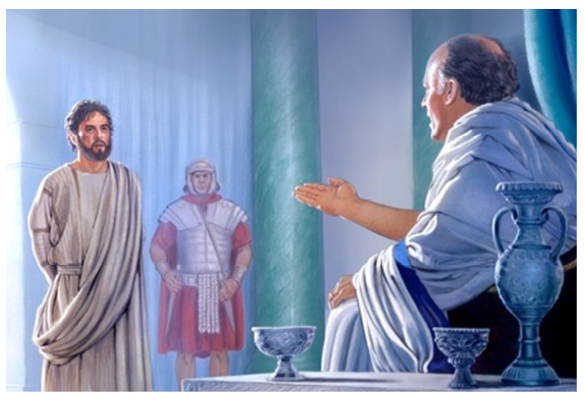
Mr 15:25—What may account for the seeming discrepancy as to when Jesus was nailed to the stake? (“the third hour” study note on Mr 15:25, nwtsty)
the third hour: That is, about 9:00 a.m. Some point to a seeming discrepancy between this account and Joh 19:14-16, which says “it was about the sixth hour” when Pilate handed Jesus over to be executed. Although the Scriptures do not fully explain the difference, here are some factors to consider: The Gospel accounts generally harmonize with regard to the timing of events during Jesus’ last day on earth. All four accounts indicate that the priests and the elders met after dawn and then had Jesus taken to Roman Governor Pontius Pilate. (Mt 27:1, 2; Mr 15:1; Lu 22:66–23:1; Joh 18:28) Matthew, Mark, and Luke all report that when Jesus was already on the stake, darkness fell over the land from “the sixth hour . . . until the ninth hour.” (Mt 27:45, 46; Mr 15:33, 34; Lu 23:44) A factor that may have a bearing on the timing of Jesus’ execution is this: Scourging, or whipping, was considered by some to be a part of the execution process. Sometimes the scourging was so terrible that the victim died. In Jesus’ case, it was sufficiently severe to make it necessary for another man to carry the torture stake after Jesus started out carrying it alone. (Lu 23:26; Joh 19:17) If the scourging was viewed as the start of the execution procedure, some time would have elapsed before Jesus was actually nailed to the torture stake. Supporting this, Mt 27:26 and Mr 15:15 mention the scourging (whipping) and execution on the stake together. Therefore, different individuals might give different times for the execution, depending on their perspective regarding the time when the process began. This may explain why Pilate was astonished to learn that Jesus died so soon after he was nailed to the stake. (Mr 15:44) Additionally, Bible writers frequently reflect the practice of dividing the day into four segments of three hours each, as was done with the night. Dividing the day in that way explains why there often are references to the third, sixth, and ninth hours, counting from sunrise at about 6:00 a.m. (Mt 20:1-5; Joh 4:6; Ac 2:15; 3:1; 10:3, 9, 30) Also, people in general did not have precise timepieces, so the time of day was frequently qualified with the term “about,” as we find at Joh 19:14. (Mt 27:46; Lu 23:44; Joh 4:6; Ac 10:3, 9) In summary: Mark may have included both the scourging and the nailing to the stake, while John referred only to the nailing to the stake. Both writers may have rounded off the time of day to the nearest three-hour period, and John used “about” when referring to his stated time. These factors may account for the difference in times mentioned in the accounts. Finally, the fact that John, writing decades later, included a time that appears to vary from that given by Mark shows that John did not simply copy Mark’s account.
Mr 16:8—Why does the New World Translation not include the long or the short conclusion in the main text of the Gospel of Mark? (“for they were in fear” study note on Mr 16:8, nwtsty)
For they were in fear: According to the earliest available manuscripts of the last part of Mark, the Gospel ends with the words found in verse 8. Some assert that such an ending is too abrupt to have been the original conclusion to the book. However, in view of Mark’s generally terse writing style, that assertion is not necessarily valid. Also, fourth-century scholars Jerome and Eusebius indicate that the authentic record closes with the words “for they were in fear.”
There are a number of Greek manuscripts and translations into other languages that add either a long or a short conclusion after verse 8. The long conclusion (consisting of 12 extra verses) is found in Codex Alexandrinus, Codex Ephraemi Syri rescriptus, and Codex Bezae Cantabrigiensis, all from the fifth century C.E. It also appears in the Latin Vulgate, the Curetonian Syriac, and the Syriac Peshitta. However, it does not appear in two earlier fourth-century Greek manuscripts, Codex Sinaiticus and Codex Vaticanus, or in Codex Sinaiticus Syriacus of the fourth or fifth century, or in the earliest Sahidic Coptic manuscript of Mark of the fifth century. Similarly, the oldest manuscripts of Mark in Armenian and Georgian end at verse 8.
Certain later Greek manuscripts and translations into other languages contain the short conclusion (consisting of just a couple of sentences). The Codex Regius of the eighth century C.E. has both conclusions, giving the shorter conclusion first. It prefaces each conclusion with a note saying that these passages are current in some quarters, though it evidently recognizes neither of them as authoritative.
SHORT CONCLUSION
The short conclusion after Mr 16:8 is not part of the inspired Scriptures. It reads as follows:
But all the things that had been commanded they related briefly to those around Peter. Further, after these things, Jesus himself sent out through them from the east to the west the holy and incorruptible proclamation of everlasting salvation.
LONG CONCLUSION
The long conclusion after Mr 16:8 is not part of the inspired Scriptures. It reads as follows:
9 After he rose early on the first day of the week he appeared first to Mary Magʹda·lene, from whom he had expelled seven demons. 10 She went and reported to those who had been with him, as they were mourning and weeping. 11 But they, when they heard he had come to life and had been viewed by her, did not believe. 12 Moreover, after these things he appeared in another form to two of them walking along, as they were going into the country; 13 and they came back and reported to the rest. Neither did they believe these. 14 But later he appeared to the eleven themselves as they were reclining at the table, and he reproached their lack of faith and hardheartedness, because they did not believe those who had beheld him now raised up from the dead. 15 And he said to them: “Go into all the world and preach the good news to all creation. 16 He that believes and is baptized will be saved, but he that does not believe will be condemned. 17 Furthermore, these signs will accompany those believing: By the use of my name they will expel demons, they will speak with tongues, 18 and with their hands they will pick up serpents, and if they drink anything deadly it will not hurt them at all. They will lay their hands upon sick persons, and these will become well.”
19 So, then, the Lord Jesus, after having spoken to them, was taken up to heaven and sat down at the right hand of God. 20 They, accordingly, went out and preached everywhere, while the Lord worked with them and backed up the message through the accompanying signs.
What has this week’s Bible reading taught you about Jehovah?
*** w09 7/15 pp. 21-22 par. 10 Imitate Jesus—Preach With Boldness ***
10 Confronted by a band of soldiers in the garden of Gethsemane, Jesus courageously identified himself to them. (John 18:3-8) Later he was led before the Sanhedrin and questioned by the high priest. Even though he knew that the high priest was looking for a pretext to kill him, Jesus fearlessly affirmed that He was both Christ and the Son of God. He added that they would see him “sitting at the right hand of power and coming with the clouds of heaven.” (Mark 14:53, 57-65) Shortly thereafter, Jesus stood bound before Pilate, who could have freed him. But Jesus remained silent in response to the accusations against him. (Mark 15:1-5) All of this took much courage.
*** w07 2/15 p. 20 par. 12 Wives—Deeply Respect Your Husbands ***
12 Submission in the face of ridicule and abuse may be viewed as evidence of weakness. Yet, that is not how Jesus viewed it. “When he was being reviled,” Peter wrote, “he did not go reviling in return. When he was suffering, he did not go threatening.” (1 Peter 2:23) Some who watched Jesus suffer became believers, at least to some degree, including a robber on a stake next to him and the army officer viewing the execution. (Matthew 27:38-44, 54; Mark 15:39; Luke 23:39-43) Similarly, Peter indicated that some unbelieving husbands—even those who are abusive—will become Christians after observing the submissive conduct of their wives. We have seen evidence of this happening today.
*** w07 6/1 p. 4 The Source of Evil Exposed! ***
IN THE first century, many of the Jews were awaiting the arrival of the promised Messiah. (John 6:14) When Jesus came on the scene, he brought comfort and enlightenment. He healed the sick, fed the hungry, tamed the elements, even raised the dead. (Matthew 8:26; 14:14-21; 15:30, 31; Mark 5:38-43) He also spoke the sayings of Jehovah and held out the promise of everlasting life. (John 3:34) By what he said and did, Jesus fully demonstrated that he was the Messiah, the one to liberate mankind from sin and all its evil consequences.
Logically, the Jewish religious leaders should have been the first to welcome Jesus, listen to him, and joyfully accept his direction. Yet, they did not. Instead, they hated him, persecuted him, and conspired to kill him!—Mark 14:1; 15:1-3, 10-15.
*** w03 10/1 p. 9 par. 2 Persecuted for Righteousness’ Sake ***
2 Jesus knew full well that Pilate had the authority to release him or to put him to death. (John 19:10) But that did not hold him back from speaking boldly to Pilate about the Kingdom. Though Jesus’ life was in danger, he seized the opportunity to bear witness to the highest governmental authority of the region. Despite that witness, Jesus was condemned and executed, dying an agonizing martyr’s death on a torture stake.—Matthew 27:24-26; Mark 15:15; Luke 23:24, 25; John 19:13-16.
What other spiritual gems have you discovered in this week’s Bible reading?
*** w17 October p. 19 Joseph of Arimathea Takes a Stand ***
It seems that Joseph was present when Jesus died. Indeed, he knew of Jesus’ death before Pilate did. Thus, when Joseph asked for the body, the governor “wondered whether [Jesus] could already be dead.” (Mark 15:44) If Joseph had witnessed Jesus’ agony on the torture stake, did that awful scene move him to examine his conscience and finally decide that he ought to take a stand for truth? It is possible. At the very least, Joseph was now stirred to action. He would be a secret disciple no more.
This story raises a question that all of us would do well to ponder: Is there anything at all—be it position, career, possessions, family affections, or even our very freedom—to which we give more importance than our relationship with Jehovah?
*** w15 8/15 p. 30 What We Can Learn From Joanna ***
Apparently, Joanna was present at Jesus’ execution, along with other women “who used to accompany him and minister to him when he was in Galilee, and many other women who had come up together with him to Jerusalem.” (Mark 15:41) When Jesus’ body was removed from the stake for burial, “the women who had come with him from Galilee followed along and took a look at the tomb and saw how his body was laid, and they went back to prepare spices and perfumed oils.” These women—whom Luke identifies as “Mary Magdalene, Joanna, and Mary the mother of James”—returned after the sabbath and saw angels who told them of Jesus’ resurrection.—Luke 23:55–24:10.
It is possible that Joanna was among the disciples, including Jesus’ mother and brothers, who gathered together in Jerusalem at Pentecost 33 C.E. (Acts 1:12-14) Because of her court connections, Joanna may have been the source of what some consider to be Luke’s inside information about Herod Antipas, especially since Luke is the only Gospel writer who mentions her by name.—Luke 8:3; 9:7-9; 23:8-12; 24:10.
The story of Joanna provides us with some thought-provoking lessons. She served Jesus the best way she could. She must have been happy if her funds helped him, the Twelve, and other disciples to travel and preach together. Joanna ministered to Jesus and was loyal to him through trials. Christian women would do well to imitate her godly spirit.
*** w14 1/1 p. 14 Hope for the Dead—The Resurrection ***
The apostles firmly believed in the resurrection of the dead. Why? For at least two reasons. First, their hope was primarily based on this fact: Jesus himself had been raised from the dead. The apostles—and “more than 500 brothers at one time”—saw the resurrected Jesus. (1 Corinthians 15:6) Additionally, Jesus’ resurrection was widely attested to and accepted, as the four Gospels show.—Matthew 27:62–28:20; Mark 16:1-8; Luke 24:1-53; John 20:1–21:25.
*** w05 5/15 p. 28 pars. 11-12 ‘Keep Yourself Restrained Under Evil’ ***
11 Jesus was not blind to the hypocrisy of those who were trying to entrap him. He did not allow opposers to lead him into fruitless debates. When appropriate, however, he did give brief, powerful replies by stating a principle, using an illustration, or quoting a scripture. (Matthew 12:38-42; 15:1-9; 16:1-4) At other times, Jesus simply did not answer when it was evident that no good would be accomplished by doing so.—Mark 15:2-5; Luke 22:67-70.
12 Occasionally, Jesus was shouted at by people under the control of unclean spirits. When that happened, he exercised restraint and even used his God-given power to bring relief. (Mark 1:23-28; 5:2-8, 15) If some people become angry and shout at us when we are engaging in the ministry, we similarly need to exercise restraint, and we should endeavor to handle such a situation in a kind and tactful manner.—Colossians 4:6.

 MeekSpaceNG