
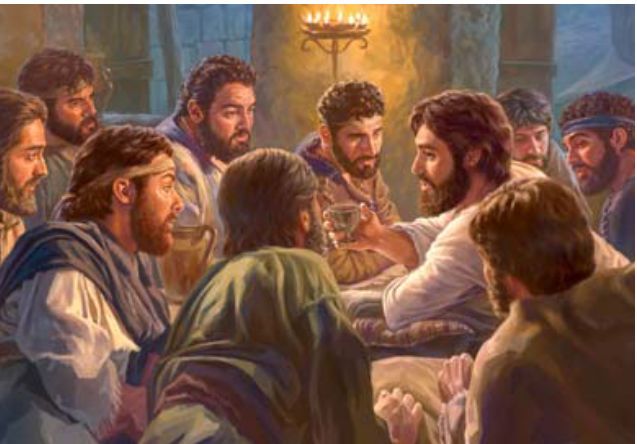
Matthew 26
Digging for Spiritual Gems: (8 min.)
https://meekspaceng.blogspot.com.ng/
Mt 26:17—Why could Nisan 13 be referred to as “the first day of the Unleavened Bread”? (“On the first day of the Unleavened Bread” study note on Mt 26:17, nwtsty)
On the first day of the Unleavened Bread: The Festival of Unleavened Bread began on Nisan 15, the day after the Passover (Nisan 14), and lasted for seven days. (See App. B15.) In Jesus’ time, however, the Passover had become so closely connected to this festival that all eight days, including Nisan 14, sometimes were referred to as “the Festival of the Unleavened Bread.” (Lu 22:1) In this context, the phrase “On the first day of” could be rendered “On the day before.” (Compare Joh 1:15, 30, where the Greek word for “first” [proʹtos] is rendered “before” in a similar construction, namely, “he existed before [proʹtos] me.”) So the original Greek, as well as Jewish custom, allows for the disciples’ question to have been asked of Jesus on Nisan 13. During the daytime of Nisan 13, the disciples made preparations for the Passover, which was later celebrated “after evening had fallen” at the beginning of Nisan 14.—Mr 14:16, 17.
Mt 26:39—What may have moved Jesus to pray: “Let this cup pass away from me”? (“let this cup pass away” study note on Mt 26:39, nwtsty)
let this cup pass away: In the Bible, “cup” is often used figuratively of God’s will, or the “assigned portion,” for a person. (See study note on Mt 20:22.) Jesus no doubt felt great concern over the reproach that his death as one charged with blasphemy and sedition could bring on God, moving him to pray that this “cup” pass away from him.
What has this week’s Bible reading taught you about Jehovah?
*** w18 April p. 16 par. 7 Imitating Jehovah—A God Who Gives Encouragement ***
7 Jesus’ apostles often quarreled over who was the greatest among them, but Jesus patiently encouraged them to humble themselves and to become servants, not bosses. (Luke 22:24-26) Peter in particular disappointed Jesus several times. (Matt. 16:21-23; 26:31-35, 75) Rather than reject Peter, Jesus encouraged him and even commissioned him to strengthen his brothers.—John 21:16.
*** w18 June p. 7 par. 14 “My Kingdom Is No Part of This World” ***
14 Caiaphas sent soldiers to arrest Jesus under the cover of night. Jesus was aware of this shameful strategy, so during his final meal with the apostles, he asked them to get some swords. Two would be sufficient to teach them a vital lesson. (Luke 22:36-38) Later that night, Peter used a sword to attack a member of the mob. No doubt, he was incensed at the injustice of Jesus’ nighttime arrest. (John 18:10) But Jesus told Peter: “Return your sword to its place, for all those who take up the sword will perish by the sword.” (Matt. 26:52, 53) This powerful lesson was in harmony with what Jesus prayed about earlier that night—they must be no part of the world. (Read John 17:16.) Fighting injustice was something to be left to God.
*** w18 June p. 24 parr. 15-16 “Let Your Light Shine” to Glorify Jehovah ***
15 Our attitude comes into the picture as we strive to increase the extent to which we let our light shine. Jesus repeatedly exhorted his disciples: “Keep on the watch.” (Matt. 24:42; 25:13; 26:41) Obviously, if we believe that the “great tribulation” is a long way off, that it will come sometime but not in our lifetime, we will lack a sense of urgency with regard to the preaching work. (Matt. 24:21) Instead of shining brilliantly in our neighborhood, our light will flicker and could even go out.
16 As these critical times worsen, all of us need to keep on the watch. When Jehovah acts, it will be at the right time. There is no question about that. (Matt. 24:42-44) Meanwhile, exercise patience, being ever watchful. Read God’s Word each day and be vigilant with a view to prayers. (1 Pet. 4:7) Take note of sterling examples of brothers and sisters whose lives reflect their joy in keeping on the watch as well as letting their light shine. One fine example is the experience recounted in the article “Seventy Years of Holding On to the Skirt of a Jew,” published in The Watchtower of April 15, 2012, pages 18-21.
*** w15 1/1 p. 14 Should We Pray to Jesus? ***
HIS EXAMPLE: In line with the way he taught others to pray, Jesus personally prayed: “I publicly praise you, Father, Lord of heaven and earth.” (Luke 10:21) On another occasion, “Jesus raised his eyes heavenward and said: ‘Father, I thank you that you have heard me.’” (John 11:41) And as he was dying, Jesus prayed: “Father, into your hands I entrust my spirit.” (Luke 23:46) In praying to his heavenly Father—the “Lord of heaven and earth”—Jesus set a clear example for all to follow. (Matthew 11:25; 26:41, 42; 1 John 2:6) Is that how Jesus’ early disciples understood his instructions?
*** w15 6/15 p. 5 par. 7 Christ—The Power of God ***
7 Poverty is not new. Jehovah told ancient Israel that there would never cease to be poor ones in the land. (Deut. 15:11) Centuries later, Jesus acknowledged: “You always have the poor with you.” (Matt. 26:11) Did Jesus mean that there would always be poor people on the earth? No, he meant that there would be poor people as long as this corrupt system of things lasts. Therefore, how heartening it is to understand that Jesus’ miracles serve as portents of better times ahead under Kingdom rule when all will have plenty to eat and be satisfied!
*** w15 7/15 p. 23 par. 3 Maintain Your Loyalty to God’s Kingdom ***
3 The institutions that govern human society may pressure citizens to take sides in conflicts that arise. True Christians cannot do so. We do not participate in the political controversies of this world; nor do we take up arms. (Matt. 26:52) We are not swayed by efforts to involve us in exalting any portion of Satan’s world over another. (2 Cor. 2:11) Being no part of the world, we rise above worldly rivalries.—Read John 15:18, 19.
What other spiritual gems have you discovered in this week’s Bible reading?
*** w17 March pp. 30-31 Being a Friend When Friendship Is in Danger ***
How would you feel if a close friend turned his back on you when you needed him most? Few things could hurt more. Would you be able to forgive him? Would your relationship ever be as strong as it once was?
Think about what happened to Jesus during his last days on earth. He had spent much time with his faithful apostles, and they were united by a special bond. Jesus rightly called them his friends. (John 15:15) Yet, what happened when he was arrested? The apostles fled. Peter had openly declared that he would never abandon his Master, but on that very night, Peter denied knowing Jesus!—Matt. 26:31-33, 56, 69-75.
Jesus knew that he would be facing his final test alone. Still, he had reason to feel disappointed, even hurt. But his conversation with the disciples a few days after his resurrection does not reveal the slightest hint of disappointment, bitterness, or regret. Jesus did not feel the need to enumerate the disciples’ shortcomings, including what they had done on the night he was arrested.
*** w17 July p. 31 par. 4 Questions From Readers ***
When Jesus told his followers to equip themselves with swords on the final night of his life on earth, he did not have protection in mind. (Luke 22:36, 38) Rather, Jesus had them bring a sword for an object lesson to teach them not to resort to violence, even when confronted by an armed crowd. (Luke 22:52) After Peter wielded one of the swords against the high priest’s slave, Jesus commanded Peter: “Return your sword to its place.” Then Jesus stated a fundamental truth, a principle that guides his followers to this day: “All those who take up the sword will perish by the sword.”—Matt. 26:51, 52.
*** w17 November p. 4 pars. 7-8 Make a Joyful Sound! ***
7 With the establishment of the Christian congregation, music continued to be a prominent feature of true worship. On the most important night in human history, Jesus included the singing of songs after the institution of the Lord’s Evening Meal.—Read Matthew 26:30.
8 First-century Christians set a pattern of praising God together in song. Even though they often met in private homes, the modest surroundings for worship did not diminish their zeal for singing to Jehovah. Under inspiration, the apostle Paul directed his Christian brothers: “Keep on teaching and encouraging one another with psalms, praises to God, spiritual songs sung with gratitude, singing in your hearts to Jehovah.” (Col. 3:16) The songs in our songbook are truly “spiritual songs [to be] sung with gratitude.” They are a part of the spiritual food provided by “the faithful and discreet slave.”—Matt. 24:45.
*** wp16 No. 2 pp. 3-4 Did It Really Happen? ***
Unlike fanciful legends, the Gospel writings reflect painstaking accuracy and attention to detail. For example, they abound with names of real places, many of which can be visited today. They tell about real people, whose existence has been corroborated by secular historians.—Luke 3:1, 2, 23.
Jesus himself is mentioned by secular writers of the first and second centuries. His manner of death, as described in the Gospels, agrees with Roman executional methods of the time. Moreover, events are related in a factual and candid manner—even portraying some of Jesus’ disciples unfavorably. (Matthew 26:56; Luke 22:24-26; John 18:10, 11) All these factors strongly indicate that the Gospel writers were honest and accurate in what they wrote about Jesus.
*** w16 June p. 29 A Godly Quality More Precious Than Diamonds ***
Jesus Christ set a good example of honesty. Recall, for instance, when High Priest Caiaphas exclaimed: “I put you under oath by the living God to tell us whether you are the Christ, the Son of God!” Jesus honestly identified himself as the Messiah, even though his truthful admission could allow the Sanhedrin to claim that he was a blasphemer and could lead to his execution.—Matt. 26:63-67.
What about us? Will we be honest in situations where a slight omission or twist of words might bring us material gain?
*** w15 1/1 p. 12 Husbands—Make Your Home Secure ***
Jesus communicated with his disciples. Jesus talked extensively to his friends. “I have made known to you all the things I have heard from my Father,” he said. (John 15:15) It is true that Jesus sometimes wanted to be alone with his thoughts and to pray. But he often shared his innermost feelings with his disciples. The night before he was put to death as a condemned criminal, he frankly told them that he was “deeply grieved.” (Matthew 26:38) Even when their actions disappointed him, Jesus never stopped talking to his friends.—Matthew 26:40, 41.
*** w15 3/1 p. 16 Bible Questions Answered ***
Who should partake of the bread and the wine?
When Jesus first told his disciples to remember his death, he spoke about a covenant, or an agreement. (Matthew 26:26-28) It opened up the prospect for them and a limited number of others to become kings and priests with him in heaven. Although millions commemorate Jesus’ death, only those in that covenant partake of the bread and the wine.—Read Revelation 5:10.
For nearly 2,000 years, Jehovah has been choosing those who will be kings. (Luke 12:32) They are few in number compared with those who will live forever on earth.—Read Revelation 7:4, 9, 17.
 MeekSpaceNG